


What are the differences between the different data availability tiers? In this post, we’ll explore the pros and cons of each approach.
Layer 2 has started to gain adoption in recent years as the focus on scaling execution has grown. At the same time, more and more participants are facing growth challenges due to limited block space and high costs. They are beginning to realize that in order to effectively scale the blockchain, a scalable data availability layer is critical. This also means that they need a base technology layer that is both cost-effective and has larger block space to support various types of rollups.
Avail and several other teams are building scalable data availability solutions from scratch, while others, like Ethereum, are trying to increase the data availability capacity of existing blockchains. Regardless of the approach, one fact remains — the base layer that developers choose today will determine their competitive advantage in the years to come.
Avail is part of a rapidly growing modular ecosystem that aims to improve data availability on blockchains. In addition to Avail, there are other data availability (DA) solutions such as Celestia and EigenDA that are working towards the same goal. Various solutions are taking different strategies and technical paths to achieve blockchain scalability. As one example, Ethereum is currently adopting a technology called Proto-Danksharding, also known as EIP-4844. This technology is a step towards Ethereum's long-term goal of achieving full Danksharding technology.
This post will evaluate the strengths and weaknesses of each approach. We will highlight the different design choices to provide a comprehensive overview and help developers find the DA layer that works best for them.
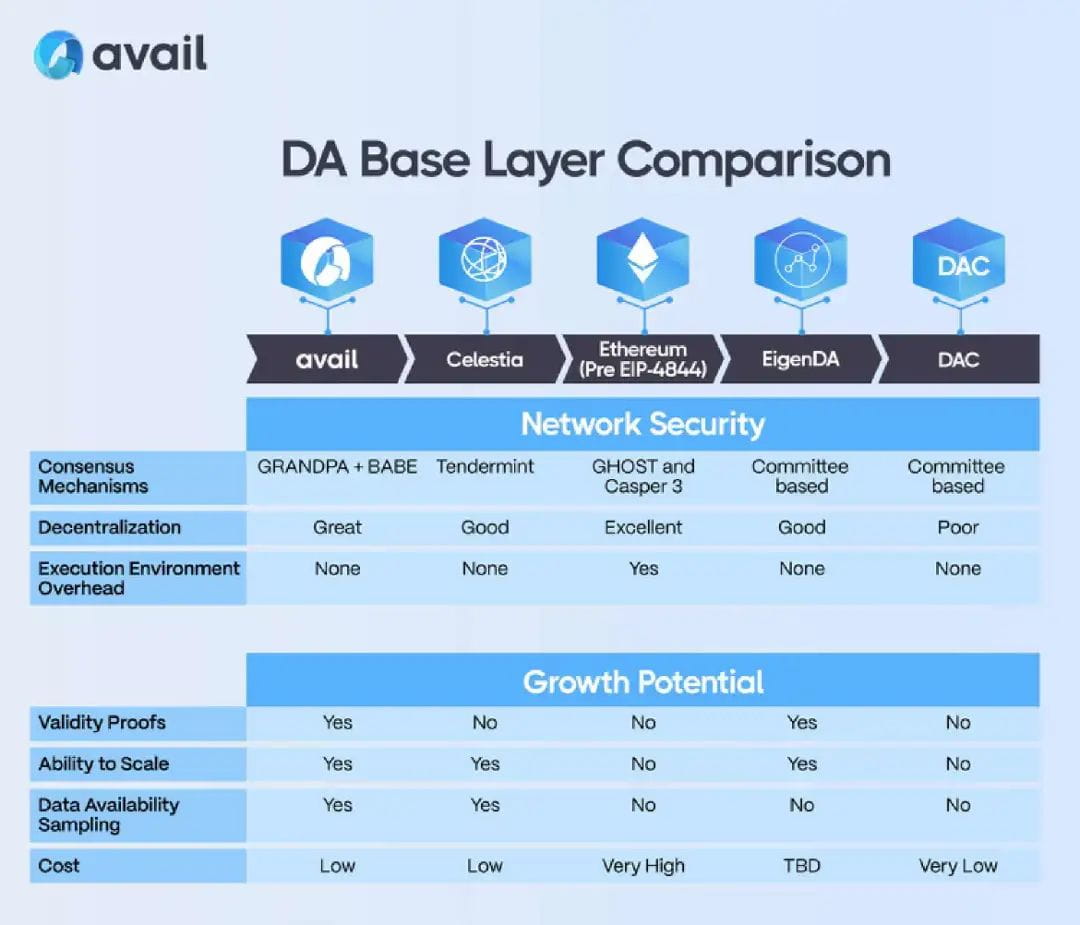
Let’s start with an overview and then dive into each category:
cyber security
When considering the base layer, the security and resilience of the network are the first things that come to mind. The following are the key factors when examining the strength of the network.
Consensus Mechanism
There is a fundamental dilemma between liveness and safety in consensus mechanisms. Liveness ensures that transactions are processed quickly and the network remains operational, while safety ensures that transactions are accurate and secure. Different blockchain systems make different choices to strike the right balance for their unique use cases.
Avail uses two consensus mechanisms, BABE and GRANDPA, of the Polkadot SDK. BABE is mainly used to generate blocks. To ensure the liveliness of the network, it coordinates with the verification nodes to determine which node will become the new block producer. GRANDPA is mainly responsible for the final confirmation of the block. When more than two-thirds of the validators confirm that a chain contains a specific block, GRANDPA allows the confirmation of all previous blocks to this specific block. By combining these two mechanisms, Avail forms a hybrid ledger, which enhances the resilience of its network, enabling it to continue to operate normally in the event of temporary network partitions or a large number of node failures.
Avail’s design choices are similar to Casper and LMD GHOST used in Ethereum. LMD GHOST is Ethereum’s block production engine that relies on probabilistic finality like BABE, while Casper FFG like GRANDPA is a finality mechanism that provides finality guarantees.
Celestia’s design choice of using Tendermint enables them to finalize blocks at the time they are generated. However, the trade-off of such a choice is the risk that the chain could be stalled if more than a third of operators or validators go down. It is also important to note that block finality does not guarantee data availability. Celestia uses a fraud-proof based design. In this design, even if a block has achieved finality quickly (i.e. it has been confirmed and will not be changed), users still need to wait until they are sure that the relevant data is available.
Data Availability Committees (DACs) are a group of organizations or entities responsible for ensuring data accessibility or verifying data availability. When they confirm that data is available, they use a specific cryptographic signature to indicate this confirmation. This means that when more than a majority of committee members agree that a piece of data is available, they use a special digital signature to prove this fact.
EigenDA is a DAC that is not directly stored on the Ethereum main chain, so it is called an "off-chain" DAC. Validators in the Ethereum network have the right to choose to join EigenDA. When DAC members confirm the availability of certain data, they provide a smart contract-based proof or statement. This proof shows that they have verified the authenticity or integrity of the data. In addition to this, in order to ensure the order or structure of the data, DAC members also rely on an external, independent service to sort or organize the data.
Decentralization
When considering the security of a network, there are two key factors to consider: the total amount of staked and the distribution of those stakes. The degree of decentralization, or how evenly the staked amount is distributed, directly affects the security of a network. The cost of a potential attack is used to assess the security of a network. This is because if the staked amount is evenly distributed across a larger set of validators, then a saboteur attempting to attack the network would need to convince more nodes to get the same staked amount.
Avail inherits Nominated Proof of Stake (NPoS) from Polkadot, which enables it to support up to 1,000 validators. Due to its sequential Phragmén method, a multi-winner election method, NPoS has an efficient reward distribution that reduces the risk of staking centralization.
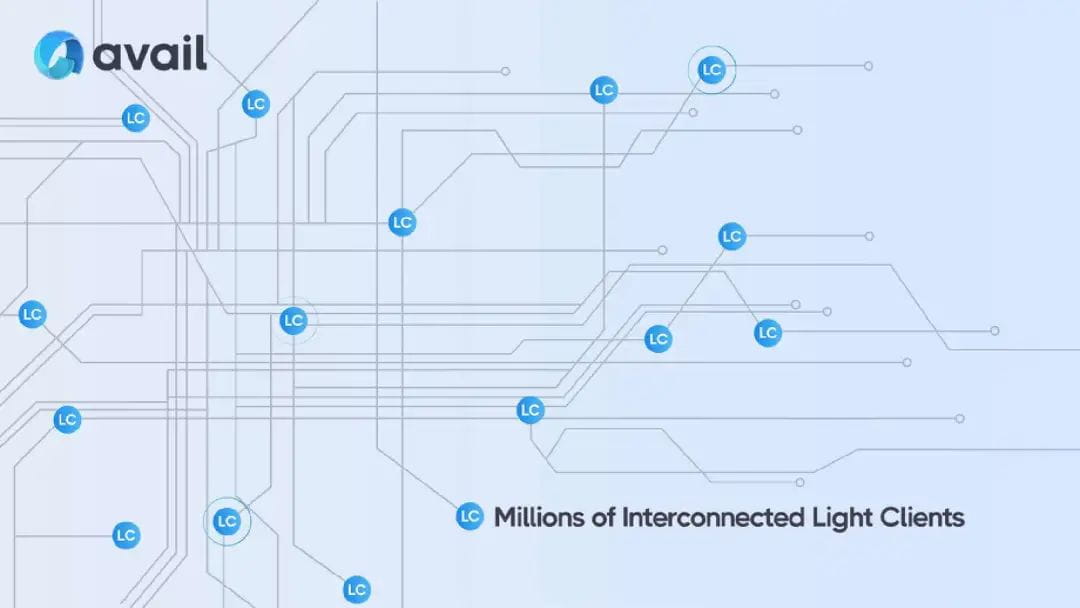
Avail is unique among all data availability solutions because it has the ability to sample data from its light client P2P network, rather than relying entirely on full nodes to fetch data when there are network issues or bottlenecks like other systems. This feature differentiates Avail from other existing and upcoming data availability solutions. With this feature, Avail provides an efficient and reliable backup mechanism to ensure data availability even in the event of failures. This further enhances the stability and anti-interference capabilities of the Avail data availability network.
Celestia uses Tendermint as its consensus protocol, with a validator set of up to several hundred.
While Ethereum, as a single blockchain, is the gold standard for security with its over 900,000 validator nodes, the distribution of the network is not fully reflected in this number.
In contrast, a DAC will typically include only a few nodes responsible for confirming the availability of blockchain data.
It is important to note that the re-staking process does not rely on security gained from Ethereum, its security is primarily dependent on the total amount of Ether that is re-staked on the platform. That is, re-staking itself does not directly contribute to the security of the platform, it just utilizes a portion of the existing stake locked on Ethereum.
EigenDA aggregates signatures from its full nodes. However, the claims it verifies through smart contracts do not provide the same level of data availability (DA) guarantees compared to data availability sampling. EigenLayer adopts a re-staking strategy, which uses funds or assets that have been locked on Ethereum to support its own network. But this practice has been criticized by some because it may reuse certain validators and lead to overload of the consensus mechanism.
Additional consumption of the execution environment
Over the past decade, single blockchains with smart contract capabilities have introduced groundbreaking innovations. However, even cutting-edge technologies of this era, such as Ethereum, where data availability, execution and settlement are merged into one, come with significant scalability limitations. These limitations have spurred the rise of Layer2 technologies, which move execution off-chain, and the development of proposed improvements like EIP-4844 (also known as Proto-danksharding and Danksharding).
Sacred smart contracts define the state and act as a bridge to rollups. In this approach, Ethereum serves as the authority and standard for verifying the accuracy of rollups.
Avail decouples execution and settlement from the base layer and allows rollups to publish data directly to Avail. The advantage of this modular approach is that rollups built on Avail can leverage Avail's P2P light client network to easily verify their state. Additionally, if this network is used to pass proof of execution, rollups have the ability to upgrade themselves without having to rely on smart contracts or base layers to define their state. This provides rollups with greater flexibility and autonomy. This new approach provides developers with a base layer that can be extended as needed, giving them the option to bridge to any execution supported layer for settlement.
Celestia takes a similar approach to Avail. The only difference is that its light client cannot yet support the network when the full node is down.
EigenDA also does not have a fixed settlement layer.
Development potential
In addition to the security and resilience of the data availability (DA) layer, the ability to accommodate the increased demand of rollups and blockchains built on top of it is critical to their success. Let’s look at some of the key factors to consider.
Proof of validity
When discussing proofs of validity, it is critical to understand the tradeoffs between fraud proofs and proofs of validity in the data availability layer. The KZG commitment used by Avail is a proof of validity for securing DAs that reduces memory, bandwidth, and storage requirements and provides simplicity, meaning that the size of the proof is fixed and not subject to polynomial complexity. This makes KZG commitments ideal for zero-knowledge based blockchains, where efficiency, privacy, and scalability are important.
Additionally, Avail’s light client can quickly access and sample data and ensure correct block encoding, providing data availability guarantees when new blocks are finalized, while fraud proofs need to wait for the challenge period to end. The combination of KZG commitments and Avail’s light client speeds up the verification process on Avail, allowing rollups or sovereign chains built on it to take advantage of its fast verification process, and creates scalability and flexibility for blockchain design in the coming years. This verification method is a key factor that distinguishes Avail from DA layers like Celestia.
Celestia uses a secure hash function, which is much faster to generate than KZG commitments. The trade-off here is that they must rely on fraud proofs to confirm the accuracy of the erasure coding, which introduces potential delays in ensuring data availability guarantees.
Celestia’s light nodes cannot definitively confirm that data is available, or if there are fraud proofs that have not yet been received. In other words, the use of fraud proofs reduces the ability of the network’s light nodes to definitively confirm the availability of data after sampling, as part of optimistic validation requires a necessary challenge period.
EigenDA will use KZG commitments and download only small amounts of data, rather than full blocks, and adopt proof of validity. Their approach is to use erasure coding to split the data into smaller chunks and require operators to only download and store a chunk, which is a fraction of the full block size.
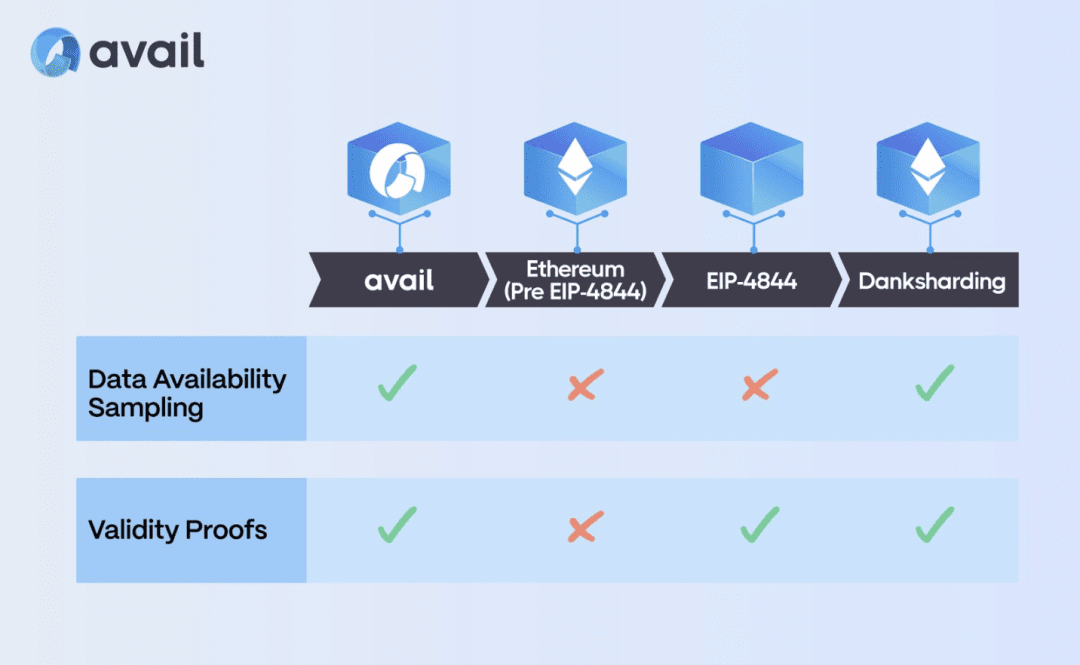
As for Ethereum, while the current version does not use validity proofs, EIP-4844 and full Danksharding will adopt validity proofs when implemented.
Expanded capabilities
The proliferation of L2s has been driven by limitations on Ethereum, such as expensive costs and slow transactions. They have become the execution layer for Ethereum, driving increased demand for block space. Currently, the cost of posting data to Ethereum is estimated to account for 70% to 90% of the total cost of rollups. This creates additional costs for validators and applications developed on Ethereum.
Base layers like Avail and Celestia aim to solve this problem. They are optimized for data availability and have the ability to dynamically scale block sizes as demand increases. By combining light clients and Data Availability Sampling (DAS), they have the advantage of scaling data availability block sizes as demand on their networks increases. This means that as block space increases, applications built on top of them remain unaffected because light clients within these networks can perform DAS without downloading entire blocks. This unique capability sets them apart from monolithic blockchains.
Ethereum has the largest community with a market cap of $191 billion as of September 2023. While protocols built on Ethereum enjoy economies of scale, they also face expensive transaction costs due to limited block space over the past few years. Amid the growth of rollups, both the number of users and transaction volumes have peaked, and rollups have become the best option for execution. As blockchain technology becomes more popular, the demand for block space will only continue to increase.
While DACs can scale due to their simple centralized approach, some rollups use DACs as a temporary measure until they can design a decentralized DA solution.
Data availability sampling
Both Avail and Celestia support light clients with Data Availability Sampling (DAS), allowing light clients to provide minimal trust security. As mentioned earlier, the main difference is how verification is done and how Avail's light client P2P network can replace full nodes to support the network in the event of an outage or bottleneck.
In contrast, Ethereum after EIP-4844 will not be equipped with DAS. This means that its light clients will not have this upgraded, minimal trust security feature. Further, Ethereum's DA solution includes its smart contract environment. In full danksharding, DAS will be implemented to expand the blob space, which is expected to be achieved in the next few years.
The security of EigenDA is based on trusting a small number of full nodes or other entities because it does not have Data Availability Sampling (DAS). The integrity of the protocol relies on the absolute majority of the committee being honest and at least one other entity having a copy of the data, similar to the optimistic construction. Although the double quorum approach improves security over a single quorum, it still does not reach the ideal of independent verification through DAS.
cost
Ethereum is the most expensive solution compared to congestion and demand. Even with EIP-4844, Ethereum will still be expensive as it only provides a one-time increase in block space. DACs are the cheapest, but this comes at the cost of taking a more centralized approach.
Avail and Celestia will be able to keep costs low by not having an execution layer. They can also easily increase block space, which Ethereum today cannot do without DAS.
As for EigenDA, it said it would introduce a flexible cost model with both variable and fixed fees, but its actual costs have not yet been announced.
Performance highlights
Now that we have examined the growth potential, we will take a look at the performance of these blockchains.
Block time
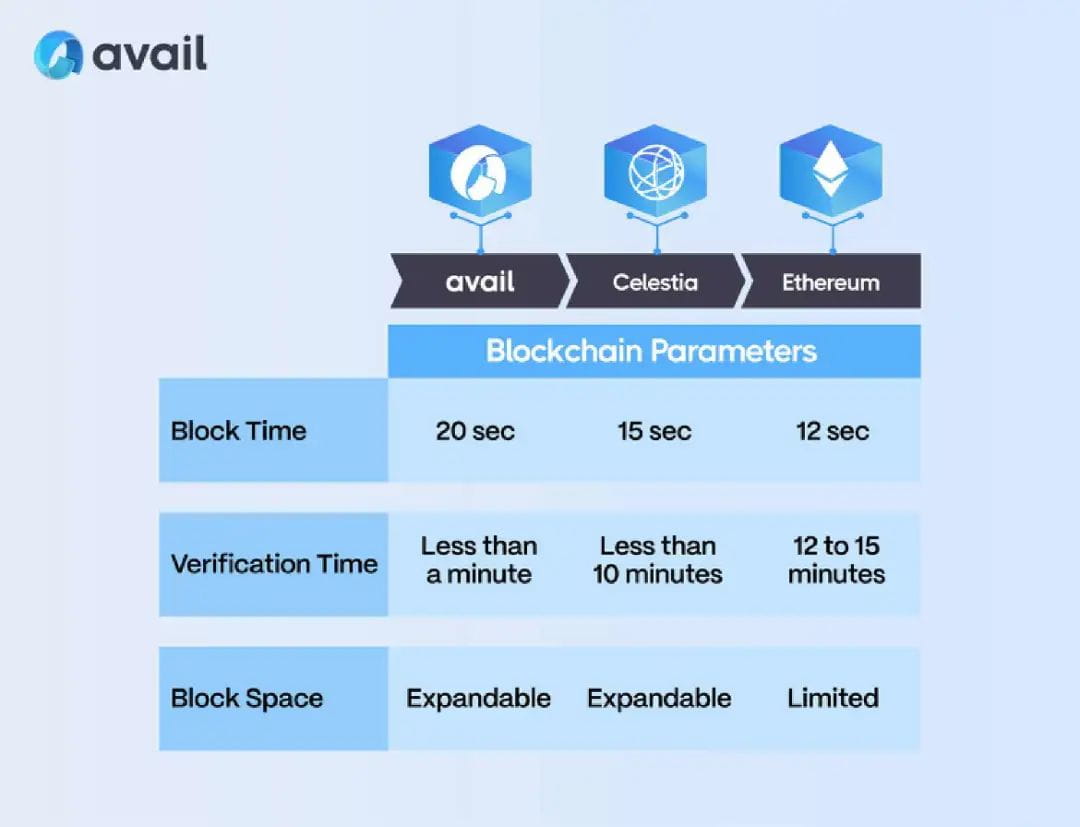
Refer to the table above to see the timings for each required building block.
Measuring the performance of a blockchain solely by the time it takes to build a block is simplistic, as this metric only addresses one aspect of the process from block confirmation to verification completion. Even with a consensus mechanism that provides instant finality, DA verification can take time when using fraud proof-based approaches.
Ethereum uses Casper to finalize a block every 64-95 slots, which means that the finality of Ethereum blocks is about 12-15 minutes.
EigenLayer is not a blockchain, but a set of smart contracts that run on Ethereum. This means that it inherits the same deterministic time as Ethereum. So, if a user sends a transaction to a rollup, the rollup will need to forward the data of that transaction to EigenLayer to prove that the data is available. However, transactions are only considered complete when the Ethereum block is finalized, which can cause delays even if the rollup has accepted the transaction. Ways to circumvent the problem by providing faster DA guarantees with cryptoeconomic measures are already under discussion.
Block space
As rollups become the execution layer of the future, the demand for block space will only increase. DA layers like Avail and Celestia will be able to meet the demand due to their modular design, while Ethereum's block space growth will be limited. Avail's Kate testnet has been configured with a block size of 2MB, which is replicated and erasure coded to 4MB. Avail is unique in its ability to increase block size using efficient client-side validation techniques. Through internal benchmarking, Avail has tested block sizes up to 128MB without difficulty.
Celestia is also able to increase block size as demand for block space increases, thanks to DAS.
EigenDA will scale throughput by decoupling DA and consensus, erasure coding, and direct unicast. However, this comes at the expense of rollups built on top not inheriting the censorship resistance of the base layer.
Summarize
Choosing a solid base layer to build on can be challenging. We hope this post helps readers understand more about the pros and cons of different design choices and choose the DA layer that’s right for you.
To stay updated, follow us on Twitter and subscribe to our newsletter. If any point mentioned in this article requires further clarification, feel free to contact the team on the Avail forum.