


Market Cap is a popular term in both the stock and crypto markets. Market capitalization plays an important role in helping investors assess the value of an asset, thereby making more reasonable investment decisions. So what is Market Cap? Let's find out with Coin Review!
What is Market Cap?
Market Cap is the market capitalization, which reflects the value of a crypto asset or the company behind that asset based on the number of tokens in circulation.
Fully Diluted Valuation (FDV) is the market capitalization of a crypto asset when taking into account the maximum supply of the token.

Both Market Cap and FDV are commonly used to evaluate and compare the value of crypto assets. This is the simplest and most basic method to determine whether a token is undervalued, overvalued, or fair.
If all tokens are issued and no tokens are burned (removed from circulation), then Market Cap will equal FDV.
How to Calculate Market Cap in Crypto Market
After learning about what Market Cap is, what investors are often interested in is how to calculate this index.
To calculate Market Cap in the cryptocurrency sector, you just need to apply a simple formula as follows:
Market Cap = Current market price of the cryptocurrency (traded on the market) x Total number of cryptocurrencies in circulation.
For example, if the price of a cryptocurrency is $100 and the total circulating supply is 1 million coins, then the Market Cap would be calculated as $100 x 1,000,000 = $100,000,000.
This formula helps you determine the market value of a cryptocurrency based on its price and the number of coins in circulation. This method comprehensively reflects the actual value of a coin in this field.
Why is Market Cap important?
Market Cap is an important indicator in the cryptocurrency market with some leading roles such as:

Market Cap: Market Cap allows investors to assess the total value of a particular asset in the market. This gives them a better understanding of the size and potential of a project or asset compared to its competitors.
Comparison between projects and assets: Market Cap helps traders compare different projects or assets. Through this comparison, traders can make smarter investment decisions based on understanding the scale and position of each project.
Measuring Growth and Decline: Changes in Market Cap can be a sign of growth or decline in the market value of an asset. Tracking this volatility helps investors better understand the market trends and potential.
Risk and Liquidity Assessment: Market Cap also provides information about the risk and liquidity of a project or asset. Projects with large Market Caps are generally more liquid and less likely to be risky than projects with small Market Caps.
Investment strategy guidance: Based on Market Cap, investors can determine the investment strategy that suits their goals and risk level. Projects with different Market Caps are often suitable for different investment strategies, from long-term investment to short-term trading.
Asset Classification by Market Cap
Asset groups can be classified as follows:
Mega cap: This group includes projects with the largest market capitalizations, $100 billion or more. These projects account for a large portion of the cryptocurrency market capitalization, similar to blue-chip stocks in the traditional stock market. Currently, Bitcoin and Ethereum are two prominent projects in this group.
Large cap: Projects in this group have capitalizations ranging from $10 billion to $100 billion and are typically among the top 20 projects in the cryptocurrency market. Notable examples include USDT, BNB, XRP, and USDC.
Mid-cap: This group includes projects with a market capitalization of $100 million to $10 billion. Most of the projects in this group have been on the market for less than 5 years and are in the development stage. They often have innovative products, especially in the DeFi space.
Small cap: Projects with a capitalization of 10 million to 100 million USD are often classified in this group. These are new projects launched in the last 1 to 2 years, have great growth potential and the ability to bring high profits, but also come with high volatility and risk.
Micro-cap: This group accounts for the majority of the cryptocurrency market with a market cap of less than $10 million. Projects in this group are usually memecoins, newly launched DeFi projects, and are often traded on DEX exchanges. This is the group with the highest volatility and risk in the market.
Coins with large Market Cap today
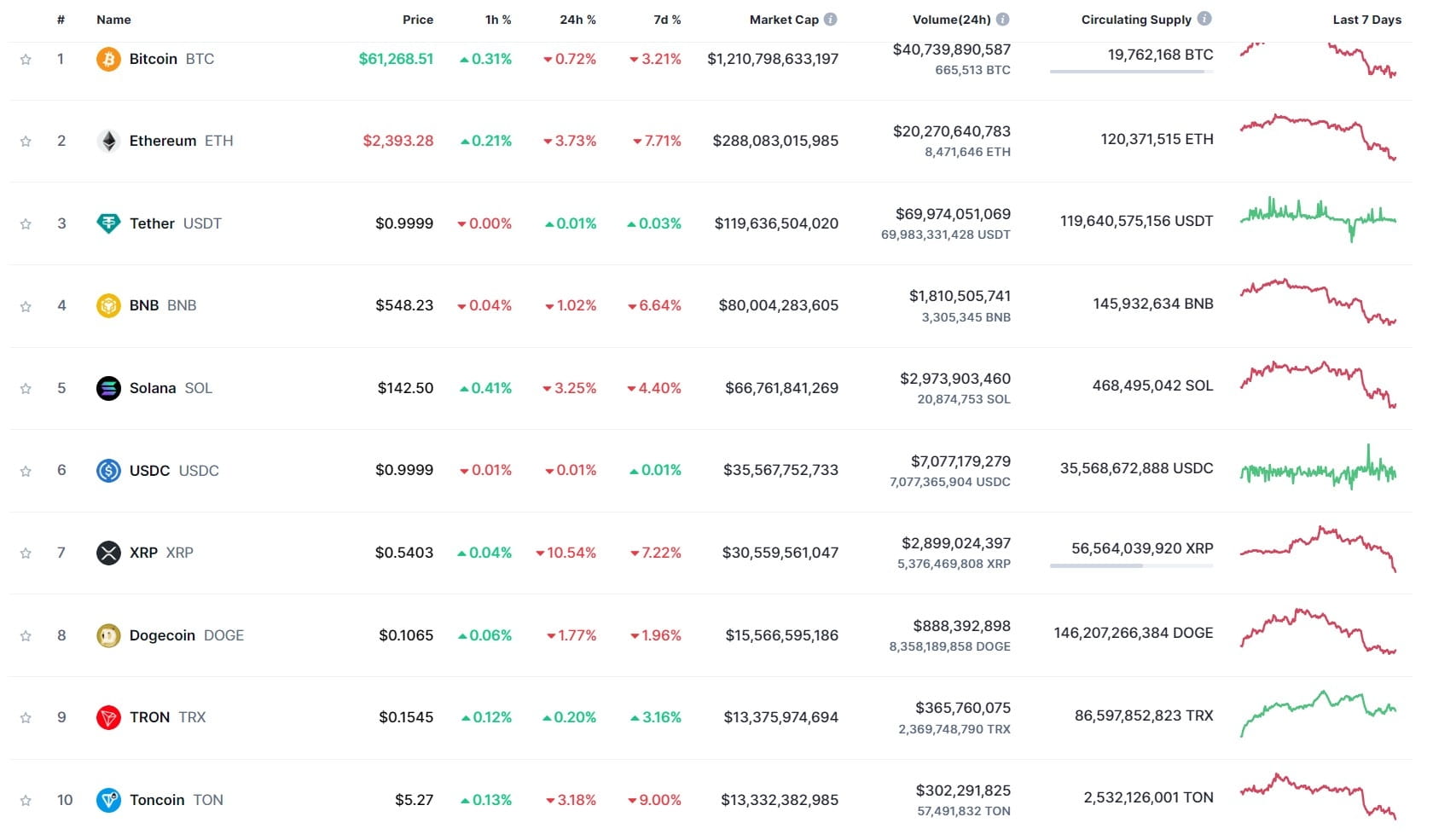
At the time of writing, the top 10 cryptocurrencies with the highest Market Cap include Bitcoin (BTC), Ethereum (ETH), Tether (USDT), BNB (BNB), Solana (SOL), USDC (USDC), XRP (XRP), Dogecoin (DOGE), TRON (TRX), and Toncoin (TON).
Investors can use platforms like Coingecko or Coinmarketcap to check these statistics.
Should I invest in coins with large Market Cap?
After learning about what Market Cap is, many investors ask questions about the benefits and disadvantages of owning coins with large Market Cap. In general, this has both certain advantages and disadvantages such as:
1. Advantages
Stability and Reputation: Assets with large Market Caps often focus on building and maintaining a reputation, especially in the cryptocurrency market. This brings stability and trust to investors.
Influence: Assets with large Market Caps often have a strong influence on the market and are considered good choices for long-term investment portfolios.
Easy to buy and sell: The market often facilitates the buying and selling of large Market Cap assets, making them an attractive option for large investors with significant investment funds.
2. Disadvantages
Growth Potential: Assets with large Market Caps have typically experienced significant growth, which may limit their potential for future growth.
Risk: While these assets can provide stability, they can also come with risks when you over-rely on certain assets and markets.
Therefore, when deciding to own large Market Cap assets, investors need to carefully consider these factors to ensure that their investment strategy is suitable for their goals and desired risk level.
What should I keep in mind when using Market Cap?
Market capitalization is an important indicator, but it is only for reference in the investment process. Investors need to consider many other factors such as project fundamental analysis, development potential, market trends and risk management before making an investment decision.

Market capitalization can change over time, so regular updates of capitalization information are necessary to ensure accurate investment decisions.
For small-cap projects, investment risks are often higher, especially for projects in the small and micro-cap groups, so investors need to be cautious and do thorough research before investing in these types of assets.
Conclude
Through our article What is Market Cap, it can be seen that this is an important indicator that helps investors evaluate the value of assets in the field of cryptocurrencies and stocks. Although Market Cap provides a lot of useful information, it is only one of many factors to consider in the investment decision-making process. To optimize performance, investors should combine Market Cap analysis with other factors such as fundamental analysis, market trends and risk management.