
1. What is “halving”?
A "halving" in the cryptocurrency world is a specific supply adjustment mechanism commonly associated with Bitcoin and some other cryptocurrencies. In this mechanism, the cryptocurrency's block reward (the token reward miners receive in each new block) is periodically halved, slowing the supply of new coins.
Bitcoin is one of the most famous cryptocurrencies to use the halving mechanism. Bitcoin’s halving event occurs approximately every four years (every 210,000 blocks mined). Initially, Bitcoin's genesis block reward was 50 BTC, then reduced to 25 BTC after the first halving in 2012, then to 12.5 BTC after the second halving in 2016, and then to 12.5 BTC after the second halving in 2016. It was reduced to 6.25 Bitcoin after the third halving in 2020. This halving process will continue until the total supply of Bitcoin reaches approximately 21 million coins.
The basic issuance of CKB is used to reward miners for protecting network security, also called mining rewards. This reward is halved approximately every four years until all 33.6 billion CKB in the basic issuance are mined.
2. How does the CKB block halving work?
In order to achieve the goal of CKB mining rewards being halved every four years, a time concept called epoch is introduced into the system.
An epoch is the time period consumed by a group of blocks. In Nervos CKB, PoW difficulty is rescaled in every new epoch, and all blocks in the same epoch share the same difficulty target. The difficulty adjustment algorithm aims to stabilize the orphan block rate at 2.5% and make each epoch last approximately 4 hours.
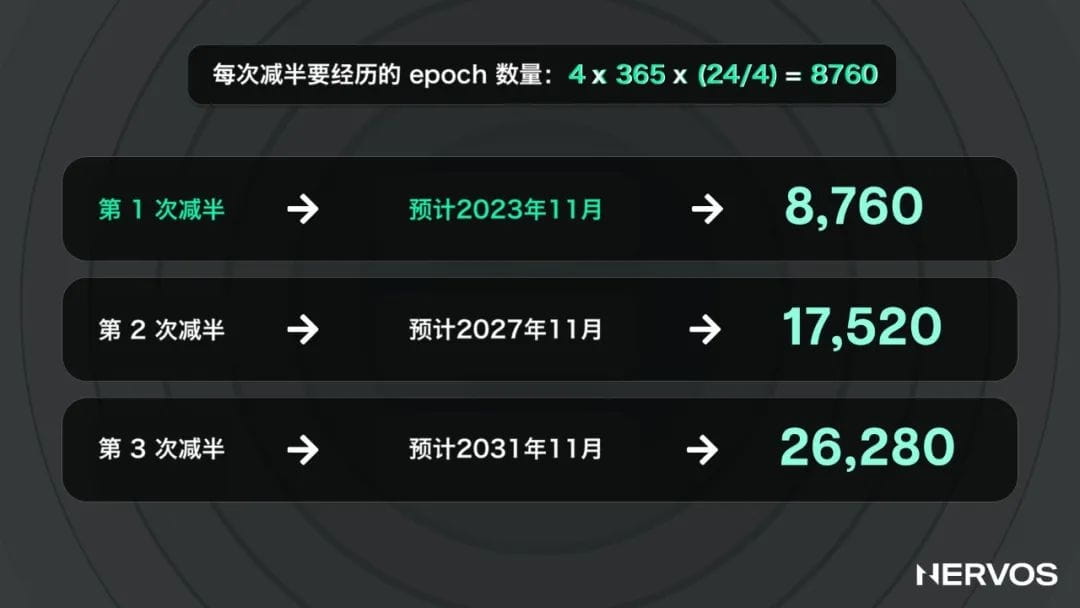
Therefore, the number of epochs that CKB needs to go through for each halving can be calculated as: 24 ÷ 4 x 365 x 4 = 8760.
Therefore, CKB halving events all occur on the specified epoch, and the epoch corresponding to the Nth halving is: the_Nth_halving_epoch = 8760 x N. For example, 8760, 17520..., as shown in the figure below:
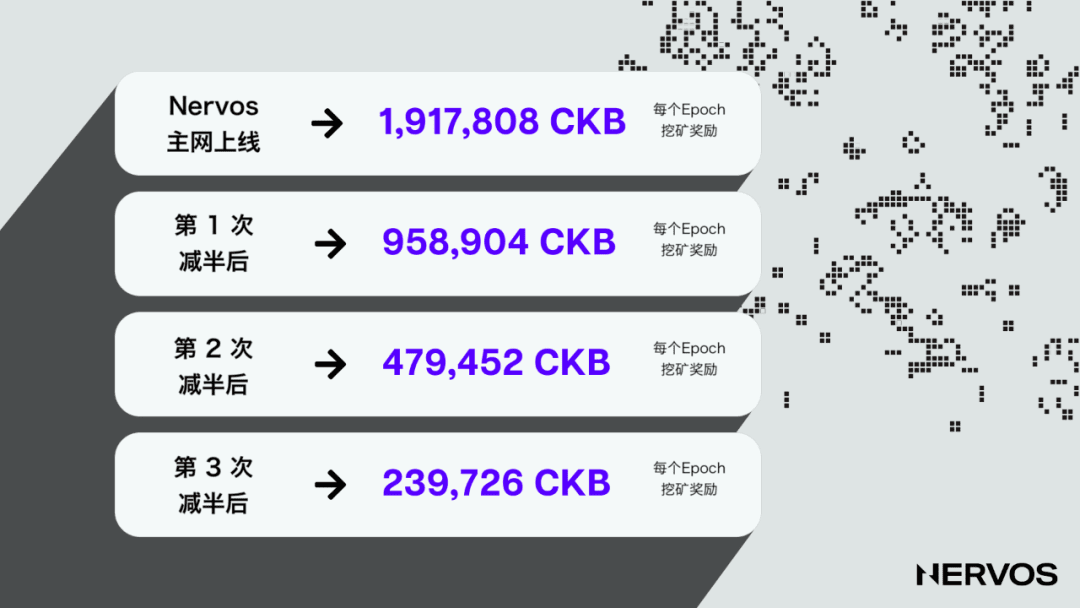
The figure below shows the mining rewards for each epoch before and after the halving:
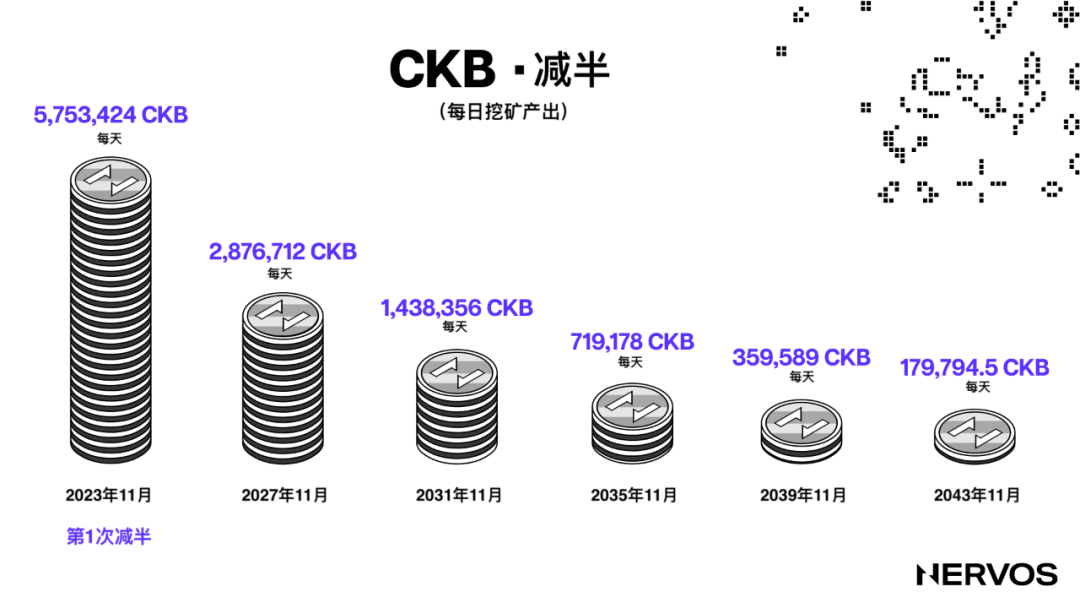
The picture below shows the daily CKB mining rewards after each halving:
It should be noted that the block production rewards of CKB miners include: basic issuance rewards, secondary issuance rewards, submission rewards and proposal rewards, as shown in the following figure:
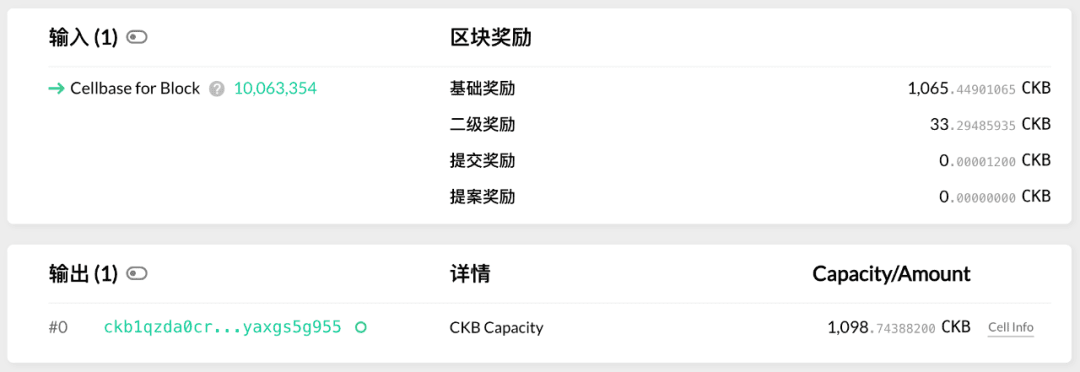
However, when we discuss CKB’s halving, it only relates to the base issuance reward. Therefore, for better understanding, the block rewards listed in the charts in this article only include rewards from the underlying issuance portion.
3. Why does the block halving have such a significant impact?
Block halving is a core element of the cryptocurrency economic model, ensuring that tokens are issued at a predictable rate. This controllable rate of monetary inflation is one of the key differences between cryptocurrencies and traditional fiat currencies, which are essentially endlessly minable.
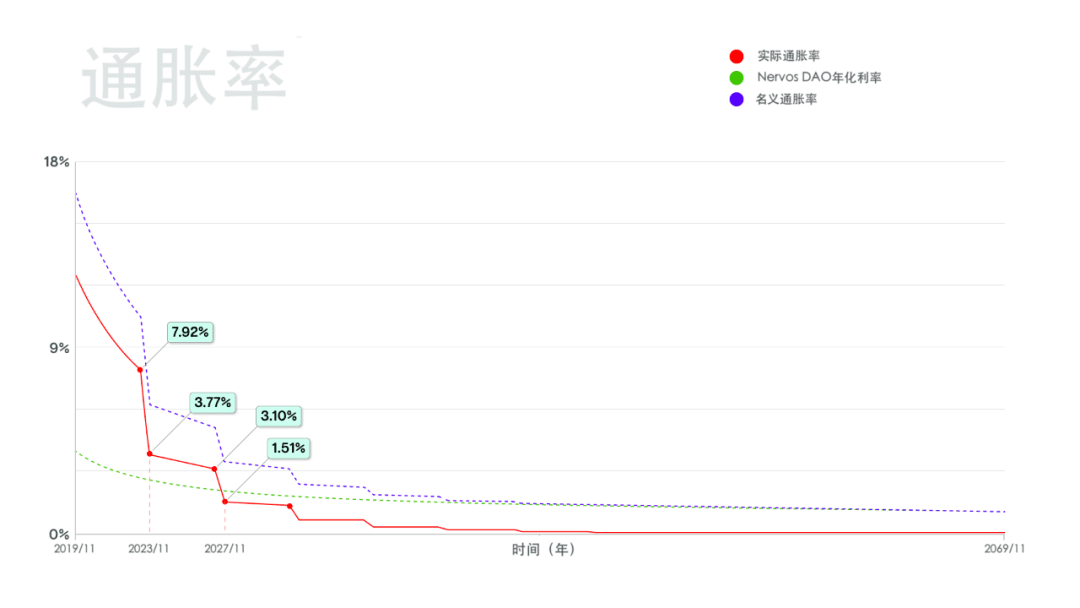
The following figure is the inflation rate curve chart of CKB with the occurrence of halving. It can be seen that before the first halving (November 2023), CKB’s actual inflation rate was 7.92%. The first halving After that, the actual inflation rate will reduce to 3.77%, and as the number of halvings continues to increase, the inflation rate will tend to 0%.
Note: Most of the content of this article comes from the ckbdapps.com website.