

Hi, ladies and gentlemen, welcome to Uncle Cat’s Coin Talk. Uncle Cat was invited to participate in the Plaza event to share with you the relevant content about DeFi. This article is the sixth one. The main content of this article is to familiarize you with the present and future of DeFi and CeFi again.
DeFi - decentralized finance. We have talked about it for a long time, so I won’t repeat the meaning of DeFi again. DeFi aims to automatically execute transactions through smart contracts without the intervention of middlemen, and create an open, transparent and permissionless financial system.
CeFi - may be unfamiliar to many people, but it is really around us. Because CeFi is our traditional finance. The characteristic of traditional finance is that financial services are provided by centralized institutions or governments. Traditional finance relies more on the credit system, centralized institutions such as banks provide funds or fund management, and middlemen are responsible for managing assets and executing contracts.
Next, we will make a step-by-step comparison between DeFi and CeFi so that everyone can more easily distinguish and understand the differences and connections between the two financial fields.
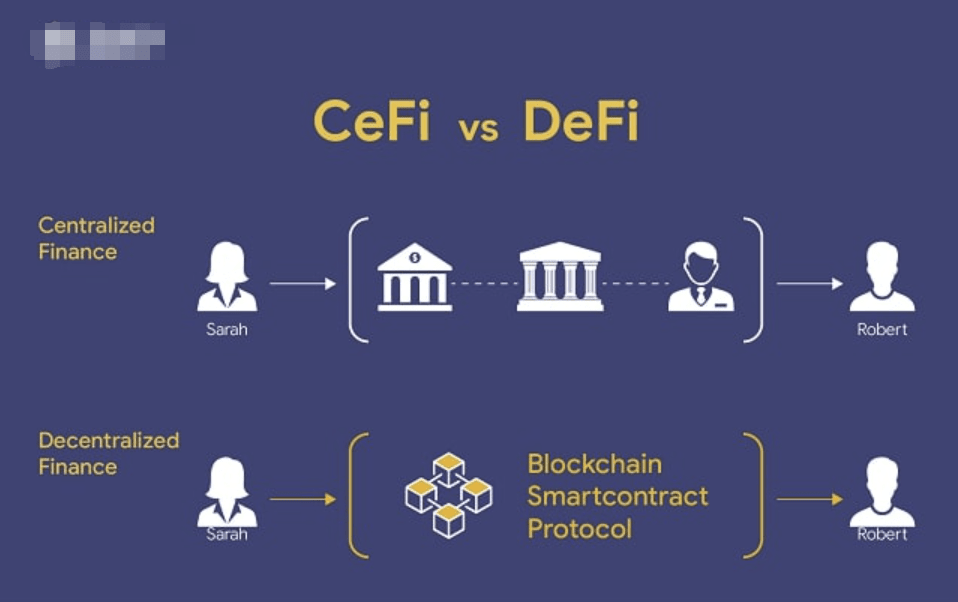
First, about control and management rights:
The management and control of DeFi are relatively open and transparent. After all, the contract is hard-coded. The contract will run in the same way as it was written at the time, without any personal or emotional factors. At the same time, the managers are the community or co-builders, and some policies can be decided through on-chain voting, which is completely open, fair, and just.
The control and management of CeFi are relatively confidential, and the power and management rights are in the hands of institutions or governments. Due to the excessive concentration of power, many decision-making issues are not in line with the true ideas of all participants, so traditional finance is more betting on government credibility or institutional credit, but historically, this credit mechanism is also prone to collapse. This is a major drawback. After all, the management power in traditional finance is in the hands of centralized people, and people have emotions and their own independent ideas, which may lead to many decisions becoming more "selfish".
The second is transparency and privacy:
The entire process of DeFi is relatively transparent. As long as you know how to query on the chain, you can know the details of each transaction. All transactions and contracts are recorded in the blockchain and permanently saved and cannot be modified. At the same time, we can see the content of the transaction but cannot determine who the trader is. This ensures the cleanliness and transparency of the transaction process and the personal privacy of the trader.
The entire CeFi process is relatively closed, and transactions and contracts may change significantly due to unexpected events, personal emotions, etc., making the entire process not completely open and transparent. At the same time, because cooperation and contracts are established between people, personal privacy cannot be fundamentally guaranteed.
Freedom and inclusiveness:
DeFi eliminates the role of middlemen because of the operation of smart contracts. This process reduces financial barriers compared to traditional finance. In DeFi, it does not distinguish who you are or which country you are in. As long as you understand the mechanism of the contract operation, you can participate in the transaction. It has strong freedom and inclusiveness. Of course, as the global crypto market faces regulatory pressure, this point has also been criticized by many people. After all, there are pros and cons. I believe that a proper solution will be found in the future.
CeFi has certain advantages in supervision, but because it is centralized management and the managers are individuals or organizations, the degree of freedom must consider the emotional issues of individuals or organizations, whether to open financial services to certain people, and fraud and data leakage between people. Of course, up to now, most people still believe that traditional finance is trustworthy. However, with the development of the economy, more and more traditional financial collapses have occurred, which is also a reminder to everyone.
Safety and risks:
The main risk of DeFi comes from technology, that is, smart contracts, whether there are loopholes in the contract, whether there are technical backdoors, etc., but these risk issues can be checked and supplemented by technology and detection areas. And excluding the most unstable factor "people", everything is safer. Moreover, virtual funds are not affected by the environment, geopolitics, war, disasters and human factors because they have no entity.
The main risk of CeFi lies in the deep-rooted traditional concepts, which lead to excessive centralization of power and management, and participants basically bet on a certain institution or government. Moreover, the main leaders in this model are people, because people's emotions or inability to be absolutely rational lead to mistakes in decision-making, which may lead to the failure of the central institution and cause inevitable losses, and the whole data leakage is a major problem.
We have talked so much about the differences between DeFi and CeFi above, so let’s also talk about the connection between them:
Judging from the current global encryption market environment, the two can complement each other. There is no need for one to completely replace the other, and they are not opposites.
For example, traditional finance can provide a legal and regulatory framework for decentralized finance, just like the current ETF. The reason why it is so popular is that with the approval of the ETF, the security of funds can be directly supervised by institutions, which is more conducive to the promotion and trading of Bitcoin.
DeFi can provide CeFi with higher efficiency and transparency, and improve its credibility. At present, the crypto market has been making continuous progress in terms of the combination of the two aspects. The current ETF and RWA are both perfect combination products of traditional finance and decentralized finance.
In fact, the main difference between the two lies in the management center. At present, both have their own advantages and disadvantages. As for how to choose DeFi or CeFi, it depends on one’s actual situation and ability to bear risks.
Finally, thank you all for your continued attention to Uncle Mao’s Coin Talk.
