

On Saturday (December 16), the US dollar index rose to 102.60, and gold fell back below $2,020. The Federal Reserve decided to keep interest rates unchanged in December, but the dot plot showed a dovish signal, and a 75 basis point rate cut is expected next year. Federal Reserve Chairman Powell said that if conditions are right, he is ready to further tighten monetary policy. But the hawks unexpectedly appeared before the weekend, and officials warned that they needed to see more progress in inflation before considering rate cuts, and they were not ready to make an urgent turn. The chairman of the U.S. Securities and Exchange Commission (SEC), who is close to the camp of U.S. President Biden, rejected the rule-making petition submitted on behalf of Coinbase, causing Bitcoin to fall below $42,000.
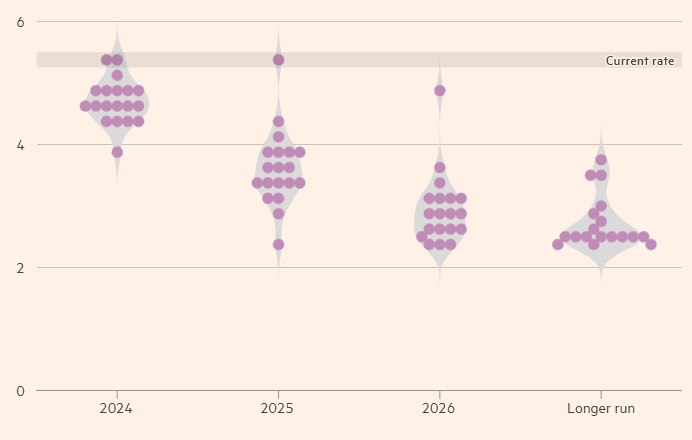
The Federal Reserve kept interest rates unchanged in December, and the latest dot plot shows that the median forecast indicates that the Federal Reserve will cut interest rates three times in 2024, each time by 25 basis points.
Powell commented at the press conference that the Fed is aware of the risk that it may keep interest rates unchanged for a long time, and they are committed to not making this mistake. He said that the authorities have tightened monetary policy significantly, interest rates have entered the restrictive area, and economic activity growth has slowed down significantly, but the full impact of the tightening policy may not yet be felt. He said that the Fed will proceed cautiously and make decisions based entirely on data, changing prospects, and possible risks.
Powell said at a press conference after the interest rate meeting that the policy interest rate is at or close to its peak, and if appropriate, policymakers are prepared to tighten policy further, but they do not want to rule out the possibility of raising interest rates.
In response to Powell’s dovish remarks, Jeffrey Rosenberg, portfolio manager of BlackRock’s Systematic Multi-Strategy Fund, said on Bloomberg TV: “The message is very clear, the Fed would very much like to see some easing of financial conditions.”
But senior Fed officials sought to calm market speculation of an imminent rate cut ahead of the weekend, warning that the central bank needs to see more progress in inflation before considering lowering borrowing costs. "We're not really talking about cutting rates right now," New York Fed President John Williams told CNBC in an interview.
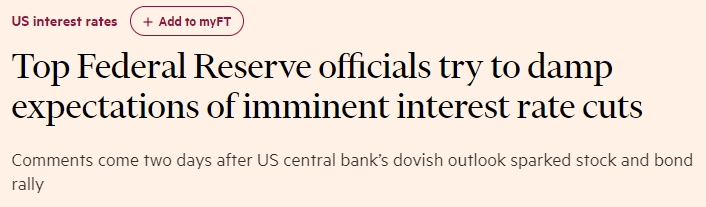
He added: “One thing we have learned over the past year is that the data can change in surprising ways. If progress on inflation stalls or reverses, we need to be prepared to tighten policy further.”
Atlanta Fed President Raphael Bostic echoed that message in an interview with Reuters on Friday, saying a rate cut was not "imminent" and that the first reduction would likely occur sometime in the third quarter of 2024.
Fed forecasts released this week show that Fed officials now expect to cut interest rates by 75 basis points in 2024, 100 basis points more than they predicted in their September dot plot, and by a full 100 basis points in 2025.
The Financial Times reported that Williams, a close ally of Powell, did not say that the current benchmark interest rate of 5.25-5.5% was "sufficiently restrictive", but he acknowledged that with the arrival of inflation, the Fed might "reach or approach" this threshold if the economy is in a downturn, unemployment is low and growth is solid.
In recent days, financial markets have increasingly priced in rate cuts as early as March and a full 100 basis points of rate cuts by the end of 2024. Falling Treasury yields have lowered the cost of capital and eased financial conditions.
Williams said it was "too early" to consider cutting interest rates starting in March next year, but he acknowledged that lower interest rates would be appropriate as the economy balances and inflation falls further.
On the outlook, Bostic said he expects inflation, as measured by the personal consumption expenditures price index, to fall to around 2.4% by the end of 2024, allowing the Fed to implement two 25 basis point rate cuts.
In an interview with The Wall Street Journal on Friday, Chicago Fed President Austan Goolsbee struck a slightly more cautious tone about the outlook and did not rule out supporting a rate cut in March.
“Obviously we’re moving toward a more balanced environment, and as we do that, as inflation comes down, we have to think about how restrained we want to be and whether the employment side of the mission is in jeopardy,” Goolsbee said.
Russ Koesterich, a portfolio manager at BlackRock, said the surge in bonds and stocks following Wednesday's Fed meeting showed the market was getting ahead of itself.
“Our base case is not that the Fed will cut rates in March of next year, and we think that’s where the market has been too aggressive and you got some evidence of that from Williams on Friday,” he said.
“We think a rate cut is more likely in late spring or early summer, so we think the market is getting a little ahead of itself,” he noted.
The Congressional Budget Office forecast released on Friday showed the United States will avoid a recession in 2024, but output will slow to 1.5% in 2024 from 2.5% in 2023.
The agency's outlook shows that labor market conditions will be weak in 2024, the unemployment rate will rise slightly, and inflation "will continue to slow over the next two years, close to the Fed's 2% target rate."
On Friday, the US S&P Global Services PMI rose to 51.3 in December, exceeding the market expectation of 50.6 and last month's 50.8. The manufacturing PMI performed poorly in December, recording 48.2, lower than the expected 49.3 and the previous value of 49.4. In addition, the S&P Global Composite PMI in December exceeded the previous 50.7 and reached 51.
U.S. Treasury yields were mixed, with the 2-year yield at 4.37%, up slightly, the 5-year yield at 3.90%, and the 10-year yield at 3.92%, down slightly.
Further weighing on the dollar, markets are currently pricing in the first rate cut in March 2024, according to CME's Fed Watch tool.
Dollar technical analysis: Bears take a step back
The dollar index was trading at 102.60 on Friday, posting its worst weekly performance in more than a month despite a late rally. The move came on the back of strong U.S. services PMI data and as investors struggled to consolidate losses from the past three sessions.
The Fed took a dovish stance at its meeting on Wednesday, saying it would lower inflation by the end of 2023, with no plans to raise interest rates in 2024, and forecasting 75 basis points of easing next year. Given this sign, market expectations are somewhat consistent with the Fed's views, stimulating risk appetite flows and curbing demand for the safe-haven dollar.
FXStreet analysts said that indicators on the daily chart of the US dollar index reflect that although the bears have taken a breather, the bearish momentum largely dominates the market. The relative strength index (RSI) shows a downward trend in the negative area, highlighting the existence of dominant selling momentum and highlighting the lack of buying enthusiasm among traders.
Moreover, the moving average convergence divergence (MACD) shows flat red bars, suggesting that bearish momentum exists but is currently being broken.
The positioning of the simple moving averages (SMAs) further confirms the prevailing bearish bias. The US dollar index is trading below the 20, 100, and 200-day moving averages, essentially indicating that sellers have a firm grip on the broader technical pattern.
Given that the US Dollar Index is now down 1.50% on a weekly basis, the current consolidation phase is likely to be a pause in the bearish trend rather than a reversal, and the short-term technical outlook remains biased to the downside.
“Support is seen at 101.50, 101.30 and 101.00, while resistance is seen at the 20-day moving average and the 200-day moving average bearish crossover at 103.45, the 100-day moving average at 104.50 and 104.70.”
Gold technical analysis: further pullback after encountering resistance
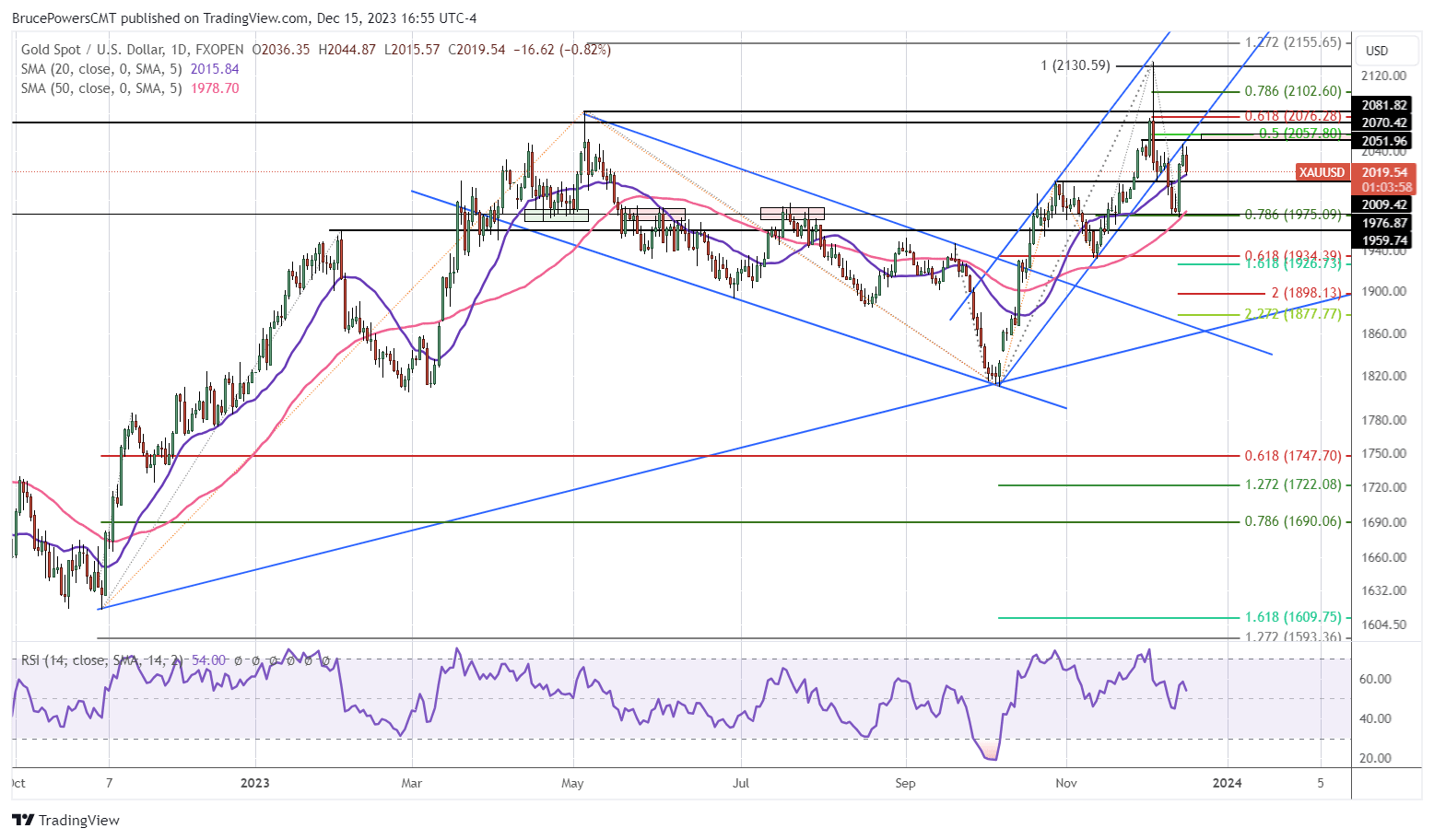
Bruce Powers, an analyst at FXEmpire, said that gold fell slightly after encountering resistance at the high of $2,048 on Friday, breaking the low of $2,024. In addition, as it tests the support level near the 20-day moving average, it is currently at $2,016. 吴们砍近裙加薇:wuj5677 Gold prices are still trading near the low of the day, but the current level is $2,016. Potential support near the previous swing high of $2,009 is slightly lower. This is also a 50% retracement of the three-day rise. Subsequently, this price area was seen as support during the small swing low on December 5.
On a weekly basis, gold is set to end the week weaker than expected. The weekly close is expected to be higher than the open, forming a green candle. Although the close will be above the midpoint of this week's range at $2,010, a close below the upper third of this week's range would indicate greater strength. This could indicate that Friday's pullback could last longer than a day.
Essentially, gold is trading between support at the 20-day moving average of $1979 to the retracement low of $1973, and resistance at $2048. Additionally, there could be a slightly higher resistance zone of $2052 to $2057, which consists of the previous swing high and the 50% retracement level, respectively. Support has been successfully tested twice recently around the 20-day moving average, each time succeeding as price was rejected to the upside, making it an effective trend indicator for further dynamic support.
Moreover, the ascending internal trendline was recognized by the market during the minor bounce from the Dec. 5 swing low and yesterday’s high.
On a monthly basis, gold prices broke above the November high of $2,052 this month, triggering a bullish continuation. Prior to this, November also continued the monthly bullish trend. Therefore, two months of gains followed October, which is a confirmed bullish trend on the monthly time frame. The October low successfully tested the support near the 50-month moving average for the second time, thus confirming the monthly bullish trend.
Bitcoin technical analysis: in a complex correction phase
Gary Gensler, chairman of the U.S. Securities and Exchange Commission, issued a statement on its official website saying that on Friday, the regulator rejected the rule-making petition submitted on behalf of Coinbase. The decision was based on three main reasons. First, existing laws and regulations apply to the cryptocurrency securities market. Second, the U.S. Securities and Exchange Commission also addresses issues in the crypto securities market through rulemaking. Third, it is very important to maintain the Commission's discretion when setting its own rulemaking priorities.
This news undoubtedly provides short-term negative impact as investors assess whether Bitcoin spot can pass the January 5-10 period.
CoinTelegraph noted that analysts are increasingly bullish on Bitcoin and the cryptocurrency sector in 2024. Bitwise senior research analyst Ryan Rasmussen made 10 predictions for the cryptocurrency industry in 2024, believing that Bitcoin will soar to $80,000 in 2024 and that "more funds will be settled using stablecoins than using Visa."
In addition to cryptocurrency-specific issues, expectations of a 2024 rate cut by the Federal Reserve have also fueled bullish sentiment. Arthur Hayes, former CEO of cryptocurrency exchange BitMEX, reiterated his bullish view on cryptocurrencies. He said that fiat currencies are "dirty garbage" and there is no reason not to be long cryptocurrencies.
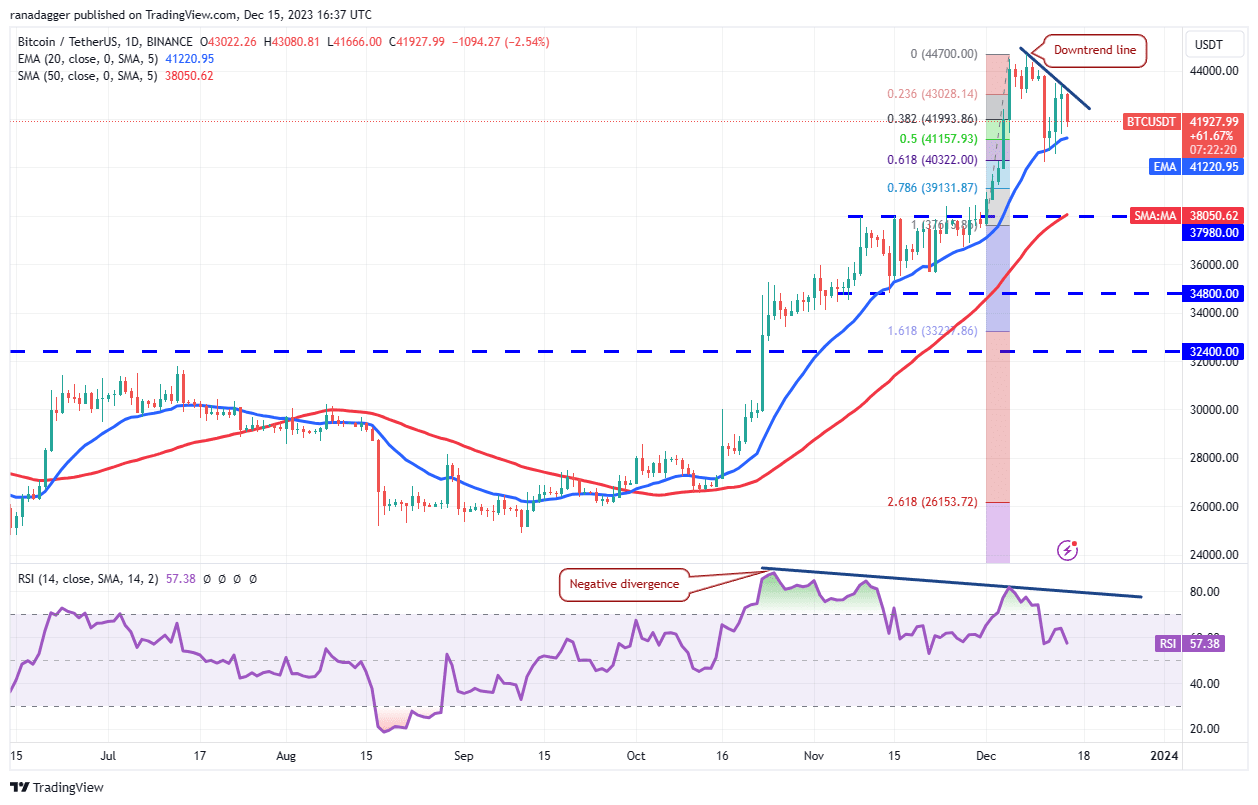
Bitcoin has been stuck between a downtrend line and the 20-day exponential moving average at $41,221 for the past few days. The tightening of price action suggests a possible range breakout in the short term.
If the price turns down and breaks below the 20-day EMA, it will suggest that the bulls are actively booking profits. This could drag Bitcoin down to the 50-day simple moving average at $38,050, where buyers are expected to defend this level vigorously.
Alternatively, if the price rebounds off the 20-day EMA and pierces the downtrend line, it will indicate that the bulls are still in control. Bitcoin could rise to the 52-week high of $44,700 and if it crosses this level, the next stop could be $48,000.
Important economic data next week:
Monday 12/18
German Producer Price Index in November (monthly rate)
German IFO business climate index for December
US December NAHB House Price Index
Tuesday 12/19
JABOR
Eurozone November Consumer Price Index Final Value (Monthly Rate)
Eurozone November Consumer Price Index Final Value (Annual Rate)
Canada November Core Consumer Price Index - Common Index (Annual Rate)
Canada Consumer Price Index (Annual Rate) in November
U.S. new housing starts in November (annualized monthly rate)
Central Bank News:
The Reserve Bank of Australia released the minutes of its December monetary policy meeting
Bank of Japan announces interest rate decision
Bank of Japan Governor Kazuo Ueda holds monetary policy press conference
Wednesday 12/20
U.S. API crude oil inventory change last week (10,000 barrels) (to 1215)
China's one-year loan market benchmark rate
UK November unadjusted producer output price index (annual rate)
UK November unadjusted producer input price index (annual rate)
UK Consumer Price Index (Annual Rate) in November
U.S. Conference Board Consumer Confidence Index for December
U.S. November NAR seasonally adjusted existing home sales (annualized monthly rate)
U.S. EIA crude oil inventory change last week (10,000 barrels) (to 1215)
Central Bank News:
Atlanta Fed President Bostic speaks on U.S. economic and business outlook
Thursday 12/21
UK December CBI industrial orders expected difference
Canada October Retail Sales (monthly rate)
Final value of US third quarter personal consumption expenditure price index (annualized quarterly rate)
U.S. weekly seasonally adjusted initial jobless claims (thousands) (to 1216)
Final value of US real GDP in the third quarter (annualized quarterly rate)
Central Bank News:
Bank of Canada releases minutes of December monetary policy meeting
Friday 12/22
Japan's November National Consumer Price Index (Annual Rate)
UK third quarter GDP final value (annual rate)
UK November seasonally adjusted retail sales (monthly rate)
UK third quarter GDP final value (quarterly rate)
UK current account in the third quarter (billion pounds)
Canada October GDP (monthly rate)
US November Personal Consumption Expenditures Price Index (monthly rate)
U.S. November durable goods orders initial value (monthly rate)
US personal income in November (monthly rate)
US personal consumption expenditure in November (monthly rate)
U.S. new home sales in November (annualized monthly rate)
Final value of the University of Michigan Consumer Confidence Index in December
Holiday Notice:
Christmas holiday, the US Brent crude oil futures contract trading ended ahead of schedule at 04:00 Beijing time on the 23rd
The UK stock market closed early for the Christmas holiday at 20:30 Beijing time