


Recently, the dispute between the Sui project and the Financial Supervisory Service of South Korea has become one of the focuses in the field of digital currency. The two sides have engaged in a heated debate on the Sui project and asset issues, which has even affected the price of tokens. The following will review this matter.
1. Sui was investigated by Korean regulators and the project was suspected to be a scam
Recently, South Korean senior officials have launched a campaign against Sui.
First, according to Coingraph, Lee Bo-hyun, director of the Financial Supervisory Service of South Korea, said that he would investigate Sui to determine whether it was a scam. The regulator pointed out that the price of the SUI token fell sharply, mainly because it falsely reported the circulation volume. In addition, Min Bingde, a member of the Democratic Party of Korea, also criticized the inaction of the Digital Asset Exchange Joint Consultative Agency (DAXA) and pointed out Sui's circulation problems. Director Lee responded that the Financial Supervisory Service would investigate this and take corresponding actions.
Live broadcast: South Korean regulators investigate Sui
In response, the Sui Foundation said on social media that it has been fully cooperating with DAXA and its members to maintain full compliance and transparency. The foundation made it clear that no SUI tokens have been sold since the Community Access Program (CAP) allocation. In addition, the Sui Foundation also stated that the token circulation supply plan displayed on its public website and public API is accurate, and any transfer of tokens can be publicly viewed and verified on the blockchain.
So, why did Sui attract the attention of the Financial Supervisory Service of South Korea? We can get a clue from the historical data of SUI tokens.
2. SUI prices have plummeted in the past six months, and have recently been shaken by the regulatory crisis
The historical high price of SUI has fallen by more than 80% in the past six months, which is terrible. However, let's take a look at the historical performance of Sui.
From the historical data, we can see that the historical highest price of Sui token is $2.16, which occurred on May 3, 2023, about 6 months ago, and its current price is only $0.378977, which is 82.48% lower than the historical high. This shows that Sui token has undergone a large price adjustment in the past 6 months, and the water content in it makes it easy for people to doubt the authenticity of its value. Its historical lowest price is $0.364846, which occurred on October 19, 2023. This is the market performance in response to the questioning of the Financial Supervisory Service of South Korea. The market is very sensitive to the attitude and actions of regulators, especially in the field of cryptocurrency.
SUI's asset price trends
When a project is questioned or investigated by regulators, investors may choose to withdraw their investment for risk aversion, leading to a drop in prices. Despite the controversy, the Sui project emphasized its cooperation with relevant agencies, as well as its transparency and compliance in public statements. This may be an attempt to stabilize market sentiment and restore investor confidence. However, judging from the data, these efforts may not have fully achieved the desired results.
However, at the same time, the 24-hour trading volume of Sui token is $47,550,433, while its market value is $325,773,760, and the trading volume to market value ratio is 0.1494, which shows that there is a certain trading activity in the market, which means that there is still attention on Sui token in the market, but the sharp drop in price may reflect the market's concerns or uncertainties about it.
3. Sui officials are still actively making various arrangements recently and are not disturbed by Korean regulation
At present, the dispute between the Sui project and the Financial Supervisory Service of South Korea has not yet passed the stable period. From recent reports, let us understand the current situation and background of the Sui project.
1. Development of Sui ecology:
Mysten Labs, as the development team of Sui, has recently launched incentive activities frequently to activate its ecological development. Its Bullshark Quest 2 and Bullshark Quests 3 activities focus on DeFi dApp interaction and gaming respectively, intending to expand its market influence. In addition, the Sui ecosystem has developed steadily in the past few months, and the network TVL in October has exceeded 50 million US dollars, reaching a record high.
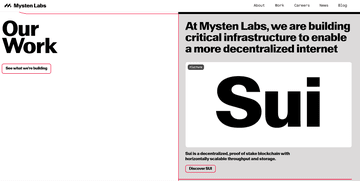
Mysten Labs official website
2. Sui’s cooperation with market makers:
The Sui Foundation recently repurchased a large number of SUI tokens from external market makers. In addition to the previously announced 117 million SUI, Sui also transferred an additional 40 million SUI from external market makers to ecosystem and community development, bringing the total amount of SUI used to promote ecological growth to 157 million.
3. Sui Foundation’s funding plan:
The Sui Foundation announced the Grants list, with a total of 15 projects receiving US$1.06 million in funding. These projects cover multiple core areas such as games, DeFi, business, tools, etc. The funds will be used to promote the adoption and development of Sui.
Combining the above information, we can see that despite the controversy between the Sui project and the Financial Supervisory Service of Korea, the Sui project itself is actively promoting the development of its ecology, cooperating with all parties, and striving to bring value to the community and users.
4. Conclusion: While users are enjoying the show, Yir returns to reality in investment decisions
As bystanders, how should we view this incident?
In the field of digital currency, every project will face various challenges and controversies. Recently, the dispute between Sui project and the Financial Supervisory Service of South Korea has become the focus of the market. As a neutral bystander, how should we view this incident?
First of all, we must realize that any emerging technology or project may encounter external doubts and challenges during its development. This is normal because new things often break existing rules and frameworks, triggering concerns and worries from all parties. The Sui project’s dispute with the Financial Supervisory Service of South Korea can also be seen as a part of this process.
Secondly, we should maintain a calm and rational attitude towards the specific situation of the Sui project. From the current information, both sides have their own statements and positions. The Financial Supervisory Service of Korea's questioning of Sui may be based on its regulatory responsibilities for the market and the protection of consumer rights. The Sui project also put forward its own response and explanation, emphasizing its transparency and compliance. As bystanders, we should wait for more facts and evidence instead of blindly choosing a side.
Furthermore, we should also see that despite the controversy faced by the Sui project, its efforts and achievements in ecological development are obvious, which means that the Sui project itself has certain value and potential and deserves the attention of the market and investors.
Finally, for investors in the digital currency market, they should fully understand and research their investments. Any investment has risks, and in a market full of variables and uncertainties, such risks will be more obvious. Therefore, investors should focus on the long-term development and value of the project, rather than short-term disturbances and disputes.
In summary, as a neutral bystander, we should maintain an open and objective attitude towards the turmoil between the Sui project and the Financial Supervisory Service of South Korea, focus on the truth of the matter and the long-term development of the project, rather than being swayed by short-term turmoil.