

Original author: Shiwen
Original source: daily planet daily
Since OFAC announced sanctions against Tornado Cash in August, some middleware providers that provide services for Tornado Cash, such as Infura and Alchemy, have also come under scrutiny, resulting in users being unable to access their assets normally and can only complete interactions by manually setting the node configuration of the wallet. , but such manual configuration has a threshold, which severely limits the number of Tornado Cash users. In addition, the official website of Tornado Cash has also been taken offline. Currently, users who want to access the website need to use direct access based on the IPFS protocol. Ordinary users who don’t understand the technology are likely to give up using it.
Along with Tornado Cash, all developers and code contributors of Tornado Cash were sanctioned by OFAC. Tornado Cash’s GitHub has been deleted, Tornado Cash developer Alexey Pertsev was arrested and jailed, and founder Roman Semenov’s GitHub account was deactivated. Therefore, while users will still have access to Tornado Cash, they will not be able to make code updates to it, nor will new developments be possible.
Moreover, OFAC has also made it clear that all applications similar to Tornado Cash will be subject to U.S. sanctions. This has undoubtedly dampened the enthusiasm of most engineers to develop privacy protocols and has also caused people to worry about the future of privacy applications.
Prior to the sanctions, Tornado Cash was a central hub for coin mixing services and had a lot of liquidity. However, weekly deposits and withdrawals from the protocol have fallen by more than 90% since the sanctions were imposed.
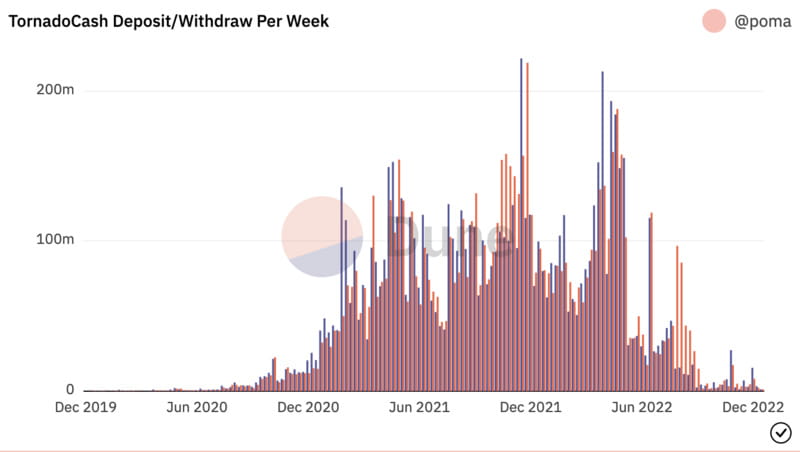
Tornado Cash is currently at a watershed moment. Whether to continue development at the risk of legal risks, or to "live on" for the time being, this is a multiple-choice question that the Tornado Cash community is facing.
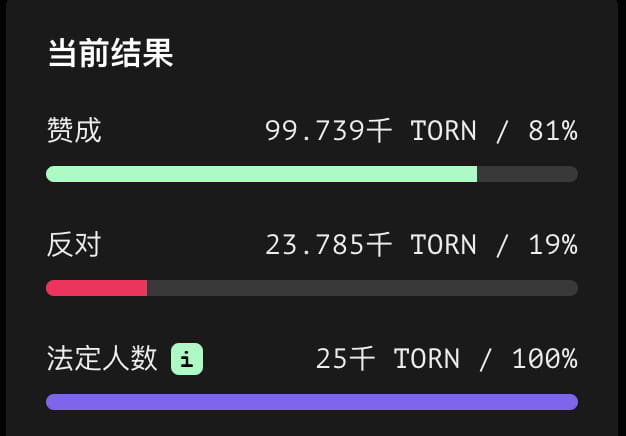
Recently, gozzy, a member of the Tornado Cash community, initiated a proposal, stating that he will assume the responsibility for the subsequent development of Tornado and continue to maintain the relevant components of Tornado to promote community building and product development. But given gozzy’s lack of assistance, the complexity of Tornado’s technology, and the potential for legal risks. gozzy hopes that the community will pay him a base salary of $240,000 per year, which will be distributed through the Sablier stream at a rate of approximately $60,000 per quarter. The community also needs to publish a proposal every quarter to decide how much salary to pay in the next quarter. In addition to salary information, gozzy also lists his work experience and the responsibilities he will have. After three days of community voting, with 81% support, the final proposal was passed.
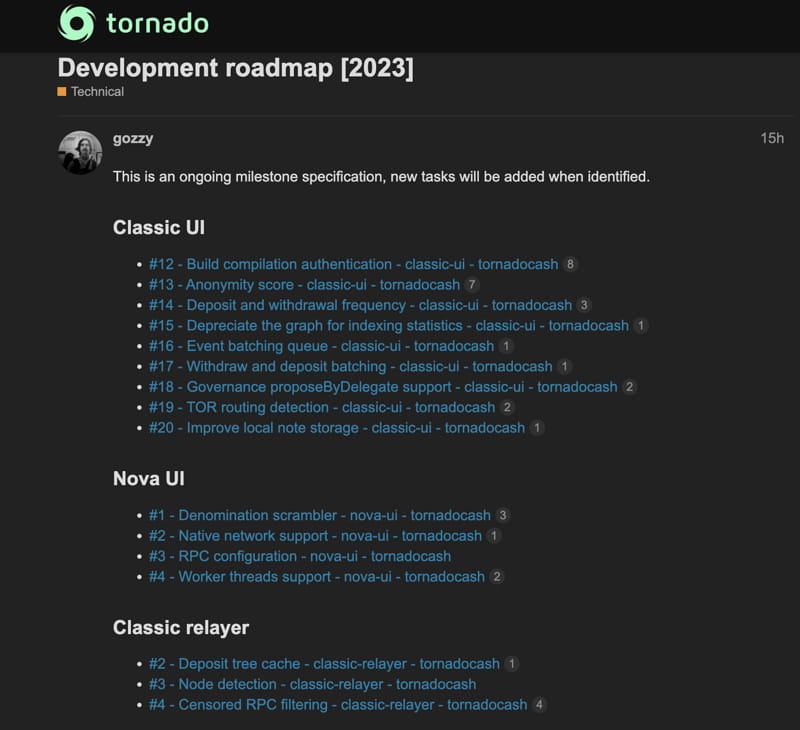
The day after the proposal was passed, gozzy began to update how users use ENS and IPFS resolvers (http://3th.ws) to log in to the website, and also released part of the Tornado Cash roadmap. As can be seen from the roadmap, gozzy’s current priority is to restore the Tornado Cash front-end and repeater connections. In the future, we will update educational resources, participate in and accelerate governance, complete the expansion and development of the protocol, etc.
Judging from the current feedback, the community is generally optimistic about gozzy’s proposal. gozzy seems to be very interested in anonymous transfers and privacy security. He once built a censorship-resistant alternative to eth.limo (a privacy-preserving ENS gateway) that can start a Tor hidden service for each ENS domain name pointing to IPFS content. That is, a website that protects user privacy. This is all some pretty hardcore engineering and privacy technology that has helped the anonymous payment protocol Firn Protocol, whose users can now use the protocol without censorship. This technology is also considered by the community to be beneficial to the entire Ethereum community.
In fact, this is not the first time the Tornado Cash community has rescued itself. Shortly after Tornado was sanctioned, some community members suggested forking Tornado Cash and using the protocol's code to create other variants of the service to further decentralize users' privacy when using crypto currency mixing services. . However, this alternative version of the agreement has no way to improve liquidity, and it also cannot solve the risk of sanctions, so it remains inactive.
Prior to this, an active participant in Tornado DAO also put forward a proposal called "Save Tornado Cash: Formal Challenge to U.S. Treasury Sanctions." The proposal recommends that Tornado DAO raise funds on behalf of Tornado Cash and hire a legal team to fight sanctions. It also calls on Tornado DAO to launch a legal challenge to the U.S. Supreme Court if necessary. But in the end, it failed because it was "unable to compete with the United States" and contributors were afraid of being sued. Tornado DAO was shut down to protect the safety of community members.
It can be seen that the results of Tornado Cash’s first two self-rescues were unsatisfactory. Although the adoption of this proposal has received strong support from the community, developers will still face serious uncertainty about sanctions and laws. Can Tornado DAO continue to operate in accordance with the wishes of the community? This will be the next big challenge for gozzy and the entire Tornado Cash community.
(The above content is excerpted and reprinted with the authorization of partner MarsBit, original text link | Source: daiily Planet Daily)
Statement: The article only represents the author's personal views and opinions, and does not represent the objective views and positions of the blockchain. All contents and opinions are for reference only and do not constitute investment advice. Investors should make their own decisions and transactions, and the author and Blockchain Client will not be held responsible for any direct or indirect losses caused by investors' transactions.
This article 4 months after being sanctioned, the Tornado Cash community passed a “revitalization proposal” first appeared on Blockchain.