

Uniswap's 0.15% "interface fee" was officially charged yesterday (18). What is the effect after one day of implementation? Is it expected to bring tens of millions of revenue to Uniswap a year?
Uniswap starts charging interface fees, what is the effect?
According to recent reports, Uniswap will begin charging users a 0.15% interface fee starting from 10/18. This fee is limited to specific currencies and is only for Uniswap front-end users (web and mobile wallets).
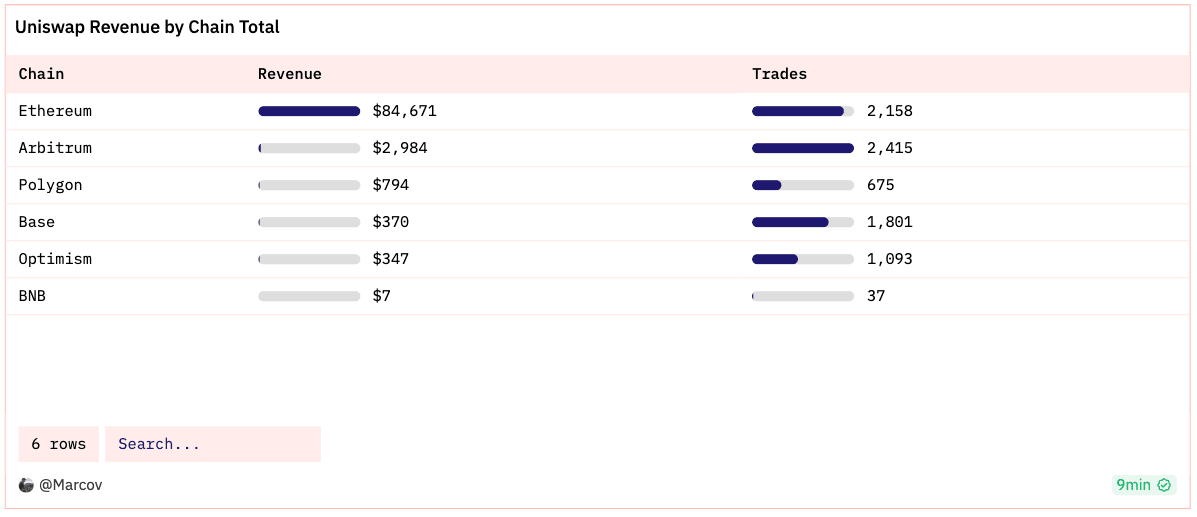
Judging from the data on Dune, this mechanism has brought good results one day after it was launched. It has accumulated nearly US$90,000 in revenue so far, while the revenue for the whole day yesterday (18) was about US$75,000.
Currently, the trading pair that generates the most revenue for Uniswap is DAI-WETH, which contributes approximately $35,000.
95% of interface fees come from transactions on Ethereum, followed by Arbitrum and Polygon in third place. From the perspective of the number of transactions, Arbitrum is better than Ethereum, but the revenue generated is very different. It can be seen that the average amount of each transaction in Ethereum is much larger than Arbitrum.
Regarding Uniswap’s first-day data, Haseeb Qureshi, managing partner of crypto venture capital Dragonfly, also expressed his views.
Based on Uniswap’s first-day trading revenue ($75,000), it speculates that its annual revenue will reach 25 million to 30 million.
In addition, dividing 75,000 by 0.15%, we can push back yesterday’s Uniswap trading volume to approximately $500 million. Haseeb said that based on Uniswap’s average daily trading volume of US$1 billion, perhaps the annual revenue can be expected to be twice the originally speculated value.
Based on 1 day of fees (tiny sample), Uniswap Labs is looking at around $25M-$30M annualized revenue.
That said, Uniswap averages about $1B in volume a day (it's spiky) and yesterday it did ~$500M, so maybe should expect 2x that?
(h/t @alex_kroeger)https://t.co/QoUFr0B9ta
— Haseeb >|< (@hosseeb) October 18, 2023
However, Haseeb’s speculation may be a little too simple and optimistic. When Uniswap starts charging, people will inevitably switch to other protocols that do not charge fees for transactions. For example, the transaction aggregator 1inch took the opportunity to promote its own product, which not only does not charge additional fees when trading, but also has a MEV protection mechanism.
Therefore, if you want to estimate how much revenue Uniswap can earn from interface fees in a year, it may be more accurate to look at it after a while.
#Uniswap going 0.15% on those swap fees? Bruh
No worries fam,#1inchgotchu always. Zero fees for those buttery swaps. Best rates, MEV protection by design, no cap.
Slide in: https://t.co/rPys9iijH6 https://t.co/RsrdlOBMPU pic.twitter.com/AymhnBVZfe
— 1inch Network (@1inch) October 17, 2023
Uniswap mobile wallet automatically displays assets on each chain
In addition to launching a new charging mechanism, Uniswap also made a small update to its mobile wallet yesterday evening.
Currently, the wallet interface will directly display the asset balance on each chain, without the need to manually switch in advance.
Stop switching networks
The Uniswap wallet makes it easy to see your funds with ALL of your tokens from ALL chains in ONE place pic.twitter.com/m4EFdujKWg
— Uniswap Labs (@Uniswap) October 18, 2023
This article Uniswap 0.15% "interface fee" is officially launched! What was the result? Is the annual income expected to exceed 10 million? First appeared in Chain News ABMedia.