

Author: Avail; Translation: Cryptonaitive
In recent years, the focus on scaling execution capabilities has brought a new wave of adoption to Layer 2. At the same time, facing the growth challenges caused by limited block space and high costs, more and more participants have now realized that a scalable data availability layer is essential for effectively scaling blockchains. They have realized that an economic base layer with scalable block space is needed that can support various types of Rollups.
Avail and several other teams are building scalable data availability solutions from the ground up, while others, like Ethereum, are trying to add data availability capacity to existing blockchains. Regardless of the approach, one fact remains. The base layer that developers choose today will define their competitive advantage in the coming years.
Avail is part of a growing modular ecosystem dedicated to increasing data availability on blockchains. Other DA solutions, such as Celestia and EigenDA, are also working on similar efforts. Each solution has chosen a different path on the road to blockchain scalability, including Ethereum, which is currently implementing Proto-Danksharding, also known as EIP-4844, as a springboard to achieve its long-term goal of full Danksharding.
This article will evaluate the strengths and weaknesses of each solution. We will highlight the different design choices and with the knowledge gained from this comparison, we hope readers can find the DA layer that works best for them.
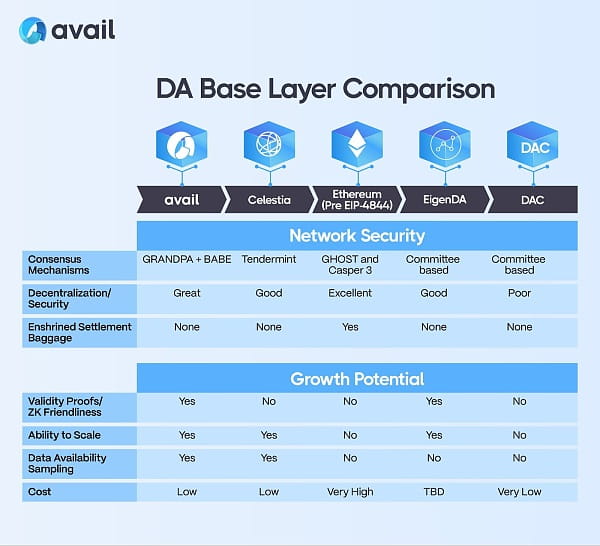
Before we dive into each category, let’s do a little overview:
cyber security
When considering the base layer, the security and resilience of the network is the first thing to consider. The following are the key factors to examine the robustness of the network.
Consensus Mechanism
In consensus mechanisms, there is a fundamental dilemma between viability and security. Viability ensures that transactions are processed quickly and the network remains functional, while security ensures that transactions are accurate and secure. Different blockchain systems seek the right balance for their unique use cases.
Avail uses the BABE and GRANDPA consensus mechanisms inherited from the Polkadot SDK. BABE, as a block generation engine, identifies new block generators by coordinating with verification nodes, giving priority to survival. GRANDPA, as finality, enables the finality of all blocks leading to a specific block to be completed simultaneously if more than two-thirds of the validators sign the chain containing the block. This hybrid ledger gives Avail network resilience and enables it to withstand short-term network partitions and large-scale node failures.
Avail’s design choices are similar to Casper and LMD GHOST used in Ethereum. LMD GHOST is Ethereum’s block generation engine that relies on probabilistic finality similar to BABE, while Casper FFG, like GRANDPA, provides finality guarantees.
Celestia's design choice is to use Tendermint, which enables it to finalize blocks as they are generated. However, the trade-off of this choice is that the chain may stall when more than one-third of its operators or validators are down. It is also important to note that block finality does not guarantee data availability. A fraud proof-based design like Celestia means that users need to wait for DA guarantees even if blocks have achieved instant finality.
A Data Availability Committee or DAC is an entity responsible for providing or certifying data availability. They use cryptographic signatures to indicate that one or a majority of committee members agree that the data is available. EigenDA is an off-chain DAC that Ethereum validators can opt-in to. DAC members provide proof of smart contract validation and rely on an independent external service for data ordering.
Decentralization
There are two key factors to consider when thinking about the security of a network: the total amount staked and how evenly that stake is distributed. Decentralization, or how evenly the staked amount is distributed, directly affects the security of the network. This is a metric for assessing the security of a network, given the cost of a potential attack. Because an adversary trying to attack the network would need to compromise more nodes to capture the same stake, the cost of an attack is higher if the stake is evenly distributed across a larger set of validators.
Avail inherits the Nominated Proof of Stake (NPoS) from Polkadot, enabling it to support up to 1,000 validators. NPoS has an efficient reward distribution through its sequential Phragmén method, i.e., a multi-winner election method, which can mitigate the centralization risk caused by its staking distribution.
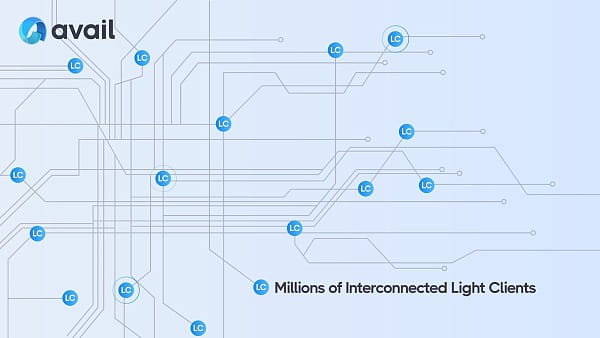
In addition, Avail is the only DA layer that can sample from its light client P2P network without relying on full nodes to fetch data in case of network outages or bottlenecks. This unique feature makes Avail stand out from all current and future data availability solutions, providing a powerful failover mechanism and enhancing the resiliency of the Avail data availability network.
 Celestia uses Tendermint as its consensus protocol, and its validator set is at most a few hundred.
While Ethereum as a whole blockchain reaches the gold standard in terms of security, with over 900,000 validating nodes, the level of distribution of the network is not fully reflected in the numbers.
In contrast, a data availability committee typically consists of several nodes responsible for confirming data availability to the blockchain.
It is important to note that re-staking does not borrow security from Ethereum. Its security relies on the total amount of Ethereum re-staked on its platform. In other words, re-staking does not provide any benefit to its security other than using a small portion of the existing stake locked in Ethereum.
As a DAC, Ethereum-based EigenDA aggregates signatures from its full nodes. Its smart contract verification proves that it cannot provide similar DA guarantee levels for data availability sampling. EigenLayer utilizes re-staking, involving locked Ethereum to support its network, and its move has also attracted criticism for the risk of reusing validators and overloading Ethereum consensus.
Execution environment overhead
Monolithic blockchains with smart contracts have introduced groundbreaking innovations over the past decade. However, even then-cutting-edge technologies such as Ethereum, where data availability, execution and settlement were merged into one, introduced significant scalability limitations. These limitations gave rise to Layer 2, which moved execution off-chain, and led to the development of improvement initiatives such as EIP-4844, also known as Proto-danksharding and Danksharding.
Established smart contracts define the state and act as a bridge for rollups. In this approach, Ethereum acts as the authority to verify the accuracy of rollups.
Avail splits execution and settlement from the base layer and enables rollups to publish data directly to Avail. The power of this modular approach is that rollups built on it can verify state by using Avail's P2P light client network, and if used to propagate proof of execution, they have the flexibility to upgrade their rollups without having to rely on smart contracts and base layers to define state. This new approach gives developers a base layer that can be extended as needed, giving them the option to choose any supported execution layer in terms of settlement.
Celestia takes a similar approach to Avail. The only difference is that its light client currently cannot support the network when a full node is down.
EigenDA also does not have a fixed settlement layer.
Growth Potential
In addition to the security and resiliency of the DA layer, the ability to adapt to the growing demands of rollups and blockchains built on top of it is critical to their success. Let’s look at some key considerations.
Proof of validity
When discussing proofs of validity, it is critical to understand the tradeoffs between fraud proofs and proofs of validity in the DA layer. The KZG commitment used by Avail is a type of proof of validity for ensuring DA validity that reduces memory, bandwidth, and storage requirements and provides simplicity, meaning that the size of the proof is fixed and is not affected by the polynomial degree. This makes KZG commitments well suited for zero-knowledge based blockchains, where efficiency, privacy, and scalability are critical.
Furthermore, compared to fraud proofs, Avail’s light client can quickly access and sample data, ensure the correct block encoding after the new block is finalized, and provide data availability guarantees without waiting for the challenge period to end. The combination of KZG commitments and Avail’s light client speeds up the verification process on Avail, enabling rollups or independent chains built on it to take advantage of its fast verification process, providing scalability and flexibility for blockchain design in the coming years. This verification method is a key factor that makes Avail stand out compared to Celestia and others.
Celestia uses a secure hash function that can be generated much faster than KZG commitments. However, the trade-off with this choice is that they must rely on fraud proofs to confirm the accuracy of the erasure coding, which can lead to potential delays in ensuring data availability guarantees.
Celestia’s light nodes cannot be certain that data is available, or that pending fraud proofs have been received. In other words, due to the challenge period of optimistic validation, the use of fraud proofs reduces the ability of the network’s light nodes to definitively confirm the availability of data after sampling.
As for EigenDA, it uses KZG commitments and only downloads a small amount of data instead of a full block, and adopts validity proof. Its approach is to split the data into smaller blocks using erasure coding and require operators to only download and store a single block, which is a small fraction of the size of the full data block blob.
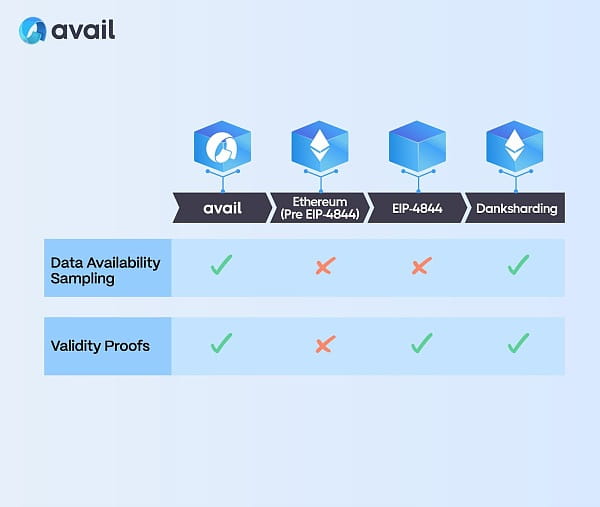
As for Ethereum, the current version does not use validity proofs, but EIP-4844 and full Danksharding will adopt validity proofs when implemented.
Scalability
The limitations of expensive and slow transactions on Ethereum have prompted a surge in L2s. They have emerged as the execution layer of the future, driving an increase in demand for block space. Currently, the fees for posting data to Ethereum are estimated to account for 70% to 90% of the total cost of rollups. Expanding block space will result in additional costs for validators and applications developed on Ethereum.
Base layers like Avail and Celestia are designed to solve this problem. They are optimized for data availability and have the ability to dynamically scale block sizes. By incorporating light clients that perform Data Availability Sampling (DAS), they have the ability to scale data availability block sizes based on demand on the network. This means that as block space increases, applications built on top of them remain unaffected because light clients in these networks can perform DAS without downloading the entire block. This unique capability makes them different from monolithic blockchains.
Ethereum has a market cap of $191 billion and the largest community. While protocols built on Ethereum enjoy the benefits of economies of scale, they also face high transaction costs due to limited block space over the past few years. As rollups grow, the number of users and transactions have peaked, and rollups have become the best option for execution. As blockchain technology becomes more popular, the demand for block space will only increase.
Although DACs can scale with a simplified centralized approach, some Rollups use DACs as a temporary measure until they find a decentralized DA solution.
Data availability sampling
Both Avail and Celestia support light clients with Data Availability Sampling (DAS), enabling light clients to provide trust-minimized security. As mentioned earlier, the main difference is how verification is performed and how Avail's light client P2P network can replace full nodes to support the network in the event of network outages or bottlenecks.
In contrast, Ethereum after EIP-4844 will not be equipped with DAS. This means that its light clients will not have this upgraded, trust-minimized security feature. To make things more complicated, Ethereum's DA solution has to accommodate its smart contract environment. Through full danksharding, DAS will be used to expand the blob space, which is expected to be implemented in a few years.
The security of EigenDA is based on trust in a small number of full nodes or other entities because it lacks Data Availability Sampling (DAS). The integrity of the protocol relies on more than half of the committee being honest and at least one additional entity holding a copy of the data, similar to the optimistic construction. Although the dual arbitration approach improves security compared to single arbitration, it falls short of the ideal scenario that can be independently verified through DAS.
cost
Ethereum is the most expensive solution in terms of congestion and demand. Even with EIP-4844, Ethereum is still expensive because it can only increase block space at one time. DAC is the cheapest, but this comes at the cost of a more centralized approach.
Since there is no execution layer, Avail and Celestia will be able to keep their operating costs low. They can also easily grow block space, which is not possible with Ethereum today without DAS.
As for EigenDA, it said it would introduce a flexible cost model for both variable and fixed fees, but its actual costs have not yet been announced.
Performance highlights
Now that we have reviewed the growth potential, we will look at the performance of these blockchains.
Block time
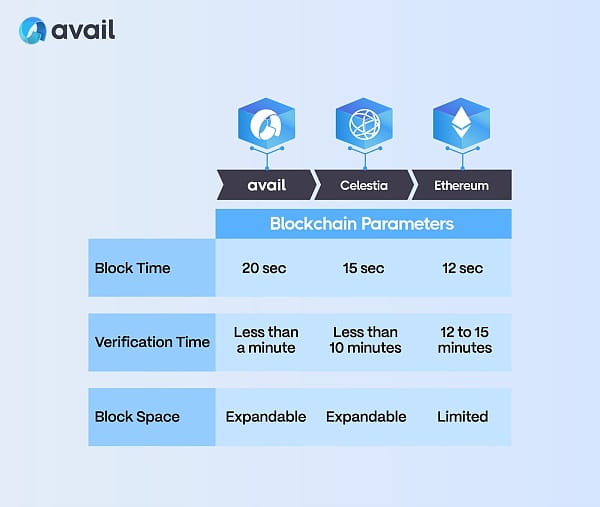
See the table above for information on how long it takes to produce each block.
Measuring the performance of a blockchain by the time it takes to produce a block provides only limited insight, as this metric only addresses one aspect of the process from block confirmation to verification completion. Even with a consensus mechanism that provides instant finality, verification can take some time when using a fraud proof-based approach to DA verification.
Ethereum uses Casper to finalize blocks in between 64-95 slots, which means that finality of Ethereum blocks takes about 12-15 minutes.
EigenLayer is not a blockchain, but a set of smart contracts running on Ethereum. This means that it inherits the same finality time as Ethereum. Therefore, if a user sends a transaction to a rollup, the rollup needs to forward the data of that transaction to EigenLayer to prove that the data is available. However, even if the rollup has accepted the transaction, the transaction will not be considered complete until the Ethereum block is finalized, which causes delays. Discussions have been conducted on ways to provide faster DA guarantees by taking cryptoeconomic measures.
Block space
As rollups become the future execution layer, the demand for block space will continue to increase. DA layers like Avail and Celestia will be able to adapt to demand because they are modular by design, while Ethereum block space growth will be limited. Avail's Kate testnet has configured blocksize to 2MB, replicated and using erasure coding to 4MB. Avail is unique in that it can increase blocksize using efficient client verification techniques. Through internal benchmarking, Avail has tested blocksizes up to 128MB without difficulty. Celestia will also be able to increase blocksize as DAS demand for block space increases.
EigenDA will scale throughput by decoupling DA and consensus, erasure coding, and direct unicast. However, this comes at the expense of rollups built on top not inheriting the censorship resistance of the base layer.
Summarize
Choosing a strong base layer to build on can be challenging. We hope this post helps readers better understand the pros and cons of different design choices and choose the DA layer that’s right for them.