

This article is from CMC Research, the original author is Sfermion, and translated by Odaily Planet Daily translator Katie Gu.
CMC spoke with Sfermion investor Mo Patel, who provided a detailed overview of the NFT market’s performance and growth in a challenging 2022, as well as insights into the market outlook for 2023.
Q1: How to measure the success of the NFT market in 2022?
The 2022 NFT market is facing a sharp drop in volume due to the bear market and overall downturn, and people are worried that NFTs are dead. However, if the bull market-driven 2021 is excluded, the 2022 NFT market is actually thriving in many areas in terms of transaction volume and development. The small decline in NFT transaction value compared to the decline in NFT transaction volume shows that people are still using NFTs, and the downturn is just a broader market trend.
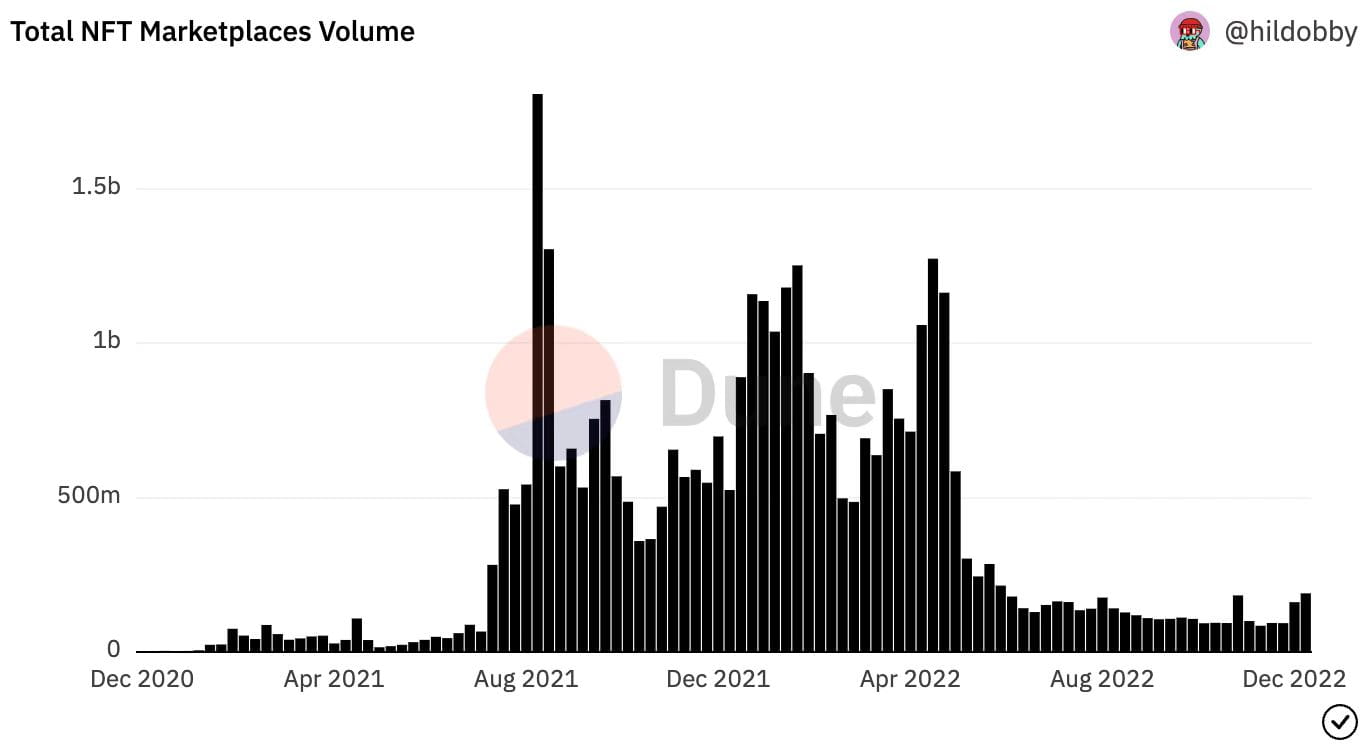
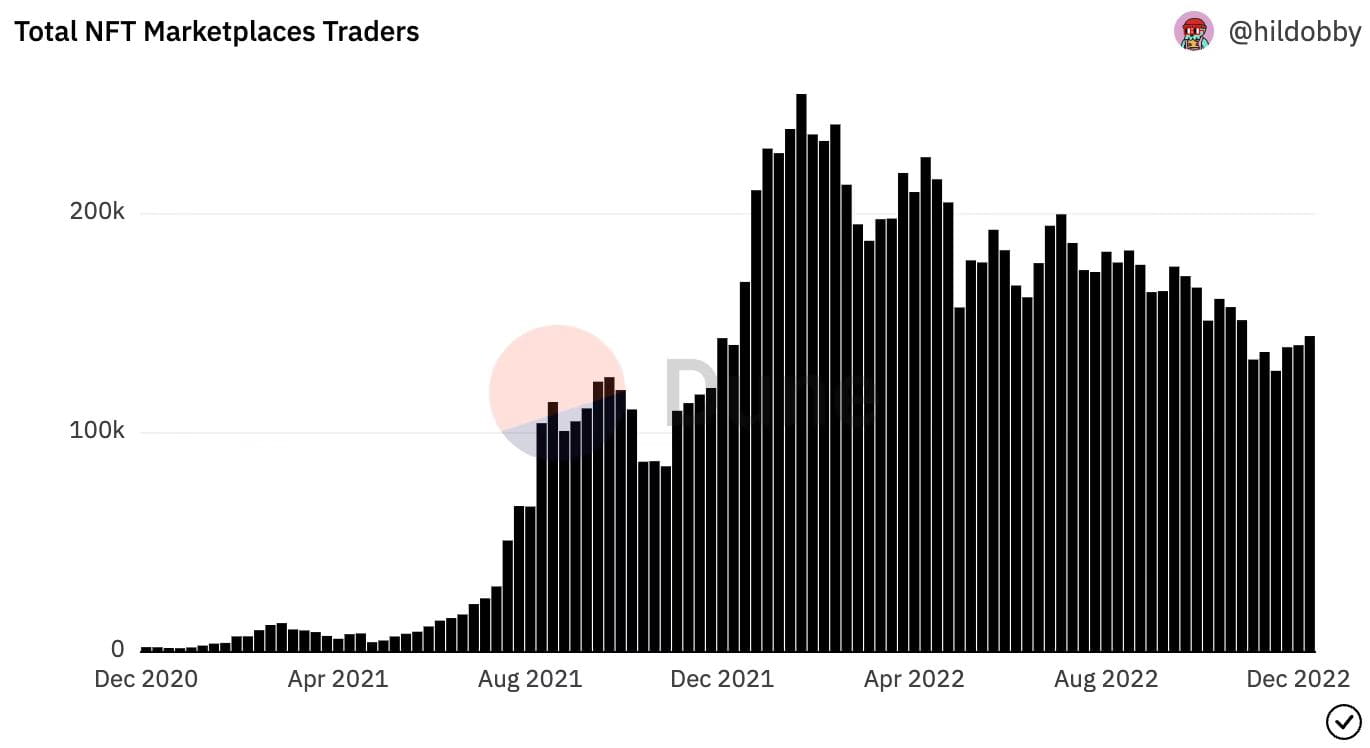
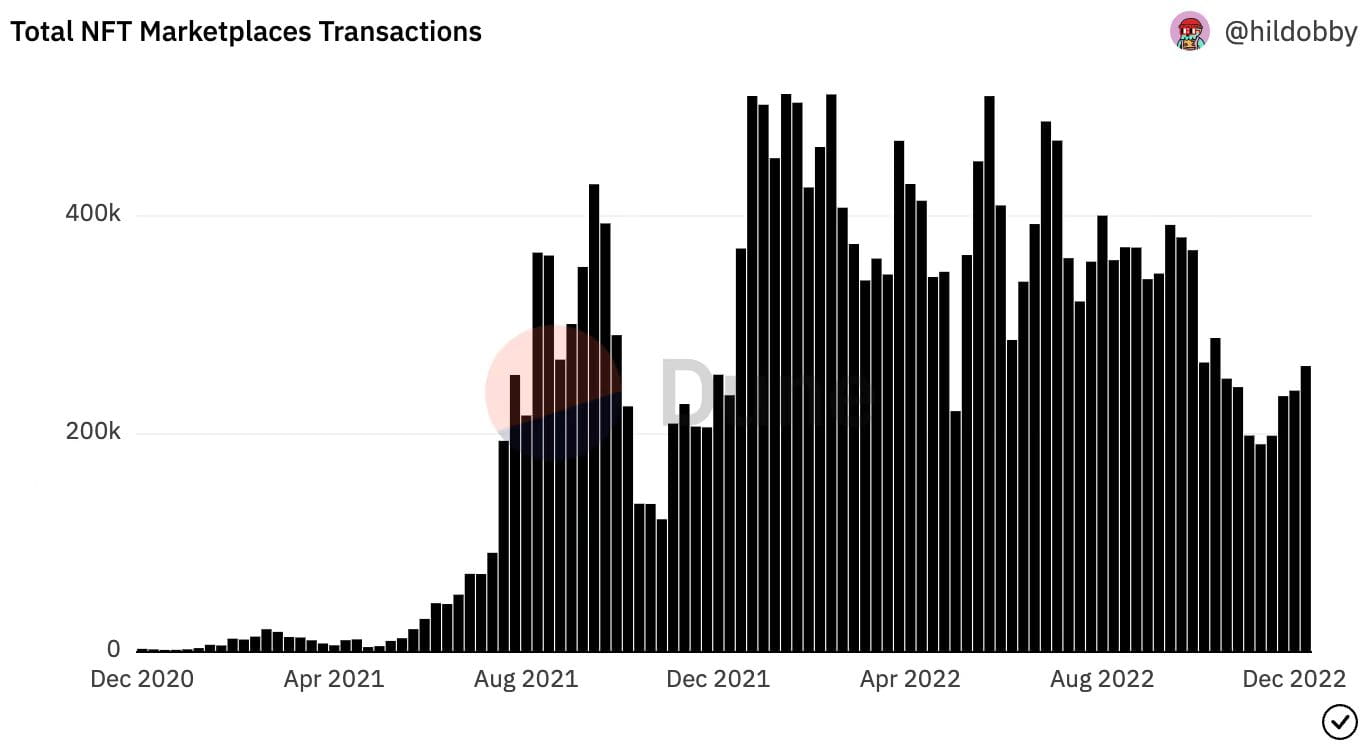
For example, the rapid adoption of L2 solutions such as Arbitrum and Optimism means growth in new addresses holding NFTs, a sign of increased activity in building support for the L2 space. At the same time, Polygon is also actively involved in NFT business development and continues to attract outstanding Web 2 talent and customers to join the blockchain. Music NFTs have also been successful on various platforms, with high sales and increased minting.
Web 3 social platforms using NFTs are also gaining traction, such as Aave’s Lens Protocol, which has nearly 100,000 users since its launch in May 2022. In addition to a lot of quantitative data, there is also a lot of qualitative data that shows that the recent NFT craze has led to a large number of strong Web 2 builders entering the Web 3 space and building with NFTs. This highlights the success of the NFT market and the global attention it has gained in a very short period of time.
These new entrants include leading Web 2 founders and game studios who have built mature products in the Web 2 space and are now using Web 3 and NFTs to drive new applications, such as NetEase, Pixel gaming, mobile game maker Wildlife, Japanese game giant Square Enix, Ubisoft, and social game Zynga. First-tier brands such as Gucci, Nike, Adidas, and Prada have all adopted NFTs in their marketing, using NFTs as a medium to connect with customers. Instagram, which has more than 500 million daily active users, is now actually an NFT market. Reddit suddenly used NFTs as the core technology of its digital collectible avatar plan this year, bringing in a large number of new users and wallet holders.
Web 2 giants are also leveraging the world’s biggest sports and entertainment events, like the World Cup and Super Bowl, to enhance real-life (IRL) experiences by leveraging NFT airdrops, such as the Coca-Cola NFT airdrop we saw at this year’s World Cup. Web 3 gaming company Limit Break plans to offer free minting as early as next year’s Super Bowl event. By scanning a QR code, you can get a free NFT mint.
The above applications of NFTs allow for seamless trading of digital property rights and interoperable assets. Despite the current market volatility, the continued involvement and innovation of top builders and brands in the NFT space is laying the foundation for strong future growth. These projects will become active and, ideally, rise in tandem with the market.
Although the overall crypto space is sluggish under the current bear market, we are still optimistic about the adoption of NFTs and many applications for online consumers. Whether it is a bear market or a bull market, players will always play games and consumers will always spend money. If NFTs continue to unlock these digital property rights and allow owners to trade in these games using interoperable assets, it will only be a matter of time before quantitative data is obtained. From this perspective, 2022 can be regarded as a very successful year for NFTs.
Attached below is a list of the “Top 10 Best-Selling” NFTs of 2022:
Bored Ape Yacht Club – $1.57 billion
Mutant Ape Yacht Club – $1.14 billion
Otherside - $1.1 billion
Azuki - $849.9 million
Moonbirds - $613.4 million
CloneX - $605 million
CryptoPunks – $575.2 million
Doodles - $391.6 million
Sorare - $318.1 million
Axie Infinity - $291.1 million
Q2: Which NFT verticals and use cases will be the focus in 2022?
The main focus in 2022 remains Web 3 games and related consumer services such as loyalty and ticketing systems, while metaverse experiences and Web 3 social applications are also gaining attention. NFT data analysis for tracking on-chain assets is also an ongoing trend and is being further built upon.
We are also seeing a "cooling" of the DAO and Guild tooling narrative. In 2022, the P2E gaming model collapsed due to the bear market, poor token economics, and failure to provide a sufficiently compelling gaming experience to retain players. It's clear that the industry is starting to realize that Web 3 gaming and the Metaverse will take time to become mainstream. As a result, our focus is shifting to building the right experience and infrastructure around this.
This change in focus will foster development in areas such as gaming infrastructure to build better gaming applications, wallet and marketplace infrastructure that can enable NFT products that can serve a more complex metaverse, and Web 3 social applications and products that help unlock Web 3 intellectual property (IP).
In 2021, the popularity of avatar NFTs has spawned a large number of new IPs, mainly interactive pictures and images. The goal in 2023 will be to create more advanced gaming products and applications that help unlock and enhance IP through the potential application of AI-based utilities or in-game utilities.
Q3: Why did NFT “derivatives” such as NFTFi and SocialFi fail to meet expectations in 2022?
Some 2022 NFT “derivatives” have failed to live up to last year’s massive hype.
While "Metaverse" is the buzzword for 2022, the industry now understands that the hype is premature and that fully immersive digital experiences take time to develop. It's not even clear whether the Metaverse will be PC-based, AR-based, VR-based, or a hybrid of the two, which will ultimately be determined by the market. So the focus now is on creating the infrastructure and experiences that make up the overall Metaverse experience, starting with small games, for example.
DAO tools (a set of software, applications, and smart contracts that decentralized autonomous organizations use to operate) were also massively hyped in late 2021 and early 2022, but lost traction this year as the market realized it was building a product to meet a need that had not yet been effectively fulfilled. DAOs are still in their infancy, but are expanding rapidly and clear use cases are emerging. As DAOs continue to form and operate, especially in a bear market, people now have a better understanding of which tools can support DAOs and meet their needs.
Guild tooling suffered a similar fate in 2022, with investors and users realizing they jumped on this gaming-driven niche too early. In hindsight, it was a mistake to think that first-generation game modes like Axie Infinity provided a blueprint for all future games. As more games enter the market and utilize guilds in different ways, it will be important to remain flexible and adaptable.
NFTFi also failed to meet expectations, mainly due to market downturns and reduced liquidity, which will take time to recover. Nevertheless, it has clearly demonstrated the huge potential of NFTs in providing powerful financial applications, such as issuing tokens and representing bonds, as we have seen in projects such as Solv Protocol, a financial NFT platform used to issue bonds.
Over time, direct NFT financial services such as lending will improve with pricing, and NFTFi will remain one of the focuses in 2023 due to better liquidity and more users than before. While there are many users who are hesitant about the risks of NFT-based lending applications, it is important to note that the long-term prospects for NFT in the financial services sector remain strong and it is expected to take several years to fully "fire on all cylinders."
Q4: What is the development trend of NFT in 2023?
Many companies are building entirely new NFT standards, using new economic models like free-to-own, and challenging new verticals like on-chain experiences. These companies (including strong Web 2 companies and studios making persistent Web 2 games) are innovating rapidly and even porting Web 2 IP to Web 3. These companies bring things that fit into the Web 2 world, like casual, mobile, and PC console games, and use NFTs as a technology to enhance these experiences.
We are also tracking how Web 2 brands and intellectual property (IP) entering the NFT space apply NFTs, and the birth of new Web 3 native IPs will continue to be a core focus in the NFT space.
The interaction of NFTs and AI, such as art and gaming asset creation, game design, games using AI-based NPCs, and the overall creation of cross-media content, remains a focus. The evolution of wallets and marketplaces towards providing premium services for specific users is also exciting. We are seeing a surge in building wallets that are more suitable for Web 2 and adding elements such as social factors and DeFi functionality for DeFi users. Independent markets for specific collectibles, such as those focused on gaming, are also emerging. Overall, it is important to focus on the NFT vertical and where further development and improvement can be made in the future.
Additionally, L2 advances are attracting builder interest, particularly in the area of zero-knowledge (ZK) rollups, which will “make a big splash” in 2023. ZK-rollups are expected to make NFTs more accessible and usable, which will drive an increase in the number of builders building on these tracks and using NFTs for social media experiences, bringing in more users.
Web 2 social media platforms are also applying NFTs. Reddit allows avatar integration and Twitter allows avatar display. However, avatars are really just “Mavericks trying out the knife”. Instagram goes a step further and allows content to be published and minted as NFTs. These are just version 1 applications, and we are very excited to see where V2 and future iterations take NFT innovation. It will be interesting to see how NFTs are used to enhance social media experiences over time.
In 2022, we also saw the emergence of a new generation of NFT marketplaces such as LooksRare, X2Y2, Blur, and Magic Eden, which are challenging OpenSea's dominance and reshaping the NFT landscape.
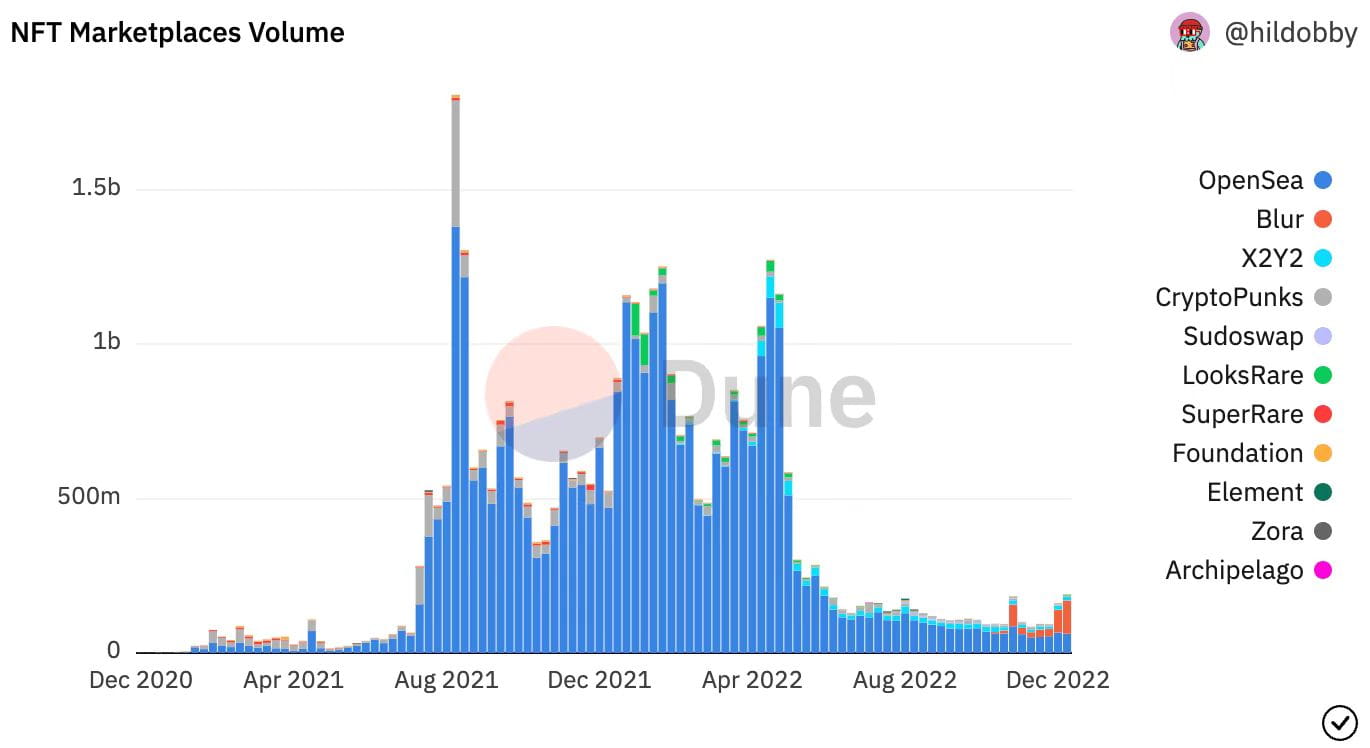
There are many strong players and well-established markets that are innovating with token-based airdrops, advanced social features, shared liquidity, focusing on certain markets (like hardcore traders), having optional royalties, going multi-chain, or focusing on specific genres (like games, music, or video). These products and applications are just beginning to fully understand their user base and target them accordingly.
For example, Magic Eden and Fractal understand that they are gaining a lot of traction on the Launchpad marketplace, so they are doubling down on that front as well, while focusing on how to play. Meanwhile, OpenSea continues to defend and enforce NFT royalties, and they are joined by companies like X2Y2 who are choosing to respect royalties for creators. It will be interesting to see how the debate over royalties plays out over time, with strong support for both camps.
We look forward to how these markets cater to users and enhance the user experience through features such as multi-chain and multi-wallet support, fraud detection, and better recommendation tools. For example, with the emergence of NFT series, it becomes increasingly important to help users find what they want more efficiently and create a more personalized market experience.
Q5: Where will venture capitalists deploy capital in 2023?
Of the current NFT verticals, VCs are still most interested in Web 3 games, despite their poor performance this year, as there is a general belief that games will eventually bring the masses into Web 3. This extends not only to NFTs, but also to crypto areas such as using hardware wallets, software wallets, interacting with DEXs, and using on-chain lending resources. As users enter the crypto space through Web 3 games, this adoption will eventually permeate other areas of cryptocurrency. Therefore, VCs are still looking for strong studios and builders in the Web 2 gaming space, as well as strong infrastructure.
In addition, venture capital is also paying close attention to NFT IP. Every year, new IPs are likely to emerge in the NFT field, as well as unlocking existing IPs to enhance the community experience, which is exactly what the Web 2 field lacks.
Web 3 social media is another exciting frontier, and the unrest on Web 2 social platforms (user anger over censorship and monetization of personal data) will attract users to Web 3 social platforms. However, it is still in its early stages, with only a few platforms actively building and gaining traction.
There are many games that choose to cater to both Web 2 and Web 3 users. It’s possible to have a game that’s considered “Web 2.5,” and Web 2 players (who may not be interested in using NFTs or tokens) can still experience the game while slowly moving into Web 3. This approach of prioritizing player intent makes more sense in the long run, rather than trying to force NFTs and tokens on players from the start.
Our New Year’s resolution is to be able to actually experience all of the games we are looking at and really understand what is feasible and what is not, as games take a long time to build. As Web 3 social media grows, anyone can start creating their own on-chain credentials and social presence. The same applies to L2 ecosystems and understanding which one works best for the end user based on their interests and goals. As the user experience of cryptocurrency improves year by year, we expect to see more and more users using cryptocurrency and NFT-based applications every day.