

Liquid Stake Derivatives (LSDFi) is gaining traction as it effectively reconciles the traditional trade-off between staking assets to ensure network security and retaining the freedom to use those assets within the broader financial ecosystem.
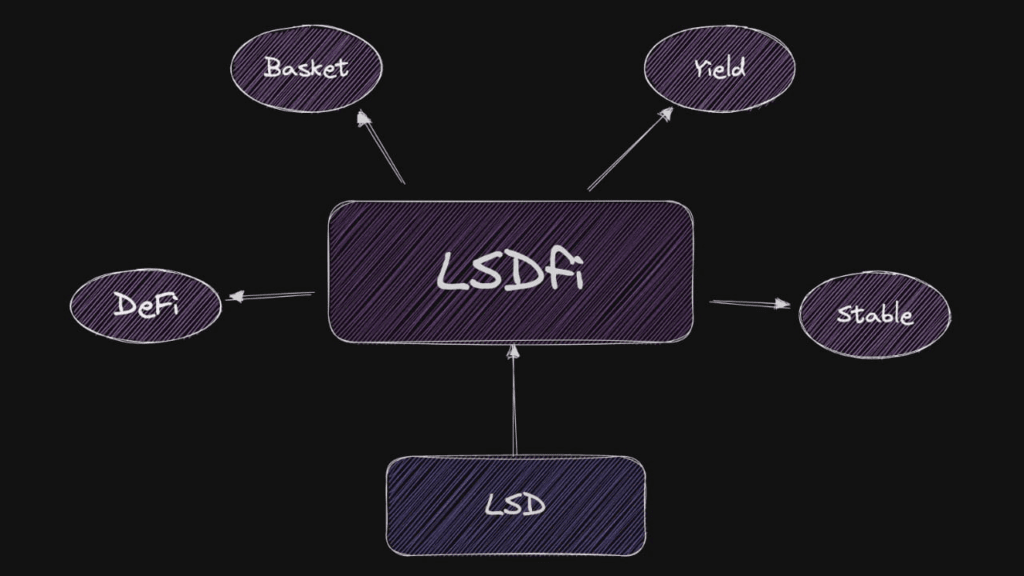
The LSDFi market is poised to grow significantly, with the potential to revolutionize areas like DeFi and staking. By offering stable returns that are independent of the market, these protocols attract the attention of both experienced cryptocurrency enthusiasts and newcomers to the field. As DeFi enthusiasts continue to seek innovative ways to maximize their investments, LSDFi is becoming a must-watch trend for those interested in the future of decentralized finance.
PENDLE
The Pendle Protocol is becoming a game changer, introducing a novel approach to yield trading. Pendle quickly gained the attention of cryptocurrency enthusiasts and investors by allowing users to maximize profits in a variety of market conditions.
Pendle Protocol is a groundbreaking DeFi platform that provides a permissionless yield trading ecosystem. Its main goal is to enable users to optimize their return exposure during bull and bear market conditions. The agreement consists of three basic components:
Yield Tokenization: The Pendle protocol starts by wrapping the underlying yield token into what is called SY (Standardized Yield Token). These SY tokens are then further divided into two distinct categories: Principal Tokens (PT) and Yield Tokens (YT). This process facilitates seamless trading of earnings exposure.
Pendle AMM (Automated Market Maker): The core of the Pendle protocol is its automated market maker, which allows users to easily trade principal tokens (PT) and yield tokens (YT). This AMM enables users to enter or exit their income positions based on market outlook.
vePENDLE Governance: Users can earn vePENDLE by actively participating in the protocol’s governance by locking their PENDLE tokens. This locking mechanism gives users the opportunity to have a say in the direction and future of the Pendle protocol, ensuring a decentralized and community-driven approach.
Pendle Protocol has set out to redefine the DeFi landscape by introducing innovative tools that enable users to easily navigate the complexities of yield trading. By tokenizing earnings and providing governance and reward opportunities, Pendle Protocol aims to foster a thriving and inclusive community of DeFi enthusiasts. As the world of decentralized finance continues to evolve, Pendle Protocol is becoming an important player, enabling users to always maximize their earning potential.
LBR

Lybra Finance has solidified its dominant position in the emerging LSDfi (liquidity-sensitive decentralized finance) ecosystem, with an impressive 40% market share. The protocol’s groundbreaking features, including the ability to mint eUSD stablecoins and zero-interest loans, make it a top choice for DeFi enthusiasts.
Lybra Finance’s eUSD is a decentralized, over-collateralized stablecoin that stands out in the ever-expanding world of cryptocurrencies. Built on liquidity-sensitive LSDFi, users can mint eUSD using their LSDFi assets such as stETH. eUSD earns an annualized interest rate of approximately 8%, providing its holders with a reliable source of passive income in the volatile cryptocurrency market.
One of the standout features of Lybra Finance is that it offers zero-interest loans, allowing users to mint eUSD for free. This strategic move makes the protocol an extremely cost-effective option for those who already hold LSD tokens in their portfolios. By leveraging the platform, users can increase the capital efficiency of their assets without incurring additional costs.
Lybra Finance has launched its governance token, LBR, which is a key element of the protocol’s ecosystem. Users can earn LBR by participating in the eUSD/ETH liquidity pool, thus incentivizing active participation in the network and contributing to its overall liquidity.
The success of Lybra Finance demonstrates the growing interest in the LSDFi ecosystem that combines liquidity and decentralized finance. With a 40% market share and innovative features that provide users with stable income and cost-effective liquidity, the protocol is shaping the future of DeFi. As the ecosystem continues to evolve, Lybra Finance remains at the forefront, setting the standard for other projects in this rapidly growing space.
The meteoric rise of Lybra Finance demonstrates that the DeFi landscape is constantly evolving, providing opportunities for those willing to embrace innovation and explore the vast potential of the LSDfi ecosystem.
UnshETH (USH)
UnshETH introduces a unique decentralized approach to staking by curating a diverse basket of liquid staking ETH assets. Designed to encourage validator decentralization and competition between protocols, the platform combines staking rewards and exchange fees into a tradable ERC-20 token.
Users can mint UnshETH seamlessly by depositing any supported Ethereum liquid staking token. In return, they will receive shares in various underlying Liquid Collateralized Derivatives (LSD) baskets. UnshETH’s current product already supports six types of LSD, with plans to expand.
One of the distinguishing features of UnshETH is its ability to generate revenue from swap fees and redemption fees. This multi-faceted approach amplifies the overall benefits that UnshETH holders can receive simply by holding the token.
UnshETH introduces a native governance token called USH. Holders of USH tokens are granted voting rights on key protocol proposals. Alternatively, they can stake USH tokens to receive vdUSH, which in turn enables them to receive a portion of the protocol’s revenue.
UnshETH’s innovative approach to decentralized Ethereum liquid staking not only introduces competition between protocols, but also enhances validators’ decentralization efforts, ultimately benefiting the broader DeFi community.
UnshETH is committed to driving innovation and inclusivity in the staking space, and it is poised to become a key player in the growing decentralized finance space.
mkUSD

Prisma became a game changer in the LSDFi space with the launch of the mkUSD stablecoin, fully collateralized by liquid staking tokens.
DeFi enthusiasts and cryptocurrency enthusiasts are excited as Prisma takes center stage in the world of decentralized finance. At the heart of Prisma’s innovation is the mkUSD stablecoin, which is unique in that it is fully backed by liquid collateralized tokens, enhancing its stability and resiliency.
Prisma’s decentralized protocol isn’t just about lending; It is a financial ecosystem that is both non-custodial and censorship-resistant. Users can mint the mkUSD stablecoin by providing liquidity staking tokens as collateral. What sets Prisma apart is its multifaceted approach to security. Collateralized assets are further protected by a stable pool, which contains mkUSD, and a network of other borrowers who collectively act as guarantors of last resort. This unique approach provides users with additional security and peace of mind.
Prisma delivers a capital-efficient lending experience with:
Collateralization Ratio: The minimum collateralization ratio is only 110%, ensuring users can borrow and borrow efficiently without overusing their assets.
Multiple Collaterals: Prisma allows users to deposit multiple types of collateral to further diversify risks.
Direct redemption: mkUSD can redeem the underlying collateral at face value at any time, providing unparalleled flexibility.
Censorship Resistance: Prisma’s non-custodial and immutable design ensures the protocol remains resilient in the face of censorship.
Prisma’s appeal also extends to Liquid Staked Token (LST) issuers. Holders of vePRISMA tokens have the power to incentivize various actions within the Prisma protocol. This includes incentivizing the minting of mkUSD via its own LST or directing emissions within the Prisma ecosystem.
Prisma’s innovative approach to decentralized lending and the creation of the mkUSD stablecoin demonstrates the project’s commitment to advancing DeFi. By combining innovation, security and flexibility, Prisma is poised to become a dominant force in decentralized finance.
Gravita Protocol
Gravita redefines the LSDFi landscape, offering users the opportunity to obtain interest-free loans while using Ethereum (ETH) liquid pledged tokens as collateral.
Gravita enables users to obtain interest-free loans, becoming a game changer in the decentralized finance (LSDFi) space. This groundbreaking protocol allows users to leverage their ETH liquid pledged tokens as collateral to obtain loans, bypassing the traditional high interest rates often associated with lending.
At the heart of Gravita’s unique lending platform is $GRAI, a stable asset designed to maintain a stable value between $1.10 and $0.97. Users can borrow $GRAI by providing supported Liquid Stake Derivatives (LSD) tokens as collateral. This over-collateralized debt token is generated by the protocol when collateral is deposited, effectively acting as a stablecoin, eliminating the volatility issues associated with cryptocurrencies.
Gravita offers users another opportunity to profit from its stable pool. Users can earn passive income by providing liquidity to the pool. The Stability Pool plays a vital role in maintaining the stability of the protocol by helping to repay the debt of liquidated ships below the minimum collateralization rate.
Gravita goes the extra mile to reward early adopters and those who contribute to the stability of the protocol. Over time, stability providers may receive early adopter rewards, and they may benefit from liquidation proceeds, further increasing the profitability of participating in the Gravita ecosystem.
Gravita’s groundbreaking approach to decentralized lending, stable assets, and liquidity provision presents a promising vision for the future of DeFi. By promoting financial inclusion and offering interest-free loans, the platform will have a significant impact on the wider cryptocurrency and DeFi space.
in conclusion
The emergence of liquid collateralized derivatives marks a major leap forward in the evolving landscape of LSDFi. It enables users to release liquidity from staking assets while reaping the benefits of staking rewards and trading opportunities. This groundbreaking innovation has the potential to expand the staking audience by removing liquidity constraints that hinder participation. Additionally, liquid staking derivatives foster a more dynamic LSDFi ecosystem, allowing users to optimize their capital efficiency and explore novel strategies that blend staking and trading.
The future of liquid pledged derivatives is promising. The proliferation of LSDFi could play a key role in accelerating the shift from traditional finance to DeFi. Therefore, liquid staking derivatives are an extraordinary innovation in the DeFi field, presenting new prospects for blending the advantages of staking and trading. The collaborative effort between developers and the community to enhance the technology and overcome challenges heralds a bright future for liquidity derivatives, with the potential to reshape the DeFi landscape and light the path to a more inclusive and robust financial ecosystem .