


Main contents
The Futures Grid Bot helps automate grid trading strategies in the futures market. The bot takes advantage of cryptocurrency price fluctuations, while allowing traders to leverage their positions. Leverage can make both profits and losses increase many times.
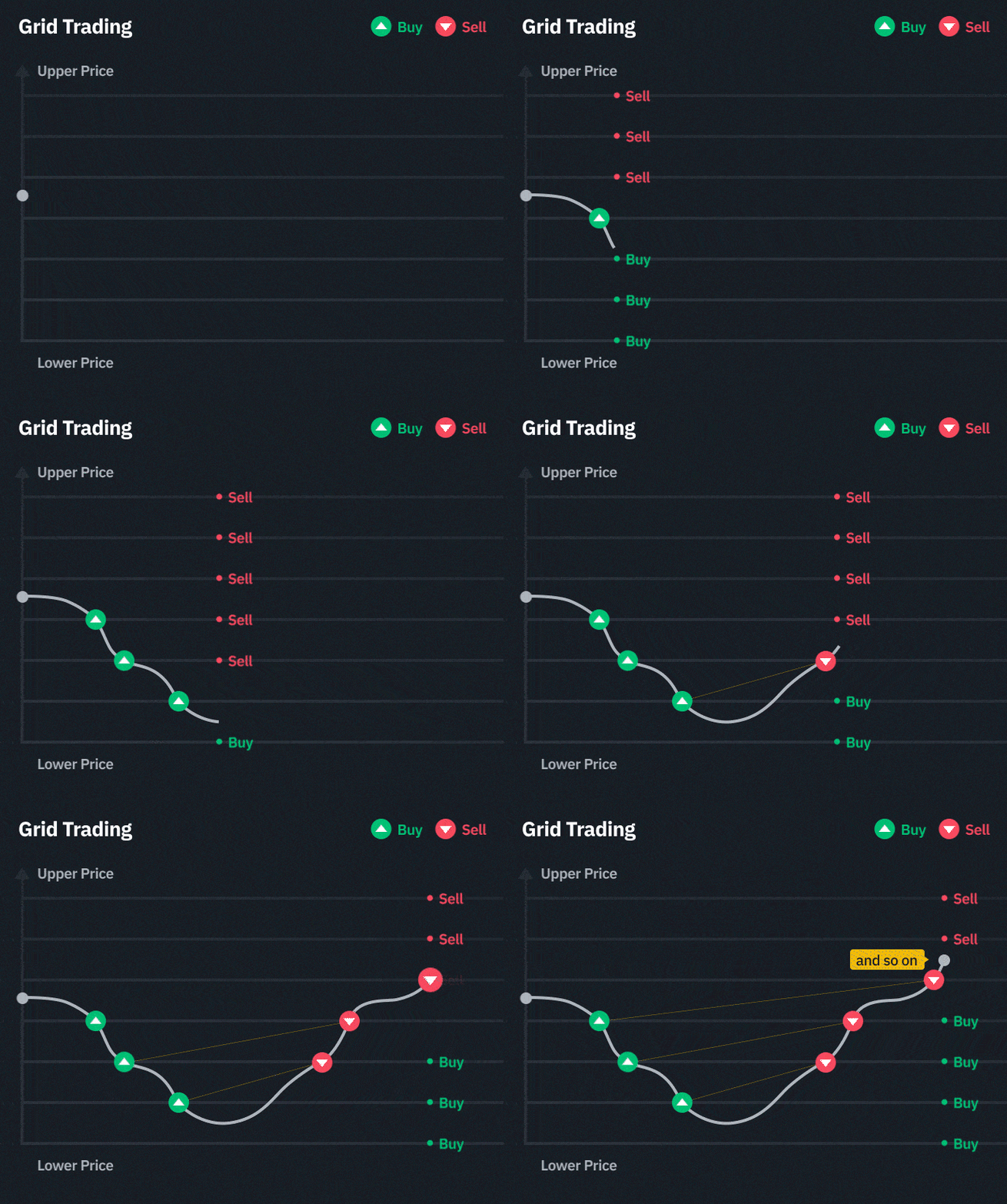
The basic logic of the Futures Grid bot is to buy low and sell high through matched orders (generating profit, also known as “matched profit”). When a buy order is filled, a new sell order is placed at a higher price. Conversely, when a sell order is executed, a new buy order will be placed at a lower price.
The bot will only buy low and sell high within the set price range and will pause when the price goes beyond that price range (below or above the price range). The bot will continue whenever the price moves back into the price range.
While bots offer potential benefits, futures trading carries inherent risks. Leverage can lead to significant losses if the market moves in an unfavorable direction, and the trader will be at risk of liquidation if the trader's margin falls below the required margin.
Explore the potential of the Futures Grid trading bot, learn about leverage in cryptocurrency trading, and understand the main risks involved.
Note: This is a general notice. Some products and services may not be available in your area.
In the volatile world of crypto trading, in addition to being an automated tool to help take advantage of market volatility, tools like Binance's Futures Grid trading bot are also becoming game changers. , allowing traders to easily access sophisticated trading strategies. This article will delve into the details of the Futures Grid trading bot, helping you understand the mechanism, advantages and risks of this type of bot.
However, if you're new to the world of grid trading, you should start with this comprehensive guide from us: Introduction to trading bots: Learn about spot grids, to get the basics down before Explore the more advanced version of this futures contract.
Are you ready to explore the future with the Futures Grid trading bot? Let's find out!
Trading grids, futures and trading bots: A brief overview
Before learning about the Futures Grid trading bot, it is important to understand grid trading strategies, futures in the context of cryptocurrency trading, and trading bot tools.
For those who are reviewing the concept or just starting out, Grid trading is a strategy in which buy and sell orders are placed at predetermined intervals, often represented as a “grid” on a chart. price. Imagine a ladder, each step representing a separate price; The goal is to make the most of the inherent price volatility of an asset, systematically buying when the price falls and selling when the price rises within a certain range.
Futures trading, on the other hand, is a bit more complicated. Instead of exchanging assets immediately as in spot trading, futures trading involves a commitment to buy or sell a specific asset (such as a cryptocurrency) at a fixed price, but the actual transaction takes place at a predetermined date in the future.
In basic terms, with futures you are speculating on the expected price movement of an asset. This speculation can be optimistic, meaning predicting the price will increase (opening a “long” position), or pessimistic, meaning predicting the price will decrease (opening a “short” position). Profitability depends on the difference between your fixed contract price and the prevailing market price when the contract expires.
Trading bots are automated tools designed to interact with financial exchanges and perform trading actions on behalf of users. Based on preset parameters, this bot can analyze market data, place trades, and sometimes even optimize strategies in real time based on market conditions.
Bots can be extremely useful in grid trading operations. Instead of manually placing each buy or sell order on those “ladders,” a trading bot can automate the entire process for you. Check out our Introduction to Trading Bots blog if you need a refresher on the advantages of using a trading bot to execute a grid trading strategy.
Armed with this background knowledge, you can learn more about the Futures Grid trading bot and how to exploit its features to achieve optimal trading results.
Futures Grid: The next step in your trading journey
When it comes to cryptocurrency trading, newcomers are often looking for tools that simplify their journey into this dynamic market. In this context, the Grid Spot trading bot has proven to be a reliable companion. An ideal tool for beginners, this bot helps traders new to the market understand the basic principles of grid trading: taking advantage of price fluctuations to continuously buy low and sell high.
However, when traders are more experienced and want to find advanced tools to further tweak their strategies, the Futures Grid trading bot will be the ideal choice. Combining the principles of grid trading with futures, the Futures Grid bot — like the Spot Grid bot — executes trades within a set price range, profiting from price fluctuations. However, bots also have important differences unique to futures contracts.
Leverage: The Futures Grid bot allows traders to leverage positions, increasing potential profits many times over. But remember, as the rewards increase, so do the risks.
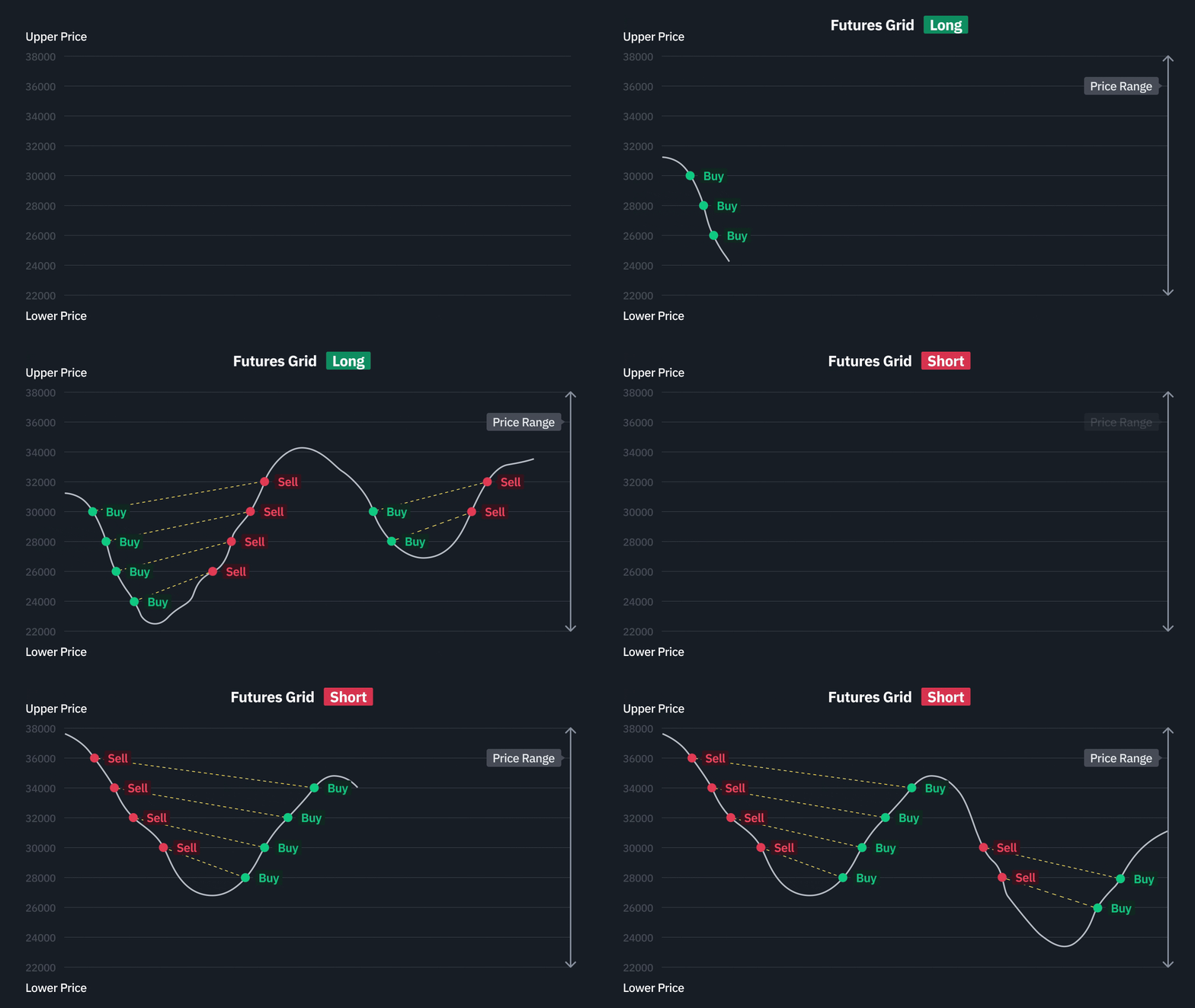
Long and short positions: Unlike spot trading, where profits arise mainly from rising prices, futures trading allows you to profit even when prices rise (long position). and when the price falls (short position). The Futures Grid bot can automate strategies in both cases.
Are you new to futures contracts? Let's learn about the importance of leverage and shorting.
1. The power of leverage
Essentially, futures trading introduces the concept of leverage, a double-edged sword that can magnify profits and losses many times over.
By using leverage — the ratio between a user's capital and the borrowed amount that the user can use to open a larger trading position — a trader can control a much larger position with capital relatively small. For example: 10x leverage means you can open a position 10 times your capital. So, if you have 1,000 USD on Binance, you can open a position worth 10,000 USD.
This potential to increase profits many times over is a significant attraction for those who want to optimize profits. However, it is worth noting that using leverage requires traders to have in-depth knowledge of risk management because leverage also increases losses many times.
2. Short selling feature
Prices do not always increase, they can also decrease. The Spot Grid bot is a great tool to profit from general price movements, but the Futures Grid bot will be a powerful tool when the market is trending down with the Short Grid Strategy feature. Unlike Spot, where profits only come from selling when prices rise, in Futures you can make money even when prices fall by "shorting".
In the digital asset futures market, shorting refers to the practice of selling a future cryptocurrency contract in anticipation that the price of the cryptocurrency will decrease. Essentially, by shorting, traders try to profit from falling asset prices. But it's important to remember the risks. If the price of the asset increases instead of decreasing, the higher the price means you will incur a loss.
So how does the Futures Grid bot work? Simple example
Suppose Laura – an experienced spot trader participates in futures grid trading using a bot. Laura believes that Ethereum perpetual futures (ETHUSDT) will fluctuate between 1,900 USDT and 2,100 USDT in the coming weeks, while ETHUSDT has bullish prospects in the long term. Laura wants to profit from the expected price fluctuation of ETHUSDT between 1,900 USDT and 2,100 USDT, while ensuring that she does not suffer losses when the price of ETHUSDT goes outside the price range (>2,100 USDT). Therefore, Laura decides to go long Futures Grid: create an initial long position.
1. Grid strategy type: Laura chooses to place a long grid as explained above.
2. Set price range: Laura sets the trading range between 1,900 USD and 2,100 USDT.
3. Number of nets: In this price range, Laura orders 10 nets. She chose the “Arithmetic” grid, which means each grid will have the same price difference.
4. Investment amount and leverage: Laura decided to invest 100 USDT as initial deposit. With the added leverage tool in futures trading, she decided to use 10x leverage, the actual trading position size is 10 times the amount of capital she has.
Laura then proceeds to activate the long strategy, resulting in the following setup:
Current ETH price: Supposed to be 1,963 USDT at the start of the strategy
Grid type is long: The Futures Grid bot starts placing 6 initial buy limit orders of 0.029 ETH each, triggered at an average of 1,963 USDT (usually always very close to the price of the ticker when creating the strategy), thus creating an initial long position of 0.174 ETH (341.5 USDT)
ETH price range for buy orders: 1,900 USDT to 1,960 USDT (4 grid orders, price difference is 20 USDT)
ETH price range for sell order: 2,000 USDT to 2,100 USDT (6 grid orders scattered throughout the price range — also with a price difference of 20 USDT)
Please note, each Order in the Futures Grid has the same amount of ETH (“Amount/Order”): in this example, 0.029 ETH.
Profit per grid: Profit per grid level is expected to be around 0.93% to 1.02%, based on the arithmetic difference in buy order levels and sell order levels.
5. Bot in action: When Ethereum price fluctuates in Laura's price range, the bot will place buy and sell orders to take advantage of price fluctuations.
If the price first drops to 1,960 USDT, Laura's buy order will be triggered at 1,960 USDT, increasing the original long position (+0.029 ETH), and the bot will place an additional new sell order at a higher price in net, is 1,980 USDT. When the price rises again, Laura's sell order placed at 1,980 USDT will be activated, capturing the profit between the sell high and buy low orders.
Instead, if the price initially increases, Laura's 2,000 USDT sell order will be triggered first, partially covering the original long position with a higher sell order and placing a new buy order at a lower price in the grid , is 1,980 USDT. When the price drops to 1,980 USDT, Laura's new buy order will be triggered, capturing the profit between the initial high short and the lower buy order.
6. Basic logic of Grid Bot:
Every time a new buy order is triggered, the grid bot places a new sell order at a higher price in the grid.
Likewise, every time a new sell order is triggered, the grid bot places a new buy order at a lower price in the grid.
Those orders (the triggered order and the newly placed order) are called “filled orders” — whenever both are triggered, a subsequent profit is generated (through the “buy low sell low” logic). High").
The number of open orders is always equal to the number set as the initial parameter. For example, if you set a strategy with 10 grids, the bot will always ensure there are 10 open orders (buy or sell) placed on the grid.
The strategy of the Futures Grid bot involves buying assets at low prices and selling assets at high prices within a predetermined price range. If the asset's price falls below or rises above this price range, the bot will suspend trading operations. The bot will only resume trading when the price moves back into the specified price range.
Long, short and neutral grid
The above example illustrates the working mechanism of the Long Futures Grid strategy, suitable for profiting from price fluctuations in a bull market.
In contrast, the Short Futures Grid strategy is designed for bear markets, focusing on profiting from sideways markets in a downtrend.
Meanwhile, the Neutral Grid strategy will be optimal in the limited market, taking advantage of price fluctuations in a set price range in the long term.
Each strategy requires traders to have in-depth knowledge and risk management. To learn about these strategies, how to implement them and what risks to consider, please see our guide to the long, short and neutral Futures Grid.
Other factors to consider
Remember: Leverage does not change the profit per unit, but it allows you to open and control a position larger than the capital you have.
Fees: Profit calculations need to take into account trading and/or funding fees, which can be substantial in leveraged futures trading and can vary widely depending on market conditions and exchanges.
Liquidation: Another factor to keep in mind is that trading with leverage also carries the risk of liquidation. If the price moves sharply outside Laura's grid zone and remains there, her position could be liquidated and she could lose her entire deposit. Liquidation? Lost deposit? Let's take a moment to consider these risks.
Understand the risks and proceed with caution
Although the Futures Grid bot has many attractive potentials, futures trading is inherently riskier than spot trading. The main risk in spot trading is falling asset prices. If you buy a token and the price of the token drops, you will incur a loss if you sell.
However, with Futures Contracts, in addition to the usual price risk, there is also the added complexity of leverage, which can increase losses many times over. Furthermore, there is also the risk of liquidation – if the price moves significantly against your position, the position may be automatically closed to avoid further losses. You must clearly understand liquidation.
Liquidation
Traders using leverage can open a position larger than the capital they have in their account. This can lead to significant profits, but can also cause significant losses.
Liquidation in futures trading is when a trader's position is automatically closed by the exchange to avoid further losses, especially when the trader's margin falls below the required maintenance margin. This may cause traders to lose their initial deposit.
Margin maintained
Maintenance margin refers to the minimum amount of assets a trader must maintain in a trading account to keep a position open. This is a safety measure that brokers and exchanges put in place to compensate for potential losses and reduce risks in futures trading.
Maintenance margin acts as a form of insurance that helps protect the integrity of the market and the exchange as it ensures traders cannot breach their obligations due to not having enough funds in their account. The exact maintenance margin required may vary.
Call margin
If the trade does not go as expected and the assets in the trader's account fall below the maintenance margin, the trader will receive a “margin call” and must add more funds to the account. If the trader fails to meet the margin call, the exchange will automatically close the position to avoid further losses — this is liquidation.
Futures and Liquidation Grid trading bot
Due to the use of leverage in futures trading, positions can be significantly affected by even small changes in price. If a trader's position goes against their prediction then the trader's margin balance will be at risk of being depleted quickly.
Despite automating trading, futures grid bots do not inherently prevent liquidations. Traders must be careful with their maintenance margin level. If the market moves in an unforeseen direction, the bot's position can quickly reach the liquidation price.
Setting appropriate stop losses and monitoring market conditions is extremely important, even when using an automated tool like the Futures Grid bot.
Emphasis on cutting losses for new traders
Stop losses are an essential risk management tool in futures trading. This is an order to automatically sell an asset when it reaches a specific price, thereby limiting possible losses. For newcomers, this tool offers important benefits: disciplined trading by setting predetermined loss limits, reducing emotional decision-making and, importantly, helping to prevent prevent the unfortunate outcome of position liquidation.
Applying a stop loss strategy is the key to safer trading. To understand more about stop-loss orders and, respectively, take-profit orders, read our detailed guide: How take-profit and stop-loss orders can help traders manage risk. Don't forget to set a stop loss when setting up the Futures Grid using "advanced parameters".
Funding fees
In futures trading, especially in perpetual futures contracts, traders often encounter “funding fees”. This fee is an essential mechanism to anchor futures contract prices to spot prices.
Funding fees are periodic payments that traders pay or receive, depending on the difference between the perpetual contract price and the spot price. If you are in a long position and the perpetual contract price is higher than the spot price, you will have to pay funding fees. Conversely, if the perpetual contract price is lower than the spot price, you will receive this fee. This principle applies in reverse to short positions.
Funding fee = Funding Rate x Position size
In there:
Funding Rate is a periodic fee (can be positive or negative) determined by the difference between the futures contract price and the spot price.
Position size is the size of the open position in a futures contract.
The frequency and size of the Funding Rate depends on market conditions and traders must clearly understand these parameters as they can affect profits, especially in tight margin situations. When investing long-term in a position, traders will incur many funding fees, which can reduce profits or worsen losses.
As always, a thorough risk management strategy is indispensable.
Copying existing bots has a high ROI
Just like Spot Grid, the Futures Grid bot strategy that other traders are using will be featured in the Binance Bot Marketplace section on the Trading Bot homepage. This valuable resource allows users to screen for the most effective futures grid strategies, copy strategies with a simple click, and learn from other traders' experiences. This is an easy way to learn more about futures grid trading, understand market nuances, and tailor your own strategy. However, it is important to remember that past performance does not guarantee future performance; Remember to always trade with caution.
Synopsis
In the fast-paced field of cryptocurrency trading, tools that provide a competitive edge are extremely useful. The Futures Grid Bot stands out not only as an advanced tool but also as a game changer for those looking to maximize profits. The appeal of futures contracts, especially when combined with a solid grid trading strategy, gives traders the opportunity to increase profits many times over, mainly thanks to the power of leverage.
For strategic traders, this means the ability to extract larger profits from relatively smaller price movements, something spot trading does not inherently offer. But the Futures Grid not only has leverage, but also allows traders to flexibly strategize in both bull and bear markets, helping traders make profits even when the market is bearish by shorting. However, the greater the control, the greater the responsibility.
Trading futures requires traders to pay attention to market fluctuations, understand potential risks, and have a strict risk management method. However, for those who are prepared, the Futures Grid bot can be the key to opening up a new profitable sector.
Read more
Grid Trading What is a Futures Contract?
What is Long/Short grid trading?
Benefits of grid trading on Binance Futures
Risk Warning: Grid trading as a strategic trading tool should not be regarded as financial or investment advice from Binance. Grid trading is used at your discretion and at your own risk. Binance will not be liable to you for any loss that might arise from your use of the feature. It is recommended that you should read and fully understand the Grid Trading Tutorial and make risk control and rational trading within your financial ability. For a complete strategy trading disclaimer, please refer to here. In offering Grid Trading to User, Binance is not providing any investment advice or recommendation, trading strategy and/or trading parameter as appropriate and/or suitable for User. User shall be solely responsible for determining whether or not to make use of Grid Trading or selecting an appropriate feature, trading strategy and/or parameters in light of their investment objectives, risk tolerance, financial situation and needs. Binance makes no representation or warranty as to the outcome of the use of Grid Trading.