

Original author: Jiang Haibo
Original source: PANews
Competition in the on-chain perpetual contract track is becoming increasingly fierce. After Synthetix, Vertex and others relied on transaction rewards to dominate the market, the once-leading GMX V1 transaction volume declined. As of October 7, the amount of funds in GLP on Arbitrum was US$360 million, but the APR has dropped to 5.65%. Considering that GLP may incur losses as a counterparty to traders, GLP no longer has the ability to earn profits from the perspective of Competitiveness, capital also continues to flee. At the same time, open interest and trading volume of GMX V2 are rising. As the perpetual contract with the highest TVL, GMX is still worthy of attention. The following PANews will interpret the updates to GMX V2 and compare the data of V1 and V2 as well as the overall competitiveness of GMX.
GMX V1 flaws and V2 updates
Although GMX V1 provides a relatively complete on-chain derivatives solution and is the on-chain derivatives market with the highest TVL. There are many projects that fork GMX ideas, and there are also multiple projects built on GMX, but for some users The experience may not be very good: transaction fees are high, both long and short parties may pay high borrowing fees, resulting in high holding costs, serious deviations in the long-short ratio may cause losses to GLP holders, and risks in a single asset may cause All GLP holders face losses.
GMX V2 has been significantly updated and can almost be considered a completely different solution. The updates are as follows.
Replace the single liquidity pool GLP with multiple risk-isolated GM pools. The liquidity of each asset is independent and can support more long-tail assets. When the price of an asset is at risk (as happened with the AVAX price manipulation attack), it does not put all liquidity providers at risk.
Introducing capital fees, and deciding whether longs pay to shorts or shorts pay to longs based on the open positions of longs and shorts, is conducive to achieving a long-short balance through arbitrageurs.
The method of collecting currency borrowing fees has been changed from the previous two-way charging for long and short positions to only charging for long or short positions based on the amount of open long and short positions.
Reduce transaction fees from 0.1% to 0.05% or 0.07%, depending on whether the trade tips the longs and shorts toward balance or more imbalance.
Introduce price effects so that transactions that tend to be balanced between long and short will receive more favorable prices, and unbalanced transactions will receive negative price effects.
Add other functions, such as adding limit orders, etc.
The above functions mainly isolate risks among liquidity providers. At the same time, through different fees, arbitrageurs are motivated to balance the long and short positions and reduce the risks of liquidity providers. Transactions that tend to balance long and short have lower transaction fees than the original ones, favorable price effects, no need to pay borrowing fees, and additional funding fee income.
GMX V1, V2 data comparison
Trading volume
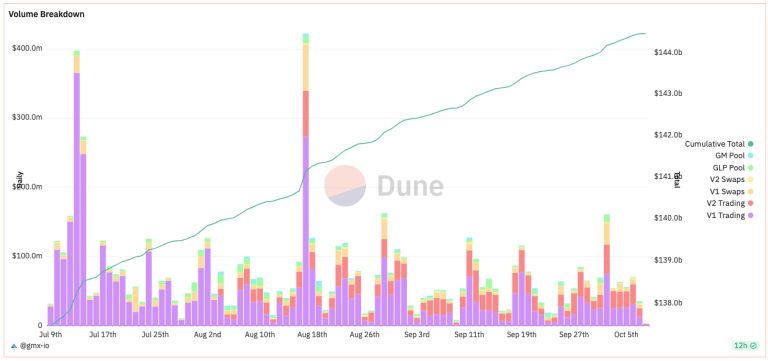
Transactions in GMX can be simply divided into three categories: transactions entering or exiting the liquidity pool (GLP or various GM pools), spot transactions, and perpetual contract transactions. According to GMX official data, on October 7, the total trading volume of V1 was US$20.99 million, and the total trading volume of V2 was US$15.01 million. Among the major perpetual contracts, the trading volume of V1 and V2 has been similar in recent days; however, the spot trading volume of V1 is several times that of V2; the trading volume of V1's GLP pool is also significantly higher than that of V2's GM pool.
cost
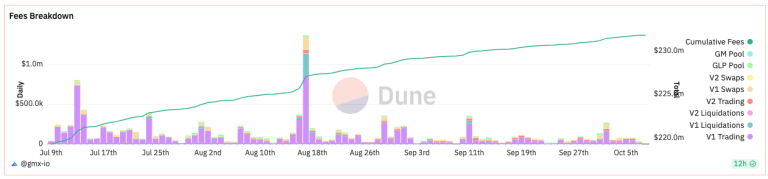
The cost incurred by GMX V1 is still significantly better than V2. In the past week, Arbitrum generated $557,000 in fees for V1 and $110,000 for V2, which is five times as much. It can also be seen from the fees generated by each transaction in the figure below that the fees generated by the V1 perpetual contract usually account for more than 50% of the total fees. The V1 perpetual contract has higher transaction volume and higher than V2. Transaction fee ratio. The recent total expenses are still far behind the highs of the last 3 months.
TVL
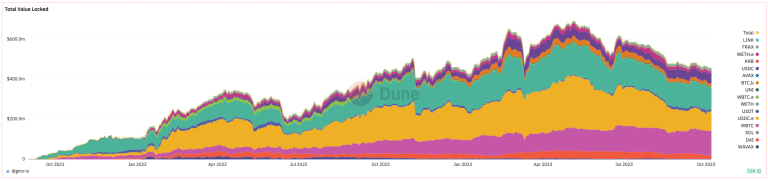
In terms of TVL of V1 and V2 (only considering GLP and GM pools), as of October 8, V1’s TVL (Arbitrum+AVAX) was US$396 million, V2’s TVL (Arbitrum+AVAX) was US$41.57 million, the former was 9.5 times the latter. However, the TVL of V1 shows a clear downward trend, the TVL of V2 shows an upward trend, and the sum of the two is still on a downward trend (probably because the yield of GLP has dropped to about 5%).
open interest
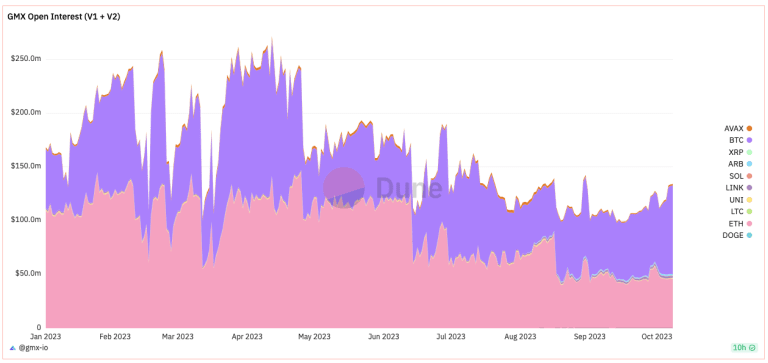
Looking at total open interest, V1 and V2 open interest combined are still trending downward, but have increased over the past 20 days. As of October 8, the combined open interest of V1 and V2 was $134 million, of which V1 was $107 million and V2 was $27 million. The former was approximately 4 times the latter. The perpetual contract trading volumes of the two have been relatively close recently, indicating that V2 has higher capital efficiency.
Number of users
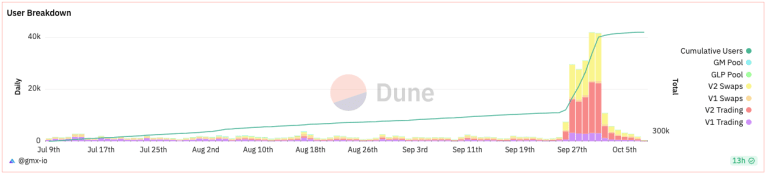
The number of GMX users shows that starting from September 26, there have been many new users in GMX V2’s perpetual contracts and spot transactions. The data has dropped sharply in recent days, which may be related to Arbitrum’s restart of the Odyssey event. The new Odyssey event starts on October 26 and lasts for 7 weeks. The first week’s tasks require margin trading on GMX V2. On October 7, the sum of the number of users of V1 was 901, and that of V2 was 942, which is equivalent. But before September 26, the number of users of V1 was significantly higher than that of V2.
overall competitiveness
According to data compiled by Dune @shogun, the recent total transaction volume of on-chain perpetual contract projects has declined compared to June and July. Trading volumes are cyclical, typically lower on weekends.
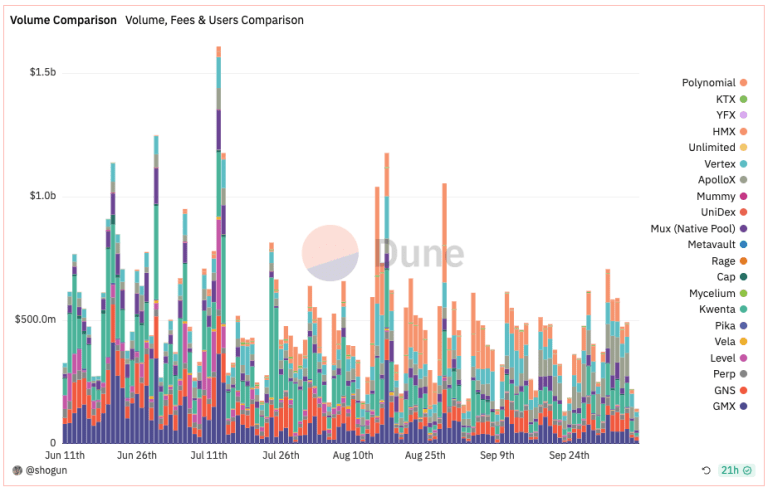
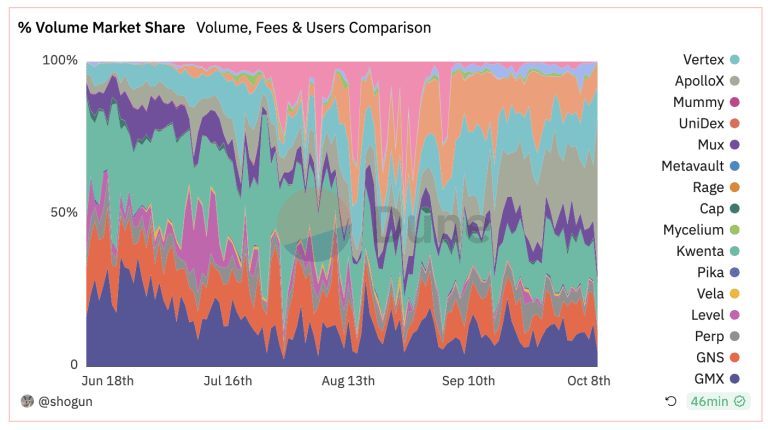
Competition on this track is fierce. Four months ago, the trading volumes of on-chain perpetual contract projects from high to low were: GMX, Kwenta (Synthetix), Level, GNS, and ApolloX (dYdX was not counted, and the trading volume of dYdX was still is the highest). But the current situation has completely changed. Taking the data on October 7 as an example, the transaction volume from high to low is: Vertex, ApolloX, Kwenta, GMX, HMX.
GMX’s share of trading volume has dropped to around 10%. Transaction mining has a very obvious impact on transaction volume. Vertex, ApolloX, Kwenta, etc. all have transaction mining rewards. At the same time, GMX also faces competition from new projects such as HMX. This is a problem for GMX, which no longer has tokens for transaction mining. It is relatively unfavorable for the project.
But the situation may change in the near future (refer to Optimism's transaction incentives for Synthetix/Kwenta), GMX applied for 12 million ARB through the Arbitrum short-term plan. The proposal has now reached the approval conditions, and GMX plans to use the funds to incentivize V2’s liquidity and trading volume, as well as build other projects on GMX.
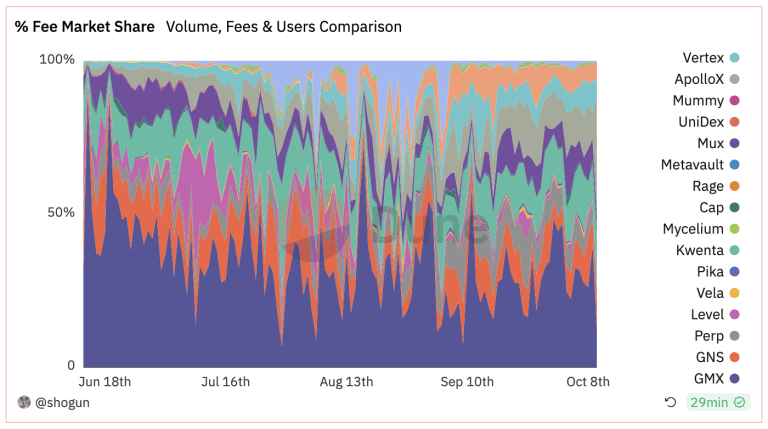
In terms of fees, GMX’s fees still account for the highest proportion, accounting for about 30% of all fees recently. This may be due to a higher transaction fee ratio and additional currency borrowing fees compared to other projects. However, it should also be noted that different projects allocate fees differently. For example, the fees generated by Kwenta/Synthetix are all allocated to SNX stakers in the early stage, while the proportion of fees allocated to GMX/esGMX stakers by GMX is only 30% at most.
summary
GMX V2 replaces the GLP pool with an isolated GM pool, and encourages a more balanced long-short ratio through capital fees, borrowing fees, transaction fees, price effects, etc. However, when market fluctuations are small, competitors with transaction mining incentives and lower transaction fees occupy more market shares.
The total funds in GMX continue to flow out. Although the liquidity in GMX V2 is increasing, more funds are withdrawing from GMX V1. Moreover, the yield rate of GLP in GMX V1 is only 5% recently. The flight of V1 funds may not stop. .
However, the situation may change in the near future. GMX has applied for 12 million ARB in Arbitrum’s short-term incentive plan. V2’s liquidity and trading volume will be stimulated, and V2’s capital efficiency is higher, which may usher in a change for GMX.
(The above content is excerpted and reprinted with the authorization of our partner PANews, original text link)
Statement: The article only represents the author's personal views and opinions, and does not represent the objective views and positions of the blockchain. All contents and opinions are for reference only and do not constitute investment advice. Investors should make their own decisions and transactions, and the author and Blockchain Client will not be held responsible for any direct or indirect losses caused by investors' transactions.
This article GMX’s transformation path: market performance and prospect analysis from V1 to V2 first appeared on Blockchain.


