

*Written by: James XYC, co-founder of MAP Protocol (Twitter: @Jmapprotocol) The essence of cryptocurrency is a decentralized ledger. There is no physical object in circulation. Aligning the ledgers of two chains is the essence of cross-chain.
The essence of cryptocurrency is a decentralized ledger. There is no physical object flowing. Aligning the ledgers of two chains is the essence of cross-chain.
Before we start, we must first mention that the term "cross-chain" or "bridge" is problematic. The reason is that the essence of cryptocurrency is a decentralized ledger, and there is no physical object flowing. Using the word "cross" or even the word "bridge" is too concrete and wrong; aligning the ledgers of two chains is the essence of cross-chain. Before discussing the cross-chain nature of cryptocurrency, let's first look at the history and nature of currency.
1. The Nature of Money: A Unit of Account
Currency is the unit of account, not the physical object (paper money) or a string of characters that we see now.
1. Barter: The beginning of bookkeeping
In the early days of mankind, there was no currency, and people traded through barter. For example, a sheep can be exchanged for a table (equivalent exchange). Afu has 10 sheep, but Ali only has 1 table at the moment. What to do? Exchange or not? If not, raising sheep is costly; if exchanged, Ali does not have enough tables. So we need to keep an account. Ali, you take my 10 sheep first, but you owe me 9 tables, and you agree to pay it back next year.
In the blink of an eye, it was the next year. Ali started to default on his debt because he could not make 9 tables. Afu saw that everyone in the region liked chocolate very much (in fact, chocolate was indeed used as an equivalent exchange item in South America a long time ago), and it was very rare, so most people were willing to exchange chocolate for most things. Ali had 9 chocolates, so he used 9 chocolates to pay off his debt. Gradually, the most liquid items in the local area (such as chocolate) became the accounting unit, and the accounting unit generated fair value, for example, one chocolate could be exchanged for a sheep or a table.
This accounting unit is currency, which is just a puppet, no matter what form it takes. But this puppet can easily go wrong, for example, if someone can suddenly make 1 million chocolates, he can easily rob others of their labor.
2. Gold, silver, gold notes and silver notes
The core of the unit of account is continuous and stable liquidity.
Later, humans expanded the scope of commercial exchange and even began global trade, and gold and silver came on the scene. Silver and gold are the natural favorites of all mankind, so they are born to be monetary accounting units. Moreover, silver and gold have been proven to be very rare on the entire earth for thousands of years, which also conforms to the characteristics of the stability of accounting units. Therefore, gold and silver, as "puppets" as accounting units, will not be easily overturned.
However, people gradually found that gold and silver were not easy to carry. Therefore, their derivatives began to appear in the market: silver (gold) notes. Silver notes, as a derivative, are essentially still trust in the bookkeeper - trust in the bank. The bank is responsible for acceptance and the right to keep accounts lies with the bank. Later, silver (gold) notes became the national accounting unit. For example, the US dollar is issued and accepted in conjunction with gold, and a small group of people, the Federal Reserve, are responsible for keeping accounts for everyone. It was not until the 1970s that the Bretton Woods system collapsed, and the US dollar announced that it would no longer be a gold note and would no longer be linked to gold. The amount of US dollars issued was entirely determined by the Federal Reserve, the accounting organization. There is certainly a logic for how the Federal Reserve makes decisions, but it is indeed a small group of people who make decisions (centralization).
But after the value of the US dollar lost its gold anchor, it began to focus on another characteristic of the currency: liquidity. The most widely used currency in the world is oil trading and financial transactions. The US dollar holds Middle East oil in its left hand and Wall Street in its right hand. Under the cautious and key operation, the US dollar has become the global accounting unit.
The foundation of the accounting unit is that it cannot be tampered with, which is what we commonly call decentralization and trustlessness. Therefore, although the US dollar has shown extraordinary strength in liquidity, it continues to harvest the wealth of global workers through issuance and contraction, which still violates the most important attribute of currency: accounting cannot be tampered with. Therefore, in 2009, Bitcoin appeared. Unlike traditional financial institutions, Bitcoin is a peer-to-peer electronic cash payment system: one party initiates the transfer and the other party accepts it, without relying on any centralized financial institution.
2. The essence of cryptocurrency: a decentralized ledger system
1. Why is cryptocurrency essentially a decentralized ledger system?
Let’s start with Bitcoin, the ancestor of digital currency. How does a Bitcoin come about? — It is mined.
So what exactly is the mined BTC? — It’s actually just a string of characters.
How to prove that this character is valuable or BTC?
At this point, the essence of the problem emerges. Because it is accounted for, it is confirmed, and all BTC transfers are recorded in the ledger. At this point, does your mind instantly form a chain scenario of BTC being generated from mining and transferred to various addresses? And tracing back to the source, any Bitcoin can be found at the address when it was first born. This is called a ledger.
Of course, this ledger is different from the traditional centralized accounting system of the Federal Reserve. What is the difference?
2. Differences from the traditional Federal Reserve centralized accounting system
We can summarize the history of currency in the most condensed and abstract popular examples as follows:
The village chief keeps accounts: In a village, axes are used as the accounting unit. The village chief keeps accounts of who owes whom an axe. Because the village chief has a high prestige, whoever the village chief says owes whom an axe is the one who owes him.
The village chief, deputy village chief, and elders formed a team to keep accounts: Later, the village chief was involved in a shady deal. It was clear that A lent an axe to B, but B was the village chief's nephew and insisted that this was not the case. This kind of thing gradually became more and more frequent. The deputy village chief and several elders asked to join the accounting team, so the village chief, deputy village chief, and several elders started to keep accounts together. Later, it was discovered that the village chief, deputy village chief, and elders had colluded, and the axes borrowed by their relatives could be written off, and everyone knew it. The villagers couldn't stand it anymore, so they simply did this, whoever borrowed money from whom, everyone could keep accounts, but this was very costly and difficult to operate.
Satoshi Nakamoto's accounting: At this time, a villager named Satoshi Nakamoto created a tamper-proof accounting method called blockchain. After that, every loan will be broadcast to the whole village. Anyone can keep accounts, and anyone can stop keeping accounts at any time. Then most people record the same account book, which is confirmed as the real account book. And give everyone who successfully keeps accounts a thing called Bitcoin (mining reward).
3. The essence of cross-chain: “ledger alignment” technology between decentralized ledger systems
1. Interesting cross-chain analogies
After laying the groundwork for so long, we can finally say that cross-chain, the essence of this behavior, is the "ledger alignment" technology between decentralized ledger systems. Specifically, it is actually to align two decentralized ledgers, commonly known as reconciliation. It is just like the supermarket owner looking for the cashier to reconcile.
However, in many cases, the supermarket owner speaks Chinese, while the cashier speaks English. This is called the alignment of accounts between heterogeneous chains in the blockchain industry. What is the EVM chain (isomorphic chain) account alignment? It means that they all speak Chinese, but the owner speaks Chinese Mandarin, while the cashier speaks Singaporean Mandarin. The basic words are the same, but the grammar and some vocabulary are different. Or, in the account dimension, the financial statements under Chinese accounting standards are aligned with the financial statements under US accounting standards.
2. Blockchain ledger alignment
Under the blockchain decentralized ledger technology, each chain is an independent decentralized distributed ledger, so how to align the ledgers of these two chains? Through the discussion of the accounting methods above, we can derive the following ledger alignment solutions:
1) The town mayor (the superior unit of the village) and several elders or village heads of each village are responsible for aligning the two ledgers (two villages). This is commonly known as MPC or TSS technology. In the blockchain world, how to prove that he is the town mayor, village head or elder? Either the project party designates a group of nodes, or the number of Power Of Staking is used as proof. Whoever stakes more coins is the authority. We also mentioned above that this kind of authority is bound to lead to the possibility of village heads working together for evil.
2) Authoritative person + several random witnesses to align the ledgers. In the blockchain world, random witnesses are Oracle nodes, and authoritative people still rely on the amount of stake for authoritative ranking. The risk of collusion between Oracle and authoritative people still exists. This is the technology of aligning the ledgers between two blockchains under the Oracle + Relayer technology. LayerZero mainly uses this technology.
Perhaps people question that the most important thing for cryptocurrency is not its widespread use (liquidity), and whether decentralization is so necessary? The centralized accounting scheme led by the US dollar has reached its peak in terms of liquidity. If the crypto world abandons decentralized accounting and pursues liquidity, it will undoubtedly have no chance of winning and will be no different from a scammer.
3) Use the blockchain's accounting mechanism to align cross-chain ledgers, which is the light client technology. As we all know, the chain's accounting method is undoubtedly decentralized. The ledger has the characteristics of being tamper-proof and traceable. Taking the POS consensus mechanism public chain as an example, all ledger confirmations are accounted for (uploaded to the chain) by groups of validators (the signatures of two-thirds of the previous group of validators authorize the next group of validators). Theoretically, it is only necessary to synchronize the validator information of the ledger (including the information set of multiple validators) to another blockchain ledger. This is equivalent to the two parties confirming the signature information.
3. Take the company's signature reconciliation as an example to see the blockchain's light client accounting mechanism
Company B also retains the signatures of Company A's financial director and general manager. If an employee of Company A says in Company B that Company A owes him money, Company B only needs to check whether there are signatures from Company A's financial director and general manager, and that the signatures are authentic.
The difference between blockchain and companies is that the signatories (validators) of blockchain are permissionless and are replaced every 24 or 72 hours. This is equivalent to a company's financial director and general manager being replaced every day. After each replacement, companies A and B immediately exchange signature validator information sets (validator private key signatures).
What if the exchange process is centralized? In fact, the exchange process is definitely centralized, but it doesn’t matter because it cannot transmit fake signature information to the target ledger (chain). This is because the validity of each new validator requires the private key signature of the upper-level validator group. Fake ones do not have private key signatures, so light client is also called independent self-verification cross-chain technology.
Currently, Polkadot, Cosmos, NEAR Rainbow Bridge, and MAP Protocol are using this technology. Although using light client for cross-chain is safe and guarantees absolute decentralization, the technical challenges are very great, especially using light client for cross-chain of heterogeneous chains, which requires more technical efforts. However, after nearly four years, MAP Protocol, a rising star in light client, finally successfully applied light client to all heterogeneous and homogeneous chain cross-chain verification. At present, MAP Protocol already supports cross-chain of Polygon, NEAR, and BNB Chain, and Eth 2.0 cross-chain is also under testing and is expected to be launched by the end of the year.
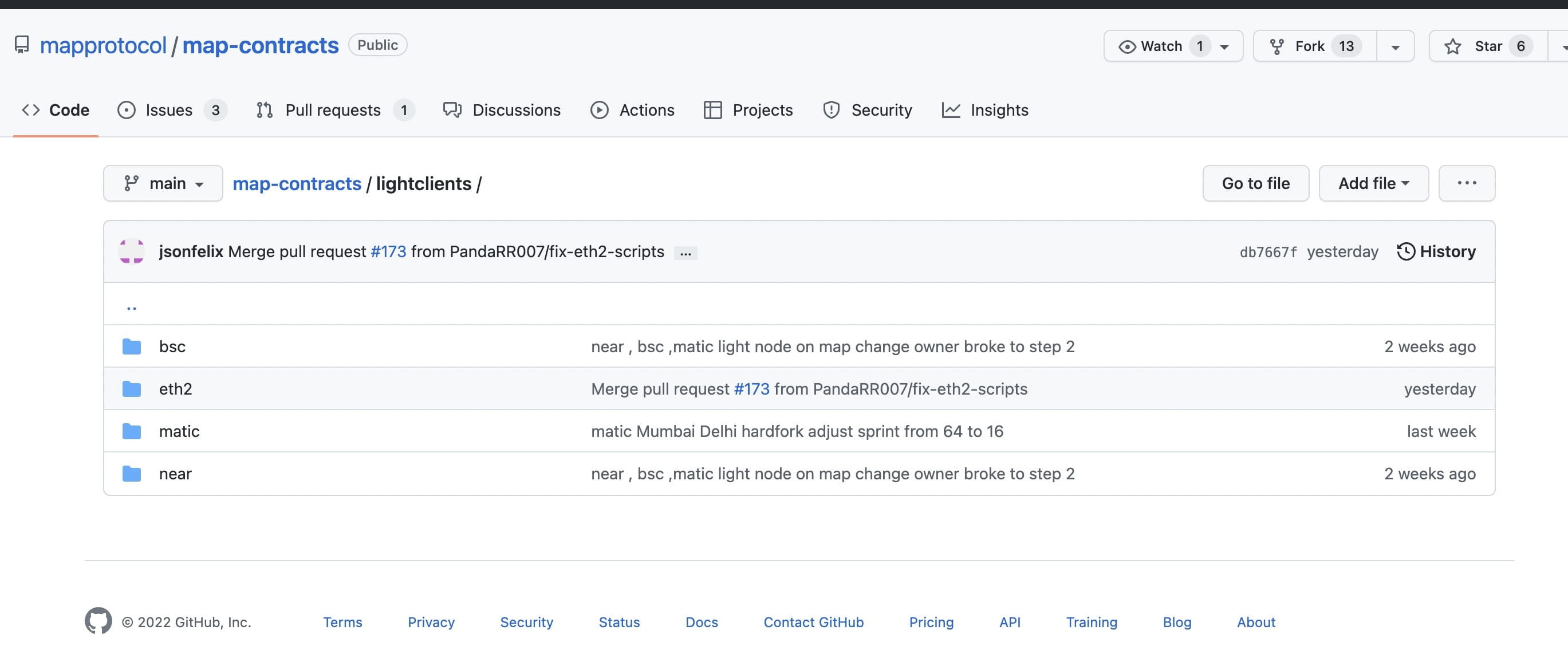 MAP Protocol's light client cross-chain code open source example
What if the inter-chain ledgers of heterogeneous chains (with different data formats) are aligned? That is to say, the signature format of chain A is in French format, while that of chain B is in Chinese format. In this case, a Relay Chain is needed as a relay chain. This Relay Chain needs to pre-implant the signature algorithm and hash algorithm of each chain, as well as meker tree proof, etc. at the smart contract development layer, so as to serve as a conversion hub for the ledger data format, thereby linking the originally different chains.
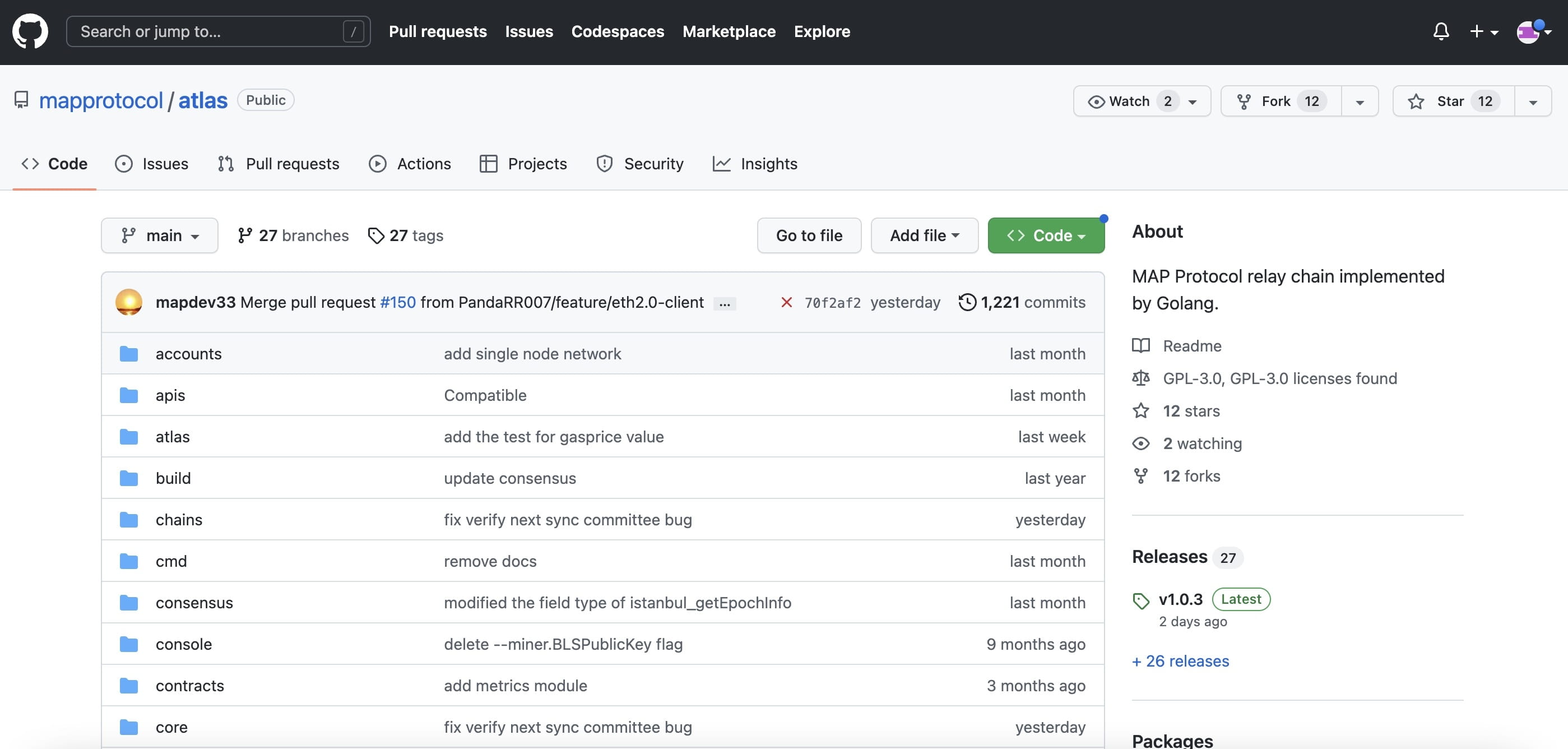 MAP Protocol's MAPO Relay Chain Code Example
4. Cross-chain and ZK zero-knowledge proof technology
As a black technology, ZK has been widely used in various roll-up solutions. Everyone used to think of using it on Layer2, but using ZK for cross-chain may be the first time to hear about it. However, according to the research of the MAP Protocol technical team, although the light client cross-chain verification is undeniable in terms of security, it consumes more gas fees compared to other cross-chain verification solutions. Therefore, the MAP Protocol team is further optimizing the data verification cost through the zero-knowledge proof (ZK) + light node (light client) cross-chain verification method, reducing the gas fee to be paid, so as to significantly reduce the cost of aligning the ledgers between chains.
IV. Summary
As mentioned above, blockchain projects that abandon the decentralized if precondition and blindly pursue usage are no different from the central bank-led currency in terms of issuance and accounting, and in terms of liquidity, the world no longer needs a centralized accounting currency. Therefore, in the current and future multi-chain landscape, embracing decentralized ledger alignment technology is an issue that the entire industry must face.
Author: James XYC