


Written by: Jam, CloudY
Editor: Vincero, YL
Reviewed by: Yasmine
 Background Layer2 is the recent market focus
The ZK series Rollups also wisely launched their own ZKEVM and test network to capture real users and funds through airdrops, which resulted in the number of Layer 2 public chains that Rollups users need to interact with every day. But this also means that this track is very crowded. In particular, Arbitrum has brought a lot of attention to itself with the help of airdrops. It has also issued ecological subsidies to its own ecological projects to encourage ecological development and motivate users. This makes Arbitrum The TVL and Tx are more than twice those of Optimism all year round. ZKSync has also achieved rapid growth in TVL and Tx through era and airdrop expectations.
In addition to being suppressed in terms of data, Optimism, the earliest coin issuer, also faces a large number of token unlocking every month. In order to turn the situation around, Optimism used the OP Stack strategy to fight back. The market did not react much when OP Stack was first launched, until Coinbase announced that it would use OP Stack to develop its own Layer2BASE, and A16Z would also use OP Stack to issue its own Layer2 Magi. After that, issuing Layer2 seemed to have become a consensus, and projects in various fields announced that they would join the Layer2 War. The price of OP tokens also rose all the way until the BASE chain was launched.
Other established Layer2s could not hold back and chose to launch their own Stacks to compete with Optimism, such as Arbitrum Orbit, Polygon 2.0, ZKSync's Hyperchain and Starware's Starknet.
Layer2 achieves a phased victory
The market has different views on whether the future Blockchain will be multi-chain or Layer 2. At present, Layer 2 and multi-chain (especially functional chains) have indeed made new progress.
At the beginning of 2022, we were still discussing whether the future of Blockchian would be multi-chain or ETH+Layer2. Now Cosmos has been relegated to the second line, and its attention has been taken away by Layer2 such as Optimism/Arbitrum/Polygon/ZKSync. Funds and developers have also voted with their feet and invested in and settled in Layer2.
After switching to POS and undergoing the Shanghai upgrade, ETH carries the most on-chain assets and is leading the way in expansion and deflation. Instead of developing a new public chain without innovation and building a new ecosystem to capture ETH traffic, it is better to directly ensure security based on the computing power and status provided by Ethereum, use ETH as the GAS Token, and attract developers and liquidity through EVM and incentives to migrate value, which will help form a flywheel effect. From the data, Layer2 now has an advantage in TVL/number of projects/number of independent users, and many project parties have announced the issuance of Layer2 and are waiting to enter the market. I believe that the multi-chain era of Layer2 has arrived.
However, although after the Terra incident, Cosmos ecosystems such as Terra chain/Juno chain are almost out of the market, Injective/Canto/Berachain/Sei/DYDX v4 and other Cosmos ecosystems are about to or have already launched their mainnets. They are trying to solve the current Blockchain problems in a more radical way and build their own ecosystems. Cosmos also has Evmos, which uses evm to catch the express train of ETH and suck blood from the ETH ecosystem to obtain ETH liquidity. And Cosmos itself has also released Cosmos 2.0, hoping to empower ATOM and enhance its importance in the ecosystem through inter-chain security and block auctions. However, judging from the current secondary trend and TVL, the Cosmos ecosystem has not successfully turned around from the decline after Terra, which is also limited by the state of the Cosmos ecosystem fighting on its own.
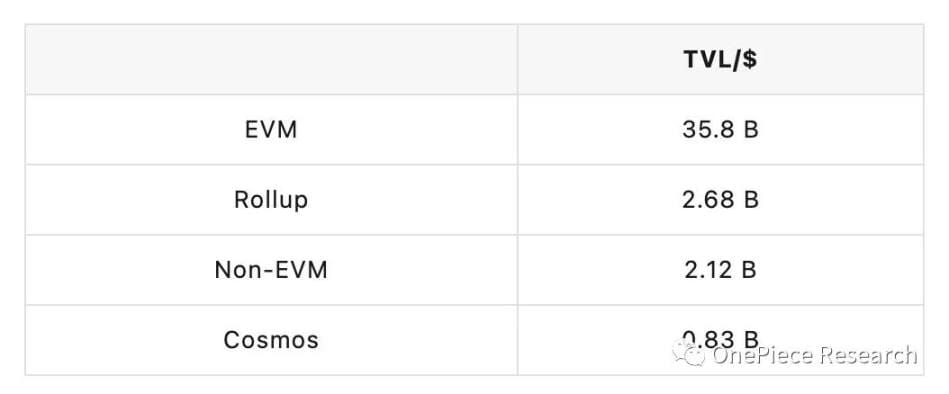
Source:L2BEAT – The state of the layer two ecosystem、defillama.com,截至 20230821
OP Stack Replica Cosmos Playstyle
The multi-chain era of Layer2 is very similar to the multi-chain narrative told by Cosmos and Polkadot in the past, except that it is not the Cosmos hub or the relay chain that connects the multiple chains, but Ethereum. But in fact, Ethereum only provides security as a DA layer and does not really connect Layer2s, so this gives Stack an opportunity. Layer2, as an intermediate Rollup layer, can not only provide public chain customized development services to make money, but also serve as a hub to capture other Layer2 values or charge Layer3 as a DA layer.
In fact, Layer2 itself is a step towards the modularization of Ethereum. By modularizing Layer2, we can simply and efficiently build a Layer2, and then connect each Layer2 through a central hub to achieve atomic cross-chain. On this basis, the central hub can also serve as the DA layer, and then build the Layer3 application chain on it, thus unleashing the innovation of the public chain.
Like Cosmos, it makes its core features into common components and provides them to other chains for use, thereby building its own ecosystem. This competitive advantage is unmatched by a single public chain. Optimism has chosen a low-threshold development similar to Cosmos, with features such as permissionless chain issuance, high compatibility, and cross-chain interoperability to build its own ecosystem.
The Beginning of the Multi-Chain Narrative: Cosmos
The design of Cosmos encourages collaboration among various blockchain networks and enables interoperability of the ecosystem by sharing value and data. It is one of the first players to explore multi-chain interoperability.
Cosmos is a highly modular and interoperable blockchain ecosystem consisting of three core components: Tendermint consensus mechanism, Cosmos SDK, and IBC (Inter-Blockchain Communication) cross-chain communication protocol.
1. Tendermint consensus mechanism
Tendermint is the network consensus engine of Cosmos Hub, which consists of Tendermint Core and ABCI. It adopts PBFT+Bonded PoS hybrid consensus to ensure that more than 2/3 of the validators reach consensus. Tendermint separates the blockchain application from the underlying consensus, controls the application logic with the state machine, and provides the ABCI interface to interact with the application layer. This architecture supports consensus and access to other chains.
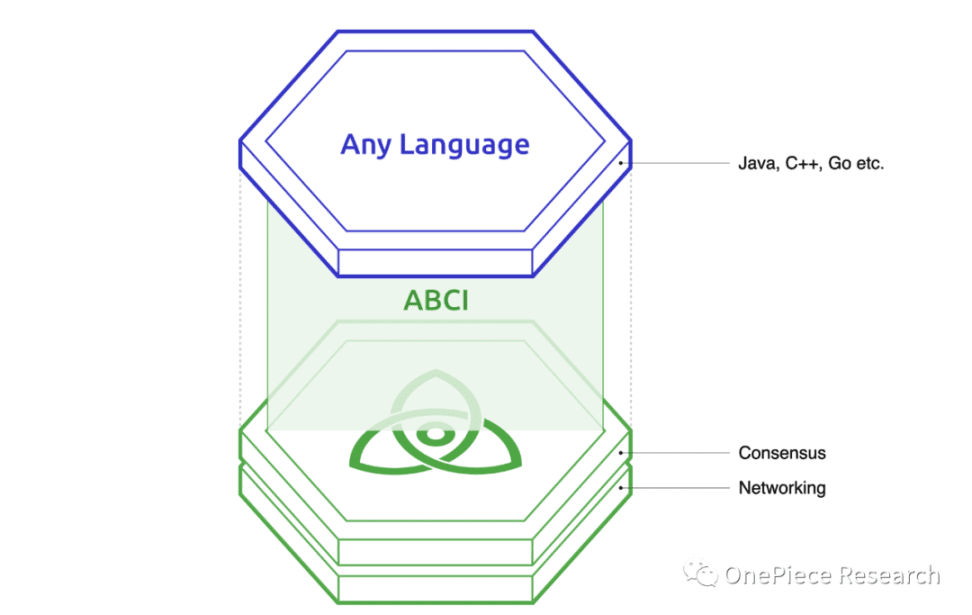
Source: Tendermint architecture: Image from official
2.Cosmos SDK
Cosmos SDK is a developer toolkit that allows modular state machines to be built on top of Tendermint. Developers can use SDK to build new blockchains, or connect to Cosmos through the Peg Zone bridge. SDK provides the concept of multiple storage, dividing the application state into different isolated zones, and each module manages its own state. The SDK's modules mainly include Bank, Auth, and Staking&Slashing, etc., which are used to build complex state machines.
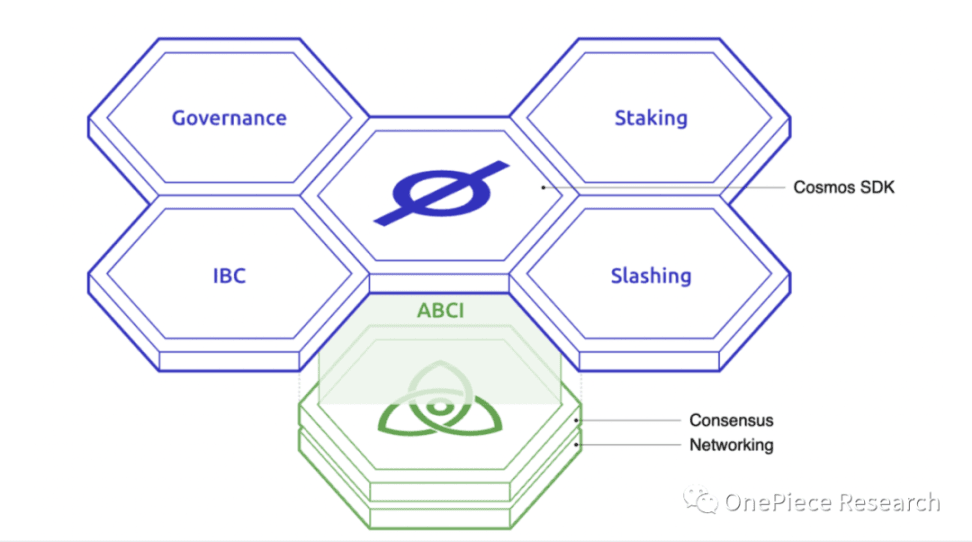
Source: Cosmos SDK Schematic: Image from official
3.IBC cross-chain communication protocol
IBC is a protocol for communication between different blockchains in Cosmos, and is used for cross-chain interaction between Zones. By establishing an IBC connection on the Hub, a Zone can communicate with other Zones connected to the Hub. Through IBC, Zones can send tokens and data packets to achieve cross-chain asset and information transmission. PG Zone acts as a bridge to connect external blockchains (e.g. Bitcoin) that cannot be directly accessed through IBC, making them interoperable with blockchains in Cosmos.
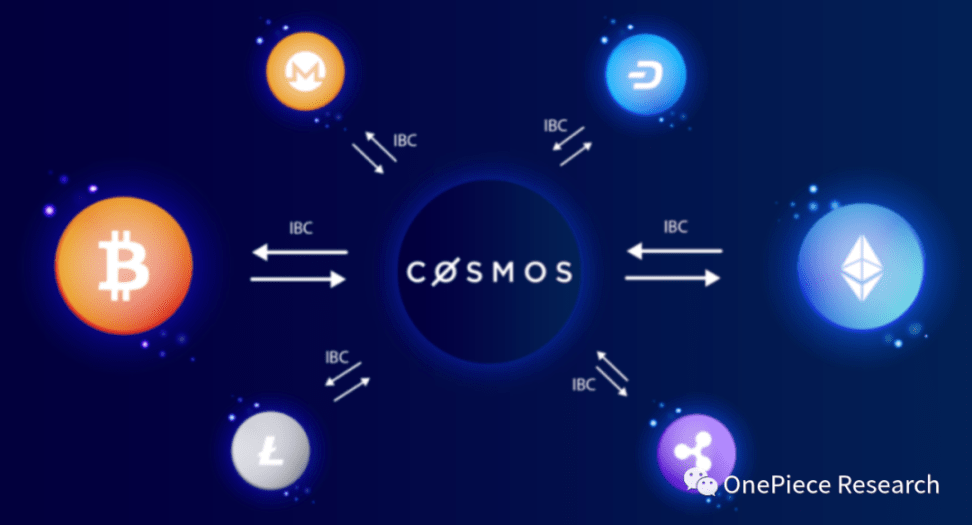
Source: IBC Communication Diagram: Image from official
The combination of these components enables developers to build secure and flexible applications and achieve cross-chain interoperability and asset transfer between blockchains.
Cosmos’ Hub and Zone architecture and cross-chain interoperability
Cosmos adopts the architecture of the Hub and Zone model, where the Hub is the central hub of the network, and the Zone is a public chain that is independently connected to the network. The Hub will track and record the status of each Zone, and each Zone needs to feed back the new blocks it generates to the Hub and synchronize the status of the Hub. Different Zones do not synchronize their status directly, but communicate indirectly through data packets sent to the Hub.
Technically, Cosmos' Hub and Zone model achieves interoperability between different blockchains. Zones communicate through the Hub, which synchronizes the global state in real time. By separating blockchain applications from the underlying consensus and providing an ABCI interface to interact with the application layer, developers can write application logic in any language. This architecture can achieve consensus and facilitate the access of other blockchains.
Cosmos' core token $ATOM is mainly used to pay transaction fees and governance voting in the Hub ecosystem. Its token demand is directly related to the development of the Cosmos ecosystem. Cosmos aims to build a general blockchain development framework and solve cross-chain problems to realize the vision of a multi-chain universe.
In terms of cross-chain mechanism, the Hub of Cosmos acts as a relay chain, and the Zone is a parallel chain, each with its own validator. As the core of the network, the Cosmos Hub allows different blockchains to interconnect through the IBC protocol. Zones need to communicate with other Zones through the Hub, and the management between different Zones is decentralized. Therefore, if a Zone is attacked or commits malicious acts, other Zones will not be affected.
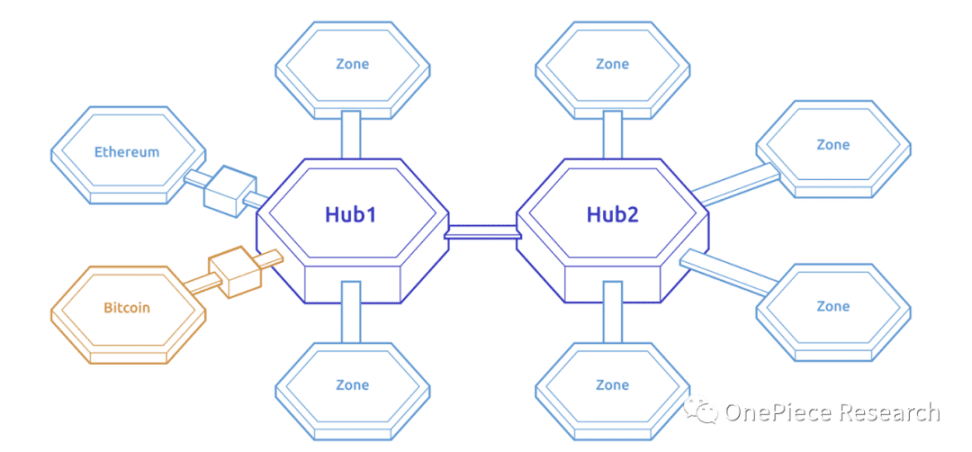
Source: Cosmos architecture diagram: Image from official
Overall, Cosmos has played a pioneering role in the field of multi-chain interoperability. It has achieved seamless communication and cross-chain asset transfer between different blockchains through the Hub and Zone architecture and the introduction of the IBC protocol. In addition, Cosmos' modular architecture provides flexibility for developers. Using the Cosmos SDK, developers can build customized blockchain applications with various functional modules. At the same time, the Tendermint consensus mechanism plays a key role in Cosmos. It adopts PBFT+Bonded PoS hybrid consensus to ensure high security and scalability. By separating consensus from applications, Tendermint achieves a higher degree of modularity and scalability, while providing an ABCI interface for interaction with application logic.
New multi-chain narrative: Superchain
“The core goal of Cosmos is to achieve interoperability between different blockchains, and the current focus of the Layer2 War seems to be moving closer to this goal.”
The common goal of Layer2 solutions is to improve the throughput and scalability of the Ethereum network to meet the growing transaction needs. However, the focus of competition between these Layer2s has gradually shifted from pure performance improvement to broader interoperability and even ecology.
Interoperability: As more and more blockchain projects and Layer 2 solutions emerge, users and developers hope to be able to seamlessly transfer assets and data between different blockchains. The realization of interoperability will provide users with greater flexibility, allowing them to move freely between different blockchain networks.
Interoperability: Competition among Layer 2 solutions drives developers to create more universal technical standards to achieve interoperability between different Layer 2s. This interoperability will promote collaboration and data exchange between different Layer 2 networks, thereby creating a richer ecosystem.
Synergy: Similar to the Hub-and-Zone architecture of Cosmos, interoperability between Layer2 solutions can create synergy. Interoperability between different Layer2 solutions will enhance the value of the entire ecosystem and attract more users and developers to participate.
Reduce friction costs: Achieving interoperability between different blockchains and Layer2 will reduce friction costs for users. Users no longer need to make cumbersome exchanges and transfers between different networks, thereby improving user experience and participation.
The following is a comparison of Layer2s solutions and paths:
Source:Stacy Wall、l2beat、OP Research|20230827
Optimism
“OP Stack is like adding more seats to a large family gathering so that everyone can attend without having to find a new seat.”
Optimism Rollup 和 OP Stack
Optimism Rollup (ORU) is a Layer 2 (L2) scaling solution based on Ethereum mainchain (L1). Its design concept is to use the consensus mechanism of L1 to ensure the security and scalability of L2, avoiding the introduction of additional independent consensus mechanisms. As part of the parent-child chain model, ORU positions the parent chain as L1, in which Ethereum plays the role of the parent chain.
There are three main steps in the operation mechanism of ORU.
First is data storage (Blockstorage), where transactions on L2 are collated and written into blocks, and then these blocks are written to L1 in a compressed format. This approach maintains data availability and ensures that transaction data can be retrieved at any time when needed.
Secondly, the Blockproduction phase involves the operation of the sequencer, which is responsible for building and executing L2 blocks. This process includes the confirmation of transactions, the construction of new blocks, and the passing of relevant information to L1 for transaction submission.
Finally, the Blockexecution phase ensures the reception of new blocks and maintains the stable operation of the L2 network.
On the other hand, OP Stack is a standardized development stack that supports Optimism technology. From a concrete perspective, looking from bottom to top, the first is the Data Availability Layer (DALayer), which defines the source of raw data for L2. Currently, the Ethereum main chain plays a major role in this layer. The second is the Sequencing Layer, the function of which is undertaken by the sequencer, which is responsible for transaction confirmation, status update, and L2 block construction. Then there is the Derivation Layer: The Derivation Layer defines how to process the raw data in the Data Availability Layer to form processed inputs, which are sent to the Execution Layer through the standard Ethereum engine API. The Execution Layer defines the state structure of the L2 system, supports the Ethereum Virtual Machine (EVM) or other virtual machines, and adds some L1 data fees to transactions. The Settlement Layer is responsible for sending transaction data confirmed by L2 to the target blockchain for final settlement. Finally, there is the Governance Layer. The current solution [1] is that multiple chains based on OP Stack share the same set of governance standards.
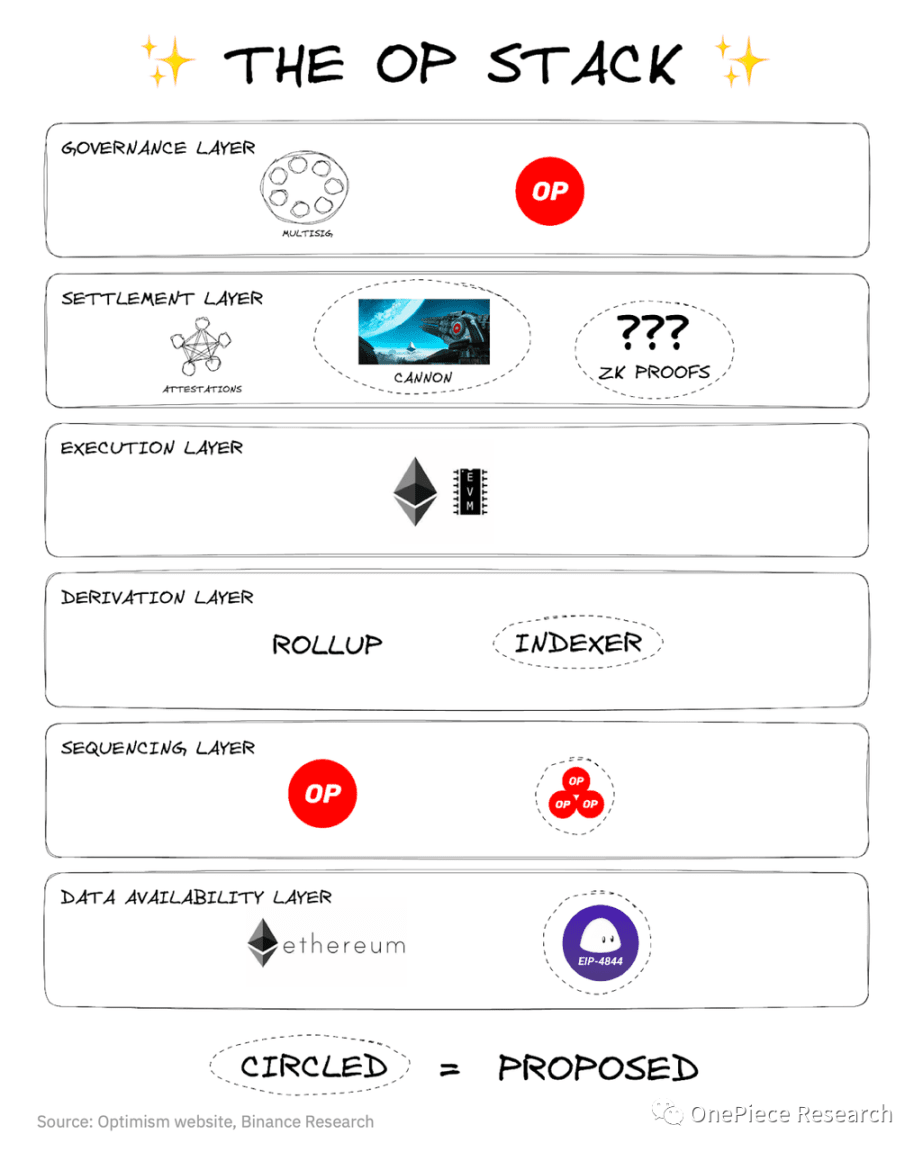
Source: OP Stack Structure | Source: Binance Research
* 注【1】:optimism.mirror.xyz
Superchain
Superchain enables different Layer 2 (L2) to work together by sharing security, communication layers, and development kits (OP Stack). In traditional L1 designs, scalability and performance are often limiting factors, and Superchain provides stronger scalability and performance by integrating multiple L2 networks together. This horizontal expansion not only gives the system higher capacity, but also provides a better experience for developers and users.
Superchain based on OP Stack will become a connection point for different L2 solutions, providing support for large-scale operation of various blockchains and decentralized applications (dApps). As a standardized development stack supporting Optimism technology, OP Stack integrates different L2 networks and promotes interoperability between these networks. By integrating multiple L2s into the superchain, more efficient and flexible cross-chain communication can be achieved, allowing users to seamlessly transfer assets and information between different L2s, thus realizing more possibilities.
One of the key attributes of Superchain is modularity. By using OP Stack as a development foundation, each L2 network can select layer modules on demand and flexibly combine different technical components to meet specific needs. This modular design not only improves the customizability of the system, but also provides a convenient access path for new technologies and innovations. In addition, Superchain also emphasizes interoperability, enabling different L2 solutions to achieve more efficient resource sharing and information transmission. Superchain based on OP Stack can provide a lower-cost deployment option, allowing more developers and projects to participate. This helps promote the development and adoption of a wider range of L2 networks.
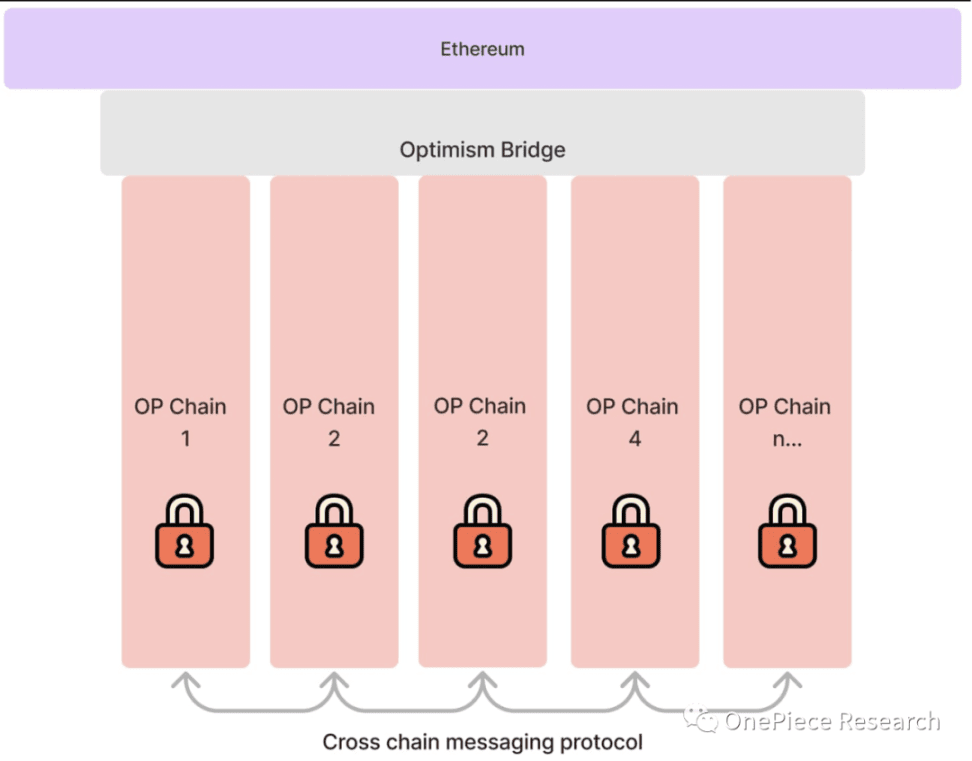
Source: Superchain Architecture: From OP official
In fact, using OP Stack to issue more Layer2 is only the first step in establishing Superchain. The formed OP Stack requires Layer2 to be able to share the economy and information of the sorter exchange, and establish a unified security governance mechanism and inter-chain ecology. Taking BASE as an example, the cooperation between Optimism and BASE has two main components. The first is protocol management. BASE complies with the Law of Chains and joins the op-geth and op-node client operations. At the same time, it adopts the op-reth fault proof client designed by paradiagm and establishes the Pessimism pessimistic monitoring system; the second is economy and governance. BASE will use 2.5% of its sorter income or 15% of the public chain profit after deducting L1 Gas (the higher one) as the cost of using OP Stack, and Optimisim will also provide BASE with up to 2.75% of the total OP supply as a reward for participating in governance. BASE and Optimism will jointly establish a Security Council to manage the multi-signature of the control contract upgrade and formulate a challenger key management plan to prevent team members from unilaterally doing evil.
In simple terms, any blockchain network built on OP Stack can flexibly combine different layers of OP Stack modules according to needs to build L2s. Optimism (now called: OP Mainnet) is its first L2, jointly building the ecological chain of Super Chain. This makes the entire ecosystem more flexible and able to meet a variety of different needs and innovations.
Decision
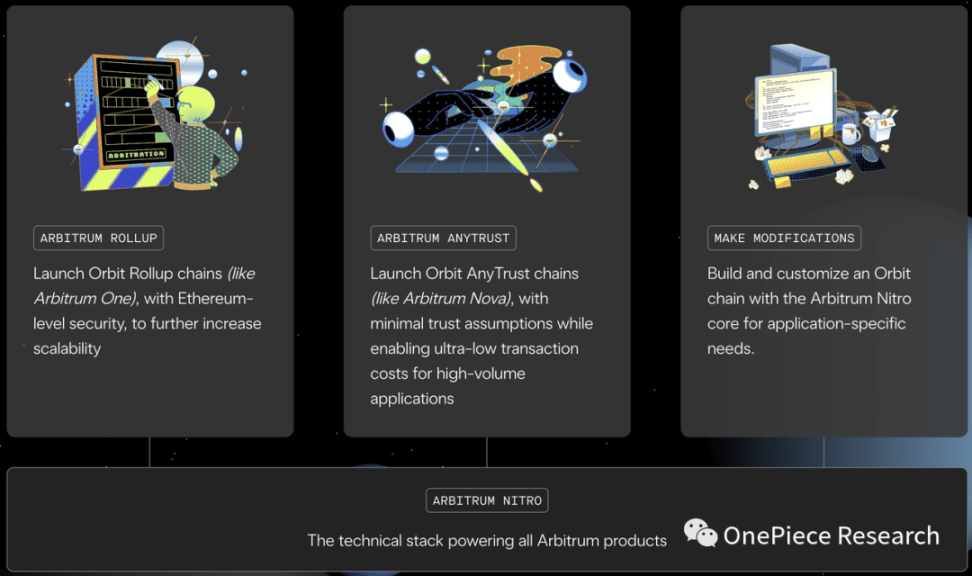
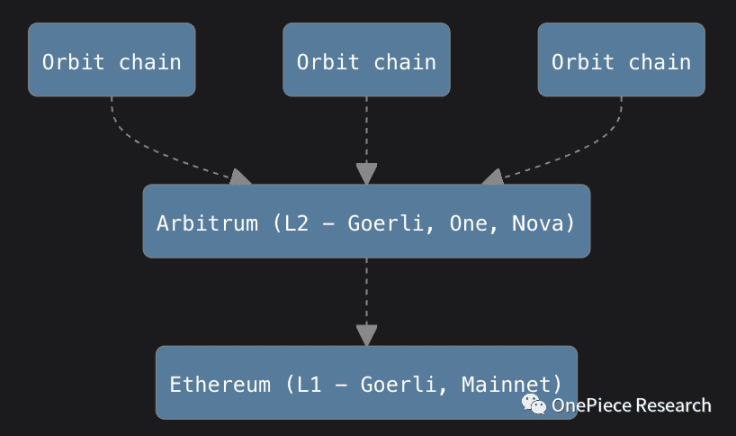
Unlike Optimism's Superchain strategy (building L2s based on OP Stack), Arbitrum's Orbitchain strategy allows the creation and deployment of Layer3, also known as application chain, on the Arbitrum mainnet (including: Arbitrum One, Nova and Goerli) based on Arbitrum Nitro (a technology stack similar to OP Stack).
Source: Orbitchain Architecture: ARB official website
Unlike Optimism's Superchain, Arbitrum takes a more flexible and customizable approach. Orbit is a development framework that allows any developer to build L3 (application chain) based on ARB, and its final architecture is Orbit chain. Orbit chain is designed to be compatible with the upcoming Arbitrum Stylus upgrade. This compatibility facilitates developers to build decentralized applications (dApps) using programming languages such as C, C++, and Rust. By leveraging these programming languages, developers can build feature-rich dApps more freely without having to migrate to a new technology stack. This creates greater flexibility and selectivity for dApp developers, enabling them to better meet the needs of different projects.
Source: Orbitchain Architecture: From ARB official documentation
However, Arbitrum Orbit is still in the testnet stage and has not yet reached the module completeness of OP Stack.
ZKSync Era
"Sovereignty and seamless connectivity" is the core narrative of ZK Stack.
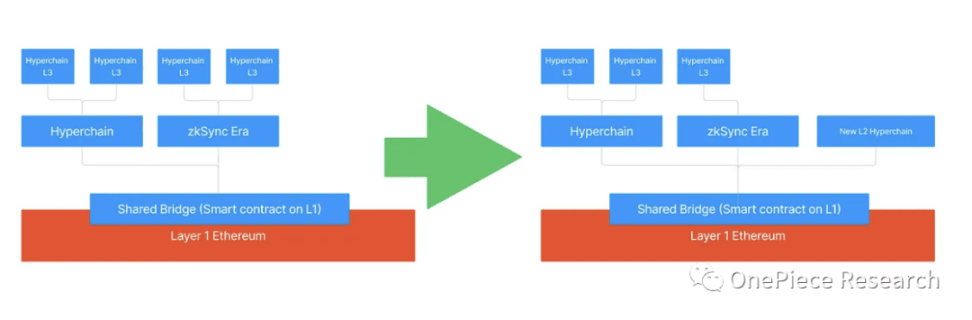
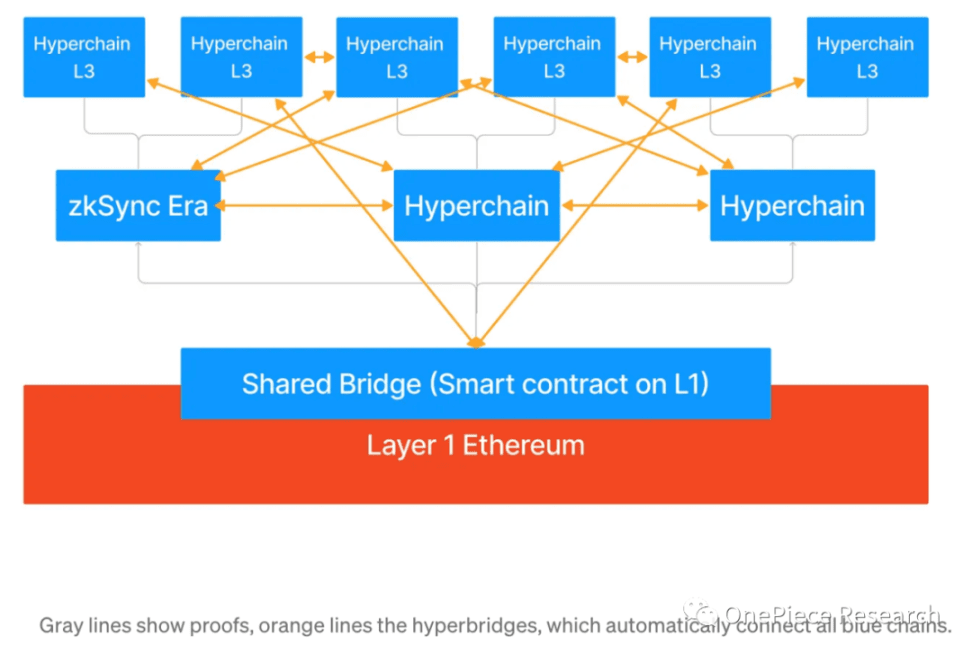
Developers have full autonomy to customize Hyperchain. Hyperchain operates independently and relies only on Ethereum Layer1 for security and activity. The Hyperbridge network connects Hyperchains to each other. ZK Stack was launched on June 23, 2023, and aims to build customized ZK-supported L2 and L3 based on the code of ZKSync Era. This is a framework for building modular, sovereign, ZK Hyperchains. Therefore, its technical architecture is no different from OP Stack.
ZK Stack is a framework for building modular, sovereign, zero-knowledge-based Hyperchains. It focuses on solving the challenges raised in "ZK Credo" and aims to provide a foundation for decentralized blockchain networks. The core features of ZK Stack include free open source, composability, modular customization, proven security, and future scalability.
The framework was developed by Matter Labs and uses the MIT/Apache open source license. Hyperchains built with ZK Stack can connect seamlessly in a trustless network with low latency and shared liquidity. Developers can customize Hyperchains to suit their needs while ensuring security and reliability. Based on the code of ZKSync Era, ZK Stack enables interconnection between hyperchains with the help of Hyperbridge, achieving fast and low-cost interoperability. Developers can customize hyperchains as needed and interconnect them through Hyperbridge, achieving trustless, fast and low-cost interoperability.
ZK Stack is suitable for scenarios that require customized Hyperchains or asynchronous connections in a wider ecosystem because the L1-L2 bridge is asynchronous. From an architectural point of view, ZKSync Era has 2 application scenarios:
1) As one of the Hyperchains of L2s, it is interconnected with L2s of the same level to share liquidity and other ecological resources.
2) Serves as the DA Layer for L3s.
Hyperchain solves the trust problem by verifying off-chain computations and using zero-knowledge proofs to ensure security. Hyperbridge connects hyperchains to achieve data transfer and interoperability. Hyperchain, through Hyperbridge bridging, has features such as verification bridging, local bridging, and data availability, thereby building a unified liquidity network. From a user's perspective, Hyperchain achieves seamless interoperability and cross-chain wallet management to ensure user experience. Technically, Hyperchains based on verification bridging, shared validators, and data availability form the basis of Hyperbridges.
Source:matter-labs
In general, the scalability and composability of Hyperchain are the core of its design. Hyperchain's L3 can be interconnected with L3 of the same level, and can also directly use Ethereum as a DAlayer. In this case, the L3 is essentially an L2. The second Hyperchain L3 on the upper left in the figure below is the most direct case proof.
However, as a public chain of ZK Rollup, Layer2s not only needs to solve the gap with the Solidity programming language, but also needs to have a certain ability to independently develop the ZK circuit system, otherwise it can only share ZKPorter to run. However, ZKSync currently does not have a complete component sharing mechanism, which shows that Hyperchain restricts a large number of developers from entering in terms of programming language and technology. In addition, although ZK Rollup can technically achieve a transaction volume of millions of PTS while being decentralized, the cost of ZK Proof is also higher, coupled with the centralization of the sorter, and the higher Gas fee of complex smart contracts is also prone to failure due to poor compatibility, which makes it difficult for ZKSync to develop rapidly in a short period of time, so it will not issue coins to promote development.
In response to this, ZK Sync has made some optimizations in its Hyperchain architecture - the system's LLVM compiler supports Solidity and any other modern programming language, increasing accessibility for developers who specialize in languages such as Rust, C++, and Swift. But overall, Hyperchain is the most difficult to develop.
Source:matter-labs
However, ZK Stack is still in the development stage and has not yet been launched on the test network.
StarkNet
"Fractal Scaling": StarkWare believes that multiple Layer3s will be built on Layer2, just as multiple Layer2s are built on Layer1. L2 is used for general expansion, while L3 is used for customized expansion.
Fractal expansion, that is, expansion is achieved through layer-by-layer recursion. The introduction of L3 provides higher scalability, better technology stack control and privacy protection for specific applications by recursively building on L2. L3 can achieve advantages such as ultra-large scale, better performance control, privacy protection, etc., while maintaining the security of L1. This will enable StarkEx (currently used as an L2 solution) to migrate to L3, and the Standalone instance of StarkNet will also be provided as L3.
At EthCC, the Ethereum community conference in Paris, StarkWare co-founder Eli Ben-Sasson announced the upcoming Starknet Appchain.
Appchains are application blockchains designed specifically to meet specific application needs. The Starknet application chain is designed to provide developers with a customized environment in which they can create customized Starknet instances for better regulatory control, lower costs, greater scale, and optional privacy. By building a Starknet application chain, developers are able to provide users with higher throughput and a better user experience. The Starknet Stack is built using modules such as STARK proofs, the Cairo programming language, and native account abstractions.
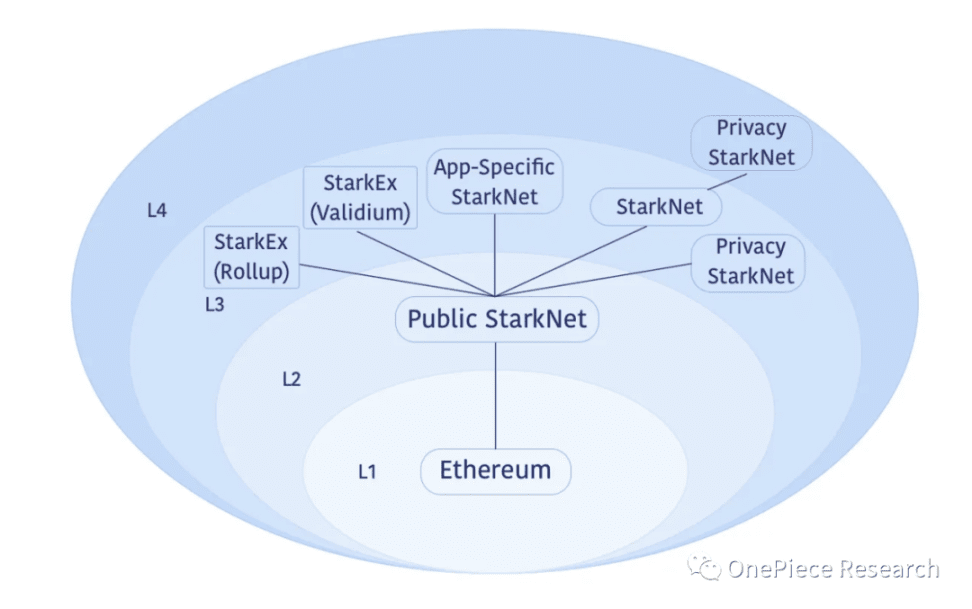
Source: Official documentation
Overall, Starknet Stack is still in the early stages of development, and the development of the on-chain ecosystem is still in its very early stages.
Polygon2.0
In the whole design idea, Polygon2.0 hopes that its own Polygon’s PoS Mainnet and ZKEVM will become the pillars of Polygon, and at the same time introduce Supernets application chains to strengthen Polygon’s ecology. The real profit is POL tokens, because Polygon2.0’s Supernets need to stake POL tokens to run nodes to ensure the security of the public chain. In order to achieve this goal, Polygon gives users three options: PoS node/ZKEVM node/Miden VM. In order to expand its appeal, Polygon also provides Polygon DID based on zero-knowledge proof and a Web3 game development guide called "Blueprint". It can be seen that Polygon2.0 chooses to strive for a richer ecology for itself from the perspective of incubation. In addition, the concept of enterprise blockchain is mentioned many times in the introduction of Polygon2.0's Supernets. From the cooperation between Polygon and Starbucks/Nike/Warner Music, it can be seen that its other moat is the low-threshold and highly customized application chain of the enterprise version.
Structurally, Polygon2.0 is similar to OP Stack. It also divides itself into several layers, namely:
Staking Layer
Interop Layer
Execution Layer
Proving Layer
Its layered form is:
Link
Network
Transport
Application Layer
These are borrowed from Internet protocol components, with each protocol layer responsible for a specific sub-process, or technology stack.
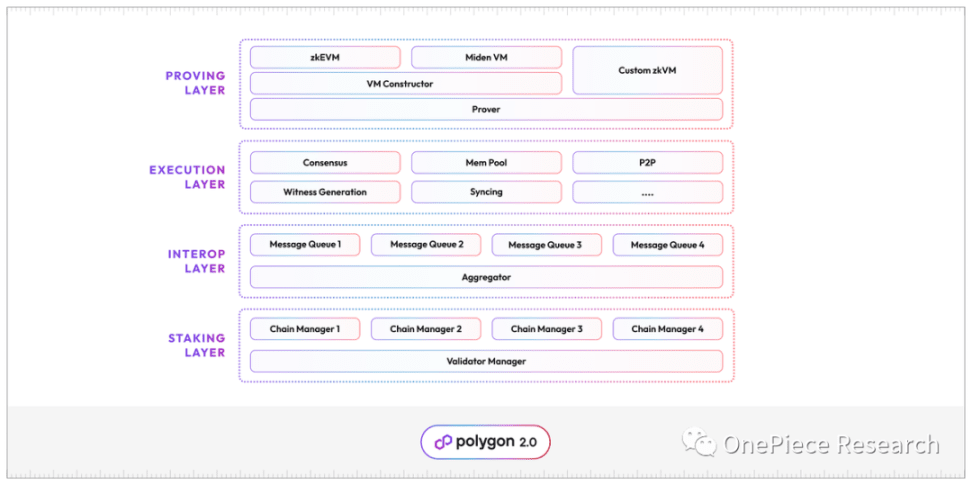 Staking Layer
This staking layer functions in much the same way as Ethereum’s PoS (Proof of Stake), but it is not just for the Polygon mainnet:
In addition to the original Polygon mainnet, Polygon also has ZKEVM, Supernets, etc. Therefore, Validators will provide services for many chains, using a model similar to restaking and managed by the Validator Manager.
The Chain Manager contract is used to manage the validators of each chain. Each chain has its own Chain Manager contract, which determines the number of validators and additional requirements for validators, such as regulations to be followed or tokens that must be additionally staked. This means that validators may need to additionally stake the chain’s own tokens to participate in its verification.
In fact, this staking layer is the focus of Polygon2.0. Unlike Optimism and Arbitrum, Supernets must be supported by Validators who have staked $POL in order to operate. The more Polygon chains there are, the more Validators are needed, and the higher the value of POL tokens. However, the Restaking model also helps the Supernets team focus on Utility and community rather than infrastructure, lowering the entry threshold of the public chain.
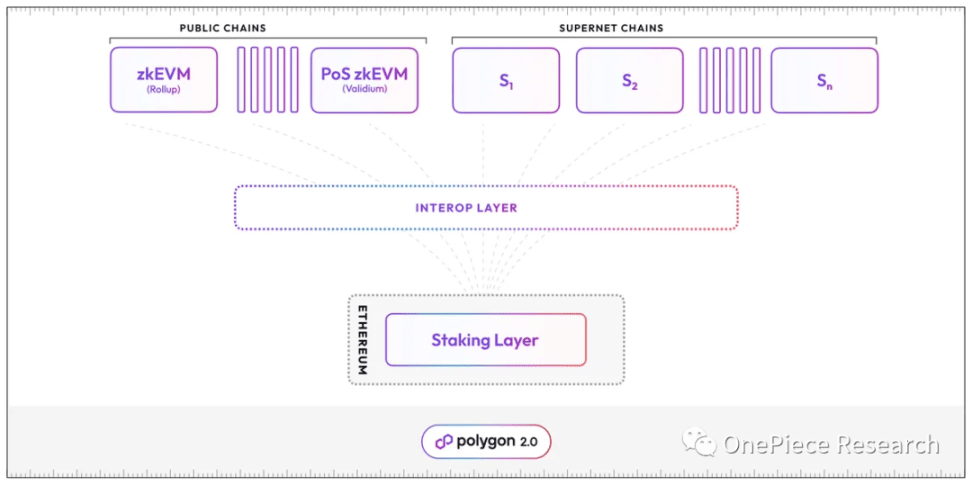 Interop Layer
Interop Layer uses ZK Proof to implement native cross-chain like Cosmos. By extending the LxLy protocol used by Polygon ZKEVM rolllup, Polygon introduced an Aggregator to achieve atomic cross-chain interoperability. First, it can receive ZK proofs and Message Queues. In addition, it can aggregate multiple ZK proofs into a single ZK proof and submit it to Ethereum for verification. So it is a middleware between Polygon and Ethereum.
Therefore, when the Message Queue and ZK proof sent by Chain A are received by the Aggregator, Chain B, as the target chain, can directly receive messages from Chain A, thus achieving seamless cross-chain interaction. Of course, Polygon also attempts to decentralize the Aggregator in the form of PoS Validator.
Execution Layer
The role of its execution layer in each chain is similar. Among them, it includes P2P/Consensus/Memepool/Database, as well as the Witness generator unique to ZK proof.
Proving Layer
The proof layer is a layer unique to ZK-Rollup, which is essentially a protocol that generates ZK proofs for all transactions on the Polygon chain.
It mainly consists of a universal prover and a state machine. The universal prover inherits Plonky2, which uses recursive SNARK technology, while the state machine includes ZKEVM and MidenVM provided by the Polygon team, or built by the public chain team itself, such as ZKWASM.
summary
From the perspective of open source technology
OP Stack is welcomed by many projects. There is a reason why more than a dozen projects including Base/Magi/opBNB/Worldcoin have announced the use of OP Stack.
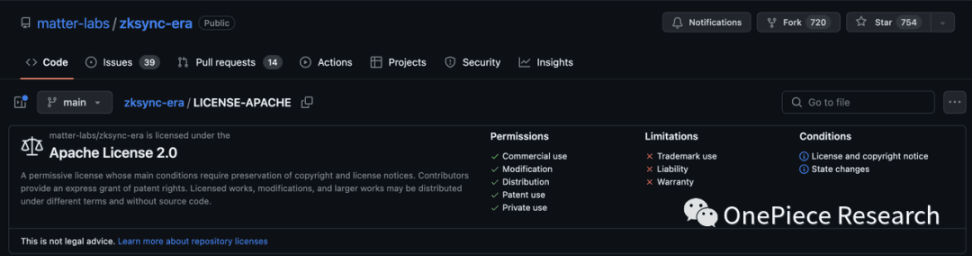
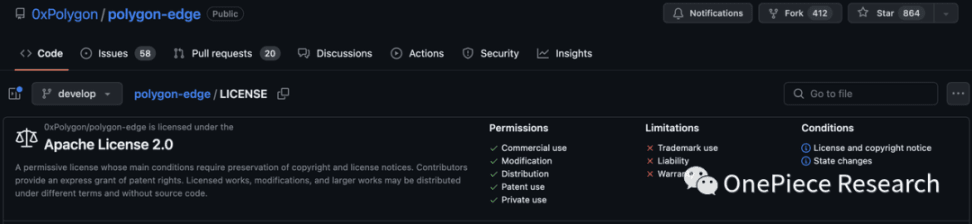
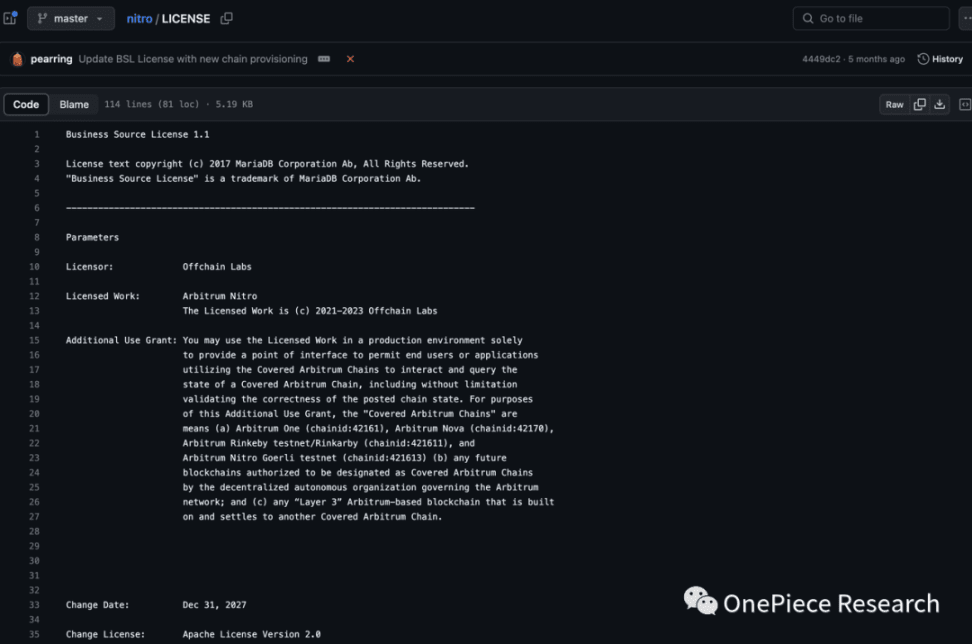
The first is the openness of the license. From the figure, we can see that Optimism uses the MIT License, while Arbitrum/ZKSync/Starknet/Polygon uses the Apache License 2.0. Although they are all open source, the degree of openness of the two licenses is different. The MIT License only requires the retention of the original license statement and copyright statement, allowing commercial use, distribution, modification, private use, additional agreements, and even the sale of MIT license code. Apache License 2.0 requires that the modified source code be explained in the modified file. In the derived project, the Apache-2.0 agreement in the original project code is required, as well as trademarks, patent statements and other instructions required to be included by the original author. In the derived project, if a Notice file is included, the Apache-2.0 agreement is also required in the Notice file.
Simply put, MIT License is the most relaxed, while Apache License is more stringent.
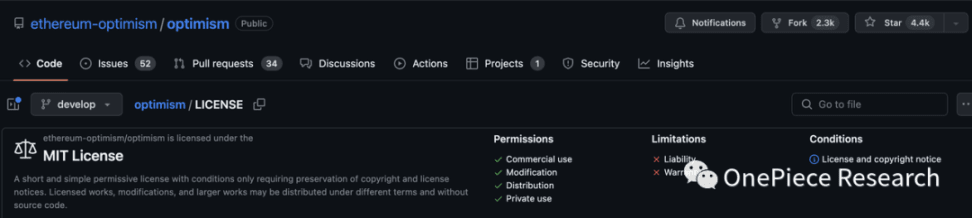

 Compatibility angle
1) Optimism is highly compatible with Ethereum EVM. The Optimism code has 12,745 commits and 2.3k forks, which means a large number of code updates and extremely high developer adoption rate.
2) In addition, from a technical perspective, the ZK system fully utilizes the security and consensus mechanism of Ethereum and directly relies on its security. Compared with the OP system, the ZK system can directly verify state changes without waiting for the underlying state to be updated, simplifying the design and improving cross-chain efficiency. However, the OP system is limited in asynchronous cross-chain calls and needs to wait for underlying verification and confirmation.
 Technical architecture perspective
1) Currently, Optimism and Polygon focus on expanding L2s, while Arbitrum, ZK Sync and Starknet focus on expanding L3s. Layer3 application chains have higher degrees of freedom/scalability and autonomy, but the market is still developing on Layer2, and Layer3 is still in the distant future. And the most important thing is that the cross-chain interoperability of Layer3 has not been fully realized technically. Currently, no company can advertise that it can achieve cross-chain interoperability of Layer3. In this case, dApps that focus on composability will inevitably choose Layer2 to build DeFi Lego.
2) Modularization and SDK components are the unified path of the current blockchain. Whether it is the public chain for dApp or the Stack for Layer2/Layer3, it is to reduce the cost of developers to build projects with the minimum programming threshold and maximum customizability, so that they can focus on product design and community operation. There are also projects like AltLayer that specialize in Rollup As A Service as their core business, so the code-free chain and project launch will surely become more common as the infrastructure improves.
Development progress perspective
Currently, only OP Stack and Polygon2.0 are developing rapidly, but OP has the fastest ecological development and has already landed on the public chain, while Arbirtum, ZKSync and Starknet are still in the very early stages of development. In particular, when the mainnet ecology of ZKSync and Starknet is not well built, it can be inferred that they may be more of a development strategy to cope with the competition of OP Superchain. However, in terms of the degree of decentralization, Starkware's ZK proof generator STARK Prove-Stone was open sourced under the Apache2.0 license on August 31, and OP Stack has not seen a schedule for a decentralized sorter with the help of Base, which shows that Starkware may be in a leading position in the decentralization process.
Comparison between multi-chain narrative and super-chain narrative
Layer2 cross-chain with IBC and Keplr wallet
A major narrative of Layer2 multi-chain is atomic cross-chain transactions. OP Stack achieves the same inter-chain communication effect as IBC through a shared sorter. Polygon2.0 uses a public validator set and shared security of heavy staking to become a "Polygon Hub".
However, Layer2 cross-chain is still in the narrative stage. The only cross-chain that can be used is EVM cross-chain (wormhole/layerzero/axelar) based on the cross-chain bridge mode. The gap between this and IBC is still very obvious.
SEI's cross-chain airdrop a while ago well demonstrated this gap: USDC that used Wormhole to cross chains from Ethereum/Arbitrum/Polygon/BSC had to wait 24 hours to cross out of the SEI chain because it exceeded Wormhole's cross-chain quota in SEI. However, ATOM and OSMO that crossed from Osmosis to SEI through IBC can cross back to the original chain the moment they cross in. Axelar USDC, which also belongs to the IBC ecosystem, has also been favored for this reason, but is limited by the Axelar cross-chain mechanism of the SEI official bridge. There is a waiting time of about half an hour to cross in and out of SEI, but if you use it to cross directly to the IBC public chain, it will also be instantly credited. 24 hours and instant credit, which is better or worse is clear at a glance.
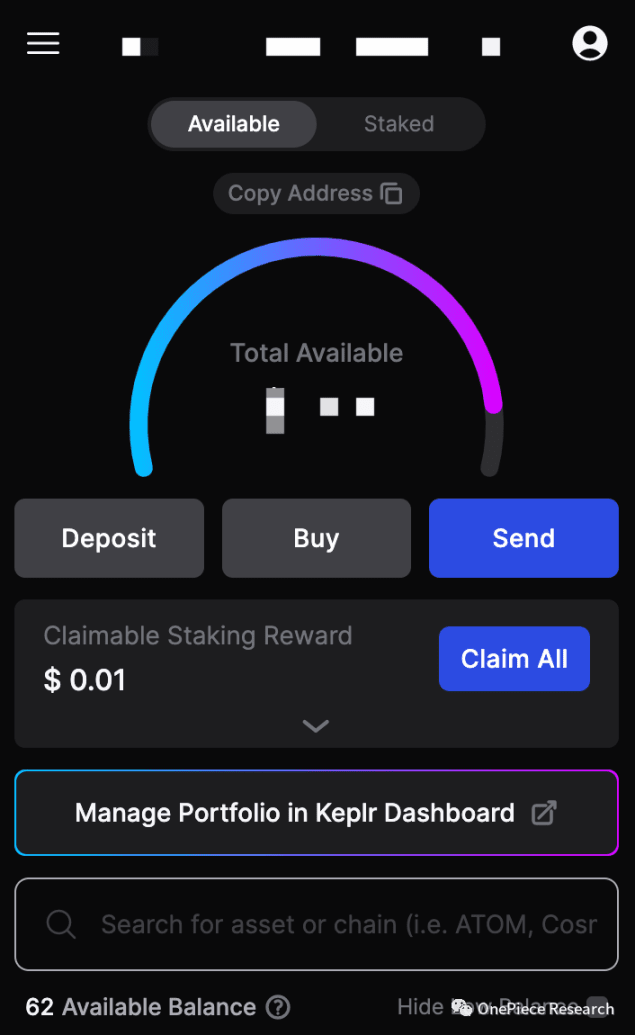
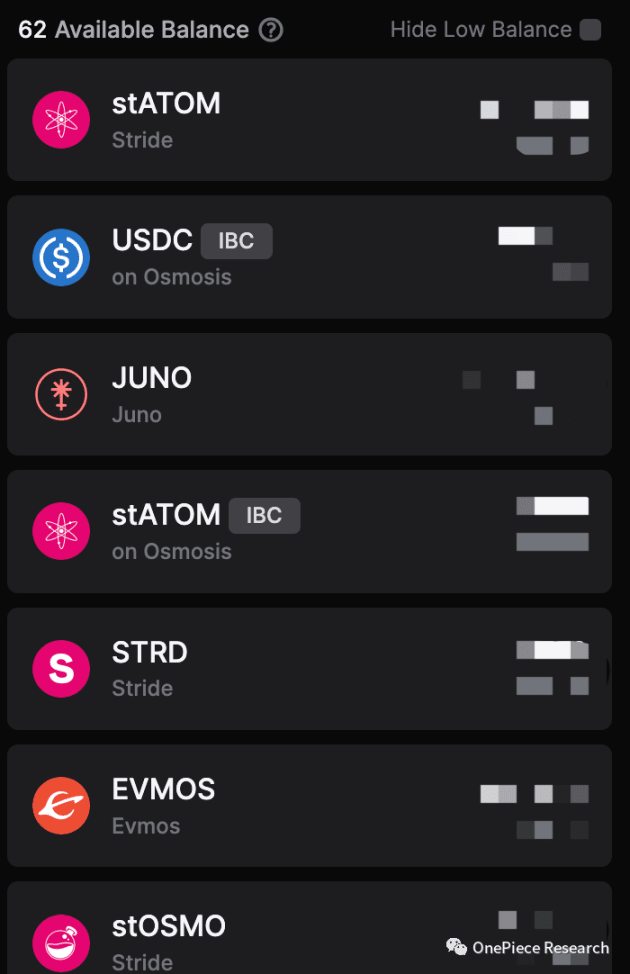
The experience of inter-chain switching of Layer 2 on MetaMask also has a significant gap compared with Keplr. With the increase of Layer 2 public chains, the demand for conversion between different chains has gradually increased. However, the assets and interactions of each chain are independent of each other on MetaMask. Third-party tools must be used for unified management, but this also increases Financial risk. However, the Keplr wallet can display the amount and status of funds in the entire ecosystem. Layer 2's Stack strategy may require a Super Wallet similar to Keplr to unify its own ecological assets.
 Shared Sequencer with ISC and Block Auctions
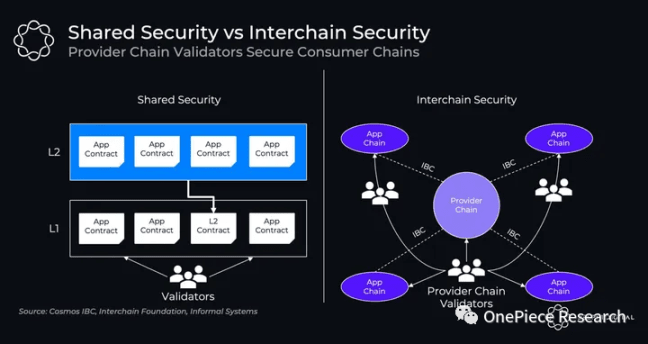
The sequencer is the key to Rollup's revenue and security. A shared sequencer allows the new Layer2 to skip the construction and maintenance of the sequencer, and can also obtain MEV income from all chains, thereby enhancing the value of the Superchain. However, sharing a sequencer also means sharing the underlying security. The current sequencers of Layer2 Stacks are too centralized. Only PoS sequencers and multi-organization multi-signature implementations can be considered a step towards Vitalik's Stage2. Therefore, shared sequencers and decentralized sequencers are the only way to expand revenue and ensure security in the future.
As one of the keys to Cosmos' self-rescue, ICS lowers the entry threshold for the Cosmos ecosystem public chain and provides more value capture for the Cosmos hub to empower ATOM tokens. In the past, each Cosmos ecosystem used PoS to ensure its own security, and ATOM was only used to ensure the security of the Cosmos hub, making staking ATOM for airdrops and taking PoS basic income the only two things ATOM can do. This is very similar to the current status of Layer2, except that OP Stack chose Layered Secuirity with Superchain, and Polygon2.0 chose Mesh Secuirity with Restaking. The block auction is to price MEV and resolve MEV from a business model perspective, that is, to quantify the value of the sorter. With the establishment of the shared sorter, the value of MEV has naturally doubled. Superchain's MEV income must not be simply pocketed by the sorter, so Stacks' block auction will definitely be launched soon after the shared sorter is launched.
Source:Delphi Digital
Conclusion: Becoming Cosmos is the final form of Layer2
Given the recognition of the Cosmos model by Layer2 Stacks, the unique mechanisms in the current Cosmos ecosystem will surely be optimized and adopted soon, such as learning from public chains such as Berachain/Injective/Sei/Canto, introducing public chain-level underlying liquidity/Terra-style native stablecoins/public chain-level native lending/Gas sharing mechanism/modular deployment contracts/block auctions, etc. to establish Layer2. Or, as mentioned above, develop a Stack ecosystem wallet similar to the Keplr wallet to integrate ecosystem assets.
But the most important and currently missing Cosmos mechanism is the complete inter-chain security. Different Layer2 Stacks can share sorters with each other, that is, the decentralization of the sorter layer, not just the decentralization of each sorter, to avoid the risk of a single sorter. At the same time, the PoS-based sorter can also use a similar re-staking method to enable multiple sorters to provide services for the same chain. That is, the Layered Security and Mesh Security of Cosmos ICS.
There will definitely be a Cosmos or OP superchain role emerging in the market.
The market is indeed looking for a role similar to Cosmos or OP superchain, which will act as a hub connecting different blockchain networks, achieving growth of the entire ecosystem by creating synergies and sharing ecological resources. If OP Stack's approach proves unfeasible, a new solution may emerge in the future to fill this gap.
Regardless of whether the final role is similar to ARB Orbit, OP Superchain or ZK Stacks, they will play an important role in the expansion of Layer2. As ZK technology matures and becomes more threshold-free, it is likely that ZK or OP Stacks that introduce ZK technology will take over the banner of Layer2 multi-chain. ZK technology comes with high TPS and decentralization, which are precisely the two most critical attributes of expansion in addition to compatibility, and are also technical guarantees under highly shared security. Although the development progress of ZKSync and Starknet is slow, the growth of their TVL and user volume is obvious to all, so we can look forward to whether OP Stack's first-mover advantage and compatibility will quickly occupy the Stack market, or whether ZK Stack's high TPS and decentralization will be able to catch up after the technology matures.