


Author: Sara Gherghelas, DappRadar
Compiled by: Felix, PANews
The third quarter of 2023 is seeing a slower pace, a trend often reflected in economic cycles, especially as many players take a seasonal break. However, even with the current calm, there are signs that the current market downturn may be entering its final stages. This report will highlight the key areas, the challenges they face, and the potential they hold.
Key Points
The number of daily unique active wallets (dUAW) interacting with DApps increased 15% from the second quarter of 2023 to 2.2 million.
The market dominance of games declined slightly from the previous quarter, while the influence of the NFT track performed well, accounting for 12% of the total industry activity.
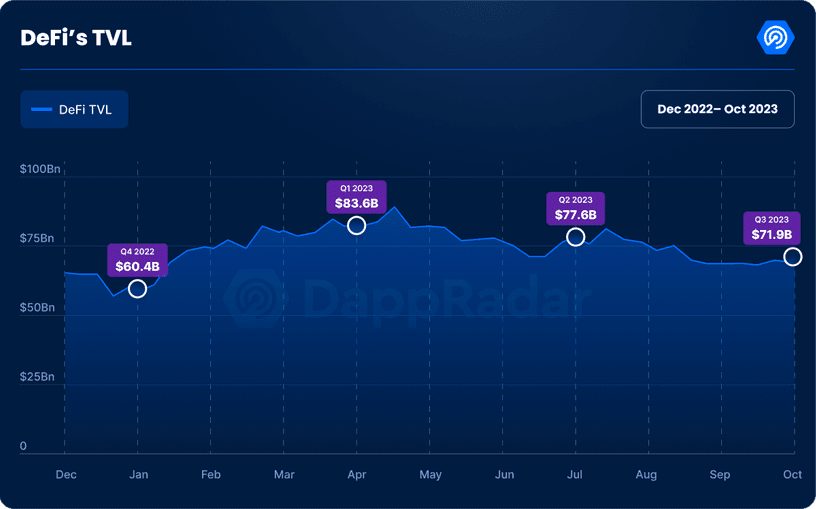
DeFi’s total locked value (TVL) fell 7% to $71.9 billion. Ethereum maintained its lead despite an 11% drop in TVL.
Base has become a major player in the DeFi space, quickly amassing a TVL of $378 million.
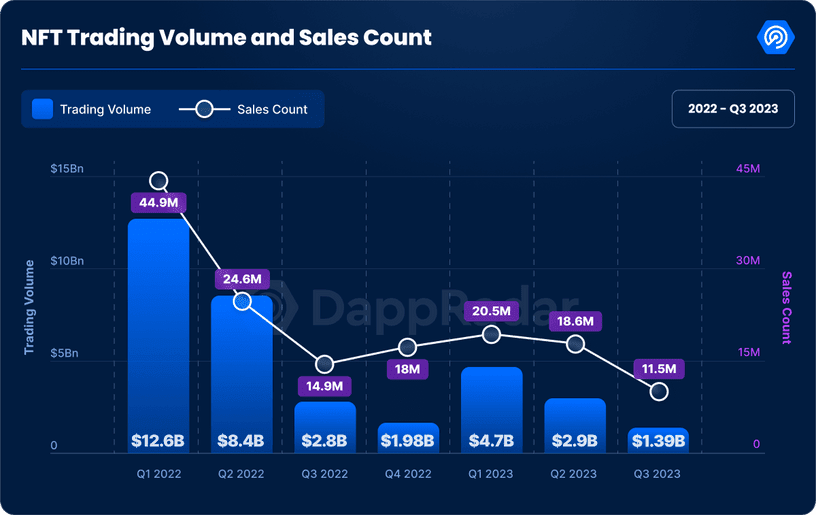
NFT market indicators such as trading volume and sales numbers hit record lows since the first quarter of 2022, suggesting a shift in the market and a change in interest.
The number of exploits and hacker attacks in the Dapp space has increased dramatically, up 204% from the second quarter, causing losses of up to $701 million. The Multichain vulnerability alone caused losses of $231 million.
1. Overview of Dapp Industry
In the third quarter of 2023, the Dapp space observed a significant increase in the number of daily unique active wallets (dUAW), which increased by 15% from the previous quarter. The final average number of participants reached 2.2 million. The main driving factors behind this are the increase in interaction with NFT dapps and the increase in the number of dapps listed and monitored by DappRadar.
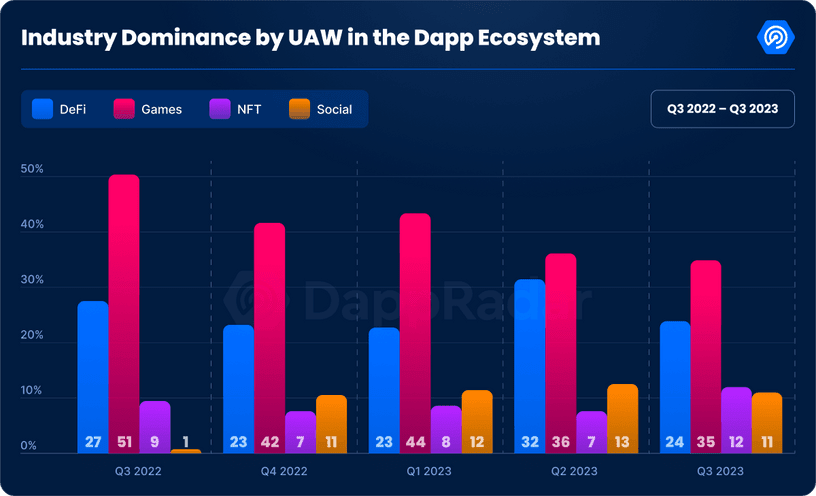
Blockchain games continue to account for the largest share of Dapp activities. However, since the beginning of the year, the dominance of blockchain games has slightly declined. On the other hand, the cyclical nature of DeFi in the Dapp field has strengthened.
An unexpected situation in Q3 is that 12% of the activities came from NFT. Considering the current decline in various data indicators and NFT popularity, this phenomenon is worthy of attention.
2. DeFi Total Locked Value Status
In the third quarter of 2023, the total locked value (TVL) of DeFi fell by 7% to $71.9 billion. A large part of the decline was due to the decline in token prices. Taking ETH as a reference, the price of ETH fell by 13% in Q3 and is currently stable at around $1,600.
When evaluating the TVL of major public chains, Ethereum’s dominance in the DeFi field stands out. Although it is down 11% from the second quarter, it can be found that the TVL of public chains is on an overall downward trend.
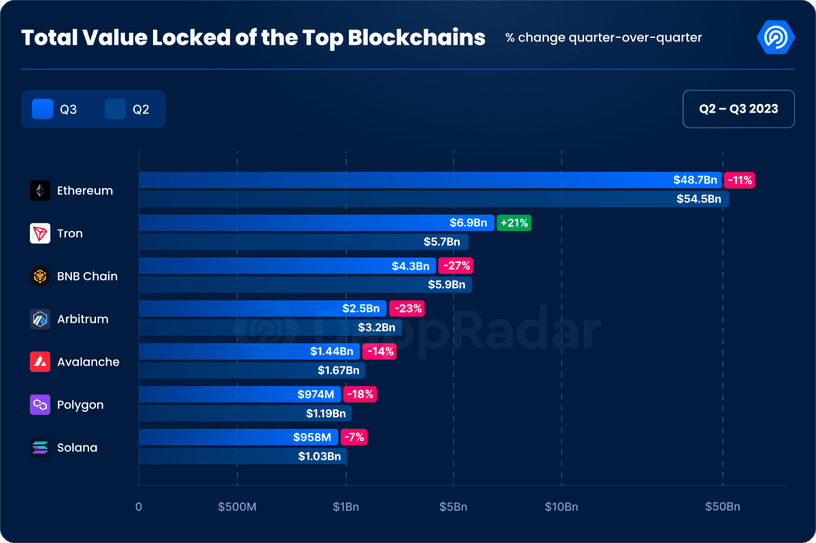
It is worth noting that the emergence of the Base network has quickly attracted market attention. Since Base went online, Base's TVL has soared to US$378 million.
3. NFT Market Overview
Q3 was a significant low point for the NFT market, with trading volume hitting its lowest point since Q1 2022. The widespread negative reports in various media outlets are indeed confirmed in the data. However, is it fair to judge the entire NFT market based solely on these data indicators?
Although the overall situation of NFT may be depressing, there is also a ray of hope in Q3, with traditional Web2 fields entering Web3 through NFT. It is worth noting that the sales of generated artworks have soared. One example is that the transaction volume of 99-year-old algorithmic artist Vera Molnár reached 992 ETH in just one week after her first foray into NFT.
So while the volume of transactions in the NFT space may not be as staggering as it once was, there has been a clear shift in its utility and perception. The era of super collectibles and avatars may be fading, but in its place is a growing demand for NFT utility among crypto enthusiasts. Consumers are being attracted to NFTs that offer real value, such as membership passes or other functional benefits.
4. Top 5 NFTs by Quarterly Trading Volume
Looking at the top 5 NFTs in Q3, Yuga Labs stands out and once again demonstrated its dominance in the NFT field. But what’s interesting is that despite the overall downward trend, three of the five series actually saw a surge in sales, likely due to a significant drop in floor prices, with most NFTs seeing floor prices drop by more than 40% . The price reduction provides a more affordable price for newcomers and provides the possibility to expand the user base.
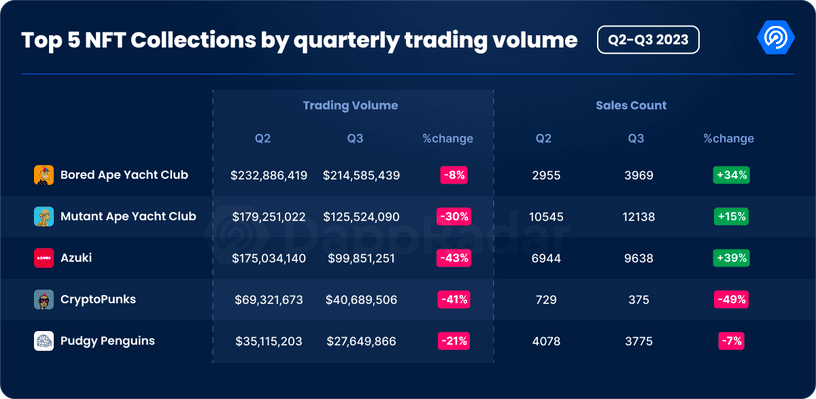
Azuki and Yuga Labs had strong performances in Q3, but the most outstanding series in Q3 was undoubtedly Pudgy Penguins. With the launch of Pudgy Toys and the Pudgy World in September, innovation in the NFT space was redefined. Pudgy Toys is the first mass-market NFT product licensed directly from the community. The intention behind these innovations is commendable - to demystify the complex world of blockchain and present it as a bridge or "Trojan horse" into the traditional toy market.
The icing on the cake is that these toys have entered the mainstream American market, finding a place on the shelves of major retail giants such as Amazon and Walmart.
These innovations not only enhance Pudgy Penguins’ market position, but also demonstrate the potential and adaptability of NFTs, reflecting the feasibility of gaining wider consumer recognition.
5. Top 5 NFTs by quarterly sales volume
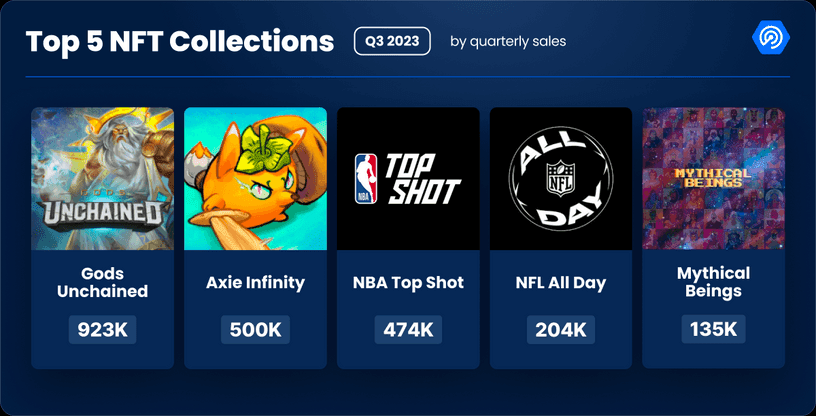
The top 5 NFTs all fall into the gaming space. This consistency reinforces the idea that NFT gaming has the most traction in the Q3 NFT space. Clearly, the synergy between gaming and NFTs continues to attract users, highlighting the continued momentum and potential of this unique intersection of the digital realm.
 6. Vulnerability exploits and hacking increased by 204%
The number of vulnerabilities in the Dapp field increased significantly in Q3, leading to hacking attacks, vulnerability exploitation, and theft of funds. Losses for this quarter alone totaled US$701 million, an increase of 204% from the previous quarter.
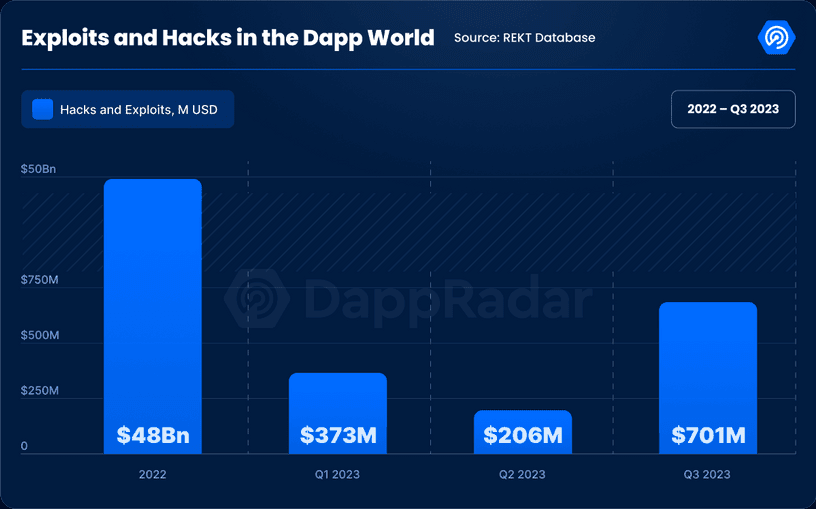
The Multichain vulnerability incident was one of the most serious security incidents in Q3, causing a loss of $231 million. On July 10, a major vulnerability occurred in Multichain, allowing an unauthorized attacker to infiltrate its system. This intrusion resulted in a large amount of funds on different chains being stolen, and the incident highlighted the urgent need for strong security measures in the Dapp field.
7. Conclusion
As Q3 2023 draws to a close, the Dapp space continues to develop and presents a complex development trend. The number of daily unique active wallets (dUAW) has grown steadily, mainly due to increased interactions with NFT Dapps and the increase in the number of new Dapps joining the ecosystem. Ethereum continues to maintain its dominance in the DeFi space.
Despite some headwinds, the NFT market has demonstrated resilience and adaptability. The increasing integration of traditional industries with the Web3 space, especially in the gaming sector, highlights the intrinsic value and huge potential of NFTs.
However, it is important not to ignore the challenges. The dramatic increase in losses due to vulnerabilities and hacks, especially the Multichain incident, shows the urgent need to strengthen security and vigilance across platforms.
In summary, Q3 2023 is a period of challenge, resilience, and potential. The lessons learned from Q3 will undoubtedly help shape strategies and approaches for future development.