

Author: Krisztian Sandor, CoinDesk; Compiler: Songxue, Golden Finance
Bitcoin is struggling with strong resistance at the $28,000 level, with two key moving averages limiting gains this week.
The cryptocurrency market rebounded, led by AVAX and SOL, after the blowout U.S. jobs data.
Bitcoin eschews correlations with long-term bonds and stocks, bringing back the narrative of "digital gold," according to an analyst.
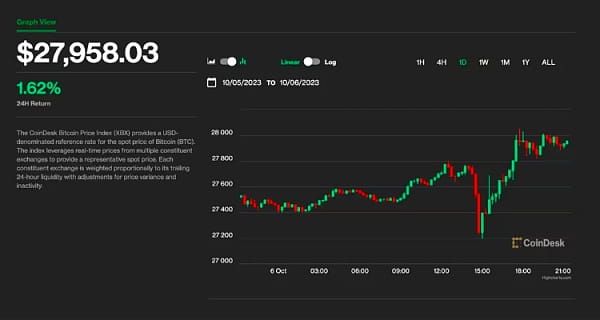
Bitcoin (BTC) hit key resistance at $28,000 again on Friday, as crypto and traditional markets rebounded from early losses on stronger-than-expected U.S. jobs data.
The largest cryptocurrency by market cap fell nearly 2% to below $27,300 following news that the U.S. economy added 336,000 jobs in September, nearly double what economists had expected. However, the losses were short-lived, with Bitcoin quickly rebounding to just above $28,000.
At press time, the price is trading just below that level, up 1.5% over the past 24 hours, slightly less than the 1.6% gain of the CoinDesk Market Index (CMI).
Meanwhile, U.S. stocks recovered from sharp early losses, with the Nasdaq up 1.75% shortly before the close on Friday.
Ethereum (ETH) halted its losing streak against BTC and outperformed the broader market, rebounding nearly 2%. The second-largest crypto asset changed hands at $1,650 in the afternoon session.
Layer 1 networks Avalanche’s AVAX and Solana’s SOL led the major altcoin market rebound, rising 6% and 3.8%, respectively.
What's next for the price of Bitcoin?
Rachel Lin, CEO of derivatives decentralized exchange SynFutures, said in an email that both the 200-day and 200-week moving averages are around $28,000, which is a huge resistance to any price increase.
“Therefore, Bitcoin has seen strong selling every time it reaches this area,” Lin said. “A sustained breakout above $28,100 would be a positive sign that could lead Bitcoin to $30,000.”
Lucas Outumuro, head of research at IntoTheBlock, noted in a market note on Friday that Bitcoin has behaved differently during the recent bond sell-off compared to last year.
“Many of the catalysts that caused BTC to fall in 2022 are no longer in play,” Outumuro said.
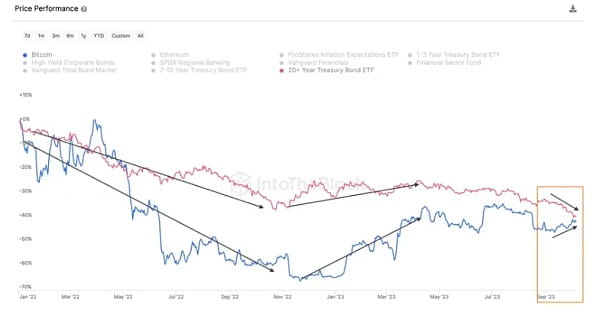
(Bitcoin and long-term U.S. Treasury bonds (IntoTheBlock))
He explained that when the Fed raised rates last year, the value of long-term bonds fell, putting pressure on risk assets like Bitcoin. As the pace of rate hikes slowed and speculation of a Fed pivot began earlier this year, long-term bonds and Bitcoin rallied.
Now, the relationship between the two assets has reversed, with Bitcoin moving higher even as long-term bond prices plummet.
“Against the backdrop of global uncertainty, the market appears to be re-evaluating Bitcoin’s value proposition,” Outumuro said.
“Bitcoin’s recent price stability during the bond and equity sell-off highlights its growing status as a standalone asset class,” Michael Silberberg, head of investor relations at crypto hedge fund AltTab Capital, said in an email. “This decoupling marks a further evolution of Bitcoin’s ‘digital gold’ narrative.”
“If it continues to trade in a tight range while stocks and bonds are selling off, it will reinforce this narrative and could attract more institutional inflows seeking uncorrelated assets,” Silberberg added. “We expect this new maturity could mark the start of a secular bull trend over the next 4-6 months.”