


Author: Thor Hartvigsen, DeFi Analyst, Translation: Golden Finance 0xjs
Last week I had the pleasure of interviewing Neel Somani, the founder of Eclipse, an upcoming Ethereum Layer 2. Eclipse is different from other Ethereum Rollups because it is modular in its approach. I asked Neel questions about these design choices and various other topics such as mainnet launch, fee structure/value capture, native tokens, etc.
Before diving into the interesting conversation with Neel, here is a brief introduction to the composition of blockchain. A blockchain consists of 4 layers:
Execution layer — processes user transactions and provides an environment for dApps.
Data availability layer — A node receives a block from a block producer and checks if the data is publicly available.
Consensus layer - determines the order of transactions.
Settlement Layer — determines the state of the blockchain (finality).
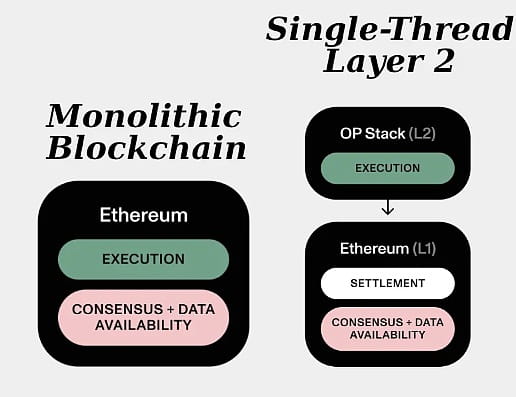
A monolithic blockchain handles all of these components by itself, i.e. contains all four layers. A modular blockchain contains only one or a few (but not all) of these layers.
Here are some examples of these different architectures.
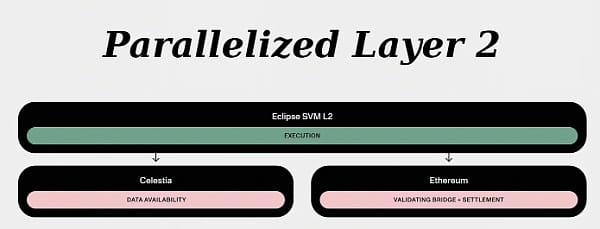 Eclipse uses:
The Solana Virtual Machine (SVM) serves as the execution layer.
Celestia acts as a data availability layer.
The Ethereum mainnet serves as the settlement and consensus layer.
The interview is as follows:
Let’s start by discussing the execution layer. What made you choose to run the Solana VM instead of the EVM as an execution environment? On your website you mention concepts like parallelism and native fee markets — are these major advantages?
“That’s definitely the biggest advantage. Think about it this way. If you have 100 people all sending transactions to an EVM chain, all of those transactions have to wait in line and be serviced one at a time. There’s no way around that. On Solana, with the Solana VM, they can actually be in different queues and all of them can be serviced at the same time. So, of course, you’re limited by the number of cores that the master executor is running on and some hardware constraints, but the throughput is much higher than the EVM chain. And they’ve also reduced the block time through optimizations, and they make single-threaded execution very fast. That was the main reason we chose it.”
Is there any trade-off here?
“The downside is, how do you figure out which queue everybody should be in? If there are 100 people all in line, trying to get served, that means they have to specify some additional information up front. So they have to say, I want to read this part of the state, or I want to write this other part. They have to say up front what they’re going to do. That’s not the case with EVM transactions. You can just say, I’m going to run this transaction, and then it runs whatever it wants. That’s one of the reasons why EVM is slow. But it’s also very convenient.”
Can you talk about the composability of Eclipse? I imagine it's easier for Solana/Rust developers to build on SVM. Can Solidity developers or Ethereum mainnet or other L2 protocols easily integrate into Eclipse?
“These are actually new features, but yes, we can support Solidity through a project called Solang. There’s also a product called Neon that lets you use your MetaMask wallet. Drift has also built MetaMask Snap, which is a new extension for MetaMask that lets you use your wallet with SVM code. For Rust contracts, developers can use Seahorse, and they can write their smart contracts in Python, and even Python works with Eclipse. So we support a variety of different languages at this point.”
Regarding the Data Availability (DA) layer, why choose Celestia instead of Ethereum?
“We will always choose what’s best for users and applications. We are not tribalists, even though obviously we are Ethereum L2. We will not try to force Ethereum DA to work if it’s not good enough right now from a cost or bandwidth perspective. But we are always keeping an eye on it. Once it’s ready, we can migrate to ETH DA. But right now, Celestia offers bigger blocks. Once they launch their mainnet, the block space will probably be empty. So we will have a lot of bandwidth, and they can increase bandwidth through governance. They are able to increase the block size through governance, and I expect they will probably do that a few times after we deploy.”
Eclipse will leverage Risc Zero for Rollup proofs. How does this make it different from other types of Rollups?
“We’re taking a very different approach than Optimism or Arbitrum. The reason for that is because the virtual machine that we’re using, because it’s parallel, it doesn’t have some of the same primitives, it doesn’t have some of the same parts, like Merkle trees, for example, Merkle trees are not part of our Rollup. Merkle trees are used in the error proof process. So we have to do error proofs differently, which ultimately requires Risc Zero to do it in an efficient way. That’s why Risc Zero comes in the stack, and it’s going to be a big part of our error proofs.”
Next I want to ask about value capture. In the case of Arbitrum, when users make a transaction, they pay fees to the Rollup, and then these Rollups have to pay a certain percentage to the Ethereum validators as settlement costs, but can basically keep the rest of the fees. How does this work on Eclipse? Which parts of this modular stack will capture these fees? Is there any balance left in the Eclipse at the end?
“So right now we haven’t decided if we’re going to allocate some amount to Eclipse and how much it will be. If there is some amount, it’s just to compensate for the risk. That is, the way we calculate the fee is we look at layer one and we say, what is the fee to post Ethereum, how much do we have to post there? Then we look at Celestia and we do the same thing and then we add all of that together and that’s the fee we’re going to pass on to the user. But the risk is that when the user pays the fee, then a few seconds pass, right? Then we post to layer one. Maybe this fee has increased. So as a result, maybe it’s wise to charge a little bit more to protect against that risk. That’s the reason for it.
The two parties involved are Ethereum and Celestia, and from a regular cost perspective, the fees paid by users are actually Ethereum and Celestia. Every transaction published to Eclipse pays a fee to Celestia. If we write a transaction, we have to publish about 200 bytes to Celestia, and Ethereum gets paid every hour. Or maybe even less frequently.
Then, there are some other participants that we need to pay periodically, every once in a while, every week (Risk Zero). Even if nothing goes wrong, we still run the Risk Zero error proof. Just to show that it still works, basically to make sure that the fee is not exactly equal to the cost of issuing the slash plus the Ethereum fee, which is why the payment is slightly more.”
What is your strategy for attracting applications and growing the ecosystem early on?
“We have some DApps from Solana who are doing multichain development, so they will additionally deploy to Eclipse. We have incubated some projects. We have supported some projects through our solar accelerator program. We provide these grants to developers and we can provide guidance, break it down into milestones, and provide them with all the resources they need. Right now, we are still talking to Solana DApps. We will expand to Solidity DApps very soon.”
Will there be an Eclipse token in the future whose purpose is to decentralize Rollups and introduce governance?
“Perhaps, this is something we haven’t thought about enough to have an opinion on because we’re so focused on building this mainnet and the mainnet has a lot of things to think about, and in order to even think about something like a token, we have to understand how we think about governance and what the full governance framework is. That takes months of effort to really think through. So we haven’t thought about it yet.”
When will Eclipse be launched on the mainnet?
“We already have a devnet, which is the network that people are actively developing right now, for mainnet. Once we freeze the code and audit it, then we’ll make it publicly available so people can look at the code for themselves, can play with it. That’s the plan for the Eclipse mainnet launch. Basically by the end of the year, we’ll have taken those steps, and ideally, assuming Celestia is stable, assuming there’s nothing else, no other infrastructure missing, then we’ll move forward with the mainnet launch.”