

Original article | Uniswap
Compiled by | Odaily Planet Daily
Since its inception, Uniswap has been committed to creating the best trading experience. As the crypto market develops, our understanding of user experience is also deepening.
To be the best trading platform, Uniswap must have the best price and the best liquidity. The best price seems easy to measure, but to find the best path, strong liquidity is required. Liquidity is best when there is a flexible but reliable combination of tokens, capital pools, and fee levels to attract liquidity providers to enter deeper markets.
Each subsequent version of Uniswap has supported more complex pool functionality, and v4 will take it to another level. While great for liquidity, the customizability of pools makes it difficult for traders to find the best route that gives them the best price. As the market has evolved, routing and liquidity have become two separate but related problem areas.
To make progress on both fronts, we separate them. Uniswap v4 introduces hooks that can build custom automated market maker (AMM) functionality, such as recurring investments or oracles. UniswapX outsources complex routing to an open network of third-party fillers, who then search for the best prices among liquidity sources. Together, these complementary protocols help provide users with the best trading experience.
Uniswap v4 provides the best liquidity
Uniswap v1 was a liquidity creation experiment designed to test whether automated market makers (AMMs) could have a place in the crypto space. However, AMMs unlock powerful new tools that allow anyone to create permissionless markets. Uniswap became the most popular venue for long-tail tokens like MKR and DAI. The next question is what it means to be the best venue for liquidity.
Subsequent versions of Uniswap have become more expressive. Uniswap v2 and v3 introduced ERC 20 trading pairs, pooled liquidity, and custom fee tiers, making liquidity deployment more customizable. Uniswap v4 goes a step further. V4’s hooks act like plugins, letting pool deployers introduce arbitrary code — code that can be run at key points throughout the pool’s lifecycle, such as before or after a trade.
With hooks, developers can innovate on top of the liquidity and security of the Uniswap protocol to create custom AMM pools that integrate with v4 smart contracts. Because each pool is now defined by more than just a token and fee tier, we will see pools of all shapes and sizes.
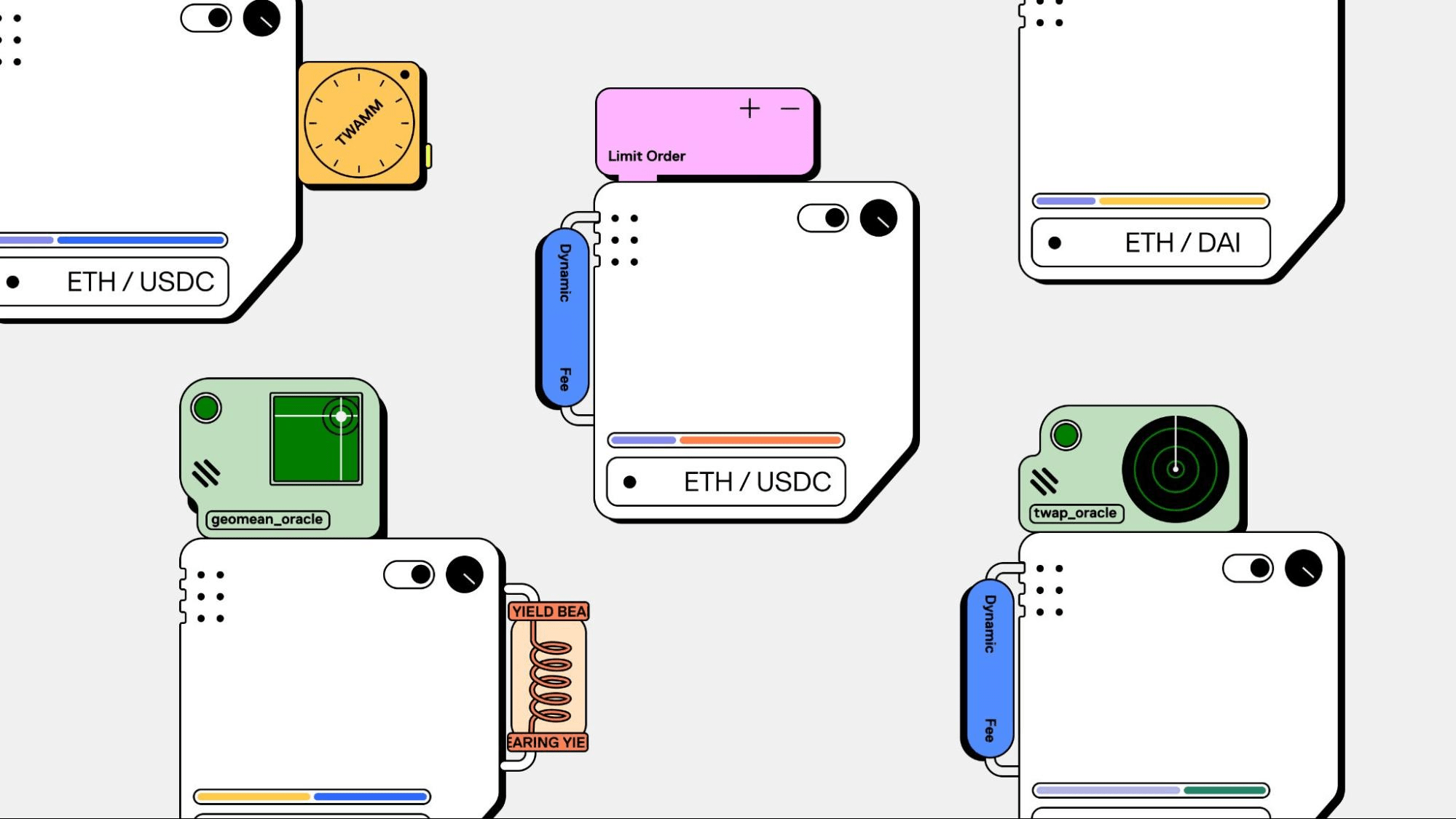
All this customization and expressiveness also spreads Uniswap’s liquidity across three (soon to be four) different versions and nearly a dozen chains. Finding the best price on a trade means checking more pools to find the best path. That means more calculations, more hops, and more gas. Custom AMM features will make Uniswap the best place for liquidity, but it becomes more challenging to find the best path to get the most tokens to traders.
UniswapX is a protocol that focuses on the routing problem. It outsources the problem of finding the best path to a competitive market — one that understands other on-chain resources and private inventories to find the best price for traders.
UniswapX Find the Best Price
Finding the best path depends on the breadth of liquidity coverage. The more liquidity we know, the more options we have for finding the best path. Uniswap auto-routers, DEX aggregators, and meta-aggregators are popular precisely because of their broad liquidity coverage.
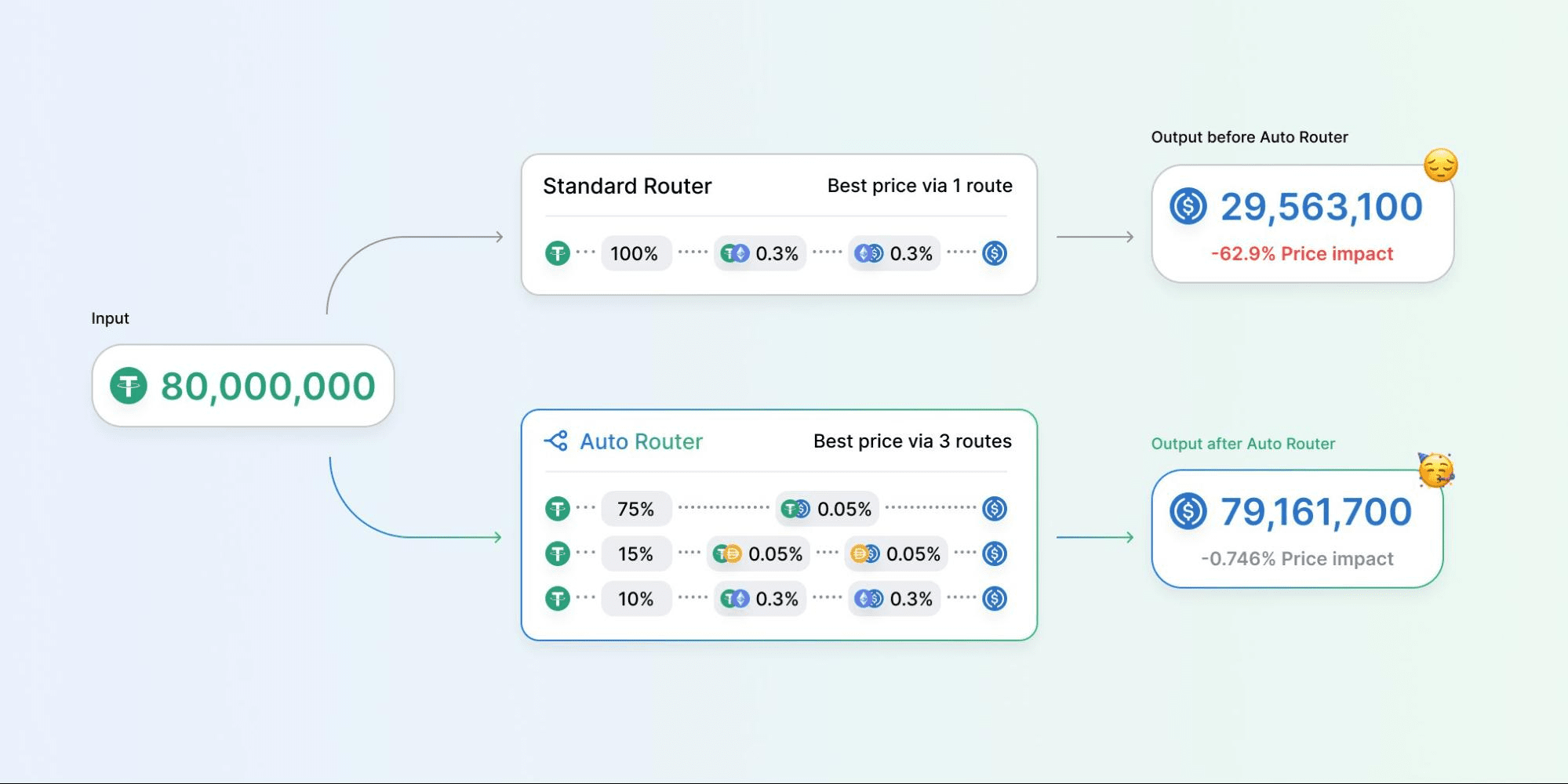
Uniswap Autorouter vs. Standard Router
But as liquidity pools scale, manually maintaining a single routing engine becomes unsustainable. Aggregators are bottlenecked by the need for constant maintenance. With Uniswap v4, maintenance will become even more difficult. Liquidity will exist behind custom hooks that routing engines will need to find, audit, and use.
Our solution to the routing problem is to create a market that gamifies liquidity discovery. Instead of accepting quotes from a single source, trades are conducted through an auction system. Fillers will compete to find the best route to provide traders with the best price.
This market is extremely competitive. “Fillers” look like today’s block builders and traders, and they are incentivized to use any strategy at their disposal to offer lower prices. They can return MEV to traders, find unknown sources of liquidity, tap private inventories, or save gas through batching — anything that gives them an advantage over others and wins the auction. UniswapX transforms routing from a one-to-one problem to a one-to-many problem through a permissionless protocol that regulates market participants, sets ground rules, and lets fillers compete to return value to traders.
Creating a swap fulfillment market also prepares us for a multi-chain future. Trading tokens across chains needs to emulate the user experience of trading on a single network. Routing needs to abstract the complexity and latency of bridging. Fillers can leverage MEV, private inventory, and user intent across domains to earn the right to maximize output tokens for traders.
With existing liquidity pools spread across four Uniswap versions and more chains, the UniswapX filling network will actively discover new sources of liquidity to maximize liquidity coverage and provide the best prices.
Parallel Complementary Protocol
Uniswap v4 and UniswapX are parallel and complementary protocols. Each focuses on a specific direction: Uniswap v4 optimizes pool customizability to maximize expression, and UniswapX optimizes routing to maximize output tokens.
These two combined provide traders with the best possible trading experience while maintaining our commitment to a decentralized, censorship-resistant, and permissionless marketplace.