


Author: Bitkoala Finance
Editor's note: Traditionally, the left usually advocates active reform, advocating the abolition of old ideology and systems in order to establish new ideologies and systems; the right is generally more conservative, advocating a safe, orderly, gradual and slow reform approach, and emphasizing the maintenance of old traditions - that is, what we often say: innovation is on the left, conservatism is on the right.
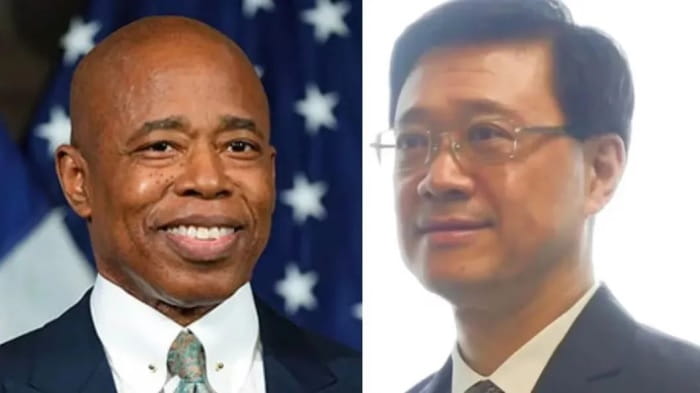
When it comes to the emerging field of Web3.0 and cryptocurrency compliance regulation, New York, known as the "Big Apple", and Hong Kong, known as the "Pearl of the Orient", seem to have taken two different paths, one from embrace to rejection, and the other from rejection to embrace.
Fleeing New York vs. flocking to Hong Kong
Although New York City Mayor Eric Adams was initially optimistic about Web 3.0 and not only tried to carry out activities supporting cryptocurrencies but even accepted salaries paid in Bitcoin, U.S. regulators did not support the wishes of the New York mayor. Last month, the U.S. Securities and Exchange Commission filed a lawsuit against Binance and Coinbase, which shocked the crypto industry. Driven by Washington, D.C.’s recent tough stance on crypto regulation, Web 3.0 companies are fleeing New York, and New York’s global relevance relative to other major financial centers is weakening, which runs counter to New York’s stated desire to shift from an outdated financial system to a digital economy.
On the other hand, when crypto companies were frustrated in New York, Hong Kong opened its arms. On June 10, shortly after Coinbase was sued by the U.S. Securities and Exchange Commission, Wu Jiezhuang, a member of the Hong Kong Legislative Council and the National Committee of the Chinese People's Political Consultative Conference, posted on social media that he welcomes global virtual asset exchanges, including Coinbase, to apply for compliant exchanges in Hong Kong and discuss listing plans. In less than a week, Wu Jiezhuang said that he had contacted Coinbase and would work together to understand the opportunities for development in Hong Kong. He bluntly welcomed global virtual asset companies to apply for compliant trading platforms in Hong Kong and discuss listing plans and was willing to provide assistance.
In fact, Hong Kong Chief Executive John Lee said as early as April this year that Hong Kong will allocate more than HK$700 million from the 2023 Budget to accelerate the development of the digital economy, and more than HK$9 million to launch a series of international initiatives and measures. He emphasized that the development of Hong Kong's virtual asset industry will be promoted, and the third-generation Internet represented by Web3.0 has great development potential. Hong Kong Financial Secretary Paul Chan Mo-po then announced a data that injected a shot of confidence into the global Web3.0 and cryptocurrency market: Hong Kong's Budget has allocated HK$50 million for Cyberport to accelerate the development of the third-generation Internet Web3.0 with blockchain as the underlying technology. Cyberport has accumulated more than 150 related companies in the past year. Cyberport and its ecosystem are also growing rapidly. There are currently more than 1,900 companies, the cumulative financing of start-ups has exceeded HK$35.7 billion, and there are more than 480 intellectual property projects.
The data doesn’t lie, Web3.0 is pouring into Hong Kong.
Crypto markets rise in the east and fall in the west. It’s New York’s turn to learn from Hong Kong
The right question for policymakers to consider is: How can new technologies be used to promote innovation and economic growth? This is the question that New York City Mayor Eric Adams has been asking, and it is also the question that Hong Kong Chief Executive John Lee Ka-chiu is asking. Unfortunately, the question that the SEC is most concerned about is: What is a security? ? ?
Frankly, it’s just as critical that lawmakers quickly enact smart laws and regulations that foster innovation and growth as it is that engineers quickly develop smart code that gets new products to users as quickly as possible.
Today, U.S. regulators have taken restrictive measures, and despite Eric Adams' efforts to support the Web 3.0 industry, venture capital funds and projects are beginning to leave Silicon Valley and the United States and turn to other regions. Most worryingly, due to the current environment in the United States, Coinbase, which supports regulation, is also considering leaving the United States - the Web 3.0 industry is keen!
On the other hand, Hong Kong's active regulation of the crypto market continues to accelerate. As part of Hong Kong's embrace of cryptocurrencies, Hong Kong regulators are formulating reference guidelines for the issuance of stablecoins, and stablecoins based on digital Hong Kong dollars are apparently already in the works.
Yes, the trend of the crypto market rising in the east and falling in the west has already emerged, and now it is finally New York's turn to learn from Hong Kong.
Summarize
Hong Kong Financial Secretary Paul Chan once said: "The crypto market has just experienced a collapse, and it is the best time to develop Web3.0."
There is no doubt that after a long period of lows, the encryption and Web 3.0 markets have begun to gain momentum. As a new piece of the "Global Digital Financial Center", Hong Kong is bound to use new technological capabilities to export to the world and accelerate the development and transformation of Web 3.0.