


Author: Bitkoala Kaola Finance
Editor's note: The movement of the U.S. dollar index affects global liquidity conditions, which in turn affects risky assets including cryptocurrencies.

Bitcoin's (BTC) negative correlation with the U.S. Dollar Index (DXY) has been broken in recent weeks, making it difficult for Bitcoin to gain upward momentum amid the continued sell-off in the U.S. dollar, but don't worry, this may not last for much longer. Long.
Last week, the U.S. dollar index fell below 100.00, with a decline of 2.26%, a new low since April last year and the worst performance since November last year. Meanwhile, Bitcoin is trading between $30,000 and $32,000, continuing a multi-week consolidation.
As we all know, the U.S. dollar is a global reserve currency that plays a huge role in global trade, international debt, and non-bank lending. When the dollar rises, those with dollar borrowings face higher debt service costs and reduce their exposure to risky assets, while a weaker dollar has the opposite effect. As a result, fluctuations in the U.S. dollar index impact global liquidity conditions and, in turn, the valuation of risk assets, including cryptocurrencies.
Although Bitcoin is a digital currency, like other currencies, it must be bought and sold through U.S. dollars. It is understood that about 98% of Bitcoins are traded against the US dollar, so the US dollar has also become an important benchmark for Bitcoin prices. Since Bitcoin is mainly used for transactions and investments, its value is usually affected by the exchange rate. Once the U.S. dollar exchange rate increases, Bitcoin's purchasing power will weaken and the price will fall, and vice versa. Therefore, changes in the US dollar index have a greater impact on the price of Bitcoin.
Frankly, the relationship between Bitcoin and the US dollar index is difficult to break in the short term, and not just because the US dollar is the "denominator" in the most quoted currency pair for crypto assets (when the "denominator" value falls, the exchange rate will rise), and at the same time, the weakening of the U.S. dollar also provides more breathing space for U.S. dollar bond holders around the world, indirectly boosting global liquidity.
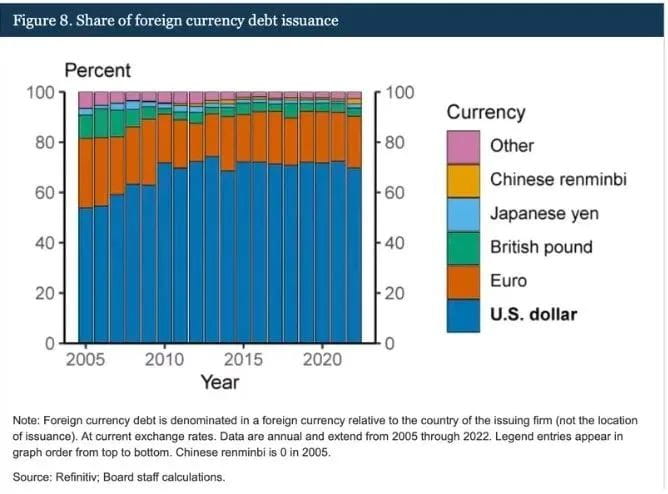
The chart above shows the currencies chosen by companies for issuing debt in currencies other than their own countries from the beginning of 2000 to 2022. The results show that the U.S. dollar is still the first choice for companies, and the proportion of debt denominated in U.S. dollars has been stable at around 70% since 2010. In the early 21st century, gold experienced an impressive bull market. Many people believed that this situation was due to the launch of spot gold exchange-traded funds (ETF). Therefore, many people felt that many Wall Street financial giants had recently "collectively" applied for spot gold. Bitcoin ETFs can also help Bitcoin prices rise, but many people ignore the macroeconomic environment when gold prices rise. The weak U.S. dollar index also played an important role in gold's rise.
It is worth noting that Goldman Sachs also hinted that the dollar’s downward trend will continue. Its economic research team pointed out in a client report released:
"With cooling inflation and expectations for a more patient stance from the Fed after July, the U.S. dollar index is likely to remain in a downward trend, and this is likely to continue in the short term and into the longer term, and fundamentals suggest it will The decline continues. This despite signs that the U.S. consumer remains strong."
Overall, the relationship between the U.S. dollar index and Bitcoin is very complex and closely linked. However, compared with the U.S. dollar, the particularity of Bitcoin makes its impact on the U.S. dollar index somewhat independent. It is undeniable that Bitcoin has become increasingly important in financial markets and is already part of many investment portfolios.
You will find that cryptocurrency market participants have been unable to ignore the trend of the US dollar index, and if the indicator continues to move lower, Bitcoin may see another round of gains.