
10/5 BTC market analysis:
The small non-farm ADP data is positive, the US stock market and the crypto market rebounded slightly, and the market has begun to brew a bullish sentiment! Beware of "false positive" sentiment. Tonight's unemployment benefits and tomorrow night's big non-farm data will determine the short-term bullish and bearish trends. Don't worry if you want to see the "bullish" trend!
Hi, ladies and gentlemen, welcome to Uncle Cat's Coins. In the blink of an eye, there is only one day left in the holiday. I wonder if you guys are having fun? Remember to adjust your state and return to normal work.
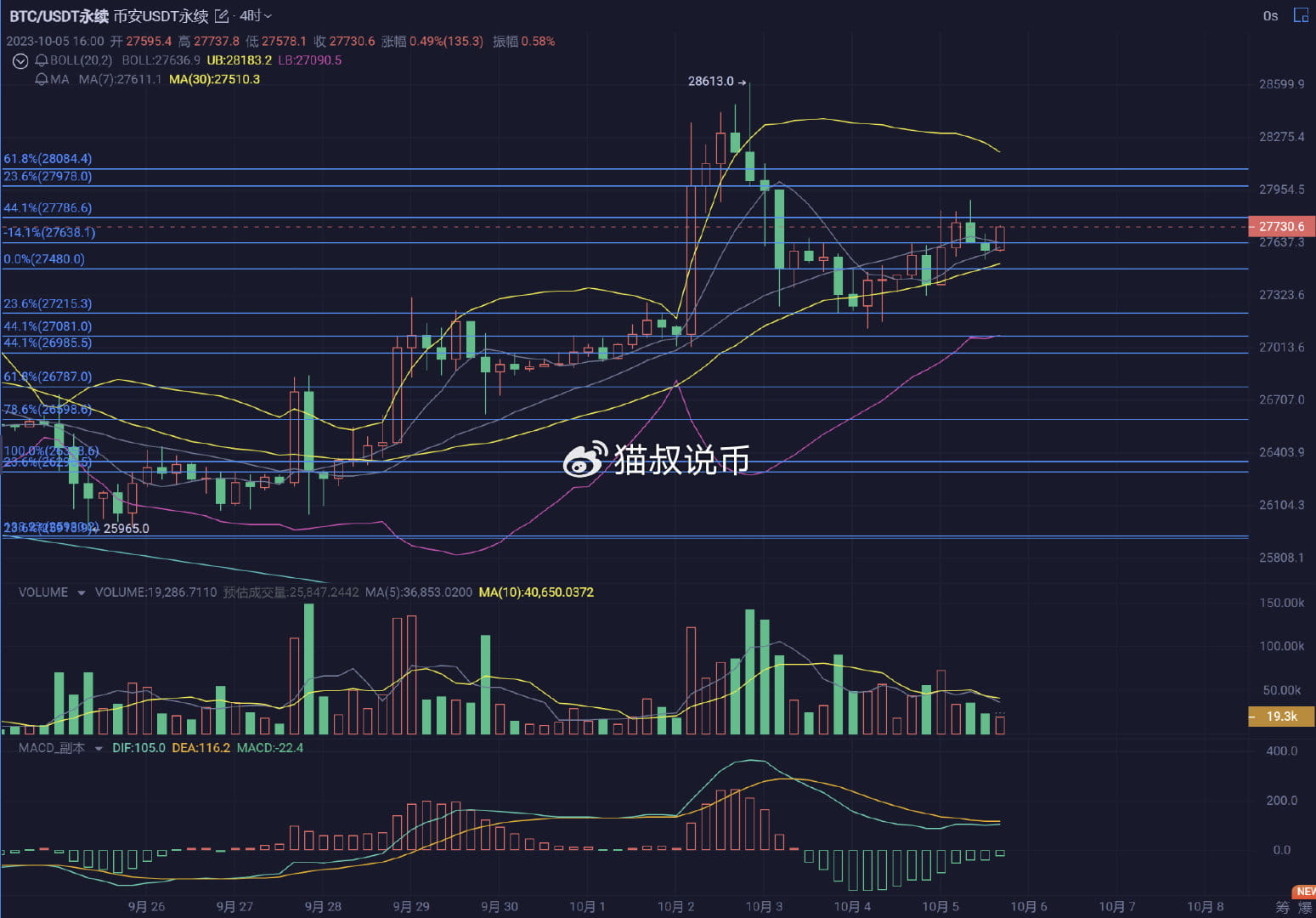
As of the time of writing, Bitcoin is priced at around 27,700. The market has been rising since midnight last night, with the highest point reaching above 27,800. Currently, bullish sentiment is spreading in the market, but Uncle Cat wants to remind everyone to beware of "fake good news" FOMO!
At present, the technical aspects of the Bollinger Bands, whether 1 hour, 4 hours or even daily, have shown an upward trend. Coupled with the positive sentiment of yesterday's ADP data, the market has begun to have a bullish FOMO sentiment, and the trading hours in Europe and the United States contribute the most to the trading volume. But how long can this sentiment last? Let me tell you!
Last night's small non-farm data ADP showed that companies planned to recruit 180,000 people in August, and the expectation was 157,000, while the actual job demand in September was 89,000, which was much lower than expected and much lower than the previous value. From the perspective of job recruitment, job recruitment in September was far from expectations, indicating that many expected companies have suspended recruitment. The suspension of recruitment by companies basically indicates that the company's own production capacity and profitability intersect, and one-sidedly reflects the possibility of the current economic downturn in the United States. With the blessing of this possibility, the expectation of the Fed's interest rate hike at the end of the year has been greatly reduced. Compared with the same period last year, U.S. stocks began to rebound one after another, there was not much fluctuation in the Asian session, and the European and American sessions began to become active in the early morning, and the crypto market also showed signs of rebounding one after another. Earlier today, many bloggers have begun to brew "bullish" sentiment, "bull market start" and so on. Although I mentioned in yesterday's market analysis that some "historians" in the crypto market have produced data showing that Bitcoin has been rising in October, and the increase is good, coupled with the current technical aspects, the small non-agricultural data, the interpretation of foreign media and Wall Street analysts, etc., the market is thriving, but I want to remind everyone to be vigilant. I am not the kind of person who believes in empiricism. I am more concerned about the current environmental and emotional factors.
First of all, the small non-farm data ADP is not official data. Of course, many people here say that official data are fake and worse than private data, but please don’t forget that we don’t care about the authenticity of the data. We care about the market direction brought by the data. According to the data of Mr. Ni on Twitter, there have been many times in the past when the small non-farm data and the large non-farm data are opposite. Of course, this does not mean that the small non-farm data this time is opposite, but it is just a reference value. In addition, if the small non-farm data is not official data, then the expectations generated by the small non-farm data cannot directly lead to whether the Fed will raise interest rates. If it is about the Fed’s interest rate hike, tonight’s unemployment benefits, including tomorrow’s large non-farm data, are more valuable for reference.
Let’s first talk about tonight’s unemployment data. The previous value was 20.4 and the expected value was 21. The expected value was greater than the previous value. However, the expected value of tomorrow’s unemployment rate data is greater than the previous value. This is a somewhat contradictory point. It can also be understood from another perspective that the Federal Reserve’s expectations for the unemployment rate have increased. This increase means that the worst-case scenario is prepared. As long as the announced value is not greater than expected, under this data, the possibility of the Federal Reserve raising interest rates remains unchanged.
On the other hand, the non-farm data tomorrow is 18.7 before and 17 after. The same is true. If the expectations are lowered, once the value meets expectations or is slightly lower than expectations, it is within the acceptable range for the Fed. If we judge whether the Fed will raise interest rates based on data alone, the previous value is not important. What is important is to look at the expected value. Once the negative economic data meets expectations, the Fed's willingness to raise interest rates will definitely not change, and if it exceeds expectations, it will greatly increase the possibility of raising interest rates.
In summary, if we simply use data to infer whether the Fed will raise interest rates to turn the market bullish, we must at least wait until the big non-farm data is released tomorrow night before we can make a decision. Therefore, the FOMO bulls after yesterday's small non-farm data were too aggressive.
If we look at the macroeconomic situation, the possibility of the market turning bullish is greatly reduced. First of all, no matter how the non-farm data is, it is bad for the US economy, at least for the current situation. Therefore, the Fed's strong desire to raise interest rates may be difficult to influence by data, especially at the end of the year as the last rate hike in this cycle. Of course, we need to pay attention to the emotions brought about by the data.
Why do we say that the quality of data does not affect the possibility of the Fed raising interest rates? Judging from the small non-farm data last night, the number of job openings in enterprises has decreased, indicating that the revenue of enterprises has deteriorated. In addition, American companies pay more attention to financing, and the American people are more accustomed to borrowing. In this case, high interest rates increase the cost of corporate financing and borrowing by the people. In addition to the rise in crude oil prices, the recent strikes in the United States came into being. Workers want to increase their wages, and companies want workers to increase production capacity. Do you think the Fed doesn't know about this mess? Why do they still speak in a hawkish tone? Of course, on the one hand, they don't want to cause the market to speculate on the expectation of interest rate cuts due to loosening their mouths. On the other hand, it is also because the Fed can even say that the core problem that the United States needs to solve now is the lack of money.
The interest rate hike will lead to economic decline, people's income will be low and their expenditure will be high, but the economy will not collapse and people will not starve to death. This is not a problem that needs to be solved urgently. However, if the US government does not solve the problem of lack of money, the United States may face big troubles. Fiscal deficits, the government almost shut down, military spending cuts, etc., these things are the number one problems that plague the US government. They need to solve external worries first before they can slowly deal with internal troubles, so raising interest rates in the economy, pushing up US bonds and the US dollar index, and sucking blood from global funds are the core. Of course, a balance must be struck during this period. The domestic economy cannot collapse on a large scale just to attract money. This is a prerequisite. So, although the data are bad, as long as they are not worse than expected, the possibility of the Fed raising interest rates will not be too low.
Although the Fed has repeatedly said that it will maintain high interest rates in the future, the final conclusion can only be drawn from the changes in the dot plot after the end of the year. The current statement is more like intimidating the market. After all, the sentiment of the investment market is that if you don't suppress it, it will automatically imagine good news and FOMO.
Back to the crypto market, based on the above, I personally think it is too early for the market to turn bullish at present. At least the short-term turn to bullish will depend on Friday's big non-agricultural data. Yes, I am talking about the short-term turn to bullish. As for the start of the bull market that many people say, I do not agree. You should know that most of the current trading volume providers are from the European and American trading areas, and the Asian trading area is still in a sluggish trading volume. In addition, the factors that stabilize the market at present also need to consider the options market. At 16:00 tomorrow afternoon, there will be about 4 billion US dollars of options for delivery (data provided by Teacher Ni), and the options market is also bullish, so maintaining the market from falling is the core. This situation has not happened before. The previous time below 29,000, several declines were covered. When everyone thought it was a bottom, the market broke through to around 24,800 overnight. There was no one to cover it below, and the main institutions broke through it when they sold some goods. The recent situation of no decline below cannot rule out this possibility. If the large-scale delivery of the options market ends tomorrow, and the non-agricultural data tomorrow night is negative data, do you think that the recent support of 27,000 can be maintained?
Therefore, it is better to be calm when judging the market trend, and do not rely on your own imagination to guess. Even if tomorrow's non-agricultural data is good for the market, the bull market is temporary. As long as there is no clear hot sector in the market to attract funds to enter the market and attract institutions to enter the market, or even as long as the Asian market is still such a stagnant water, it is difficult to talk about the start of the bull market in the market. Many people say that the start of the bull market is to make everyone ignore it and start it inadvertently. For this conjecture, I can only say that it is a bit too fantasy. Conspiracy theories are not used in this way. Many people always say that institutions will pull up a bull market, but why? If there are no large number of market hot spots and not enough newcomers entering the market, will the upper trapped retail investors be forced to sell for charity? Simply pull it up by yourself, 1,000 points, 2,000 points, 5,000 points are all fine, but if there are more, don't consider the market selling pressure? Not everyone will think that the rise is the return of the bull market without thinking FOMO. Many people who play contracts should really learn from friends who do spot trading. Friends who play contracts are always too impulsive and always dominated by emotions. For a real bull market to start, on the one hand, there must be a hot market to attract enough funds and retail investors to enter the market, and on the other hand, the main players must have enough chips and arbitrage methods to pull up and boost the market.
Without further ado, let’s get back to the market:
In terms of contracts, based on the above, I personally think it is not rational to switch to long at the moment, at least not before the big non-farm data tomorrow. If tomorrow's big non-farm data is positive, I may wait for the market to pick up volume next Monday before deciding whether to switch to long, otherwise I will deal with it according to the big trend. Of course, we cannot ignore the current rebound momentum, and the best choice is to look at the rebound short at a high level. You can just adjust the point where the gap was filled yesterday.
Many people saw the gap in the futures market I mentioned yesterday and entered the market. Some could take 300 points, and some could take 150 points. It was a small wave. It's better to quit while you're ahead.
Spot:
The idea is still the same as the contract. Before the big non-farm data is released on Friday, I will be bearish first. If the big non-farm data is positive, the market will continue to fluctuate or rise over the weekend or next Monday. In the short term, I will appropriately select a few spot short-term tokens to take advantage of the short-term.
Finally, Uncle Cat wishes everyone a happy time in the remaining one day of vacation, and pay attention to adjusting your state to welcome a better day every day!
Thank you for following Uncle Cat’s Coin Talk!