


Bitcoin's position as the gold of cryptocurrency is gradually consolidating. One mechanism that can ensure the scarcity and value of Bitcoin is the Bitcoin halving, which basically occurs every four years. At first glance, it seems that the Bitcoin halving has a bad impact on the price of the currency.
But that is not entirely true. Bitcoin halving is also a double-edged sword for people from different backgrounds. This article introduces what Bitcoin halving is from scratch, and answers the most concerned questions of current crypto investors.
What is Bitcoin Halving?
The total supply of Bitcoin is 21 million. The underlying code determines that only 21 million Bitcoins will ever exist. The limited supply of Bitcoin ensures the economics of Bitcoin. The limited supply of Bitcoin is a powerful economic statement and supports its value system.
Bitcoins are obtained through mining. The 21 million bitcoins that exist today are expected to be mined by 2140. In other words, the last newly generated bitcoin is expected to be produced in 2140, and at the current issuance rate, the unmined bitcoins will be mined before this time. Currently, miners have mined nearly 90% of the total supply of bitcoins, mining about 900 bitcoins per day.
In order to maintain the issuance rate and increase scarcity, the number of bitcoins issued in each block will be reduced periodically. This process of reducing the issuance of bitcoins is called Bitcoin halving.
After a predetermined block height (a number used to denote a specific block), the number of bitcoins issued in each block will be reduced to half of the previous number. A new halving occurs every 4 years or every 210,000 blocks.
The most recent halving (2020) reduced the number of bitcoins issued in each block from 12.5 to 6.25. This means that miners will be rewarded with 6.25 bitcoins for mining a block instead of the previous 12.5 bitcoins.
Why does the Bitcoin halving matter?
The Bitcoin halving is of great significance both in economic and sustainability terms.
From an economic perspective, the halving creates scarcity for Bitcoin, and scarcity makes things more valuable. The Bitcoin halving reduces the velocity of Bitcoin supply in the face of fluctuating demand. Over the years, the demand for Bitcoin has continued to grow, while the supply velocity has continued to decline.
In short, this solidifies Bitcoin’s position as a store of value. The reduction in supply velocity combined with the growth in demand ensures that Bitcoin’s value will grow over time. Given market sentiment and the desire for scarce commodities, the impact of the halving on Bitcoin’s value goes beyond the economics of supply and demand.
It is estimated that 3 million bitcoins have been permanently lost due to reasons such as forgotten wallet information, lost hard drives, or the death of the owner, and most of these bitcoins cannot be recovered. Considering the rate at which bitcoins are permanently lost, Bitcoin is a deflationary currency, and the halving further increases this scarcity.
From a sustainability perspective, Bitcoin mining incentivizes miners to verify blocks and protect the Bitcoin network. Miners ensure that the blockchain is not vulnerable to malicious attacks. As long as the issuance of Bitcoin continues, miners will be attracted to participate in mining, thereby ensuring the security of the Bitcoin blockchain.
Halving maintains supply, thus sustaining mining. Halving creates scarcity, driving up value, and slowing the rate at which Bitcoin is issued, attracting more miners to secure the blockchain longer.
Bitcoin halving chart
The chart below shows the changes in token economics and miner rewards caused by Bitcoin halving. The chart shows that with each halving, the block reward continues to decrease as the supply gradually slows with each halving.
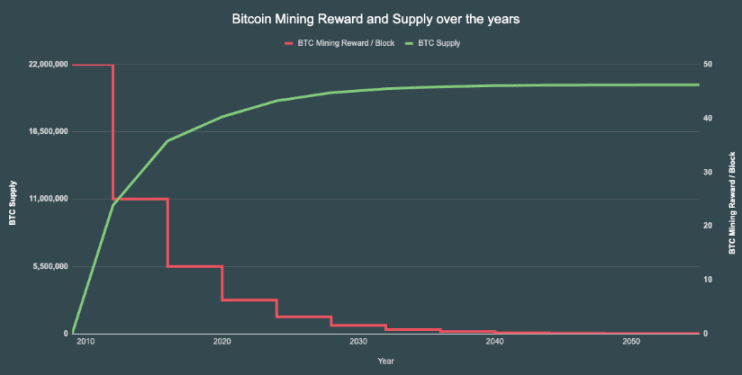
The next Bitcoin halving is expected to occur on May 4, 2024, at block height 840,000. At that time, Bitcoin's block reward will be reduced to 3.125 Bitcoins.
The last Bitcoin halving occurred on May 11, 2020, at block height 630,000. Bitcoin’s block reward was reduced from 12.5 to 6.25 bitcoins.
Bitcoin halving date
The Bitcoin halving algorithm was confirmed and developed in the original Bitcoin version. The Bitcoin white paper explains the reasons for the continuous reduction in the issuance of Bitcoin and the timeline of the halving event.
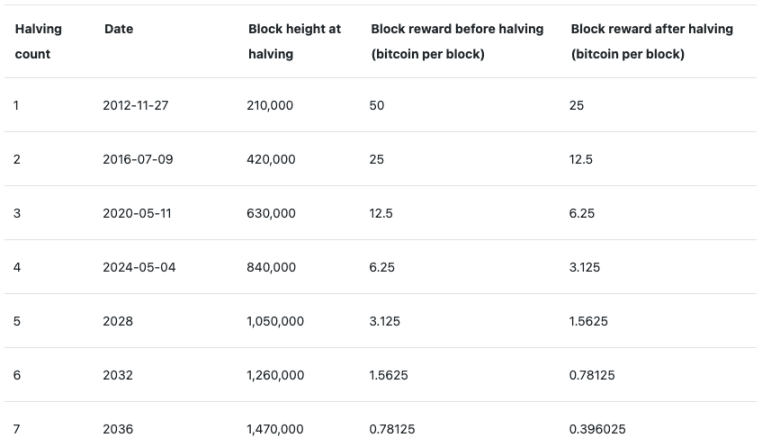
The first halving occurred on November 28, 2012, four years after Bitcoin’s “Genesis Block” was created and after mining exceeded 10 million bitcoins and 210,000 blocks. The first halving reduced Bitcoin’s mining rewards from the original 50 bitcoins per block to 25 bitcoins per block.
The most recent halving occurred on May 11, 2020, at block height 630,000, reducing the Bitcoin block reward from 12.5 to 6.25 Bitcoins.
The next Bitcoin halving is expected to occur on May 4, 2024, at block height 840,000. At that time, Bitcoin's block reward will be reduced to 3.125 Bitcoins.
The last Bitcoin halving occurred on May 11, 2020, at block height 630,000. Bitcoin’s block reward was reduced from 12.5 to 6.25 bitcoins.
Below is a table of Bitcoin halving dates:
What impact does the Bitcoin halving event have on Bitcoin prices?
For different people, halving has advantages and disadvantages and is a double-edged sword.
For investors, halving means that the frequency of new Bitcoins is reduced, and miners are less inclined to sell Bitcoins. Historical data shows that expected scarcity has a positive impact on investor psychology. Investors expect the value of Bitcoin to rise, and more buying may occur.
Past halving events have had positive effects, however, the impact of halving events on Bitcoin prices can vary depending on changing market conditions.
Prior to the 2020 halving, the price of Bitcoin had risen by about 40% due to investor behavior and subsequent speculation. After the halving, the value of Bitcoin rose to three times its previous all-time high, reaching a new high of $67,000.
For miners, the halving ultimately means a reduction in rewards. Setting up and maintaining Bitcoin mining facilities is an expensive undertaking, and miners expect the block reward to at least cover those expenses.
When the reward is halved, the income of miners is cut in half. Considering the current value and the cost of running a Bitcoin mining farm, many miners may shut down their mining setups if they cannot maintain the facilities with the calculated post-mining income.
As miners cease their activities, mining hashrate is expected to decline. The reduction in mining hashrate could slow down the Bitcoin network and cause transactions on the blockchain to take longer to execute than before. If Bitcoin prices continue to rise and miners find it profitable to run mining farms, hashrate could return to previous levels.
According to a research report released by JPMorgan in mid-July, with the next halving event expected to arrive in the second quarter of 2024, Bitcoin (BTC) computing power continues to set new historical highs and competition among miners is escalating.
The halving will reduce Bitcoin’s issuance reward from 6.25 BTC to 3.125 BTC, which the report states: “This means that miners’ revenue will decrease, while the cost of producing Bitcoin will effectively increase.”
“While the Bitcoin halving is considered to have a positive impact on Bitcoin prices as production costs have historically acted as a floor, it is a challenge for Bitcoin miners,” the team led by analyst Nikolaos Panigirtzoglou wrote in the report.
Hashrate refers to the total computing power used to mine and process transactions on proof-of-work blockchains like Bitcoin.
Financial market predictions for the next Bitcoin halving
JPMorgan pointed out in a report that the next Bitcoin halving event will be a stress test for miners, because in the next halving, miners' income will decrease, while the production cost of Bitcoin will increase.
JPMorgan said miners with lower electricity costs will be able to survive more easily, while miners with higher electricity costs may struggle after the halving.
It is estimated that a change of 1 cent per kilowatt-hour (kWh) of electricity cost could result in an increase of $4,300 in the cost of Bitcoin production. After the new halving, with a change of 1 cent in electricity cost, the production cost will increase to $8,600, making it more sensitive and more vulnerable to high-cost miners.
The report also pointed out that the sharp increase in computing power means that competition among Bitcoin miners will intensify and more and more mining equipment will be deployed.
However, the report added that after the halving event, "for hashrate to continue to rise at the same rate, it would require either a sustained increase in the price of Bitcoin exceeding its production cost, or a significant increase in transaction fees to offset the reduction in issuance rewards, which is unlikely."
Overall, the market remains optimistic about the large Bitcoin mining market. According to a research report by Bernstein, U.S.-listed Bitcoin (BTC) mining stocks suffered heavy losses during the cryptocurrency turmoil in 2022, but have more than doubled this year.
This recovery is driven by two main factors. First, the strong rise in Bitcoin prices has been driven by improved market sentiment due to exchange-traded fund (ETF) filings by institutions such as Blackrock and Fidelity. Second, some Bitcoin miners are taking advantage of opportunities in the fields of high-performance computing and AI as a "revenue diversification strategy."
“This is a unique battle for survival, where only top-tier miners with low costs and conservative debt profiles can survive when Bitcoin prices exceed production costs, consolidate capacity and market share, and achieve super-normal profits,” the report states. Weaker miners with higher debt cannot survive and “collapse during the crypto winter,” citing the recent bankruptcy of Core Scientific (CORZQ).
Currently, the first round of consolidation has been completed, and surviving miners are now increasing their capacity in preparation for the next Bitcoin halving expected in 2024.
What happens when all bitcoins are mined?
You may be wondering how miners on the Bitcoin network will be compensated for securing the Bitcoin blockchain after the Bitcoin supply is completely mined in 2140. When all Bitcoins are mined, the incentive for miners will be maintained through the Bitcoin blockchain transaction fees paid by users.