


Author: Climber, Golden Finance
LSD
Liquid Staking Derivatives/Tokens (LSD for short) is a tool in the blockchain industry that helps staked digital assets release liquidity and improve tradability. Its value form is similar to "derivatives (also known as derivative assets)" - that is, the value of LSD depends on the native digital assets, and it is a type of asset derived from the staked digital assets.
Simply put, LSD is a liquidity token, which is equivalent to a substitute for the pledged token, but its functions are similar to the pledged token, such as selling, providing liquidity, lending, using as collateral, etc. Users can earn additional income in addition to the pledge income earned.
With LSD, the security and stability of the blockchain network can be enhanced, while also maintaining the flexibility for holders to manage their token assets to incentivize more people to stake their tokens and participate in the world of DeFi, ultimately benefiting all involved.
However, investors may face financial risks when participating in the LSD process. One of the main issues is the possibility of "slashing", if the misconduct of the staker is detected, even if it is not intentional, they may lose a portion of the staked tokens. Therefore, investors need to consider the risks before deciding to participate in the liquidity staking agreement.
Another issue is the risk of smart contracts. If the smart contracts that handle these derivatives have loopholes or errors and are unfortunately attacked by hackers, all the assets staked on these contracts and derivatives may be lost permanently.
According to DefiLlama data, Liquid Staking's TVL has surpassed DeFi lending since the beginning of March with the release of Ethereum's Shanghai upgrade and has remained in first place until now.
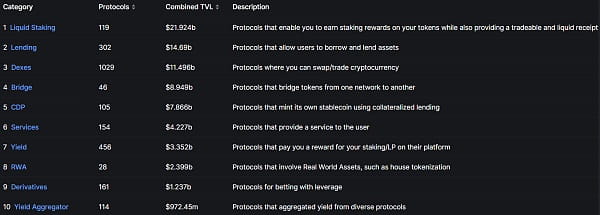
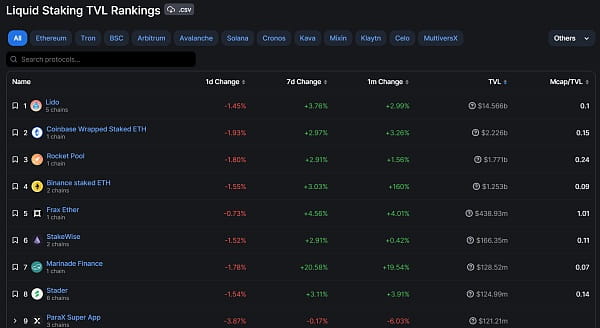
It can be seen that LSD is firmly ahead of the second-ranked lending, with a TVL of nearly US$22 billion. The leader in the field, Lido, has deployed as many as 5 chains, and its TVL has reached US$14.5 billion.
Previously, Bankless gave five potential projects in the LSD track, namely Prisma, Swell, unshETH, Origin Ether, and Diva.
At present, the LSD concept has evolved into LSDFi, which refers to the DeFi protocol built on liquid staking derivatives (LSD). LSD is a token that represents the rights and interests of staking ETH, such as stETH, rETH, wstETH, etc.
LSDFi uses LSD as collateral or assets, providing additional income opportunities and functions such as lending, trading, stablecoins, indexes, etc.
As a downstream application of LSD, LSDFi has also expanded rapidly in the past few months and currently has a total locked value (TVL) of more than $400 million. The main protocols of LSDFi include Lybra, Instadapp, Pendle, Raft, unshETH and Asymetrix.
RWA
RWA (Real World Assets) refers to those assets with real value that are tokenized through blockchain technology. Owning a token means that the user has ownership of the asset in the real world, and the user can conduct transactions such as lending, renting, buying and selling on the chain.
The underlying assets that support its value are usually real estate, stocks, bonds, etc. In fact, the crypto industry has already had successful cases of RWA, such as the commonly used stablecoins USDT and USDC, which belong to RWA.
In terms of operating principle, RWA is to digitally manage and trade actual assets (such as real estate, stocks, bonds, etc.) through blockchain technology. These actual assets will be converted into tokens or other digital assets, and then traded and transferred on the blockchain through smart contracts.
In theory, RWA can provide higher liquidity and lower transaction costs, while also increasing investor confidence and transparency. However, the operation of RWA relies on some intermediaries (such as asset management companies, custodians, etc.) to conduct asset evaluation, token issuance, transaction matching, etc.
The introduction of RWA can bring more real asset support to the cryptocurrency market, thereby increasing investor confidence and market value. Secondly, RWA can bring higher liquidity and lower transaction costs to the traditional financial market, while also providing more investment opportunities.
Especially for DeFi, the digitization of RWA can provide DeFi with more asset types and expand the market size of DeFi.
In addition, RWA can also improve the transparency and security of assets and reduce fraud and risks through digital management and transactions. With the continuous development and application of blockchain technology, the potential of RWA will continue to expand.
However, RWA also faces some challenges in the process of digitalization. The biggest challenge is compliance. Tokenized RWA needs to comply with various laws and regulations and be approved by regulators. This requires a lot of time and cost, and may limit the speed and scale of development in the RWA field.
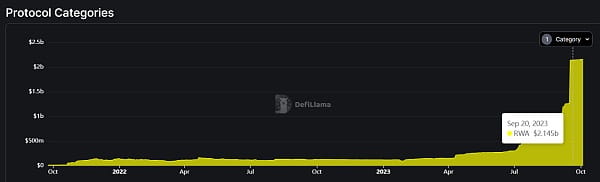
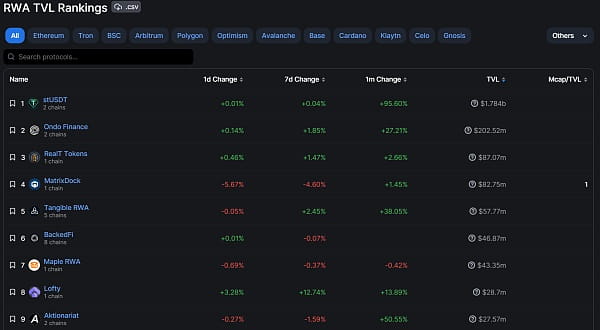
According to DefiLlama data, the RWA track has grown rapidly and is currently ranked among the top ten TVL list with a total of US$2.4 billion.
Representative projects:
1. MakerDAO bonds and stablecoins
MakerDAO is an open-source decentralized autonomous organization created on the Ethereum blockchain in 2014. Anyone holding its token MKR can participate in project governance. In addition, MakerDAO issues the stablecoin DAI and supports and stabilizes the value of DAI through mechanisms such as a dynamic system of collateralized debt positions.
MakerDAO issued the world's first real-asset loan based on DeFi, and laid out the RWA track early. In 2020, MakerDAO officially included RWA as a strategic priority and released guidelines and plans for the introduction of RWA. In addition to issuing the stablecoin DAI, MakerDAO passed a proposal to use RWA as collateral in the form of tokenized real estate, invoices, and accounts receivable to expand the issuance of DAI.
Currently, MakerDAO's total RWA assets have reached US$3.246 billion.
2. Ondo Finance Public Bonds
Ondo Finance is a DeFi protocol founded by Nathan Allman, a former member of the Goldman Sachs digital asset team, and Pinku Surana, a former vice president of the Goldman Sachs technology team. It has currently received US$34 million in investment from well-known institutions such as Pantera Capital, Coinbase Ventures, Tiger Global, and Wintermute.
Ondo Finance is a large, highly liquid ETF managed by asset management giants such as BlackRock and Pacific Investment Management Company (PIMCO). It has launched four tokenized funds: U.S. Money Market Fund (OMMF), U.S. Treasury Bonds (OUSG), Short-Term Bonds (OSTB), and High Yield Bonds (OHYG).
3. Centrifuge Private Credit
Centrifuge was launched in 2017 and is the first project to do RWA on MakerDAO. It is an on-chain ecosystem for structured credit, focusing on securitizing and tokenizing previously illiquid debt. It aims to help central enterprises raise funds with lower thresholds while allowing investors to earn income from real assets.
Centrifuge has raised more than $385 million so far, with its TVL doubling from last year. Its tokenized assets have been integrated into the entire DeFi, including $220 million in risk-weighted assets on MakerDAO.
Huobi Research Institute believes that the RWA market is expected to reach $500 million in 2025. A recent research report by Citibank believes that this is the killer weapon to drive the blockchain industry into the tens of trillions of dollars market. A statistical data from BCG (Boston Consulting Group) shows that the RWA track is expected to reach an overall scale of $16 trillion by 2030.