
The Solana chain breaks the impossible triangle of blockchain and creates a fast, low-cost and decentralized public chain network. Although Solana suffered a major blow from the bankruptcy of FTX at the end of 2022, it is still continuously working hard to find various opportunities, such as issuing Web3 mobile phones, cooperating with VISA, and importing Solana Pay into Shopify, etc., to continuously expand the ecosystem and get rid of the impact of the FTX incident as soon as possible.
What is Solana?
Solana is a high-performance public blockchain network founded by Anatoly Yakovenko in 2017. Its goal is to become a secure, high-speed, and low-cost public chain to support the future decentralized network world, solve the inefficiency problems of the Ethereum blockchain, and provide a foundation for a wider range of Dapps.
The biggest reason why Solana has been able to rise so quickly is that it has broken the impossible triangle of blockchain, namely "security, decentralization, and efficiency"
Most public blockchain networks typically only have ways to satisfy two of these mechanisms, while Solana uses a consensus mechanism called Proof of History that can achieve high throughput and low latency while maintaining decentralization and security.
How does Solana work? Why is Solana called the “Ethereum Killer”?
The Solana network achieves high throughput and low latency transaction processing by integrating multiple innovative technologies and protocols, including the Proof of History (PoH) consensus algorithm, Tower BFT consensus algorithm, and parallel processing mechanism:
Proof of History (PoH): The consensus algorithm uses a cryptographic clock to achieve fast transaction confirmation times. This algorithm timestamps each transaction so that nodes can quickly verify whether the transaction is legal and valid.
Each transaction is timestamped, and a clock keeps track of all previous transactions. This allows nodes on the network to instantly confirm the legitimacy of new transactions.
Tower BFT consensus algorithm: It allows nodes to efficiently reach consensus on the state of the network, and is optimized compared to traditional Byzantine Fault Tolerance (BFT) to meet Solana's high performance requirements.
Written in the Rust programming language: Rust is known for its performance and safety.
These advantages of Solana have been called the "Ethereum Killer" by some because it surpasses Ethereum in speed, throughput, and scalability, becoming a popular choice for developers and users in the past few years.
However, with the upgrade of Ethereum 2.0 and the rapid development of Layer 2, the performance of the Ethereum ecosystem has gradually improved.
Solana Features
High throughput: According to official information, Solana can process more than 65,000 transactions per second.
Low transaction costs: Transaction costs can be reduced to less than $0.00025.
Fast transaction confirmation: Solana's unique consensus mechanism and technical design enable transactions to be confirmed instantly, providing an instant experience.
Scalability: Solana’s architecture and design allow the platform to scale and operate efficiently as the number of users and transaction volume increases.
Support for smart contracts: The DeFi ecosystem continues to grow.
High security: The smart contract language Rust and hybrid consensus mechanism are used to improve security.
Solana Wallet Operation Tutorial
Using the Solana main wallet has the following steps:
Download a wallet that supports Solana, such as Phantom, OKX Web3 wallet.
Create a new Solana wallet account.
Write down your mnemonic as a backup.
Buy SOL tokens and transfer to your wallet (can be purchased from the exchanges mentioned above)
Start operating the relevant ecosystem.
Phantom is the most popular wallet in the Solana ecosystem and has recently undergone a major product upgrade, launching a more modern interface and a smoother user experience.
In addition to the Solana network, the new version also adds comprehensive support for the Ethereum and Polygon public chain ecosystems, realizing cross-chain asset management.
Further reading: OKX Web3 wallet tutorial: security, features, and step-by-step operation
Introduction to Solana's Popular Ecosystem
Raydium
Raydium is an early AMM decentralized exchange in the Solana ecosystem, similar to Ethereum's Uniswap.
Raydium provides a decentralized trading protocol for trading and liquidity mining. Users can provide liquidity for the tokens of the SOL network ecosystem on Raydium and earn income.
Orca
Orca is another DEX decentralized exchange on Solana. Orca is similar to Raydium, but has faster transaction speeds and a more streamlined interface design. It is currently the DEX with the highest TVL on the Solana chain.
Solend
Solend is the largest lending and deposit protocol in the Solana ecosystem. Users can deposit tokens to earn returns, or use deposits as collateral for mortgage loans.
Marinade Finance
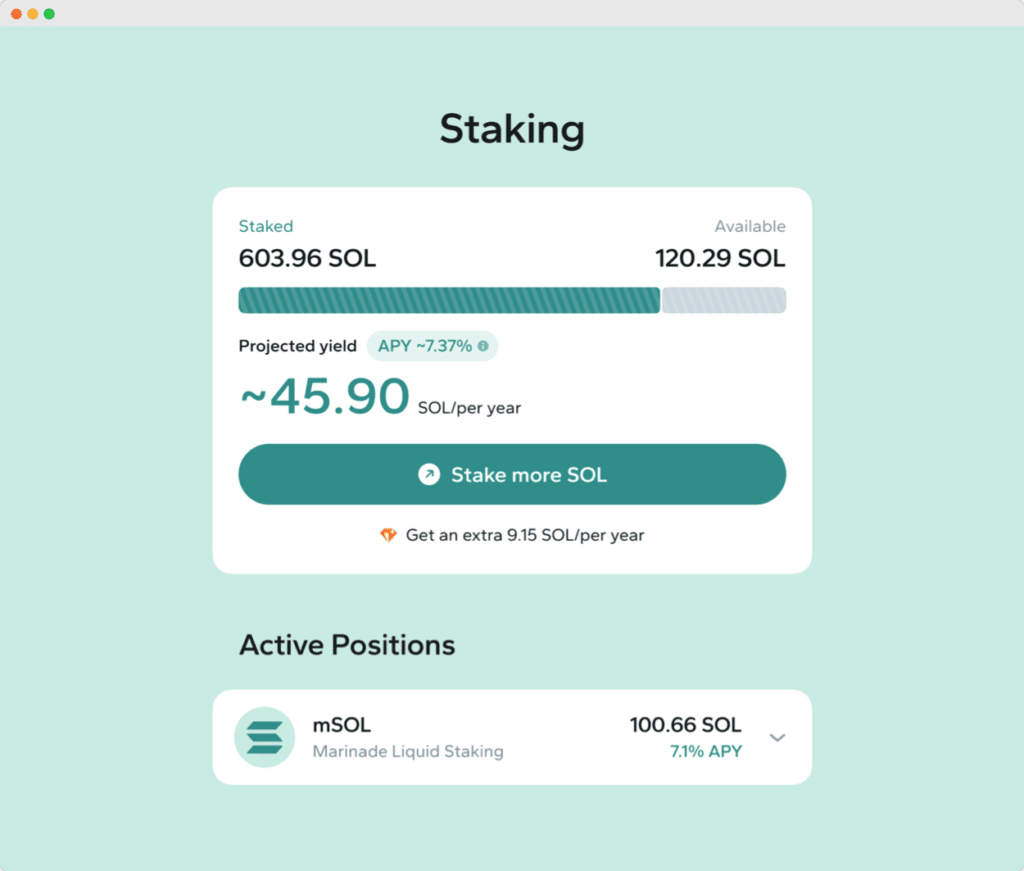
Marinade Finance is a liquidity staking protocol for the Solana ecosystem that provides a way to pledge SOL tokens and obtain higher returns. The pledged SOL coins will be automatically invested in DeFi to obtain transaction fee income, and users can easily earn passive income.
As of now, Marinade Finance is the DeFi protocol with the largest locked-in volume in the Solana ecosystem.
Magic Eden
Magic Eden is one of the popular NFT markets on Solana. It provides a convenient platform for "users" and "creators" to create, issue and trade Solana NFTs. Magic Eden has become an important pillar in the Solana NFT ecosystem.
Note: Magic Eden currently also supports Bitcoin Ordinals, Ethereum, and Polygon NFT markets.
Read more: What is Magic Eden? A complete introduction and tutorial will help you understand it all at once!
Tensor
Tensor is a Solana NFT market that emerged this year. It has designed different interface systems for ordinary users and professional users and is widely loved by Solana users.
In addition, Tensor also launched the same strategy as Blur, using airdrop rewards to attract users to perform related operations. Earlier this year, the trading volume even exceeded the Solana NFT market leader Magic Eden.
Solana 2022 – 2023 Update
Solana will be strongly impacted by FTX in 2022
In 2022, Solana suffered a series of setbacks, the most serious of which was the collapse of FTX.
FTX and the market maker behind it, Alameda Research, are the largest institutions supporting the Solana ecosystem. Their bankruptcy dealt a huge blow to Solana, causing cracks in the ecosystem's funding chain.
Although the Solana ecosystem suffered a major blow in 2022, according to DeFiLlama data, the overall ecosystem TVL has begun to gradually grow. The overall ecosystem locked volume ranks 10th among public chains and 2nd among non-EVM ecological networks, second only to the Tron blockchain network.
Solana Physical Phone
In 2022, Solana launched its first physical phone, Solana Saga. Solana Saga is a physical phone designed for Web3, equipped with a Solana wallet and Solana browser.
Built-in hardware wallet for secure storage of private keys.
An intuitive Web3 app store.
Provide a safer and more convenient Web3 mobile experience.
However, Saga was initially priced at $1,000. Based on Saga's hardware specifications, this price did not have much advantage over other Android phones or iPhones, so actual sales were not as good as expected. However, Saga officials announced in August this year that they would reduce the price of Saga by about 60%, and now it only costs $599 to buy a Saga phone.
Although the sales of Saga phones were not as good as expected, which dealt a huge blow to them, this was the first time that the Web3 world was connected to the Web2 world in a user-friendly way, which was a historic step.

Summary: Solana Current Status and Future
In summary, although Solana encountered a major test at the end of 2022, Solana still has the opportunity to stand out in the market competition with its advantages of speed and efficiency.
For example, Visa, a global credit card giant, recently announced that it will expand the settlement business of the crypto stablecoin USDC to the Solana blockchain. It is the second public chain network to join the project after the Ethereum network.
The well-known e-commerce platform Shopify will also import Solana Pay, a decentralized, peer-to-peer payment protocol launched by Solana Labs, in the coming months.
From the above actions, it can be seen that the Solana team is still working hard to find various opportunities, strengthen the ecosystem, and get rid of the impact of the FTX incident as soon as possible.
Further reading: Breaking through the deadlock: A look at the Solana DeFi ecosystem in 2023