


Blockchain analysis company Chainalysis recently released a research report on the East Asian cryptocurrency market, pointing out that Hong Kong is becoming the "engine" driving the region's Web3 market forward.
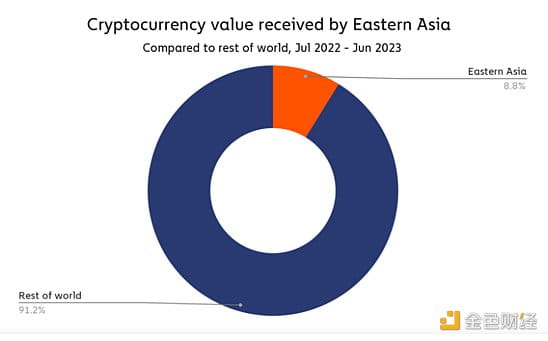
Data shows that East Asia is the world's fifth largest active cryptocurrency market, accounting for 8.8% of global cryptocurrency activity between July 2022 and June 2023.
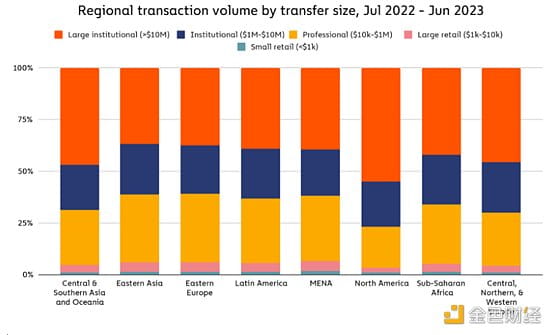
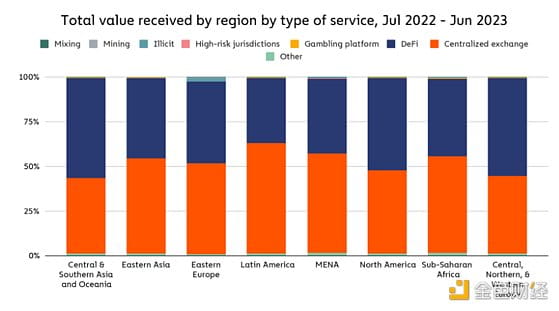
Compared to other markets with larger cryptocurrency activity, East Asia’s cryptocurrency markets appear to be less driven by institutional activity, showing a higher “DeFi propensity” than similarly sized markets such as the Middle East, North Africa, and Latin America.
In fact, in 2019, East Asia was one of the markets with the highest cryptocurrency trading volume in the world, but after a series of domestic bans on cryptocurrencies, trading activities and mining markets fell sharply in the following two years.
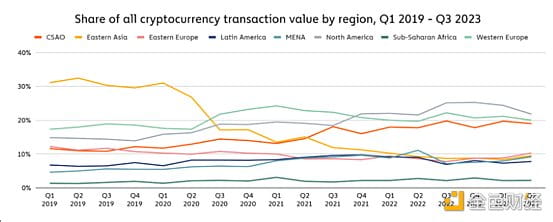
Data shows that the main driving force behind the recovery of cryptocurrency activities in East Asia actually comes from Hong Kong, China. Hong Kong has recently launched a series of friendly cryptocurrency policies and compliance measures, which have promoted market optimism. In terms of raw transaction volume, Hong Kong is an extremely active cryptocurrency market. From July 2022 to June 2023, the estimated transaction volume of Hong Kong's cryptocurrency has reached US$64 billion. Although it is a bit far from the two major markets of Japan and South Korea with over US$100 billion, if factors such as market size and population are taken into account, the momentum of cryptocurrency trading activities in Hong Kong is still very strong.
The reason why Hong Kong has been able to take the lead in the East Asian crypto market in a short period of time is largely due to the highly active over-the-counter (OTC) market in the region. These services usually provide large-value transfer functions for institutional investors and high-net-worth individuals. Analysis found that:
l Hong Kong, China has a high market share in institutional-level large-scale crypto trading activities of US$10 million or more.
l South Korea appears to be the least institutionally driven market in East Asia, likely due to local regulations that make trading difficult for financial institutions (South Korea requires a specific type of bank account associated with an individual to open a cryptocurrency trading account, making it challenging for institutional players to enter the cryptocurrency market).
Most cryptocurrency activities in Japan are almost evenly distributed between centralized exchanges and various types of DeFi protocols. (Note: There are fewer DeFi-related transactions in South Korea, which may be related to the TerraLuna crash. Locals prefer to conduct activities on centralized exchanges)
Hong Kong’s growing status as a cryptocurrency hub
As a special administrative region of China, Hong Kong has autonomy over many aspects of policy, including the regulation of cryptocurrencies. As mentioned above, Hong Kong has become a large local crypto market driven by over-the-counter trading, but what exactly is driving local cryptocurrency adoption, and what does Hong Kong mean for the future of cryptocurrencies in the region as a whole? Merton Lam of CryptoHK and Dave Chapman of OSL Digital Securities provide some insights.
Both acknowledged that a variety of use cases have driven the adoption of cryptocurrencies in Hong Kong. Dave Chapman said, "Many institutional investors are bullish on cryptocurrencies, and the future of digital assets is no longer in doubt; people generally believe that digital assets will not disappear, regardless of whether traditional finance is ready to accept digital assets as a new asset class."
Merton Lam said that international commercial payments are another important use case for cryptocurrencies in Hong Kong, because crypto payments can provide more advantages than bank transfers. For many businesses, it is much easier to pay suppliers through stablecoin transfers than through banks. SWIFT transactions can take up to three days to settle, and payments are particularly difficult when dealing with counterparties in developing countries such as South Asia and Africa. The international payment use case also reminds people of another noteworthy factor: the dominance of the US dollar in international trade is being weakened.
Overall, Hong Kong’s unique cryptocurrency market offers a variety of use cases, suitable not only for local users but also for foreign users, while a series of local regulatory initiatives may indicate that the stance towards cryptocurrencies in East Asia is changing.