


Author: Bitkoala Finance
The crypto market downturn has begun to affect the NFT sector, although the launch of Bitcoin Ordinals has injected a shot in the arm to this sector and opened a new chapter in the NFT narrative. However, as with the development of other emerging markets, not all narratives can maintain their initial momentum.
This article will start with data, delve into the latest trends of Bitcoin Ordinals, and compare its development trajectory with other players in the NFT field.
Bitcoin Ordinals Plunge: Sales and Transaction Value Drop Sharply
Bitcoin Ordinals was a hot topic in the second quarter of this year. The introduction of NFTs and smart contracts into this "oldest" blockchain completely changed people's traditional views on Bitcoin, but just a few months later, the situation took a sharp turn for the worse.
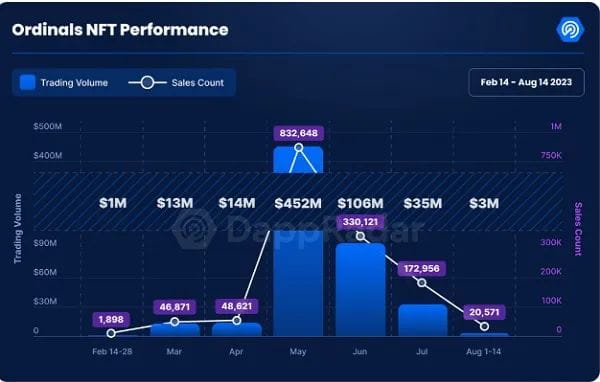
Judging by the volume and number of sales, Bitcoin Ordinals appears to be facing a serious downturn.
May 2023 was the peak for Bitcoin Ordinals, with 832,648 transactions and an impressive $452 million in sales.
The wind direction changed in June 2023, and Bitcoin Ordinals sales plummeted 76.5% to US$106 million. At the same time, the number of transactions also dropped sharply by 60.3% to 330,121 transactions, and trading enthusiasm weakened.
Data for July 2023 further exacerbated the decline, with sales falling 66.9% to $35 million and transaction volume falling 47.6% to 172,956.
Early data for August 2023 paints an even more dire picture, with sales shrinking 91.4% to a “miserable” $3 million and transaction volume falling 88.1% to just 20,571 transactions, highlighting the lack of deal interest.
The dramatic drop in sales and volume in such a short period of time is shocking for Bitcoin Ordinals, and the reduction in sales highlights that enthusiasm and confidence in Bitcoin NFTs has waned significantly. While fluctuations in sales can be attributed to market dynamics, the continued decline in the number of transactions may indicate a broader problem, indicating that fewer and fewer traders are participating in Bitcoin Ordinals. The next few months will be critical to discern whether this trend is a temporary setback or there are more systemic problems with Bitcoin NFTs.
How Ethereum and Polygon Collectibles Face the Current Downtrend of the NFT Market
In terms of the number of independent wallet addresses, as shown in the figure below, Bitcoin Ordinals once soared from 696 in February to a peak of 79,261 in May, but then experienced a rapid decline. The trend after May was very dramatic - Bitcoin Ordinals independent wallet addresses fell to 40,932 in July and 6,708 in the first half of August. In contrast, although the Ethereum and Polygon NFT markets are more resilient, they are not immune to market challenges.
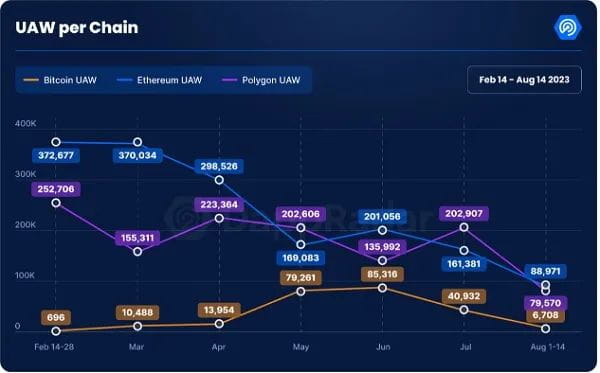
In the NFT world, Ethereum and Polygon have longer reputations and wider applications, which makes them relatively less vulnerable to drastic changes in the market. In addition, it is worth noting that Bitcoin NFTs are highly concentrated in the PFP category, and generally speaking, there are not many real use cases for PFP. Most NFT digital collections on the Bitcoin blockchain are still in their early stages and still lack the innovation that the NFT field is experiencing - especially in terms of interoperability, vitality, and practicality.
Ethereum hosts a wide variety of NFTs, Polygon benefits from the growth of the NFT gaming space, and Bitcoin, still seems overly concerned with the "early days" hype of NFTs. Public sentiment seems mixed. Many believe that the hype around Bitcoin Ordinals was unsustainable from the start.
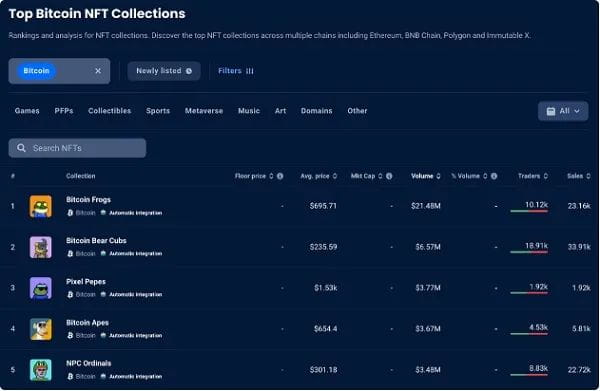
There are some voices within the community that view Bitcoin primarily as “digital gold,” suggesting that its primary function should still be a store of value. Ethereum, on the other hand, is often referred to as “digital oil,” indicating its role in driving the digital economy.
in conclusion
Overall, the significant decline in sales of Bitcoin Ordinals and the sluggish trend of the NFT market have sparked discussions about the future of NFTs on the Bitcoin blockchain. Although it is too early to completely dismiss Bitcoin NFTs, there is still some doubts about the volatility of Bitcoin NFTs. In terms of uncertainty and unpredictability, the current market trend of gradually falling into a "death spiral" has issued a serious warning.
Many in the community believe that Bitcoin and Ethereum have different uses and perhaps the boundaries should be clearer. The next few months will be crucial in determining whether Bitcoin can find a foothold in the evolving NFT landscape or resume its primary role as a store of value.