

Original source: AiYing Compliance
Reprinted by: Alvis, Mars Finance
In recent years, Turkey's cryptocurrency market has been rapidly globalizing, growing from a regional market to an important part of the global crypto industry. Internationally renowned crypto companies such as Coinbase and KuCoin have entered the Turkish market, reflecting the huge potential and strategic importance of the market.
The Capital Markets Board of Turkey (CMB) recently updated the regulation of cryptocurrencies, which directly led to a surge in the number of companies applying for licenses. The initial 47 applications quickly expanded to 76. This bill provides a clearer regulatory framework for crypto asset service providers in Turkey, prompting companies to actively seek legal ways to operate. However, although these companies have been included in the "List of Operating Companies", this does not mean that they have obtained a formal operating license. The CMB made it clear that the final authorization still needs to be approved by the board of directors, and the key to this process lies in the promulgation of secondary legislation. What has driven the development of the Turkish market in recent years? Aiying Aiying will take you to learn more about it.
1. Peculiarities of the Turkish Market
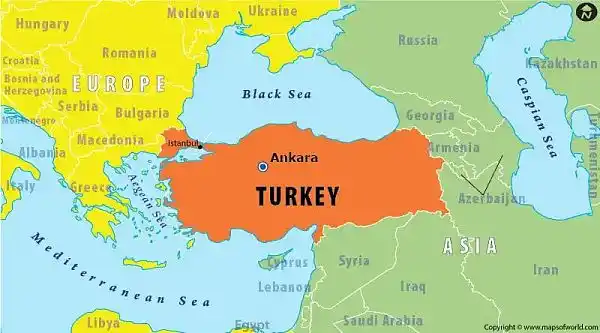
Turkey is located at the junction of Europe and Asia, and its geographical location is extremely strategic. By setting up operations in Turkey, crypto companies can more effectively cover the European, Middle Eastern and North African markets and expand their global business footprint.
In addition, Turkey's cryptocurrency market is becoming increasingly important worldwide and has become the fourth largest market. According to Chainalysis data, Turkey's annual cryptocurrency trading volume is approximately $170 billion, which is an astonishing number that exceeds many traditionally more well-known markets, such as Russia and Canada. Aiying Aiying shows you the relevant data through Kaiko's report:
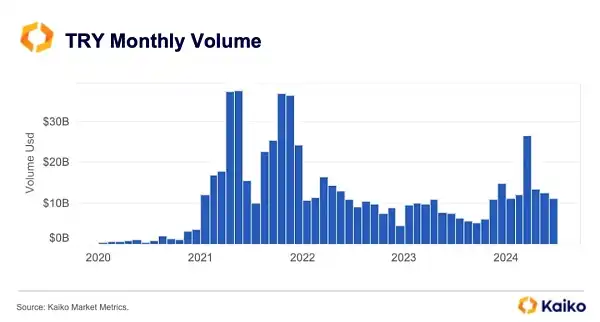
1. The growth of the Turkish Lira in cryptocurrency trading: Over the past four years, the trading volume of the Turkish Lira has grown from a few million US dollars to more than $10 billion. In 2024, the monthly trading volume of TRY trading pairs exceeded $10 billion for eight consecutive months, which is the longest period of sustained high trading volume on record. The cumulative trading volume for the whole year is about $95 billion, which is almost equivalent to the total trading volume for the whole year of 2023.
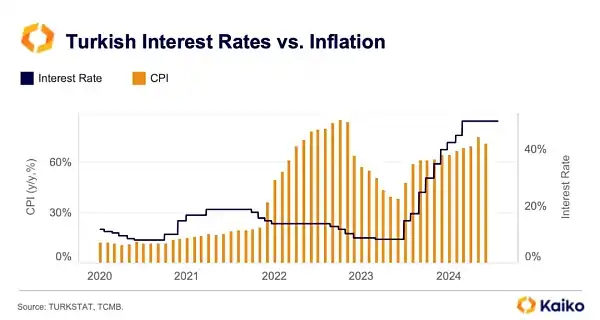
2. Turkey has long faced the problems of high inflation and currency depreciation. In particular, the Turkish Central Bank has been adopting a monetary policy of interest rate cuts until 2023, driven by "Erdogan Economics", which has exacerbated the depreciation of the lira. Despite a policy shift after the 2023 election, the lira's depreciation has only slowed, without significantly restoring confidence. The Turkish lira depreciated by more than 300% between the end of 2020 and the end of 2023.
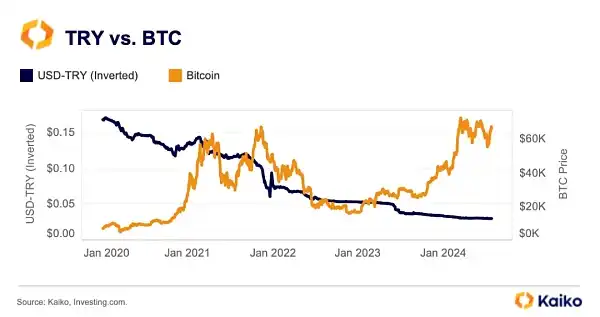
3. The safe-haven role of cryptocurrencies: Contrary to the depreciation of the lira, the price of Bitcoin has increased significantly since 2021, becoming an important value-preservation tool for Turkish investors. This has led to a surge in trading volume for the BTC-TRY trading pair, up more than 800% since 2021.
4. Binance's market dominance: Although several other exchanges such as Gate.io, KuCoin, and OKX have recently entered the Turkish market, their market share is less than 1%, while Binance and BTCTurk are the most commonly used platforms by Turkish traders. Although BTCTurk is the largest local platform, its market share has dropped from 95% in 2020 to 13% in 2024. Binance has gradually dominated the market due to its deep liquidity and low transaction fees.
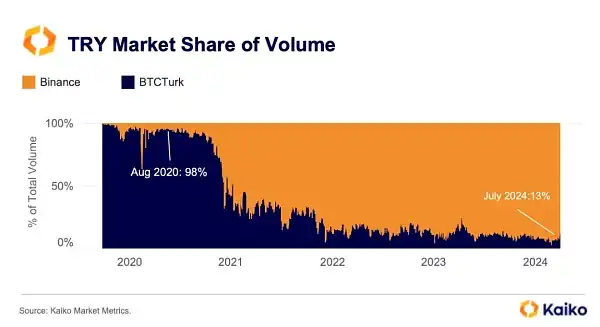
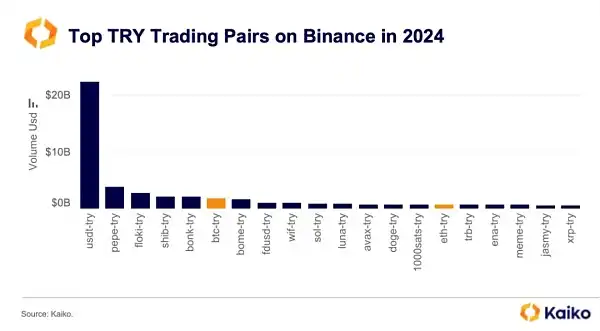
5. Stablecoins are expanding: Due to Turkey’s inflationary environment, the use of stablecoins has increased significantly. In 2024, USDT-TRY was the largest trading pair on Binance, exceeding $22 billion.
According to Aiying, cryptocurrency transactions have been deeply integrated into daily life in big cities such as Istanbul. For example, in some small shops near the Grand Bazaar, customers can directly exchange cash for Bitcoin or USDT. In addition, some Turkish real estate developers and agents also accept Bitcoin as a payment method for real estate transactions. In the tourism industry, including travel companies, hotels and travel agencies, more and more merchants are beginning to accept cryptocurrency payments. The number of cryptocurrency ATMs in Istanbul is also increasing, and users can conveniently use cash to buy major cryptocurrencies such as Bitcoin and Ethereum. These phenomena show that the popularity of cryptocurrencies in Turkey is deepening and is becoming part of daily transactions. Therefore, this has also become the reason why many crypto agencies choose to be stationed here.
II. Türkiye's Capital Markets Law Amendment
Turkey's new Capital Markets Law Amendment Act officially came into effect on July 2, 2024. This regulatory update brought many changes to the cryptocurrency market with the aim of better regulating this rapidly developing field. Here are the main contents of this law, explained in a more understandable way. Here is Aiying's summary of the key points of the bill:
1. Licensing system and compliance requirements
The new regulations stipulate that all cryptocurrency-related service providers, including trading platforms, custody services, etc., must obtain operating licenses from the Turkish Capital Markets Board (CMB). In other words, both local and international companies must first be approved and obtain a license before they can legally conduct business in Turkey. In addition, these companies must also comply with stricter compliance requirements, such as international standards such as Anti-Money Laundering (AML) and Know Your Customer (KYC) to ensure transparency and security of business operations.
2. Obligation to pay fees
The new bill also stipulates that all cryptocurrency platforms must pay an annual fee equivalent to 2% of their revenue, 1% to CMB and 1% to the Scientific and Technological Research Council of Turkey (TUBITAK). These fees are to support the government's regulatory work and ensure the order and stability of the market. This may be a considerable burden for small businesses, but overall it will help create a fair and sustainable market environment.
3. Transitional period and provisions for existing enterprises
For cryptocurrency companies already operating in Turkey, the new regulations set a transition period. These companies need to submit a statement to the CMB within one month after the law comes into effect, either applying for a license to continue operating, or completing liquidation within three months to ensure that the interests of customers are not harmed. During the transition period, these companies are not allowed to accept new customers and must focus on meeting the requirements of the new regulations.
4. Classification of Crypto Assets
The new bill provides a detailed classification of crypto assets, mainly including:
Security-type crypto assets: crypto assets similar to traditional securities.
E-currency crypto assets: Cryptocurrencies used for electronic payments.
· Utility crypto assets: crypto assets that provide access to a certain service or product, such as NFTs.
Technology-driven crypto assets: such as Bitcoin and Ethereum, whose value is inseparable from their underlying blockchain technology.
These classifications help clarify the regulatory requirements for different types of crypto-assets, ensuring that each asset operates within the appropriate legal framework.
5. Requirements for foreign platforms
The new regulations also set clear requirements for foreign cryptocurrency platforms. If these platforms market through Turkish websites or specifically to Turkish customers, they must stop these activities within three months after the bill comes into effect, unless they obtain a license from the CMB. This regulation is intended to prevent unauthorized foreign platforms from operating in the Turkish market and ensure that all service providers compete under the same regulatory framework. According to Aiying, Binance has announced that it will update its services in accordance with Turkey's new cryptocurrency regulations. All direct marketing activities for local users will be completely stopped, and the Turkish language option for Binance.com services will be gradually closed within 3 months.
6. Transactions and Customer Protection
Under the new bill, the CMB will formulate detailed trading and customer protection rules. All contracts between service providers and customers must be signed in writing, and any clauses that limit or exclude the service provider's liability to customers will be deemed invalid. The CMB will also regulate the content of these contracts to ensure that customer rights are fully protected.
7. Penalties for Violations
The new regulations set strict penalties for unauthorized cryptocurrency service activities, including fines and imprisonment. Any service provider’s employees or shareholders who are involved in illegal activities will face severe legal consequences.
Turkey's position in the global cryptocurrency industry is becoming increasingly important, especially considering its huge market demand and strategic location. As the world's fourth largest cryptocurrency market, Turkey not only occupies an important position in terms of trading volume, but also becomes a frontier market for cryptocurrency applications due to its domestic economic conditions and young, technology-sensitive user groups. As the market matures and policies become more clear, Turkey is expected to play a greater role in the global cryptocurrency industry and contribute to the innovation and development of the global market. Aiying is also paying attention to it, and everyone is welcome to communicate on WeChat.
