
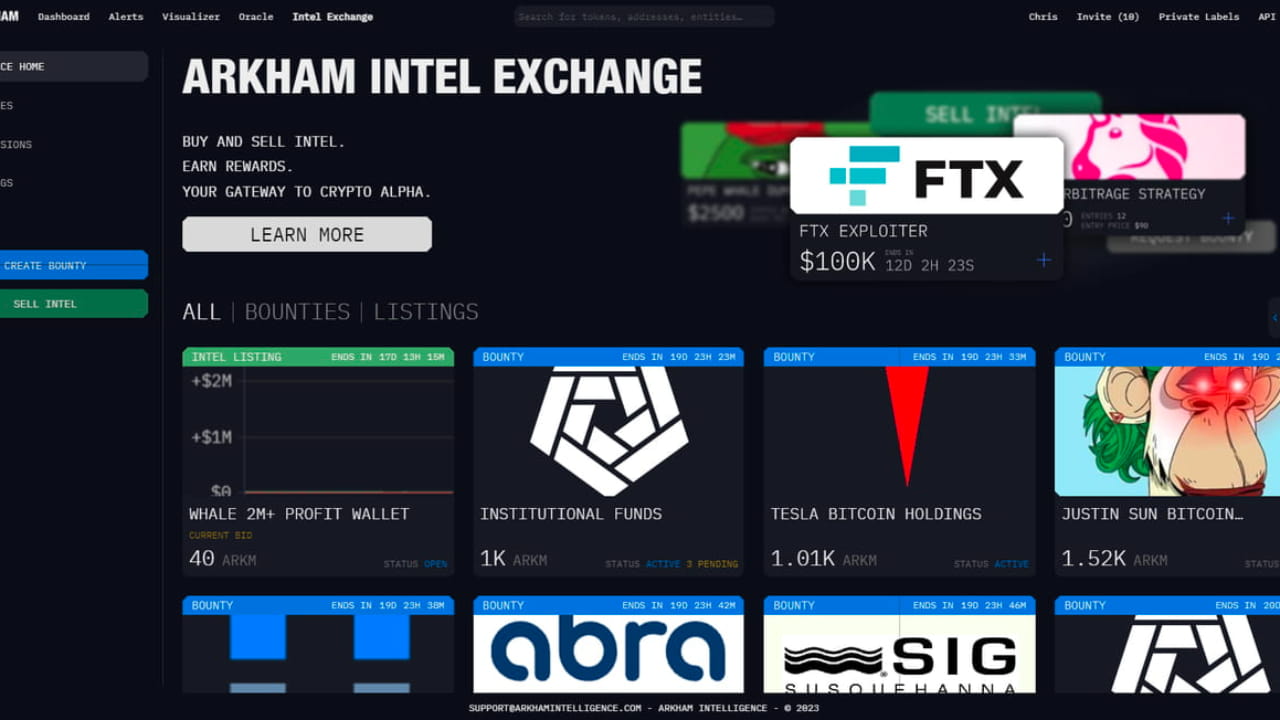
Arkham, a new project recently launched on Binance, has become a tool frequently used by many on-chain data analysts. Some analysts use Arkham to analyze whether the market maker DWF is really manipulating some small-market value projects. Some analysts use Arkham to monitor tokens. Coin’s multi-chain transaction information.
So what kind of on-chain data analysis platform is Arkham? Can Arkham become a powerful tool for on-chain supervision? Below I will answer the above questions through this article.
Arkham product functions Arkham products are mainly divided into several product modules such as address and token details, user-defined panels, monitoring, visual maps, AI robots, and on-chain intelligence information trading platform.
1.Address and token details
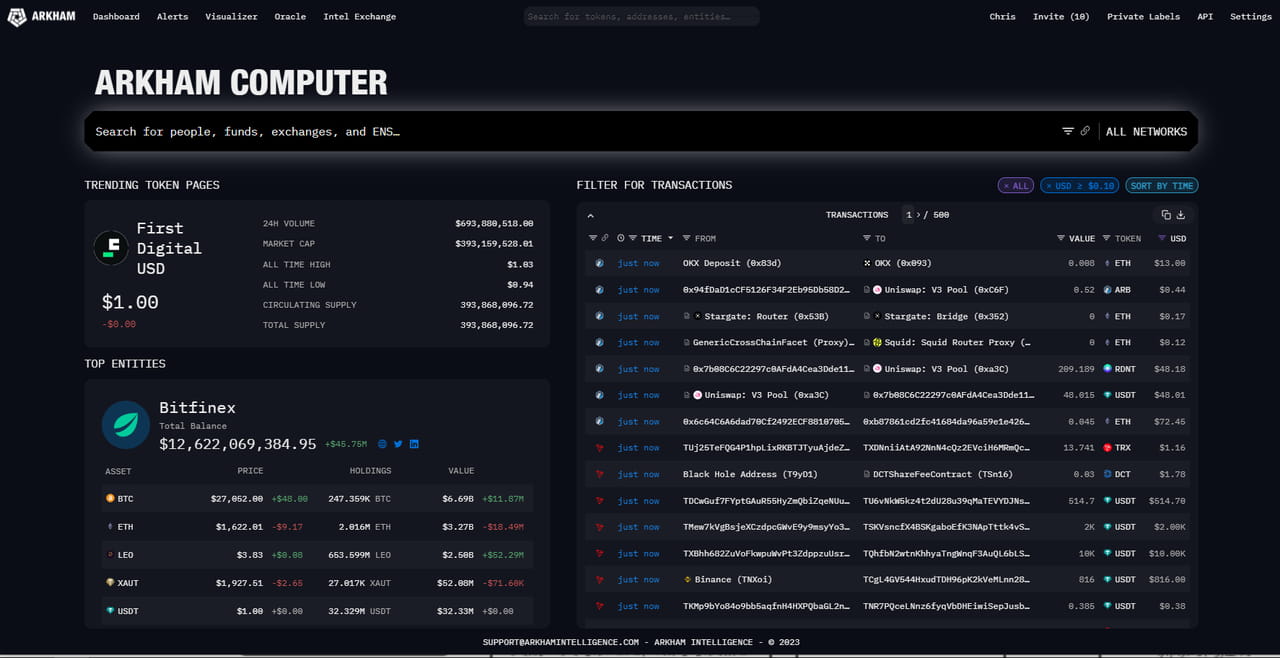
The Arkham homepage displays popular tokens, mainstream institutions, and real-time transaction data on the chain. Transaction data can be filtered by transaction quantity, sender and recipient, and other conditions. In the search box above, you can search for Twitter username, address, entity, and ENS, and enter the details page. This method is equivalent to realizing the matching of on-chain and off-chain information, allowing users to associate messy on-chain data with real entities off the chain.
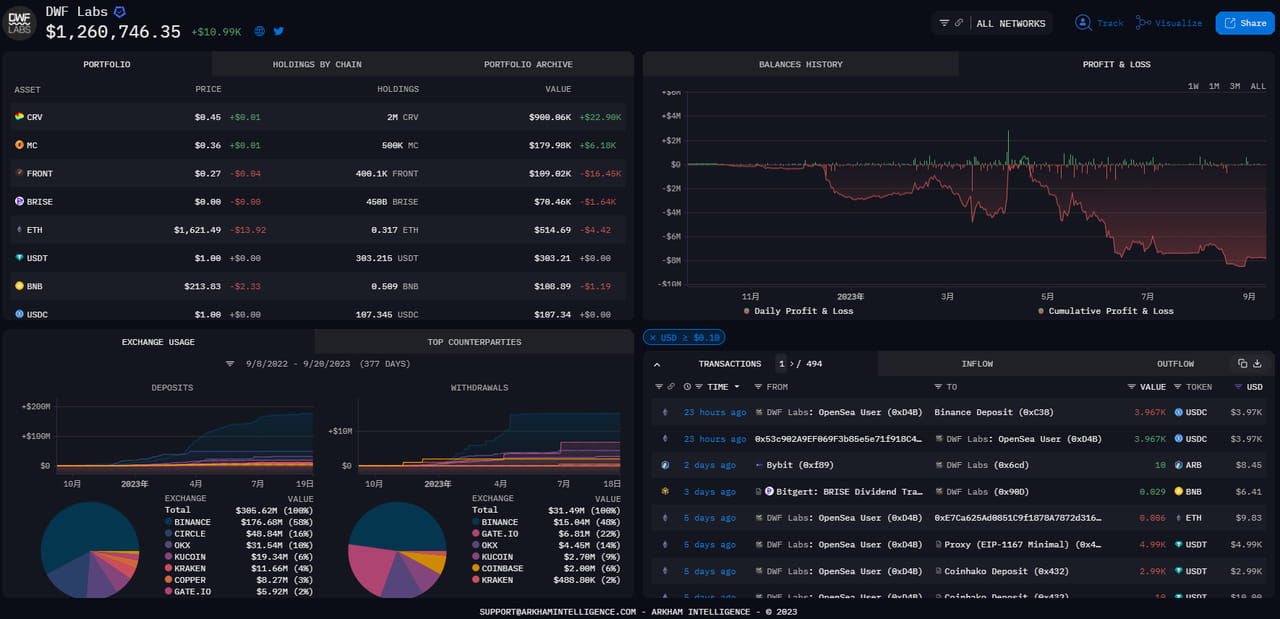
On the entity details page, Arkham aggregates the total assets of the entity in each chain, and does not use a scoring system to rate addresses or entities. Instead, it displays data in various dimensions, and also performs statistical calculations on profits and losses to display to users. When displaying transaction data, Arkham automatically filters spam transaction information and advertising information on the chain to minimize the misleading of invalid data information to users. For entities, you can directly click to enter the official website or Twitter, which facilitates users to understand more detailed off-chain entity information and reduces the interference of phishing websites to users.
2.Dashboard
Arkham supports users to customize data dashboards. Users can choose different data statistical dimensions to form their own dashboards. Compared with dune, Arkham's user threshold is relatively low. Users do not need to understand the underlying data structure and programming language. They only need to customize it according to business needs.
3. Monitoring (Alerts)
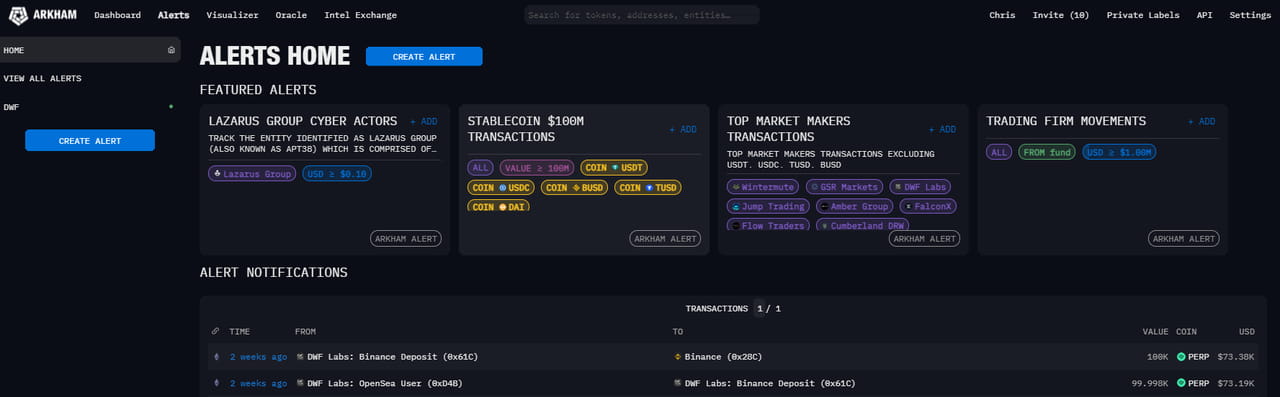
Arkham's monitoring module provides a monitoring dashboard function, allowing users to have a more intuitive understanding of the progress of monitoring tasks. It also provides some regular monitoring tasks for large-value transfers and stablecoin transactions on the chain for novice users to choose from. The monitoring reminder method supports email, but the content of the email reminder is relatively simple and requires users to enter the platform to query after receiving monitoring.
4. Visualizer
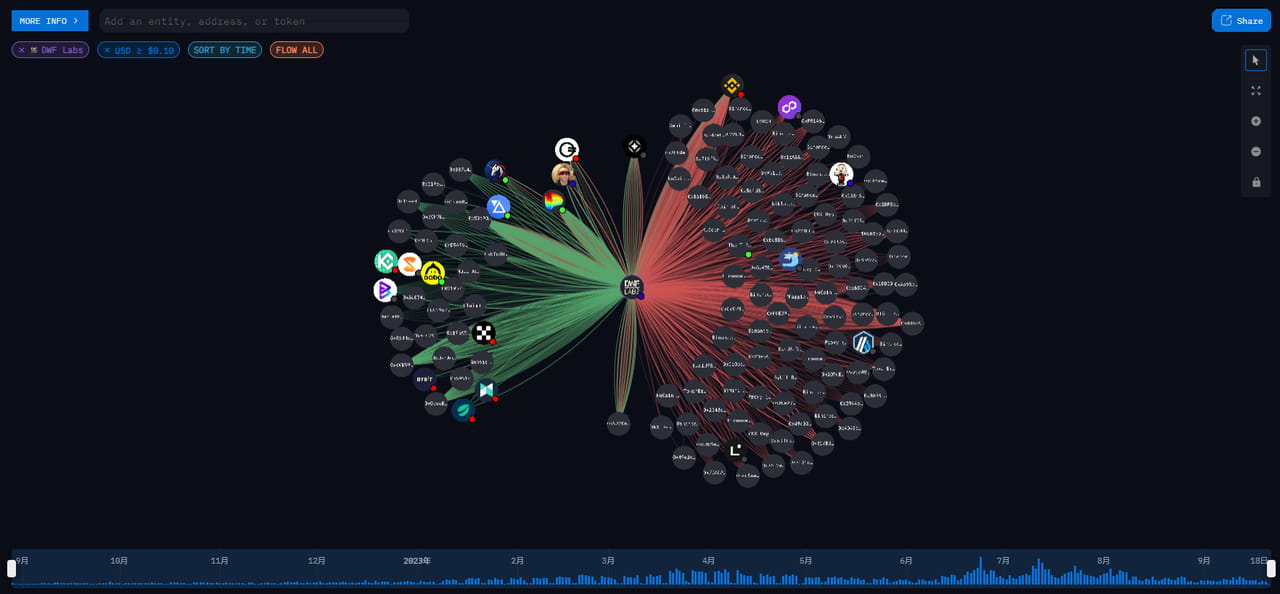
Visualized graphs are standard features of on-chain data analysis platforms. Compared with other platforms, Arkham’s graph function does not have a great differentiation advantage, but its rapid generation of complex address graphs illustrates the performance and technology of its system. The reserve is pretty good.
5.AI Assistant (Oracle)
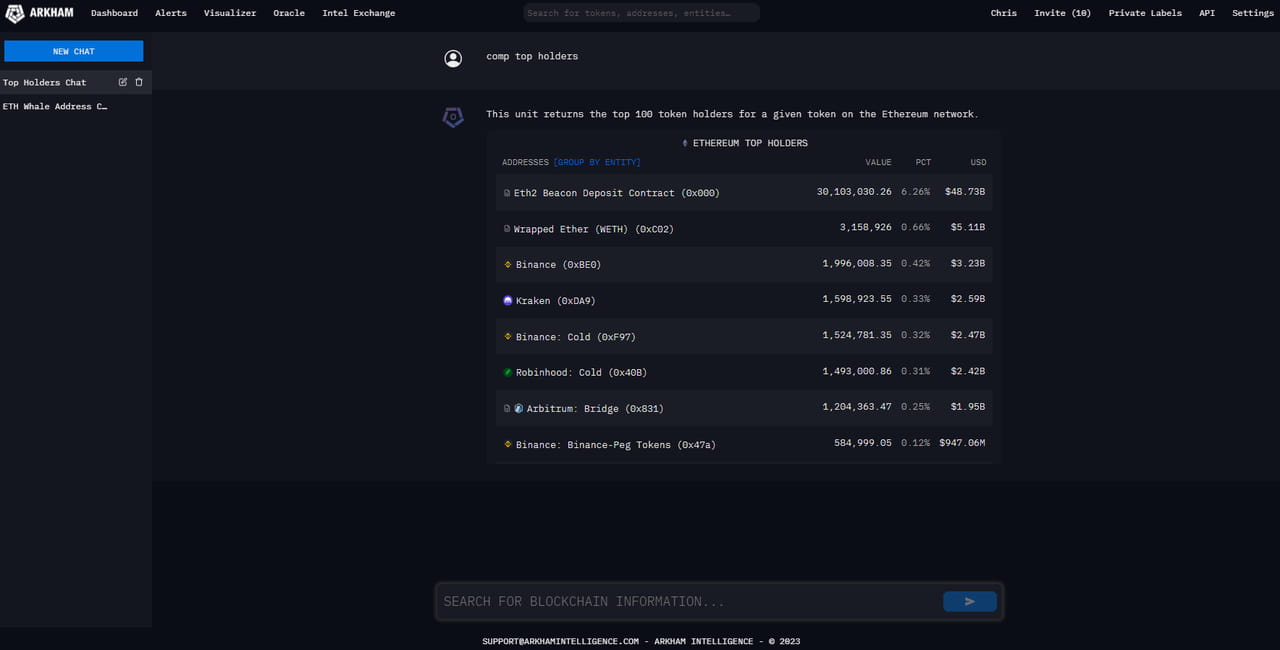
Arkham's artificial intelligence engine ULTRA was supported by the founder of OpenAI during the development process, so its AI functions are among the leading among similar products. Users can directly obtain on-chain data through dialogue with the AI.
6. On-chain intelligence information trading platform (inter exchange)
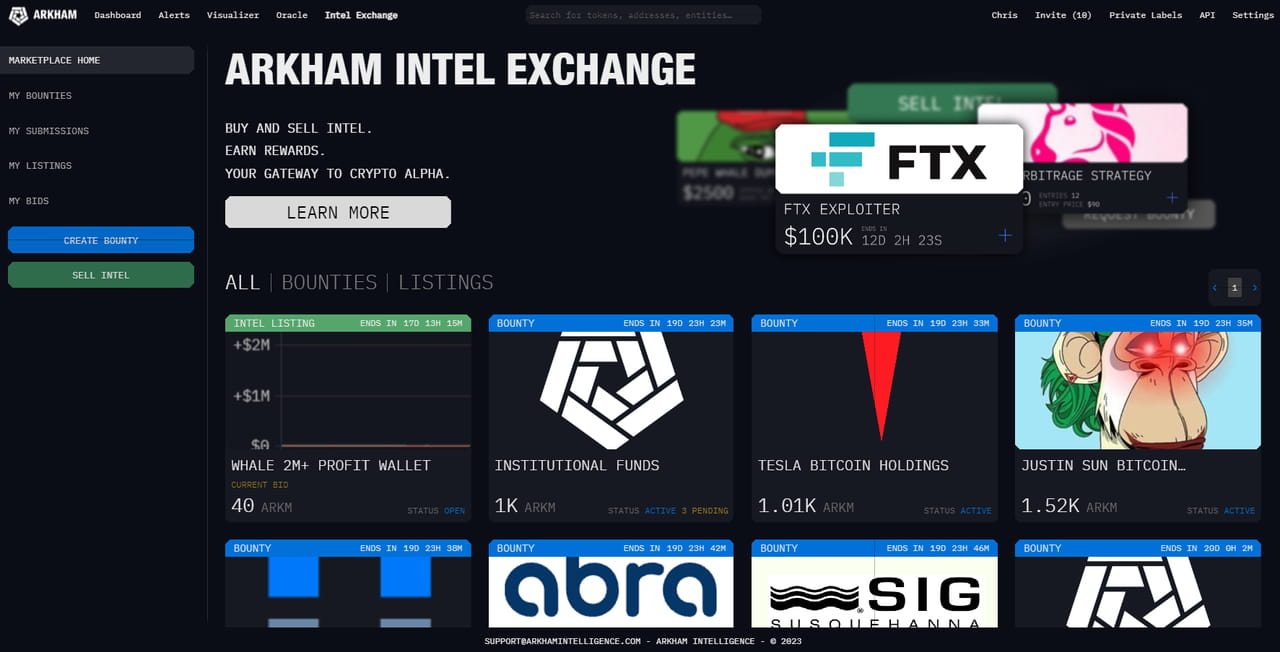
Arkham’s unique on-chain intelligence information transaction is a major feature of this product. In the blockchain world, on-chain address information is mostly anonymous. With the emergence of related address labels and address portrait products, on-chain addresses are gradually becoming more and more closely related to each other. Real world connections. Arkham's inter exchange function makes on-chain addresses and off-chain real information exchangeable. Users can collect on-chain information intelligence through bounty rewards on the platform, and some valuable on-chain information can also be auctioned on the platform.
1. Intelligence acquisition: The acquirer of intelligence information publishes the information he wants to obtain through arkm bounty, and the information provider needs to pledge arkm to provide information. In order to prevent the provision of spam information, if the submitted information is rejected, the information provider will lose The pledged arkm.
If the publisher of intelligence information for the first time wants to be the exclusive acquirer of the intelligence, he or she needs to pledge additional arkm to have the right to obtain exclusive information.
2. Intelligence auction: Providers of intelligence information can also sell valuable on-chain information through auctions. Sellers also need to pledge arkm when submitting information. The platform will detect the intelligence information. If it is spam, the seller will lose Pledged arkm. If any user knows the intelligence information of the hacker, he or she can obtain rewards through inter exchange.
Generally speaking, although Arkham's Oracle, inter exchange and other product functions are eye-catching, what attracts me more is its accurate and wide-coverage address label function. When performing on-chain data query, other platforms do not have address labels. , you can find the answer on the Arkham platform, and the label data for new addresses is also updated the fastest. In on-chain data analysis products, address tags are the cornerstone of the product, and an accurate and rich address tag database can determine the upper limit of the product. Many people may ask why Arkham has such a rich address tag library? Maybe you will get the answer when you see its investor Palantir. Palantir is a big data analysis and intelligence services company. Its customers include the US Department of Defense, the US Central Intelligence Agency (CIA), the British Ministry of Defense and other government departments.
Can Arkham become a powerful tool for on-chain supervision?
For supervision, the accuracy, timeliness, and richness of the address tag library can determine the effectiveness and difficulty of regulatory enforcement, and this tag library is the advantage of Arkham's products. Regulatory authorities can obtain regular on-chain addresses and entity label information through Arkham, and can directly link to the entity's official website and official tweets to establish contact with it.
Another pain point in supervision is how to identify unlabeled addresses. A common method in the industry is to find the label information of its associated address, so as to infer the unlabeled address. However, for some situations where there is little transaction data information and no valid information on the associated address, perhaps Arkham The inter exchange can play an important role by publishing the address information to be searched for in the form of bounties. Some private security teams or on-chain analysts can cooperate with regulatory authorities in this way.
In addition, Arkham's Oracle can also help regulatory authorities lower the threshold for law enforcement, and obtain useful on-chain data information through this AI-intelligent and highly confidential method to assist them in completing regulatory enforcement. #Arkm