

1. The principle of usde
It is essentially a funding rate arbitrage agreement. USDE is a new type of stablecoin collateralized by equal amounts of spot longs (mainly ETH) and futures shorts.
The benefits of the agreement come from two aspects:
1) Staking income for spot longs. Staking spot ETH through liquidity staking derivative protocols such as Lido can earn an annualized return of 3% - 5%.
2) Unstable returns from futures short funding rates. Users familiar with futures contracts understand the concept of funding rates. Although funding rates are an unstable factor, for short positions, the funding rates are positive most of the time in the long run, which also means that the overall returns will be positive.
The combination of the two benefits and the current bull market make the yield of usde very objective.
2. Potential risks of usde
The ethena official website has analyzed several risks in detail, which are roughly as follows:
1) Funding Risk. Although the funding rate of short positions is positive most of the time, there is a possibility that it will turn negative. If the comprehensive rate of return after weighted staking income is negative, the protocol income will be negative.
2) Liquidation Risk. Ethena uses spot assets of ETH and BTC as collateral for its short derivatives positions, and also uses a portion of staked Ethereum (stETH) as collateral. Since stETH is different from the underlying assets of derivatives positions (such as ETH or BTC), there may be a difference in value, which will trigger liquidation risk. The official website discussed that the probability of this happening is extremely low and the risk is controllable, mainly because Ethena uses very low leverage, the exchange is gradually liquidated, historical data shows that the stETH spread is usually small, and the Ethena team has emergency funds and corresponding measures.
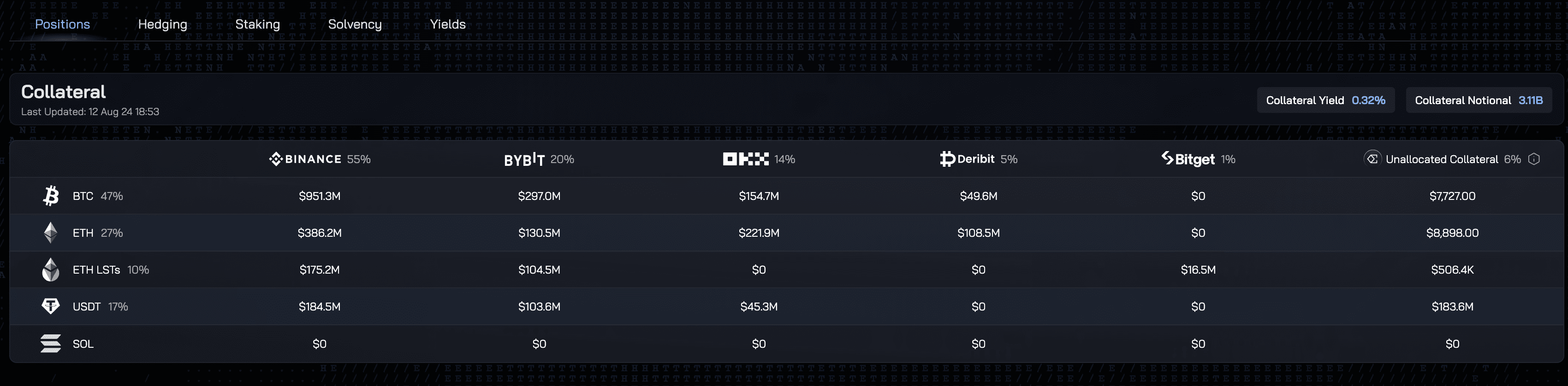
3) Custodial Risk and Exchange Failure Risk: Ethena adopts the "Off-Exchange Settlement" custodial method. In simple terms, funds are usually managed by the principal (ie Ethena), the custodian (third-party custodian) and the exchange, eliminating the single point risk of centralized exchanges (but also introducing the risk of custodians doing evil and failing). Ethena reduces risks by making the settlement cycle as short as possible, diversifying partners as much as possible, and monitoring the market and the operations of partner institutions.
4) Collateral Risk. This article mainly discusses the liquidity of pledged Ethereum (Ethereum LSTs) and the risk of LST collapsing if the pledge protocol fails. The liquidity issue is mainly the liquidity of the market supported by Ethena. If LST collapses, it will not only affect the Ethena protocol, but the entire Ethereum ecosystem may have to undergo a hard fork.
In addition, the official website did not mention the risk of market capacity. The current market value of usde is about 3.1 billion (2024-08). A large part of usde's income comes from the funding rate of short positions. If the volume increases, the short positions in the contract market will definitely affect the yield of contract funding fees and the liquidity of redemption in a short period of time. At the same time, there will be greater transaction friction and slippage. Normally, the yield of usde will continue to decline.
Conclusion
In general, I feel that the funding rate of the contract market under extreme market conditions, the collapse of exchanges and custodians, the pledge agreement of the Ethereum ecosystem and the price difference of pledged coins, and the situation of the Ethena project are all risk points that need to be paid attention to in the development of usde. However, the current market value of usde is 3.1 billion (usdc is more than 30 billion, and usdt is more than 100 billion). The current project is still in its early stages. Considering the current size and current market conditions, the current APR is still somewhat attractive, and there is still money to be made, but attention should be paid to the related risks mentioned above.
Off topic, we must realize that many of the project parties are also grass-roots platforms. Many of the risk control management measures in the official website introduction are human intervention and emergency funds to reduce risks. Human intervention is easy to fail (mistakes, attacks, deliberate evil), and emergency funds often cannot be saved after the project size increases. Of course, usde is currently playable, DYOR.