

As digitalization and blockchain technology become increasingly mature, various applications and platforms continue to emerge, aiming to improve our lives and work efficiency, and similar cases are constantly unfolding.
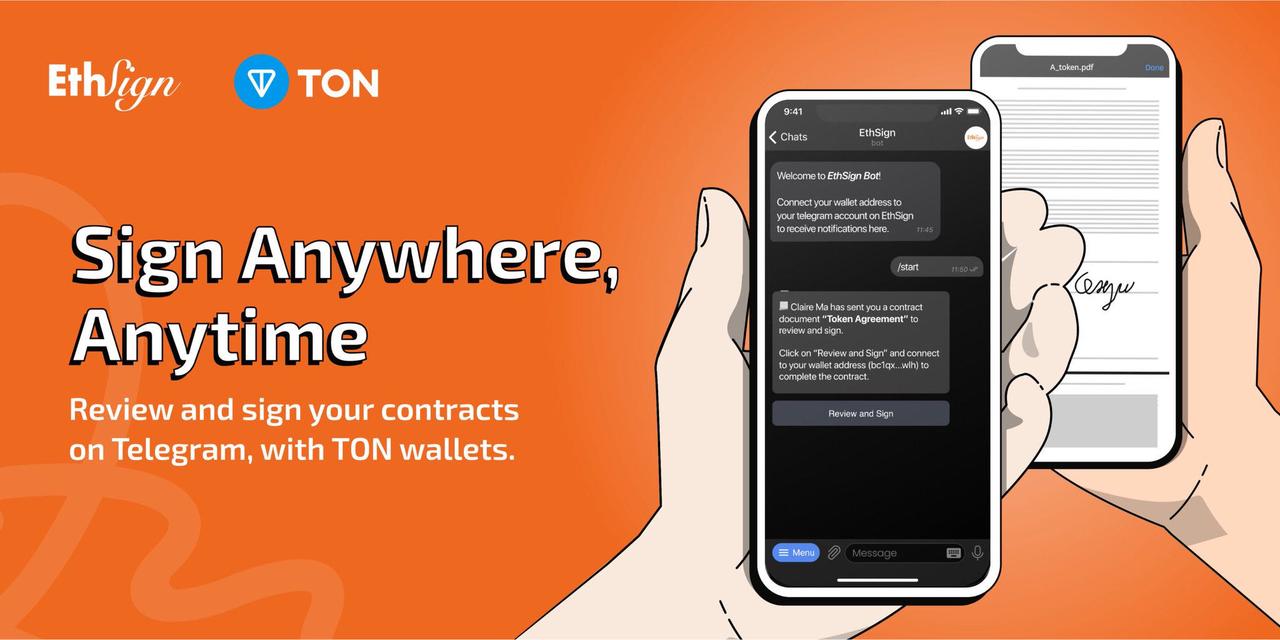
Recently, EthSign, a decentralized electronic agreement signing platform, recently released an exciting news on the X platform: it has reached an important cooperation agreement with the TON Foundation. The two parties will work together to launch EthSign Bot, a new service that will enable users to receive and sign contracts on the Telegram platform. This innovative move will not only simplify and accelerate the contract signing process, but will also further promote the application and development of decentralized applications (dApp) in real scenarios.
 Promotional poster for the cooperation between the two parties
We may be very familiar with TON, but EthSign may be relatively unfamiliar. So, in the context of this cooperation attracting widespread attention, let us take a deeper look at what EthSign is and how it will play a role in the new Web3 track.
EthSign, the electronic signature tool in the Web3 world, ensures data security and privacy
In the current context of paperless office and remote work, electronic signature has become a trend, but traditional electronic signature systems still face many problems and challenges, such as irregular operation, easy tampering, file loss and identity verification issues. These problems mainly stem from the centralized nature of traditional electronic signature systems. Users often need to use third-party service providers to perform signature verification and protocol retrieval, which not only increases complexity, but also increases the risk of data loss and leakage.
As a decentralized electronic agreement signing platform, EthSign aims to solve these problems. Currently, ETHSign is committed to serving users in both web2 and web3.
Although users on the ETHSign platform will eventually use decentralized identities to interact, ETHSign has not ignored traditional users who do not yet have digital wallets. Through cooperation with the digital identity solution Magic, ETHSign has built a bridge for Web2 users to the Web3 world. Users can now use Magic to automatically create public and private key pairs through emails, and easily register and log in through email links.
 ETHSign concept diagram
In addition, ETHSign has also integrated Web3 Auth (Solana Torus wallet), allowing users to log in using social accounts such as Discord and Twitter. The use of the Torus wallet further simplifies the process, eliminates the mnemonic link, and lowers the threshold for new users to enter the Web3 world.
For traditional users who are not familiar with the crypto world, ETHSign provides a convenient way to generate private keys and sign specific documents, while recording digital signatures and related operations. ETHSign also uses Biconomy's sub-product Gasless TX to prepay Gas fees for users who do not have native tokens in their wallets, further reducing the transaction barriers for new users in the crypto world.
For users who are already familiar with Web3, ETHSign provides support for wallets such as Metamask and has been deployed on networks such as Ethereum, BSC, Avalanche, Polygon, Fantom, etc.
Most importantly, although EthSign's signature data will be recorded on the blockchain, all private contract and agreement data will be stored on the decentralized storage platform off-chain, further ensuring the security and privacy of the data. Through these innovative solutions, EthSign provides users with a safer and more convenient electronic signature service, while also promoting the development and popularization of decentralized applications.
After explaining the working principle and functions of EthSign, we can explore its role and influence in the new Web3 track in more depth. EthSign not only provides convenient services to users through cooperation with Magic and Web3 Auth, but also promotes the development of the entire Web3 ecosystem through cooperation with other projects and platforms. This is further reflected in the latest cooperation between EthSign and TON Foundation.
Thoughts triggered by EthSign: Large-scale deployment of Web3 smart contracts will be a major trend
It is worth mentioning that the cooperation between EthSign and TON also makes us think about small "protocols" because this is the direction of the future.
Back in 2018, an application invested by Zhen Fund, “Mini Agreement”, appeared on the WeChat Mini Program platform. Once launched, this application immediately caused a huge sensation in the VC industry. It allows both parties to confirm and constrain an informal agreement, and records the WeChat IDs and agreement contents of both parties through the Ethereum network to ensure that the information cannot be deleted or modified. However, just 48 hours later, this application was officially removed by WeChat.
Although the life of "small protocols" is short, its emergence indicates the huge potential and future development direction of Web3. In the wave of Web3, blockchain technology provides a new solution to many problems in the Web2 era. Through blockchain and other new technologies, we can reconstruct many applications in daily life scenarios. The development of these applications depends on the continuous maturity and improvement of infrastructure.
As a major innovation of Ethereum, the application potential of smart contracts has been fully explored and utilized since DeFi Summer. It is expected that as the infrastructure continues to mature, the next two years will be a period of explosive growth in applications. In the Web3 technology stack, projects such as Filecoin, Sia, and Arweave at the storage layer are in their infancy, while Ethereum at the computing layer is expanding to side chains by providing better interoperability.
At the same time, various key modules in the middleware, such as the smart contract trigger platform, message push service, cache service, etc., have also begun to be claimed and developed by various professional teams. We can foresee that in two years, the fully upgraded Web3 technology stack will bring the diversity of application scenarios, the number of users, and the amount of asset deposits to a new level.
The potential for Web3 smart contracts can be demonstrated through the following key data points:
1. Growth in smart contract deployment: In 2019, the number of smart contracts deployed on the Ethereum network per month was about 15,000; in 2021, this number increased to about 40,000 per month, an annual growth rate of about 167%;
2. DeFi market growth: The total value locked (TVL) of the DeFi market in 2020 is about $1 billion; in 2022, TVL grows to more than $15 billion; the growth rate is 1,400%;
3. NFT market transaction volume: The annual transaction volume of the NFT market in 2020 was approximately US$250 million; in 2021, this figure increased to more than US$2.5 billion; the annual growth rate was 900%;
4. Cross-chain interoperability projects: In 2020, the number of cross-chain projects will be less than 10; in 2022, the number of cross-chain projects will increase to more than 50; annual growth rate: 400%;
5. Actual application cases: In 2019, there were less than 100 actual application cases based on blockchain; in 2022, the number of actual application cases based on blockchain will increase to more than 1,000; the annual growth rate is 900%.
These data clearly demonstrate the rapid growth and huge development potential of Web3 smart contracts in all aspects. As more projects and applications continue to emerge, we can expect this trend to continue in the next few years.
Conclusion: Looking forward to the future of Web3 contract applications, the potential may exceed market imagination
Looking back at the above events, it is not difficult to find that the cooperation between EthSign and TON Foundation has injected new vitality into the development of this field, and it also foreshadows a series of positive chain reactions and far-reaching impacts:
1. Significant improvement in user convenience:
By using EthSign Bot directly within Telegram for contract signing, user convenience and efficiency are significantly improved. This seamless operating experience will further attract more users to use this service.
2. Further expansion of the market:
EthSign’s collaboration with TON will hopefully attract a wider user base, especially those who are already Telegram users, who may be more inclined to try and adopt this new and convenient way of signing contracts.
3. Further strengthening of cooperation and partnership:
This collaboration not only strengthens the partnership between EthSign and TON, but may also attract more other companies and platforms to seek cooperation and integration with EthSign and TON to jointly promote the development of the industry.
4. Wider promotion of blockchain technology:
By launching EthSign Bot on a popular platform like Telegram, more people will have the opportunity to access and learn about blockchain technology and electronic signature services. This will not only help popularize blockchain technology, but will also further promote the development of electronic signature services.
 EthSign promotional poster
In summary, the cooperation between EthSign and TON will undoubtedly bring broader prospects and more far-reaching impacts to the development of the new Web3 track. It not only solves the practical problems of users in contract signing, but also opens up a new path for the promotion and application of blockchain technology. In the future, we have reason to expect more similar cooperation and innovation to emerge and jointly promote the prosperity and development of the Web3 ecosystem.