

Original author | Vara Network
Compiled by | Odaily Planet Daily Jessica
Editor's note: Before choosing a specific smart contract language, it is wise to do in-depth research and find out which language is suitable for your project. To write smart contracts, two popular choices stand out: Solidity and Rust, each with its own characteristics. Vara Network published an article discussing the differences between Solidity and Rust (it should be noted that Vara chose Rust), and Odaily Planet Daily compiled it as follows.
Solidity: The most popular programming language for blockchain development
Solidity, as a high-level language, focuses on data and objects rather than complex functions. Being statically typed, it can find errors during compilation, making it more reliable. It was created as a programming language for smart contracts on the Ethereum blockchain.
Solidity is not limited to Ethereum, as networks such as Polygon, Avalanche, Polkadot, Optimism, and Arbitrum also support its features. While various Polkadot parachains have integrated the EVM, not all of them have adopted this feature. Solidity is designed to be portable across devices with an EVM executor, allowing for smooth execution.
Solidity has become a popular choice for smart contract development and takes into account Ethereum compatibility factors:
1. Built-in conditions
Solidity makes it easy to perform actions based on specific conditions. Developers don’t need to write complex conditional statements individually. Instead, they can specify these conditions in the source code. Once all the requirements check out, the code will automatically perform the action.
2. Data types become simple
Solidity has built-in support for common data types such as integers, strings, floating point numbers, and arrays. In addition, developers can even create custom data types for their smart contracts.
3. Security during development
The compiler checks developers’ code for errors as they write it and lets them know about potential problems. This feature is very useful, especially when dealing with large and complex DApps.
However, Solidity also has its disadvantages.
It is a high-level language, so it is not as fast as other languages. Its limited speed can cause trouble when dealing with tricky smart contracts or large transactions. Solidity’s design flaws have led to financial losses from hacker attacks. For example, in the 2016 DAO hack, hackers exploited a recursive Ethereum send vulnerability to steal $150 million.
Odaily Planet Daily Note: Solidity was first used by Gavin
Rust has gained tremendous traction among developers since its release in 2015. It has consistently (now for 8 years) been the most loved or admired language on Stack Overflow.
So why do developers (in general) love this programming language? Rust successfully addresses the challenge of providing high-performance tools to design applications without compromising safety and effectively guarding against potential vulnerabilities. Rust has a strong type system and strict memory safety. The language ensures:
Performance — Rust is known for its fast and memory-efficient features. Since it has no garbage collector, Rust is suitable for powering performance-critical services, running on embedded devices and integrating seamlessly with other languages.
Reliability - Rust's rich type system and ownership model ensure memory safety and thread safety, allowing developers to eliminate many errors at compile time, thereby enhancing the overall reliability of the code.
Productivity — Rust provides excellent documentation, a friendly compiler with helpful error messages, and first-class tooling. Its integrated manager and build tools, smart multi-editor support with auto-completion and type checking, and auto-formatter contribute to a smooth and efficient development experience.
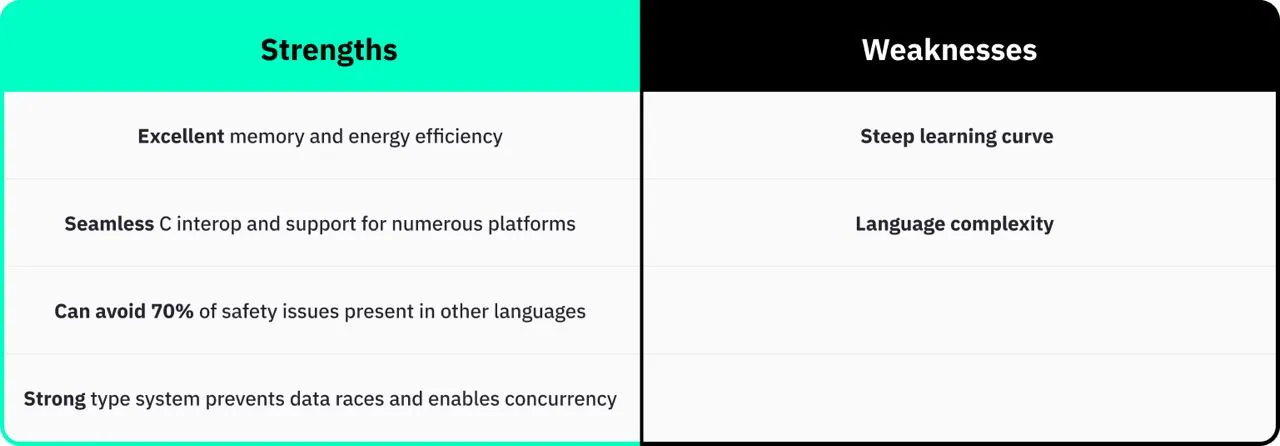
Advantages and disadvantages of the Rust programming language
Like all languages, Rust has some disadvantages, however, its advantages far outweigh its disadvantages for blockchain development. Additionally, the support of the community and how Rust handles its flaws and challenges make this programming language attractive due to active participation. The asynchronous programming request and implementation highlight Rust’s engaged community.
Therefore, Rust is an excellent choice for building secure and robust blockchain applications. Its high performance and low-level control allow developers to optimize their code.
Odaily Planet Daily Note: Rust was designed and released by Mozilla employee Graydon Hoare in 2006. It is a low-level language with syntax similar to C++. Most blockchain systems usually choose to be compatible with EVM in the initial stage because it is convenient for developers to quickly intervene with experience, but Solana chose Rust. Unlike Solidity, it was originally designed as a general programming language and is not limited to smart contracts.
Solidity and Rust: Common Strengths and Differences
Both languages are Turing complete, enabling them to efficiently handle complex computational problems.
Their multi-chain compatibility enables these languages to facilitate interoperability across various blockchain networks. Solidity has expanded its support to include layer 2 and modular blockchains, sidechains, and EVM-compatible layer 1 blockchains. Similarly, Rust has expanded its support to different blockchain networks such as Solana and Near, and provides an implementation based on the Substrate framework.
Although Rust and Solidity have similarities, they differ in various applications, as shown in the following table:
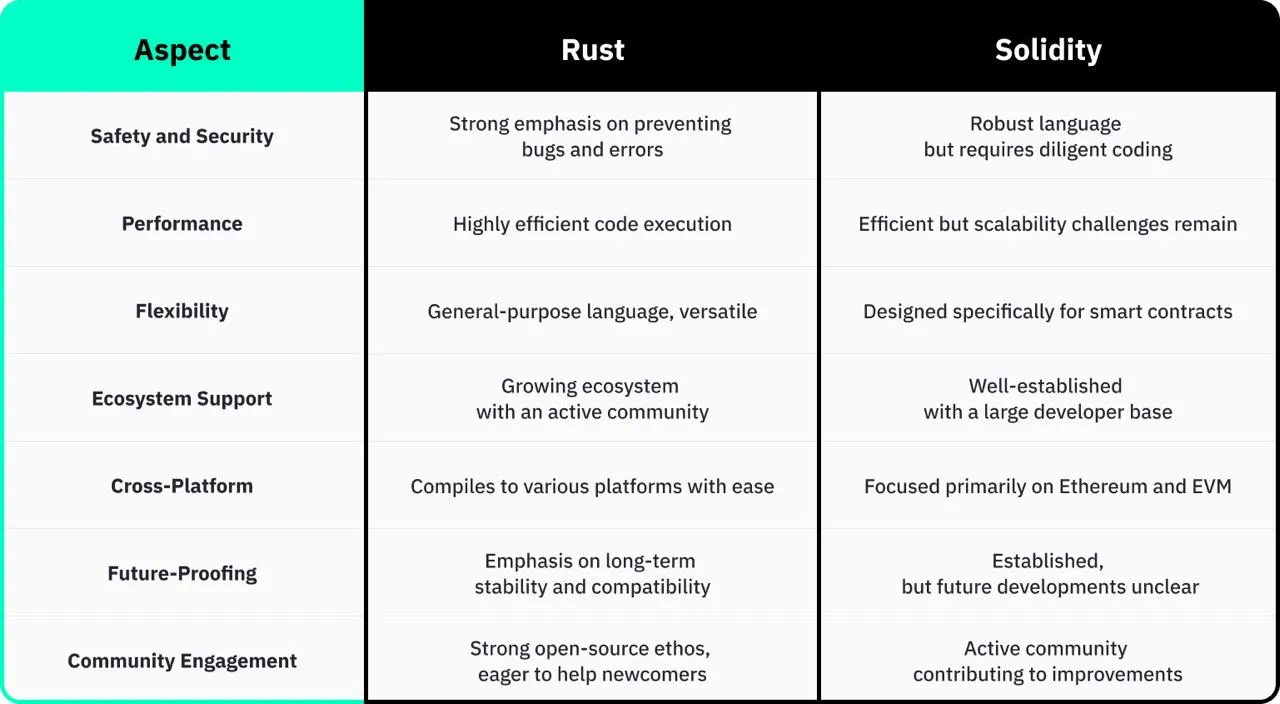
Differences between Solidity and Rust
Conclusion
The advantages of Solidity and Rust can provide a better understanding of which programming language should be chosen for DApp development. However, the differences between Solidity and Rust should also compare the trade-offs of each language versus the other.
The most obvious trade-offs of using Rust instead of Solidity for DApp development include slow compilation speeds and a difficult learning curve. Rust relies on the low-level virtual machine, or LLVM architecture, to generate code. For large projects, program compilation can take more than 10 minutes.
On the other hand, the Solidity vs Rust debate also outlines the challenges of learning Rust programming. For example, developers must grapple with the concepts of ownership and borrowing systems. Additionally, Rust programs require creating an entire codebase from scratch.
On the other hand, Solidity also comes with its fair share of frustrations compared to Rust. The prominent issues were common problems in early versions before Solidity 0.8. Another issue with Solidity is that it is difficult to perform static analysis due to the Turing completeness of Solidity.
Both Solidity and Rust have unique features and challenges. Solidity is a popular choice for smart contract development because it is the core language of Ethereum. Rust, on the other hand, is the core language of Solana, an emerging competitor of Ethereum.
This Solidity vs Rust comparison also outlines how you can gain specific advantages and disadvantages by choosing one over the other. Ultimately, the choice of programming language depends on the developer’s desired use case and specific features required.