

Singapore doesn’t seem to be interested in TOKEN 2049.
Written by: Jade, Foresight News
Editor: halou.eth, Foresight News
More than 300 exhibitors, more than 200 side events, and tens of thousands of attendees from all over the world...TOKEN 2049 may be the largest Web3 event this year.
People gathered at Singapore's iconic Marina Bay Sands, rubbing shoulders with each other and socializing enthusiastically. But outside the wall, on the streets of Singapore, people went to get off work as usual. In Asia's Web3 center, the concentration of Web3 on the streets is close to zero.
After landing in Singapore, Foresight News randomly interviewed 7 Singaporeans. Two of them said they had purchased cryptocurrencies, while most said they did not understand them, and three of them thought it was a scam.
In fact, since January 2022, Singapore has banned cryptocurrency projects from promoting their products to local residents. Web3 has long been completely blocked from websites, broadcasts, billboards, and other promotional channels. Correspondingly, in April this year, during the Web3 Carnival held in Hong Kong, Web3 advertisements were posted on the streets and buses.
Another obvious contrast is that compared with the enthusiasm shown by Hong Kong Chief Executive John Lee and Financial Secretary Paul Chan in embracing Web3, almost no Singaporean officials showed up at TOKEN2049 events and rarely accepted related interviews.
During TOKEN2049, many Hong Kong legislators (Ng Kit-chung), government officials (Leung Hon-king) and university presidents (Wang Yang) came to "show their support", while Singapore, as the "host", did not have any political officials or academic leaders present.
"They have never appeared. For the Monetary Authority of Singapore, the TOKEN2049 activity represents speculation." Li Guoquan, a professor at Singapore's Singapore University of Social Sciences, said that this is not surprising. "TOKEN2049 has not grasped the key points of Web3."
"Singapore held many conferences at the same time, including the Global Biopharmaceutical Summit, Milken, Forbes Global CEO Conference, SuperReturn and many other traditional financial conferences, and these were all conferences that both the political and business circles actively participated in...TOKEN2049 was a very small part of them." said Cobo COO Lily Z. King.
TOKEN2049 is big for crypto practitioners, but small for Singapore.
Singapore is restrained amid the crisis
Over the past year, Singapore has seemed somewhat "unfamiliar" with Web3.
It doesn’t want to miss out on new technologies, but it also deliberately keeps a certain distance. Compared to the “inseparable” relationship between Hong Kong and Web3, Singapore and Web3 show a kind of friendship that still wants to keep a distance after the ambiguity.
“Singapore likes to innovate and experiment with large institutions. After the FTX incident, Singapore is reluctant to let its citizens and investors gamble on the price of coins, but they are very active in promoting blockchain technology, and in many places, their ideas and what they want to do are very cutting-edge and open,” said Lily.
“For example, this year I went to Switzerland with MAS (Monetary Authority of Singapore) and attended the PointZero Summit with the Swiss Financial Authority and the Monetary Authority of Singapore. At the summit, they put Circle and Paxos on one side and traditional banks on the other side, and asked them to debate and discuss cutting-edge topics such as why we need stablecoins or tokenized deposits, while officials from the MAS acted as judges and made comments on the debate.”
"Singapore regulators will be concerned about the practical application cases of the combination of Grab (equivalent to Didi abroad) and stablecoins in economic life," Lily added.
However, Singapore's openness to cryptocurrencies is extremely restrained and seems to be limited to technology and large institutions. In the broader field, Singapore has given people a reserved welcome.
Singapore's regulatory attitude towards Web3 is often quoted by interviewees in two sentences during interviews with Foresight News.
First, Ravi Menon, managing director of the Monetary Authority of Singapore, said in his speech in November last year that "Singapore wants to be a center for digital assets, but does not want to be a center for speculative cryptocurrencies."
Another is Singapore’s Deputy Prime Minister and Finance Minister Lawrence Wong’s statement in November, “Singapore has no plans to become a hub for cryptocurrency activities, but rather to become an innovative and responsible digital asset participant.”
Both of these statements happened after the famous FTX crash. When TOKEN2049 was held last year, FTX founder Sam Bankman-Fried was at the forefront of the guests and enjoyed great success.
Just one month later, the $32 billion financial empire collapsed. According to statistics, at least 4.2% of Singapore users have used FTX and were affected by the crash. Singapore's state-owned investment company Temasek has also been held accountable for investing $275 million in FTX, and the salaries of company executives and related teams have been cut.
This year, the tide of Hong Kong is rising, but Lion City is no longer bustling.
According to data from FinTech Global Research, Singapore's fintech deal activity has fallen for the first time in five years, with 84 deals in the first half of 2023, down 27% from the first half of 2022.
Some people say that the collapse of FTX has caused Singapore's attitude towards Web3 to take a sharp turn. Is this true? What has Singapore been doing in the past year?
This year, apart from the MAS’s repeated calls to reject speculative behavior, Singapore has not made many overt actions. On August 15, the MAS announced the final regulatory framework for stablecoins, which means that Singapore has become one of the first jurisdictions in the world to incorporate stablecoins into the local regulatory system.
On September 4, the MAS announced that it would introduce a series of regulatory measures by the end of the year, by which time Singapore will have one of the world’s strictest regulatory regimes for the use of cryptocurrencies in the retail sector.
While strengthening retail supervision, the MAS also provides funding support. In August, the MAS announced that it will invest S$150 million in emerging technology projects such as Web3 over the next three years. The MAS calls for the use of Web3 innovative technologies in industry use cases and will provide grant funds to support practical trials and commercialization.
"This is not contradictory. Singapore has never relaxed its regulation on cryptocurrency retail," Adric, head of dtcpay's market, told Foresight News. Currently, there are 11 institutions in Singapore that have obtained digital payment token (DPT) licenses, and Singapore's crypto payment provider dtcpay is one of them. "The government is more inclined to promote the use of virtual currency for payment rather than encouraging everyone to trade."
In fact, Singapore’s attitude towards Web3 has never made a sharp turn, but after the FTX bankruptcy, the focus of supervision shifted from anti-money laundering and anti-terrorist financing to retail investor protection.
Founder Alice Liu previously worked as managing director at China Minsheng Bank. She decided to start dtcpay while studying for an EMBA at the National University of Singapore in 2019. dtcpay aims to open up crypto payment channels in the Singapore market and provide regulated cryptocurrency payments for institutions and retailers. dtcpay told Foresight News that the number of users has grown by 200% since January and the transaction volume has increased fourfold.
Anson, the head of compliance at dtcpay, said that compliance does require funding. The company needs to provide MAS with transaction volume and other data every month, and conduct external audits every year.
“We have been here for quite a while and have been communicating with banks and other financial institutions here. They all have licenses, and some have already issued stablecoins and cards. It’s just that these institutions are more traditional, and we can’t reach them through TOKEN2049. These institutions and Web3 projects are not in the same circle, and they are more down-to-earth.” Evervision founder Xiong Wei moved to Singapore in May last year and set up the Arweave Asia Ecosystem Conference here.
"The implementation in Singapore is actually very good." As early as May, digital asset payment infrastructure StraitsX launched the Singapore dollar stablecoin XSGD on Hedra. In September, DCS Card Centre (DCS), a financial institution with a license to issue credit and consumer cards in Singapore, announced the launch of its payment token DCS Tokens (DUS). And a few days ago, Grab, known as the Didi of Southeast Asia, launched a Web3 wallet based on the Polygon public chain, allowing users to store and manage digital assets.
Under this demand, payment-related projects that support fiat currency deposits and withdrawals have become relatively popular. Many projects that provide payment solutions also appeared at the booths at the main venue of TOKEN2049.
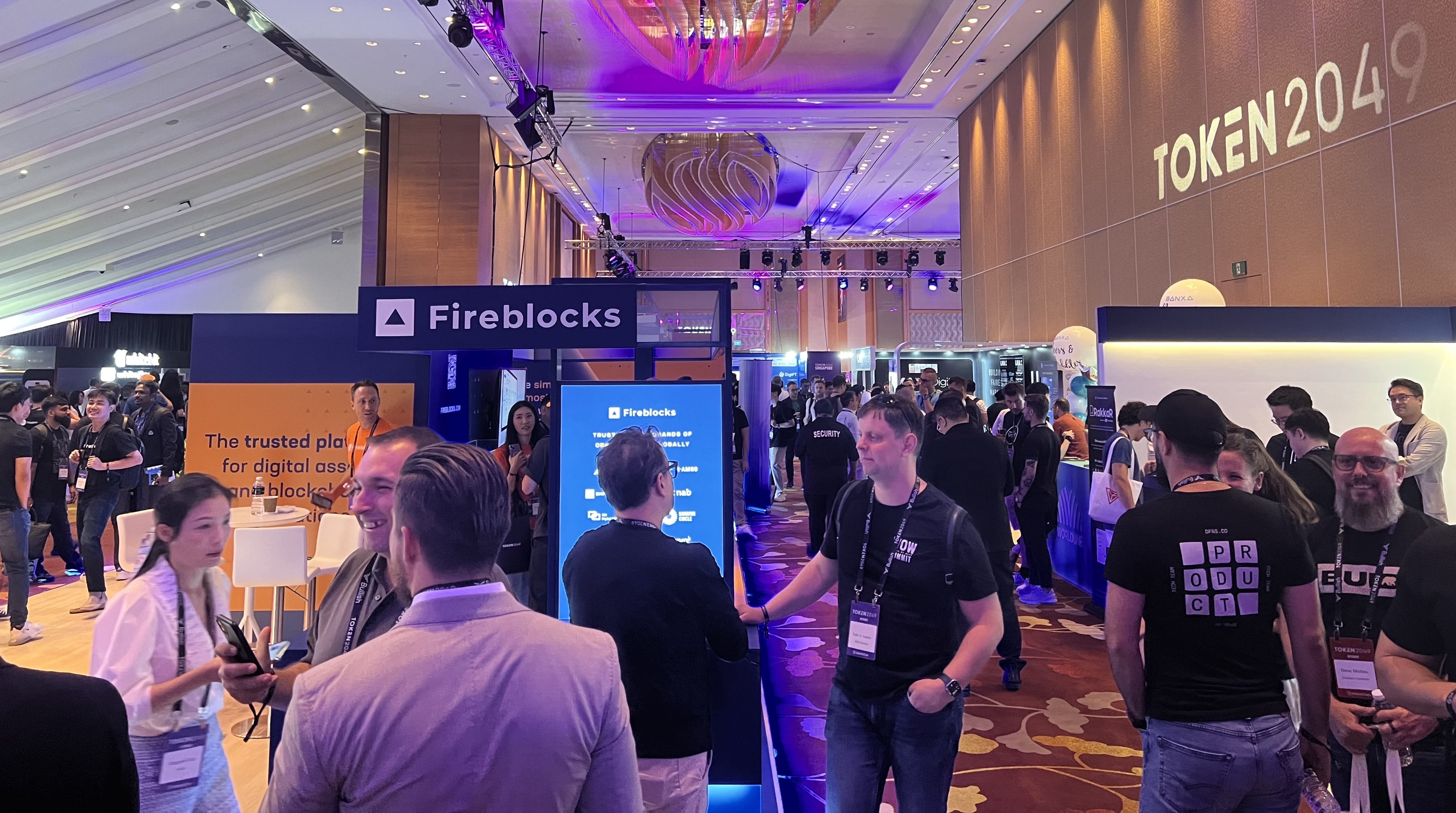
Foresight News filmed at TOKEN2049
In contrast, exchanges that rely on the retail side have encountered difficulties in settling down in Singapore. Binance withdrew its application for a license in Singapore at the end of 2021, and then it was revealed in March this year that it planned to reapply, but the target was shifted from retail customers to corporate customers.
“Cost is very important for Web3 projects. Centralized exchanges will definitely flow to low-cost countries, but for pure outsourcing projects, it doesn’t matter at all. Compliance itself is a driving effect. The direction of exchanges does not represent the development of Web3.” Xiong Wei told Foresight News, “In fact, to put it bluntly, the Monetary Authority of Singapore has no control over these. It controls whatever Singapore has studied. It has nothing to do with anything that it has not studied.”
Singapore is not in a rush to become the capital of Web3
KPMG's Fintech Pulse Report for the first half of 2023 mentioned that as the United States' scrutiny of the cryptocurrency industry has tightened, other jurisdictions, including Singapore and Japan, are becoming more attractive to investors and startups. Singapore in particular is seen as a strong first mover because it has already enacted relevant regulations, including the Payment Services Act and the Digital Token Payment Act, and is planning to issue regulations related to the issuance of stablecoins.
The report also mentioned that many jurisdictions in the Asia-Pacific region are committed to becoming global crypto asset hubs. Among them, Singapore has taken the lead in this field. In addition to Singapore, Japan and Hong Kong, China have also taken a series of measures to establish a strong crypto asset ecosystem.
Lan, co-founder of NFT marketplace and aggregator Alienswap, told Foresight News that he stayed in Japan after leaving China last year. After TOKEN2049, he decided to move to Singapore and is considering setting up a company entity in Singapore next year.
“When we first started going overseas, we considered Singapore, Hong Kong and Japan. Although the cost of living in Japan is 30% lower than in Singapore, and IT-related businesses are more open. But communicating in Japanese is a problem. On the other hand, the current project parties in Japan have not actually reformed, so everyone still comes to Singapore in groups, and the communication cost in Singapore is very low.” Lan is looking forward to coming to Singapore.
"I found that after last year's conference, many investment institutions continued to move to Singapore, which I didn't expect. It's also because the market is too bearish now. From 2021 to 2022, Singapore actually supported many start-ups. This year, Singapore's overall policy is indeed not as open as in 2022. But the support VCs receive in Singapore is actually quite good. There are policies that allow them to go through procedures and set up companies locally more conveniently. As far as I know, the cost of obtaining a license in Hong Kong is actually very high." Lan saw that even in a bear market, Singapore still provided a lot of support.
In terms of the comparison between the regulatory requirements of Hong Kong and Singapore, several senior practitioners told Foresight News that Hong Kong is more stringent. "When we compare the custody requirements of the Singapore payment service license with the custody requirements of the Hong Kong virtual asset trading platform license, we find that the latter has relatively stricter regulations," said Liu Jia, founder of dtcpay.
Cobo provides white label solutions for multiple companies applying for Hong Kong licenses. COO Lily Z. King said that Hong Kong is indeed stricter than Singapore in terms of both the requirements for the exchange's custody capabilities and the ratio of hot and cold wallets.
Xiong Wei has settled in Singapore. He is very optimistic about Singapore's regulatory path, especially compared to Hong Kong, which has opened up retail trading. "Hong Kong is a bit anxious. The official orders are too much. If things go wrong, there may be some big loopholes." Evervision does not plan to develop business in Hong Kong. "Now that the supervision is relatively weak, there will be many plate-type projects mixed in, and they will advertise on the street."
Xiong Wei’s concerns about Hong Kong are not without reason.
On September 13, the exchange JPEX was exposed for money laundering of more than 190 million USDT. The Hong Kong Securities and Futures Commission (SFC) warned it by name for promoting services and products to the Hong Kong public without a license. JPEX also had a booth at TOKEN2049 this year. After the incident was exposed, JPEX immediately emptied the booth and staged a "runaway" scene.
In terms of business development, Hashkey Exchange, which has obtained a license in Hong Kong, has a very unsatisfactory retail business transaction volume. "What I understand is that KYC is too strict," said Xiong Wei.
“Singapore and Hong Kong are actually complementary. If you want to empower the government and build infrastructure, you should come to Singapore. If you want to develop retail cryptocurrency, you should go to Hong Kong,” said Li Guoquan. “The only competition between the two places is talent.”
"But talents are also for stimulating consumption. Singapore used to need to attract a lot of talents, but now it is full. If it continues to do so, housing prices and consumption will be too high. Hong Kong wants to attract 300,000 people as much as possible, but it doesn't need more. So now there is no competition between Singapore and Hong Kong, as Singapore already has too many talents. Talents spend 6 months in Hong Kong and 6 months in Singapore, which I think is great.
For companies, every company that truly wants to have a position in the international arena must have a license in Singapore and Hong Kong. I think the final structure is that each region will have its own local exchange, but four or five will be enough for each country, and the rest will be decentralized exchanges and other Web3 projects that empower the government. "
TOKEN 2049 blindfolded carnival, Singapore "watches from the sidelines"
One year has passed since TOKEN2049 was held. The crypto market has gone from the tail end of the bull market to a deep bear market, and almost everyone is extremely confident that the bull market will come next year along with the Bitcoin halving.
“The mood was better last year, as the bull market had not ended for long. This year I invited some domestic OGs, but they didn’t come. However, this year’s event is more international. This time I also saw intuitively that the maturity of European and American project parties is completely different from the maturity of our Chinese projects.” At the Arweave Ecosystem Conference, which TOKEN2049 has held for two consecutive years, Xiong Wei felt the complete difference in atmosphere.
Moreover, with the continuous regulatory actions of the SEC this year, more resources from Europe and the United States have been transferred to Singapore, and the difference in projects is very obvious. "European and American project parties are more likely to attend meetings and talk about technology, while here we mainly look at beautiful women." Xiong Wei sighed, "The difference is not a little bit."
Although TOKEN2049 is crowded with people, not many actually invest. Xiong Wei told Foresight News that compared with last year, VCs are much tighter. "Last year, many investment institutions like Tencent came. After FTX collapsed, they completely withdrew from Web3. Now there are also traditional investment institutions entering the market, but a new group of people have entered."
“Last year, we looked at 1,000 projects and only invested in 9. We couldn’t invest in them.” Li Guoquan is not only a professor at Singapore’s SUSS, but also one of the founders of BlockAsset Ventures. “In 2017 and 2018, there were many scammers in mainland China, but the projects in Singapore are very good, and the ideas are much better than now.”
At TOKEN2049, the most unavoidable topic is compliance and regulation. Many project parties regard concepts such as RWA that are tied to it as the next hot spot to trigger the bear market.
“But I see that many senior practitioners are beginning to reject the most noble spirit of Web3 itself - privacy protection. Everyone hopes to have more traffic and users to comply with regulations. But this will take us further and further away from Web3 and will become more and more centralized.” Li Guoquan emphasized, “Satoshi Nakamoto’s white paper was published in 2008, and 50% of the content was about political economy. That was during the financial crisis. Web3 is about changing Wall Street, not becoming Wall Street.”
“From last year to this year, it is clear that everyone is taking the path of turning the crypto industry into another Wall Street. Now the entire financial market has fallen into monopoly, but the essence of Web3 should not be to monopolize the market.” While most project parties regard compliance as a way out, Li Guoquan said: “Now we should cooperate with the government to empower the government, but not let it be regulated only by the government. These two points are different.”
“The government is regulating now because it is disappointed with our industry. It feels that the industry has no self-discipline and everyone is speculating. But despite this, there are still many Web3 projects that are not regulated in Singapore. The MAS said that we must innovate responsibly. Singapore itself has a lot of regulations, and many projects in the sandbox must be regulated. It also cooperates with our crypto circle. Last year, the MAS went to Africa to help African countries with inclusive finance and inclusive education. These countries really need our crypto industry.”
Professor Li Guoquan worked in the quantitative finance industry from 1993 to 2012, and then returned to the school as a professor in 2012 until he "re-entered the field" this year.
As for the reason, Li Guoquan said that it was because he saw the combination of AI and blockchain and felt that the time was really ripe. Foresight News noticed that when Professor Li Guoquan was interviewed, the whole wall behind him was filled with books. "It was the same when we were young. Young people should use quantitative, financial technology, and cryptocurrency to make money. I think it is very good to have entrepreneurial spirit. But at the same time, don't forget that what you do should be beneficial to society, be environmentally friendly, reduce speculation, increase trade, and solve political and economic problems. But now I have read many white papers and many business models, and they are not sensitive to economics and politics. They are only sensitive to regulation, which is much lower."
Li Guoquan, who also served as a member of the HKMA's Financial Research Committee, shared the HKMA's statement at the SUSS event this year, "I hope that Web3 will not be used for speculation, but to solve the bottlenecks of human development, including trade."
As for why the HKMA did not participate in TOKEN2049, Li Guoquan analyzed: "TOKEN2049 has not grasped the key point of Web3. If it wants to become an activity that attracts regulatory attention, it must be beneficial to the environment, trade, or inclusive finance. We do not want to be a lower-level part of the regulation, but to bring blockchain technology to various places at the same level. Only after TOKEN2049 or Web3 changes its speculative image, can we see the emergence of regulatory agencies."
"There will be fewer and fewer speculators in the future. Not everyone needs to comply with regulations. 20% will do compliance, 20% will do anti-money laundering technology, 20% will do inclusive finance, 20% will do inclusive education, and 20% will focus on projects in cooperation with the government. This is the truly innovative industry."