


Original title: Understanding Mantle: A Comprehensive Overview
Original article by: Toe Bautista & Leisha Murthy
Original source: messari.io
Compiled by: Mars Finance, Eason
Key insights
Mantle is an ecosystem consisting of Mantle Network (Ethereum L2), assets (ETH-based, USD-based, and BTC-based), governance, and finance (Eco-Fund and Economic Committee).
Mantle, formerly BitDAO, was launched in January 2023 and inherited BitDAO's $3 billion fund. Mantle has the second largest fund in the industry.
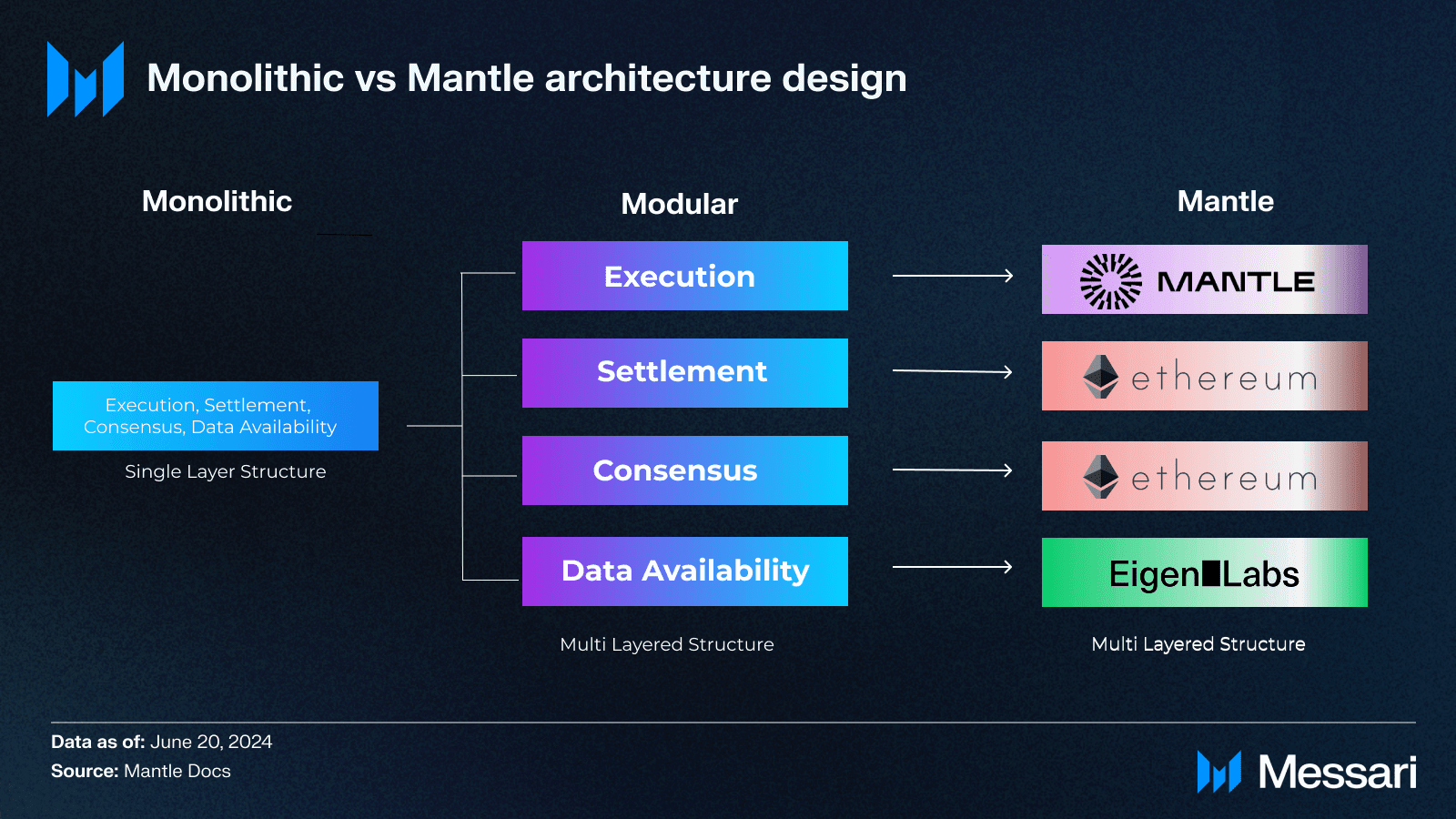
Mantle Network takes a modular blockchain approach, leveraging Optimism’s OP Stack Bedrock and Cannon, while deriving EigenLayer’s DA technology into a Mantle DA variant.
Mantle recently announced cmETH, a new re-staking solution for users, and COOK, a new governance token that enables holders of mETH and cmETH to play an active role in governance decisions.
introduce
L2 continues to compete for market share in the Ethereum ecosystem. Despite the popularity of leading networks such as Arbitrum and Optimism, the market remains highly competitive with over 30 active L2 networks competing for users and liquidity. As a result, users and developers face challenges in choosing the best network in such a fragmented market.
Every network makes some trade-offs in terms of scalability, security, cost-effectiveness, and ease of use. Many existing L2 solutions struggle to balance these requirements, leaving a gap in the market for more innovative approaches.
Enter Mantle. What sets Mantle apart is that it goes beyond traditional L2. It takes a differentiated approach to the ecosystem through strategic products and partnerships, bringing more convenience to users and applications. Its cost-effective model provides a reliable experience for developers and users. In addition, Mantle's ecosystem includes six tokens - MNT, mETH, FBTC, and the upcoming cmETH and COOK (expected to launch in the fall of 2024) - and a $200 million EcoFund to incentivize application development on its platform. By solving complex problems in the L2 field, Mantle presents a comprehensive solution that is ready to redefine scalability and usability.
background
In June 2022, BitDAO proposed to incubate Mantle. Its first testnet went live in January 2023. With the support of Peter Thiel and Pantera Capital, BitDAO fully merged into Mantle in May 2023 to streamline its focus on L2 scaling solutions. The Mantle Network Sepolia testnet was launched in January 2024.
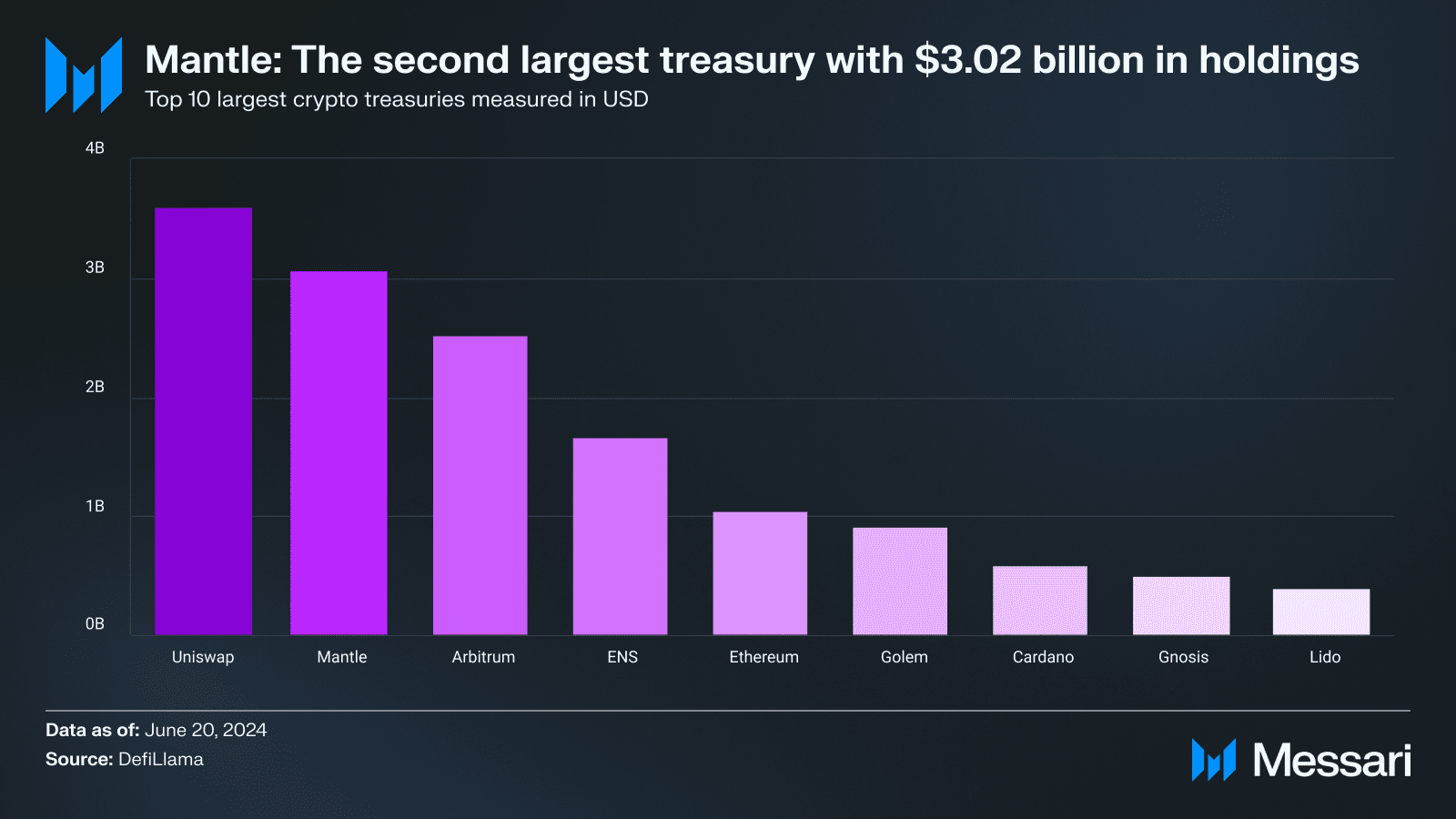
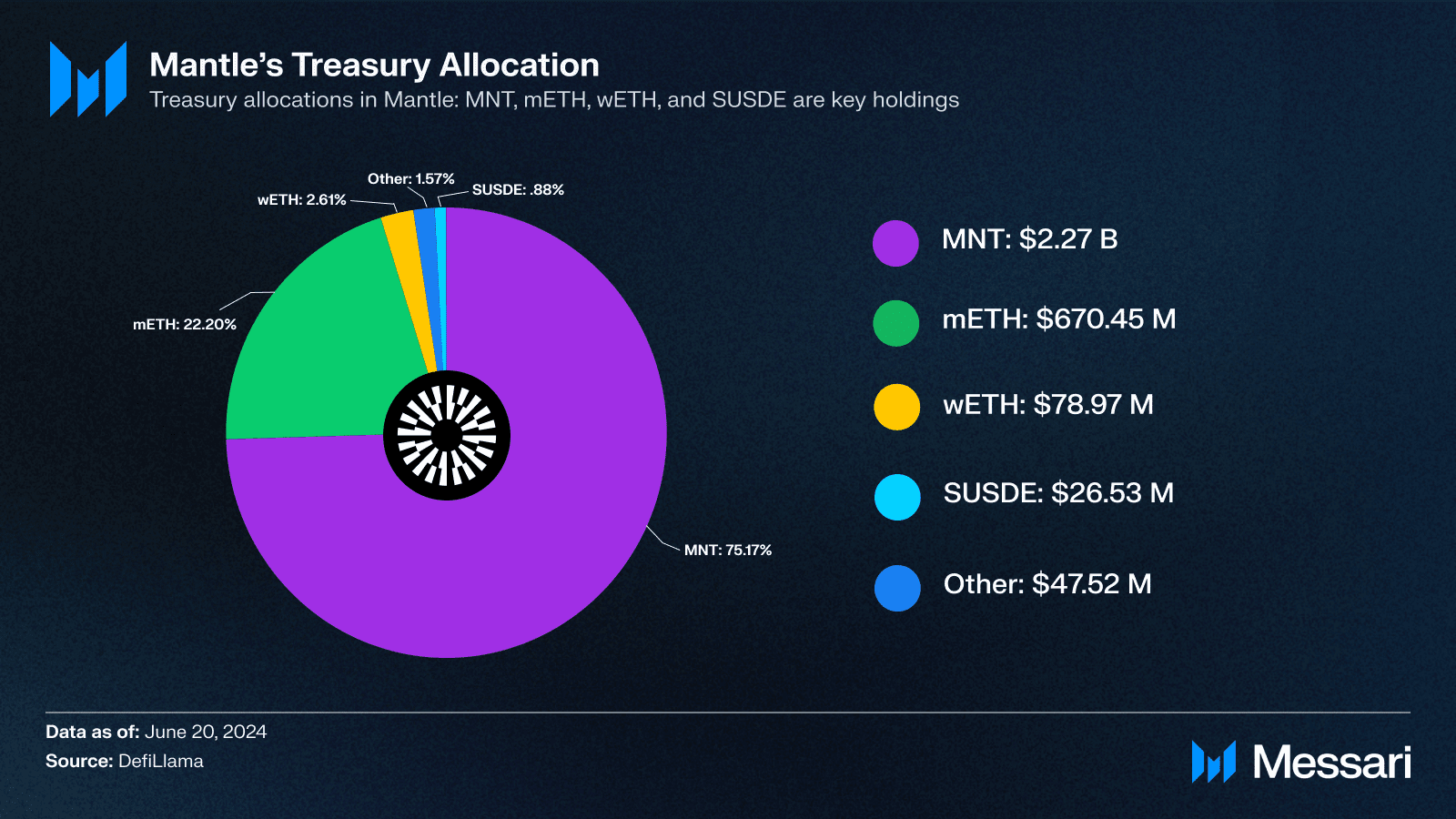
During the merger, Mantle also inherited a huge amount of funds from BitDAO. As of June 2024, Mantle's total funds are $3.01 billion, including $2.27 billion in MNT, $670.45 million in mETH, $78.97 million in wETH, and $26.65 million in USDe.
After the merger, one of Mantle's initial actions was to convert the original ERC-20 BIT token to ERC-20 MNT. After the conversion, Mantle destroyed 9.86 billion ERC-20 BIT, representing 98.6% of the maximum supply, to increase the value and demand of its new token. Soon after, Mantle launched its mainnet in July 2023, and additional features such as Network Bridge and Mantle Journey were launched shortly thereafter. Mantle also launched multi-signature functionality in September 2023 and launched Migrator V2 in September 2023, see MIP-27 for details.
In November 2023, the Mantle Liquid Staking Protocol (LSP) Alpha version was released, allowing users to stake their native ETH as mETH on Ethereum. In March 2024, the Tectonic upgrade (V2) of the Mantle Network was completed, which included fixing the block schedule and removing the TSS (Threshold Signature Scheme) nodes. In addition, after the Mantle V2 Tectonic upgrade, MNT became the native token of the Mantle Network, replacing its previous status as a bridge version of the Ethereum ERC-20 token.
technology
Mantle Network’s technology leverages Optimism’s rollup design to facilitate its modular architecture. Since its inception, Mantle’s technology stack has had two versions, the latter of which made significant changes to the structure.
Mantle V1 Alpha was launched in July 2023, leveraging Optimism's OVM codebase to introduce modularity to the network. During the launch, Mantle found some obstacles that needed to be addressed. For example, V1 lacks support for EIP-1559, an Ethereum upgrade that changes the way transaction fees are calculated. Without the upgrade, users will have to bid against each other to have their transactions processed, resulting in high fees and instability. Additionally, without EIP-1559, block generation depends on the number of transactions. Having only one transaction per block will lead to delays, higher costs, and variable block times.
To address this, Mantle V2 Tectonic was launched in March 2024, transitioning to Optimism's OP Stack Bedrock. With the integration of EIP-1559, Mantle users enjoy a base fee adjustment that sets standard fees based on network demand. An optional tipping mechanism has been created for users who prefer faster transaction processing. In addition, block generation is now transaction-independent, fixed at 2 seconds, and multiple transactions are allowed per block.
While Mantle leverages Bedrock’s technology, it also develops its own solutions and outsources specific components. For example, Mantle uses EigenLayer’s DA technology, eliminating the need for cross-chain bridges and making MNT a native L2 asset.
Breakdown of the Mantle Network
Currently, in V2 Tectonic, the Mantle Network architecture has three key components:
Optimistic Rollups: Scalable, low-fee off-chain transaction processing.
Fraud Proofs: Maintaining the integrity and security of transactions.
Mantle DA: A variant of EigenDA that aims to achieve accessible and verifiable data.
Optimistic Aggregation
Optimistic Rollups (OR) aim to increase Ethereum's throughput by processing transactions off-chain. They are "optimistic" because they assume these off-chain transactions are valid without initially providing proof of validity. Instead, they rely on fraud proofs to verify transactions if a discrepancy occurs. The ultimate goal of OR is to increase transaction speed and efficiency on the Ethereum network.
Mantle's flagship product, Mantle Network, uses an Optimistic Rollup architecture consistent with the Ethereum Virtual Machine (EVM). By integrating Bedrock and security through Ethereum consensus, Mantle Network builds censorship resistance and allows direct, third-party-free bridging of assets to and from Ethereum.
Mantle secures its solution through verified fraud proofs for its Optimism product Cannon. Mantle verifies blockchain transactions using a system called MIPS, which functions like a virtual computer that emulates EVM instructions.
In the current fraud-proof model, on-chain validators handling disputes can only run instructions in simpler virtual machines such as MIPS or WASM. Therefore, EVM clients (such as op-geth) convert fraud proofs into simpler languages (such as MIPS-opcode) for validators to understand. Cannon uses on-chain contracts to simulate MIPS-opcode, allowing EVM to check whether MIPS instructions are executed correctly. At the same time, it uses an off-chain simulator to create proofs for any MIPS instruction, completing the verification process.
In summary, optimistic rollups increase transaction throughput, while fraud proofs ensure integrity. The next layer in the stack is the data availability layer, which guarantees access to the data needed to verify these proofs.
Data availability layer
Mantle has partnered with EigenLayer to leverage EigenLayer’s re-staking and verification mechanisms to improve data availability and protection. With a write throughput of 10 MB/s, EigenLayer has five times the capacity of its closest competitor. In addition, EigenLayer’s decentralized structure is supported by hundreds of operators with delegated staking rights, ensuring high security and imposing economic costs on misconduct. Leveraging these advantages, Mantle has developed its own Mantle DA module, built on EigenLayer technology, to further enhance the data availability and security of its native network.
Stool DA
Mantle DA allows licensed nodes to provide data availability services to the network and ensure security by staking MNT. Mantle DA has three main features.
First, the data availability layer is separated from the consensus layer. This setup allows the data availability layer to focus on storing and distributing data. At the same time, the consensus layer can focus on verifying and agreeing on transactions without being burdened with data storage tasks.
Second, Mantle DA uses unicast (one-to-one) channels for direct communication. By sending information to the intended recipient rather than broadcasting it to the entire network, it reduces unnecessary data traffic, thereby reducing bandwidth usage.
Finally, Mantle DA uses an erasure rate system to save multiple copies of data fragments. These fragments contain transaction and state data, allowing validators to reconstruct complete information when certain fragments are lost or damaged, thereby ensuring data integrity. By using both L1 and L2 sources, the system provides redundancy and aims to maintain secure data storage.
The integration of EigenDA on the Mantle Sepolia testnet was launched on July 11, 2024, while the launch date of the mainnet integration has not yet been announced.
Token Economics
Mantle Token Breakdown
MNT
Mantle's native token, MNT, is the underlying asset on the Mantle network. It serves as both a governance and utility token, giving holders voting rights and utility functions such as gas fees and collateral on the network. In addition, MNT can be locked for rewards and used for lending in DeFi applications. Its diverse utility supports a variety of ecosystem activities, reinforcing its role as Mantle's governance and ecosystem growth token.
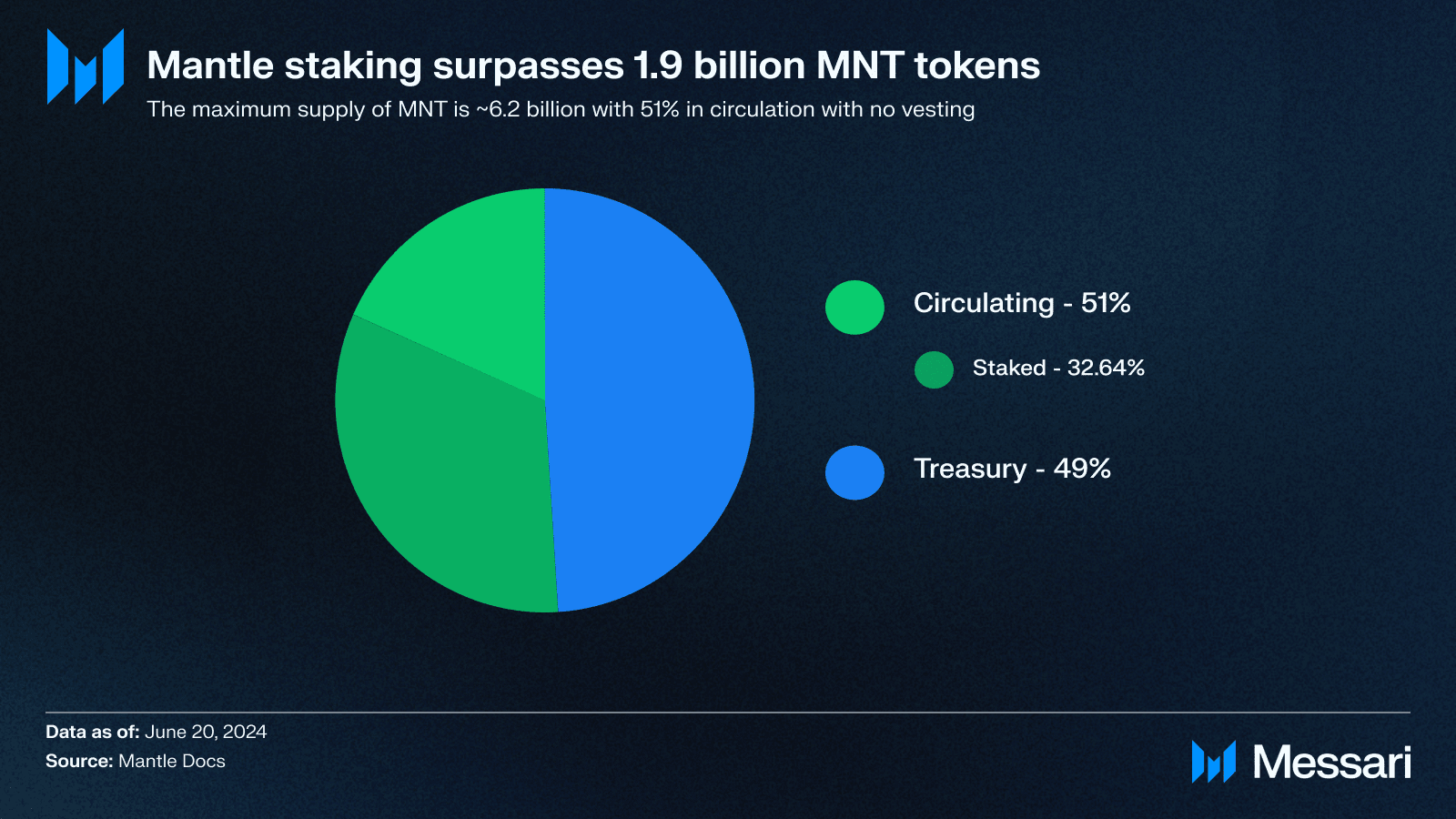
As of June 2024, the maximum supply of MNT tokens is 6.2 billion. The initial distribution of MNT tokens is as follows: Mantle Treasury holds approximately 2.9 billion tokens, and the circulating supply is approximately 3.3 billion tokens. The Treasury's 2.9 billion MNT tokens account for approximately 47.8% of the total supply. The current distribution is 49% allocated to Mantle Treasury and 51% circulating and unowned. MNT is traded on 27 exchanges, with Bybit being the largest centralized exchange (CEX) by volume. Bybit accounts for 90% of its CEX market share, while decentralized exchanges such as Uniswap support trading.
The Mantle governance process oversees the distribution of MNT tokens from the Treasury through a strict budget and capital call process highlighted in the BIP-19 Mantle Network Budget. MNT token distribution focuses on promoting adoption through user incentives such as achievements, tasks, and rewards. It encourages infrastructure providers, protocol partners, and dApps through technical partner incentives. Tokens are distributed to core contributor teams and also include strategic opportunities such as acquisitions or token swaps. Finally, each token has equal voting weight in DAO decisions.
mETH
One of Mantle’s core products is mETH, a token that represents staked Ethereum in its Liquidity Staking Protocol (LSP). LSP collects ETH from users who stake and in return provides them with mETH tokens that earn rewards over time. This process allows them to earn staking rewards while liquidating their staked assets. As of June 2024, the exchange rate for mETH to ETH is 1 mETH, which is equivalent to 1.037 ETH.
mETH holders can access various DeFi platforms for liquidity pools, yield farming, and other financial activities without unstacking ETH. Here are a few examples of dApps currently available to users.
For trading, Bybit offers mETH/USDT and mETH/ETH pairs, while NativeX offers mETH/WETH pairs and other exchange options.
On the lending side, INIT Capital allows deposit/borrow positions using ETH, Timeswap utilizes ETH as collateral, and MYSO Finance offers zero-fee swaps and customized zero-liquidation loans.
Vaults include Range Protocol’s mETH/WETH vault, Circuit Protocol’s automated compound vault for the Lendle market, and Rivera Money’s mETH-ETH LST vault.
To provide liquidity, Merchant Moe offers a variety of liquidity pools, while Butter.xyz allows liquidity to be added to any available token, including ETH and MNT.
Mantle has demonstrated a strong commitment to providing competitive yields. The “ mETH Double Incremental Drive” from December 2023 to April 2024 doubled the market yield on the ETH liquidity staking protocol to 7.2%. Due to strong user traction, Mantle increased the initial cap from 250,000 mETH to 333,333 mETH just one month after the program began, and then again to 600,000 mETH in March 2024. The program, funded by ETH staked by the Mantle Treasury, increased returns for early users. With TVL approaching $2 billion, mETH has become the fourth largest liquidity staking product in the market. As of June 16, 2024, the yield has dropped to 3.3%.
There are two different re-staking methods in the network. First, in April 2024, mETH holders can re-stake through EigenLayer's EIGEN allocation. To qualify, users need to hold mETH on Mantle L2 between February and April 2024. For example, if a user has 50 mETH, they will have 44,000 Eigen points, which can then be converted into 19.24 EIGEN. In addition, Mantle has launched a new liquid re-staking token cmETH and a governance token COOK as part of its native re-staking protocol.
Methylcyclopentane
In May 2024, following the success of the re-staking program, Mantle Network integrated cmETH and COOK through MIP-30, with 198 million MNT in favor and 2.8 billion MNT against. The strategy is to make mETH re-stakeable, thereby promoting the development of cmETH and bringing native yield opportunities to the Mantle ecosystem. cmETH aims to achieve high composability in Mantle dApps and solve the liquidity fragmentation problem in the early re-staking model. cmETH functions similarly to mETH and can be used in various DeFi protocols and use cases. It aims to establish the same partnerships and integrations as mETH and has the potential to become the preferred asset in the ecosystem.
Ongoing discussions with ecosystem partners such as Pendle and Ethena highlight collaborative efforts to integrate cmETH, enhancing its adoption and utility within the Mantle network. “This approach ensures a clear and efficient re-staking solution for ETH within the ecosystem,” stressed Jordi Alexander, Chief Alchemist at Mantle.
COOK
COOK is cmETH’s governance token, designed to allow the community and mETH and cmETH holders to play an active role in governance decisions, such as selecting AVS and guiding integrations. COOK incentivizes participation and promotes a more engaged ecosystem.
Federal Trade Commission
In May 2024, Mantle became a core contributor to FBTC, a full-chain Bitcoin asset pegged 1:1 to BTC. FBTC aims to increase the utility of Bitcoin by making it a liquid and easily composable asset on blockchains such as Ethereum, Mantle, and Solana. It introduces yield-enhancing strategies such as Babylon Staking, which aims to provide more profitable ways to use Bitcoin assets. In addition, Mantle is a signatory to FBTC's TSS network, ensuring the creation and redemption of FBTC tokens.
Summary
The Mantle Network ecosystem includes five existing and upcoming tokens:
MNT: Mantle Network’s native token, which can be used as both a governance token and a utility token.
mETH: Provides native yield opportunities and aims to improve network security through staking rewards.
cmETH: An upcoming liquid re-staking token designed to enable high composability of DeFi protocols.
COOK: The upcoming cmETH governance token that will enable the community to participate in governance and reward mETH and cmETH holders.
FBTC: A full-chain Bitcoin asset pegged 1:1 to BTC. Mantle manages its liquidity, composability, and token creation through the TSS network.
Networking activities
Transaction volume and adoption increased in both periods due to the launch of the token and Mantle’s push for large-scale community building.
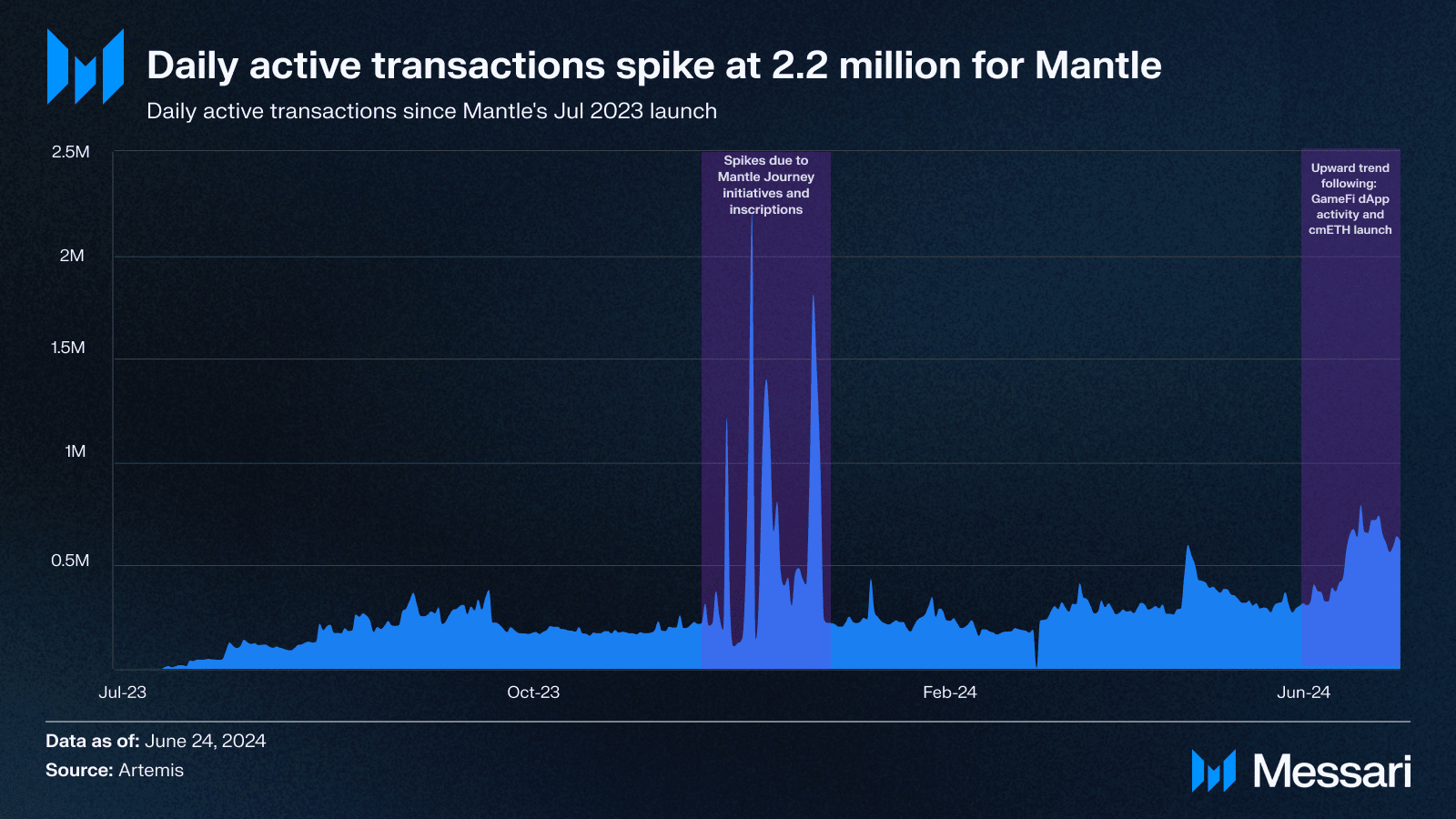
The first upswing occurred between late 2023 and late January 2024. mETH and USDY were listed in late November 2023, setting the stage for increased activity. As mentioned above, the market yield on mETH doubled to 7.2% in December 2023. Initially, the cap was set at 250,000 mETH, but was later raised to 333,333 mETH in January 2024.
Immediately following this announcement, a holiday draw for mETH and mUSD (a repriced version of USDY) was held in December 2023. The draw offered lucrative prizes, including 97 mETH and 115,000 mUSD, with winners having the chance to win up to 5 mETH. The draw attracted participation from December 22, 2023 to January 1, 2024. Additionally, inscriptions on Mantle caused a surge in daily active transactions from late 2023 to mid-January 2024, with a peak of 2.2 million transactions in December and 96,700 daily active addresses.
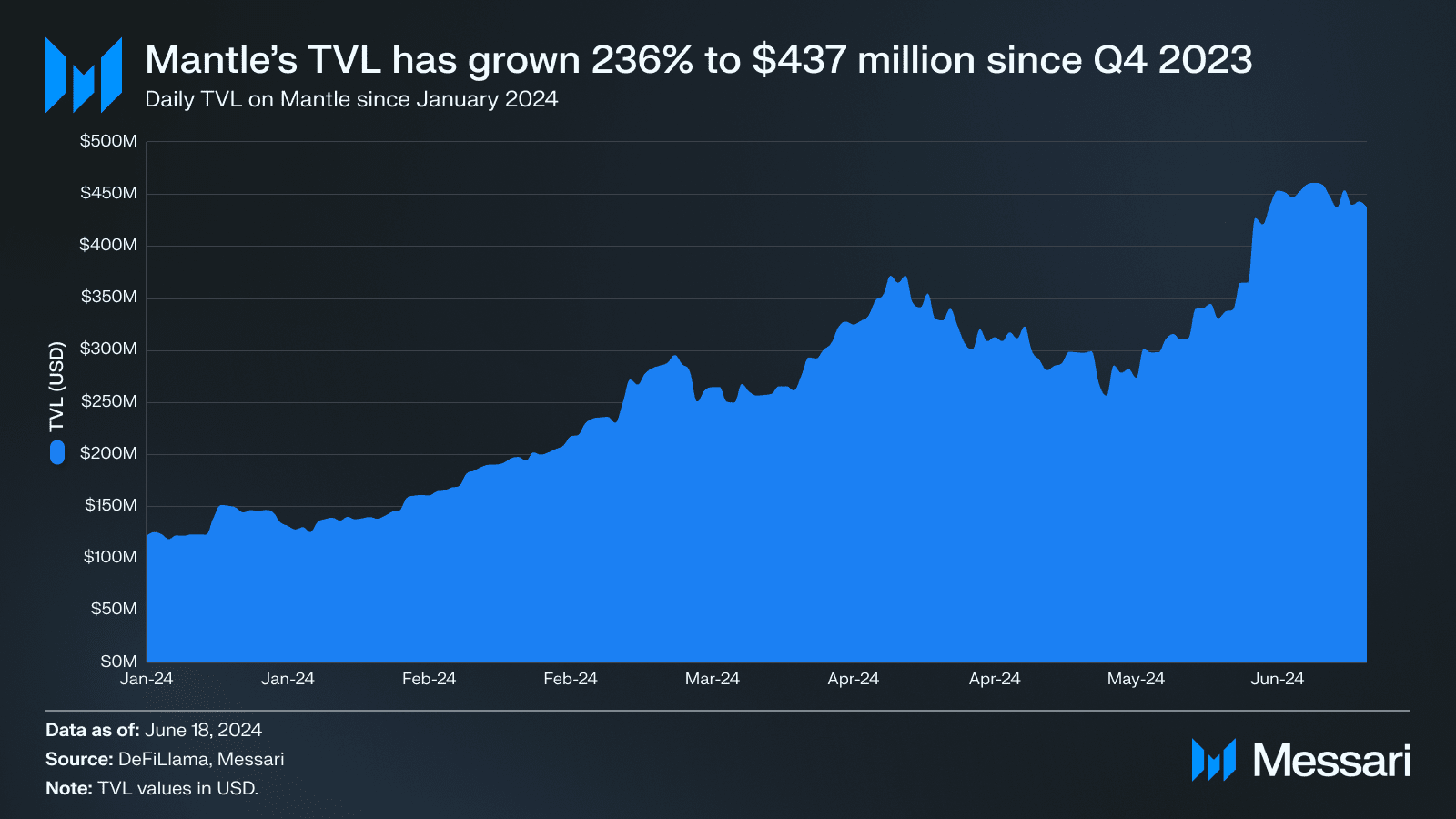
The second indicator growth period is May 2024 to June 2024. Mantle's growth is largely due to its re-staking programs, such as the mETH feature point and the recently launched cmETH and COOK. In addition, Mantle has pledged $5 million to promote SocialFi and gaming innovation on the Mantle network. This new funding supports new dApps such as Catizen, xMetaCene, and BladeGamesHQ. Since launching on Mantle, xMetacene has accumulated 387,000 total addresses and 2.8 million transactions. In May 2024, MNT on-chain holders increased from 1.59 million to 1.69 million, an increase of 9%. In addition, DEX trading volume reached $93.8 million, daily trading volume reached 790,900 transactions, and active addresses peaked at 194,200. Furthermore, Mantle’s TVL reached a peak value of $437.4 million on June 6, 2024.
ecosystem
DeFi
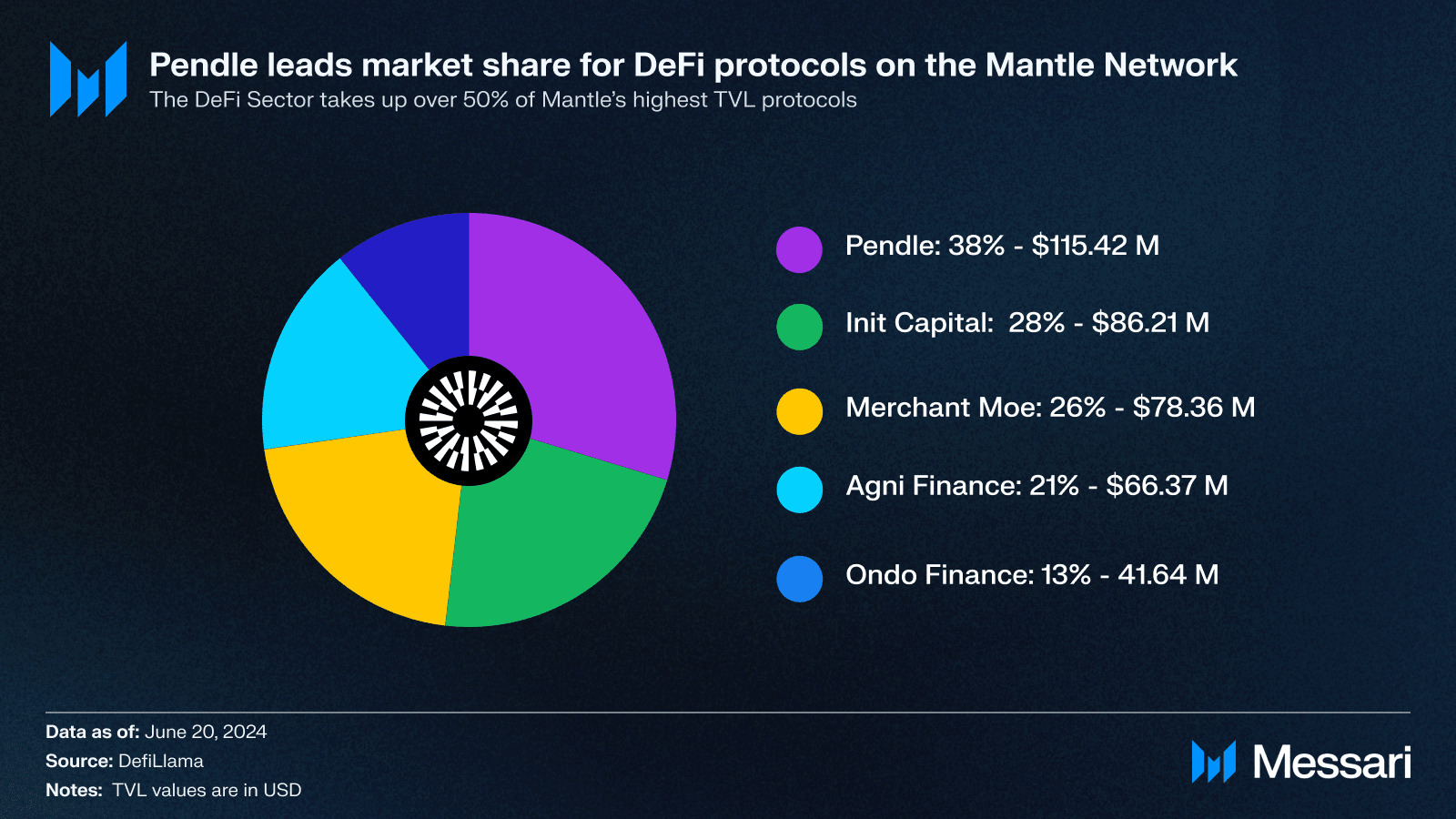
Mantle’s emphasis on DeFi growth is evident from its TVL, as all of its top 10 applications are DeFi-driven.
Pendle
Pendle is a DeFi protocol that allows users to trade tokenized future yields and leads Mantle’s protocol with a TVL of $117.3 million. Pendle tokens can be exchanged through Pendle’s AMM. In contrast, its governance token vePENDLE integrates the TradFi interest derivatives market into DeFi, enabling yield strategies such as fixed income, long-term yield, and compounded yield. In May 2024, Pendle integrated principal tokens (PT) and LP directly into the Mantle platform, launching the first LST protocol on Mantle. When users deposit LRT into the Pendle contract, the protocol distributes points to holders of yield tokens (YT). This mechanism allows users to separate the potential airdrop yield of points from LRT to YT. Pendle is one of the biggest beneficiaries of the EigenLayer and mETH staking programs, with its TVL growing by 381% since 2023.
INIT Capital
INIT Capital is a platform that aims to democratize liquidity acquisition, providing liquidity pegs to support DeFi users and protocols in acquiring and maintaining initial liquidity. Since its launch on Mantle Network, INIT Capital has reached $146.9 million in May 2024, up 52% from the beginning of the month. In December 2023, INIT Capital acquired a position in the $200 million catalytic capital pool from the Mantle EcoFund. It now serves as the base layer of Mantle, allowing other protocols to build on it. Users can earn INIT points, EigenLayer points, and Ethena Sats by participating in INIT's circular peg strategy. On Mantle, INIT Capital has a market cap of $124.1 million and total borrowings of $36.4 million.
Merchant Moe
Merchant Moe is the largest DEX on Mantle, with a TVL of $78.4 million as of June 2024. As part of the Trader Joe's ecosystem, Moe aims to change on-chain trading through its liquidity ledger protocol. MOE is the governance token of the Merchant Moe ecosystem. Staking MOE allows users to earn stablecoin income through sMOE and grant voting rights on future MOE issuance through veMOE. Its AMM allows users to earn passive income by staking tokens in various liquidity pools. As of June 2024, Merchant Moe's liquidity ledger has a TVL of $50 million and offers users up to $250,000 in MNT rewards.
Agni Finance
Founded in 2023, Agni Finance is an AMM-based DEX specializing in spot trading and pooled liquidity. As of June 2024, its TVL is $55 million, with 6 tokens and 26 trading pairs, and a 24-hour trading volume of $6.43 million. Its most active trading pair is Mantle Staked Ether ( mETH/wETH ), with a 24-hour trading volume of $1.9 million alone. Agni also offers other features, such as exchanging Mantle-supported EVM tokens and allowing users to deposit idle funds into liquidity pools to earn additional trading fees.
Puff’s Penthouse
Puff's Penthouse is a vault on the Mantle Network where users can convert mETH or USDT into PUFF tokens. As of June 2024, its TVL is $25.66 million with 280.14 million PUFF and 19.8k mETH bonded. Users lock or "bond" their PUFF or mETH for a specified period and receive Blue Magic Tokens (BMT) as a reward. This gamified approach to staking allows participants, known as "Puff the Dragon," to receive more "potion strength" (rewards) the longer they bond. The tokenomics of Puff Penthouse include a total supply of 888 million PUFF, distributed across Puff Drops, Genesis Potions, liquidity, early contributors, partners, and marketing.
NFTs
Accelerating the growth of Mantle’s NFT backbone has been a major goal of the network. This focus has fueled the development and launch of various projects within the NFT space.
Mintle
Mintle is a secondary NFT marketplace on the Mantle Network, developed in partnership with Rarible. It provides cost-effective and secure NFT trading and launches Mantle's first NFT series "Citizens of Mantle" co-created with renowned artist Chen Man. Mintle showcases a vibrant marketplace with 38,700 items, 29,700 owners, 1.3 million MNT in trading volume, and a reserve price of 21 MNT ($16.77).
Co-Museum
Co-Museum is an NFT community that aims to build a public digital art platform. Inspired by his experience in art storage, Yang Wei founded Co-Museum to solve the problem of priceless art being locked up as a pure investment. Yang Wei believes that art should be in the hands of the people, transforming these artworks into asset-backed collectibles (ABC) so that everyone can participate in consumption and cultural projects.
Co-Museum has participated in notable events such as Art Basel Miami 2023 and Proof of Concept, Singapore’s largest NFT art fair. At Art Basel, Co-Museum partnered with Pudgy Penguins to give away free commemorative coins and facilitated the co-ownership of a Tony Hawk-signed gold skateboard. Exhibitions featured works by influential artists such as Tyler Hobbs, Sarah Meyohas, and Reuben Wu. As a portfolio project of the Mantle EcoFund, Co-Museum continues to revolutionize the art world by making it more accessible and community-oriented.
Gaming
As mentioned above, Mantle has promoted gaming initiatives within its ecosystem, allocating $5 million to support gaming projects. Currently, Mantle Network has several notable gaming initiatives, including:
Catizen
Catizen is a gaming network created by Pluto Studio, which is working with Mantle to improve in-game transactions and asset management in Web3 games. Within a month of public beta, Catizen attracted 2.3 million addresses. The platform has more than 2.6 million on-chain transactions and generated more than $3 million in revenue. The alliance also allows users to unlock rewards of up to 230,000 MNT.
Dungeons & Dungeons
Dungeons & Dragons is an RPG (retro role-playing game) inspired by Dungeons & Dragons, launched by Game7, the Mantle ecosystem initiative. It is part of Mantle and Game7's campaign to strengthen the Mantle gaming community. The beta version is available on the Game7 portal. The two-phase initiative starts with five new dungeons and adopts the LootDrop product to promote user growth and retention, with a reward pool of up to 2 million Mongolian Tugriks. Sorare and Gunzilla Games support the campaign.
xMetacene
x MetaCene is a game project on Mantle Network, funded by a $5 million Game Innovation Promotion Fund. It connects MMORPG players, content creators, and Web3 enthusiasts to realize the vision of "joint entertainment, joint creation, and joint governance." Developed by the founder of Blizzard, MetaCene's world is divided into three chapters: The Origin of Fire, The Realm of Apocalypse, and The Spirit of All Things. It has ecological NFT series such as Apostles, Realms, and Treasure Chests.
route map
To grow the Mantle ecosystem, we have launched various initiatives and strategic partnerships to increase DeFi functionality, provide new opportunities for users, and promote active participation.
Integrations
Mantle announced a partnership with Vertex to enhance its DeFi applications. Vertex is a DEX focused on spot trading, money markets, and perpetual contracts. Although the exact launch date has not yet been announced, the partnership will improve the trading experience for Mantle users with a latency of 5-15 milliseconds. Vertex's cross-chain liquidity solution, Vertex Edge, will solve the problem of liquidity fragmentation across blockchains, and its sorter will provide instant liquidity access for perpetual markets. To encourage early use, 1 million MNT will be provided as a trading reward, and then compete with Perps.ai, which uses the same reward pool.
To drive wider adoption, Mantle is partnering with Bybit Web3 to host an event that runs from June 13, 2024 to July 13, 2024. This event allows users to win up to $15,000 in prizes and gain access to whitelisting for future ByBit NFT projects. Inspired by upgrades to the Ethereum ecosystem, the collection of NFTs represents cities such as Berlin, Cancun, Istanbul, London, and Shanghai. Collecting multiple NFTs from each city can increase reward potential. With 100,000 NFTs available, Mantle Community Citizens (CoM) members can participate in the airdrop of nearly 38,700 Mantle City Canvas NFTs.
Finally, after cmETH and COOK were approved, Mantle launched the "Season 1: Methamorphosis" campaign. This points program allows users to earn redeemable points from Mantle's LSP token COOK. The campaign starts on July 1, 2024 and will last for 100 days. Before the launch of cmETH, the existing receipt token mETH will accumulate Powder (the name of the points in Methamorphosis). In addition, a retroactive COOK distribution will be designed in collaboration with Puff Chapters.
Conclusion
Formerly known as BitDAO, Mantle started out as an L2 scaling solution and has now encapsulated a comprehensive network with five current and upcoming tokens for governance, liquidity staking, and re-staking opportunities. As the second-largest cryptocurrency treasury, Mantle has allocated $200 million in its EcoFund to drive dApp initiatives in various fields. Notably, dApps such as Pendle, Merchant Moe, and Puff's Penthouse have received more than $210 million in total TVL in the Mantle ecosystem. Mantle has also made technological advances by working with partners such as Vertex to solve transaction latency issues for users.
To support the network, Mantle's technology stack integrates multiple components. These include OP Stack Bedrock for stable block times and reduced fees and OP Cannon for fraud-proof verification. In addition, Mantle DA leverages EigenDA technology, taking advantage of re-staking, independent data availability, and unicast communication while maintaining the security of the Ethereum mainnet.
Since its inception, Mantle has experienced two peaks in network activity with fees exceeding 280,000, driven by inscription and marketing programs for MNT and mETH holders. These programs include two re-staking opportunities, doubling the earnings of mETH, and airdrops to the Mantle dApp. Mantle's roadmap focuses on the growth of DeFi and GameFi dApps, reducing user fees while trading, and driving user participation through a re-staking program involving cmETH/COOK.