

Original | Odaily Planet Daily
Author | Qin Xiaofeng

Recently, the bankrupt FTX has made a lot of new developments, and Binance has been repeatedly questioned about its "liquidity crisis", which has further caused market panic. With the superposition of multiple factors, users' attention to the CEX platform's proof of reserve (PoR) has increased again.
It has been 10 months since the collapse of FTX. Is CEX, which once claimed to increase industry transparency and regularly publish PoR reports, really fulfilling its promise?
Odaily Planet Daily investigated several platforms including Binance, OKX, Bitget, Kucoin, Bybit, HTX (Huobi renamed), Gate and Crypto.com, and found some interesting situations.
1. Binance and other platforms regularly publish PoR reports
Binance, OKX, Bitget and Kucoin have published PoR reports on time every month since FTX in November last year, and provided users with Merkle Tree for open source verification. Among them, Binance upgraded its system in January this year - using zk-SNARK technology to upgrade its reserve proof system, and "discontinued" one issue; Bitget also missed a report in February due to the overall platform upgrade.
Among the other platforms, Bybit publishes PoR reports every two months, and has updated five PoR reports in total. HTX (Huobi’s name change) claims to update data at the beginning of each month, but the official website cannot view past POR reports. Currently, only data from September 1 can be seen. Some of the data involved in the statistics in the following text are captured from the official newsletter, which may not be complete.

(Gate Report)
Gate currently only has a "reserve certificate" issued by a third-party auditing agency, which was released in May 2020 and October 2022. No relevant data has been presented since then, and no verification tools have been provided; Crypto.com only released an asset certificate in December last year, and the promised Merkle tree asset certificate has not yet been launched.
2. Binance’s total reserves are far ahead, and the BTC reserves of many CEXs are rising
Judging from the statistics of various companies, Binance's total asset reserves are far ahead, ranking first every month, and more than the sum of the reserves of several other companies; OKX is second only to Binance and always ranks second; Bybit has surpassed HTX (Huobi's name change) since May this year and ranks third. The changes in the reserves of each company are shown in the video below:
        (CEX reserve ranking, click to play video)
In general, the asset reserves of each company have increased significantly compared to when they were first announced. One important reason is that the number of currencies involved in the reserve announcement is increasing. Taking Binance as an example, only BTC reserves were announced in the November 2022 report, and the number increased to 9 in the December report. Since then, it has continued to increase. The latest September report contains a total of 31 tokens, which is also the most in all CEX PoR reports.
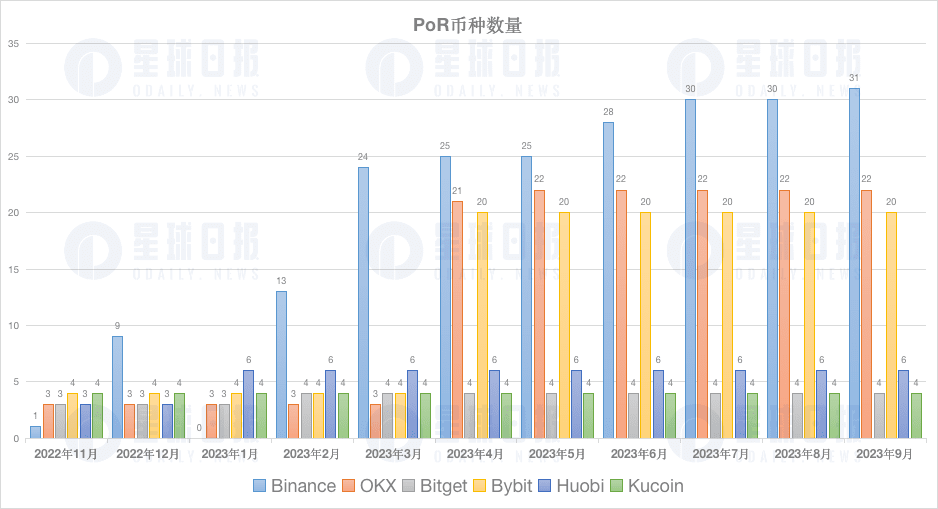
OKX is the second largest platform in terms of the number of currencies announced, increasing from 3 at the beginning to 21 in April this year - currently 22; Bybit is second only to Binance and OKX, increasing from 4 in the early days to 20 at present. Bitget and Kucoin have always been four - BTC, ETH and two stablecoins (USDT, USDC).
Another consideration is the BTC reserve. According to Odaily Planet Daily statistics, Binance has the largest BTC reserve, currently about 618,000, followed by OKX (138,500). The BTC reserve of each company is as follows:
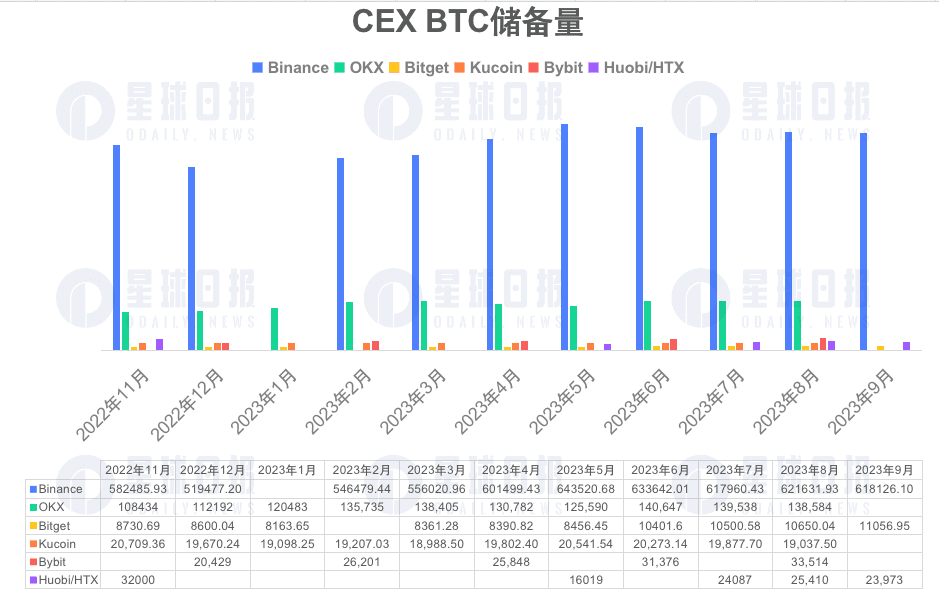
Binance, OKX, Bitget and Bybit all have significantly increased their BTC reserves compared to 10 months ago, with increases generally exceeding 10%. Bybit saw the largest increase (64%), followed by OKX (27.7%) and Bitget (26.6%). HTX (Huobi’s name change) saw the largest drop, with its BTC reserves once halved, and has now rebounded to 23,973.
The last indicator is the cleanliness of the reserve fund, that is, the proportion of non-platform currency assets in the total assets. Bitget and Kucoin’s PoR reports do not involve platforms and are excluded; among the other four, Bybit has the highest reserve fund cleanliness, exceeding 95% in the April, June and August reports; Binance follows closely, with the reserve fund cleanliness maintained at more than 85%, with a maximum of 87.69%; OKX and HTX (Huobi renamed) reserve fund cleanliness is between 50% and 60%, in other words, nearly 40% of the reserve funds are exchange platform coins - HTX platform coins include HT and TRX in statistics.
3. Analysis of specific reserves of each company
Binance's total reserves rose from US$9.451 billion when it was first announced in November 2022 to a peak of US$69.905 billion in May this year; then, due to the panic caused by Binance's lawsuit by the SEC in June, capital outflows were obvious, and the final record for the month was US$653.43.
In the past two months, Binance's total asset reserves have continued to decline, but its BTC and ETH reserves have not dropped significantly compared to June. One possible explanation is that the overall downward trend in the crypto market has led to a decrease in the value of total asset reserves.
       
(Binance asset reserve changes, click to play video)
OKX has seen several obvious changes over the past 10 months: first, the BTC reserves have continued to rise; second, the stablecoin reserves have also continued to grow, from the initial $3.06 billion to $5.43 billion, an increase of more than 70%. However, the value of OKX platform coin reserves has always been above $10 billion, more than 40%.
Bitget's BTC reserves and total asset reserves are constantly rising, showing a positive trend, which may be due to its upgraded strategy this year - grabbing various new coins to gain high market attention. Bybit, like Bitget, has steadily increased its BTC reserves and total asset reserves.
Kucoin has not changed much overall. In addition, according to Nansen data, the platform currency KCS accounts for 12.7% of Kucoin addresses, and the cleanliness of its reserve assets exceeds 85%.
Odaily Planet Daily will continue to track the asset reserves of each CEX.
Recommended reading:
"As traditional auditors exit the market, where will CEX reserve certificates go?"
"Analyzing the asset reserve details of the seven major exchanges, who exposed the potential risks?"