

Written by: JamesX
Yuga Labs and Horizen Labs officially launched the ApeStake.io website on December 5, and also started the one-week pre-staking phase of Ape Staking. The official Ape token staking incentives will be distributed from December 12, and based on the current pre-staking data (December 8), the expected APY is 1000%+.
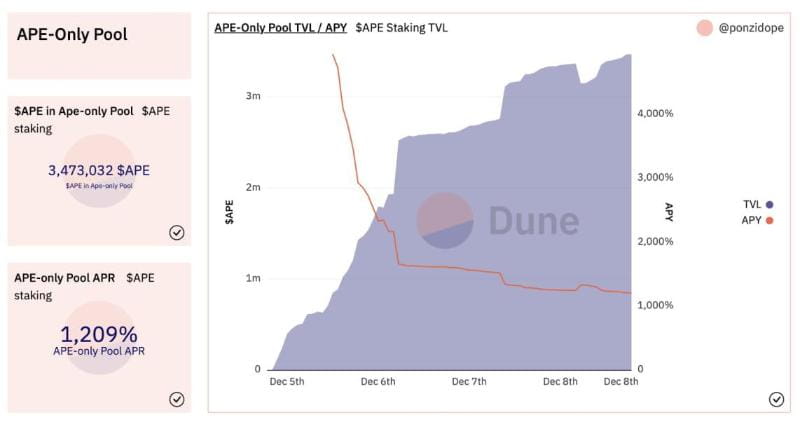
Although there are still a few days before the official mining begins, and the expected APY yield at that time will decline after more APE tokens and BAYC/MAYC/BAKC series NFTs participate in staking, Ape Staking is an investment opportunity not to be missed for investors and NFT collectors.
This article will elaborate on the official rules of Ape Staking and the risks of participation, and compare the staking rules and expected returns of three third-party Ape Staking platforms (ParaSpace, BendDAO, Binance NFT), so as to help you make the most rational decision based on your own situation.
ApeStake.io Official Staking
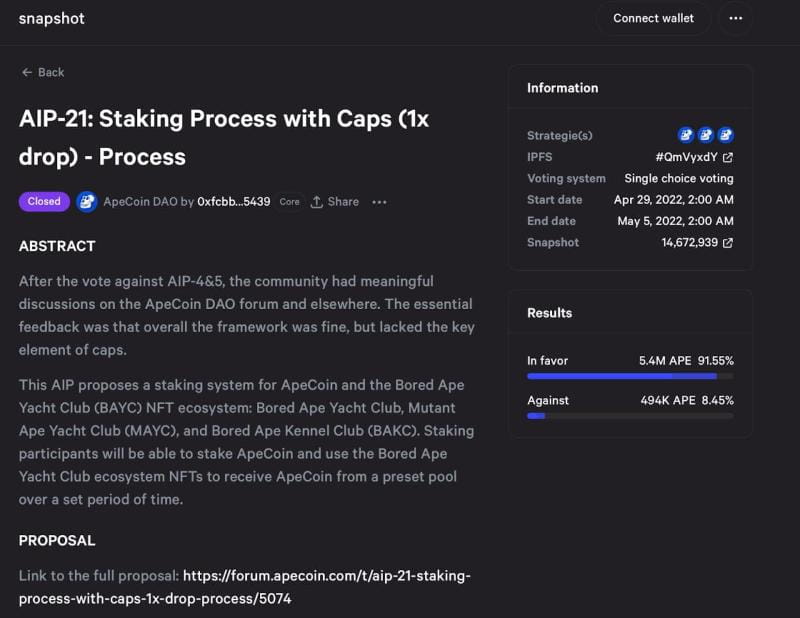
Ape Staking's earliest proposals, AIP 4&5, were rejected by the community vote. After a lot of community discussions, it was not until AIP 21&22 was passed that the details of Ape Staking's activities were considered to have formed a community consensus and began the preparation process.
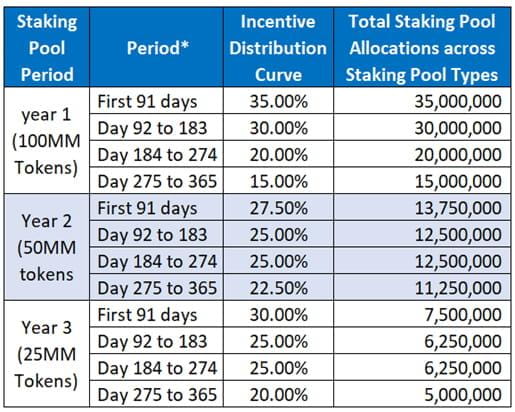
The figure below shows the amount of APE token incentives released each quarter during the three-year Ape Staking activity. It can be seen that early participants can obtain more APE token incentives and higher expected returns.
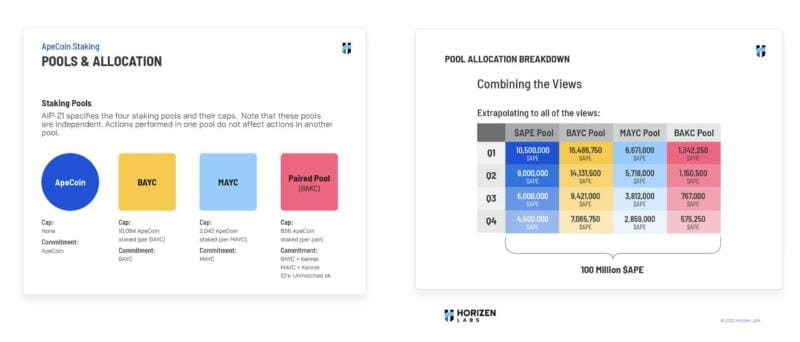
The participation form of APE Staking activities is divided into 4 independent staking pools: APE token staking pool, BAYC pool, MAYC pool, and BAKC pairing pool. Any number of APE tokens can be directly staked in the Ape token staking pool, so the income of participants depends on the proportion of APE tokens invested in the total pool. In the BAYC and MAYC staking pools, NFT is more like a container for APE tokens. APE tokens need to be paired with it to participate in APE Staking mining. Its mining share is determined by the number of paired APE tokens, and each NFT has a paired APE token upper limit. BAKC must first be paired with a BAYC/MAYC before it can cooperate with APE tokens to participate in staking. Please refer to the figure below for the specific APE token mortgage upper limit and the amount of APE tokens released in each asset pool.
Note: If you choose to participate in the staking mining activity directly through ApeStake.io, please note that if you sell the corresponding Ape NFT during the staking period, you will lose all the paired staked Ape tokens. Therefore, please remember to cancel the staked Ape NFT and recover all the staked Ape tokens before the transaction occurs to prevent being attacked by arbitrageurs.
The above introduces the details of participating in Ape Staking through official channels, but please note that the premise is that you must own both BAYC/MAYC/BAKC NFT and the corresponding upper limit of APE tokens to achieve the highest expected rate of return. If you only own the corresponding NFT or APE, or if you want to get a higher expected rate of return and more liquidity, then you have three better options: ParaSpace, BendDAO and Binance NFT.
ParaSpace
You may be unfamiliar with the name ParaSpace because it is indeed a new player in the NFT lending market, but its sister project Parallel Finance, the largest lending protocol in the Polkadot ecosystem, is definitely familiar to everyone, and the development team is also Para Labs.
The first exploration of Para Labs' multi-chain deployment + multi-market layout is ParaSpace, an innovative NFT lending platform based on the Ethereum ecosystem. This strategic layout is somewhat similar to the logic of Uniswap Labs' recent entry into the NFT trading market. As its first battle to open up the Ethereum NFT lending market, the ParaSpace team also developed a complete set of products for Ape Staking, and opened an additional 30% APY mining reward for APE tokens in the pre-staking stage to encourage early user participation.
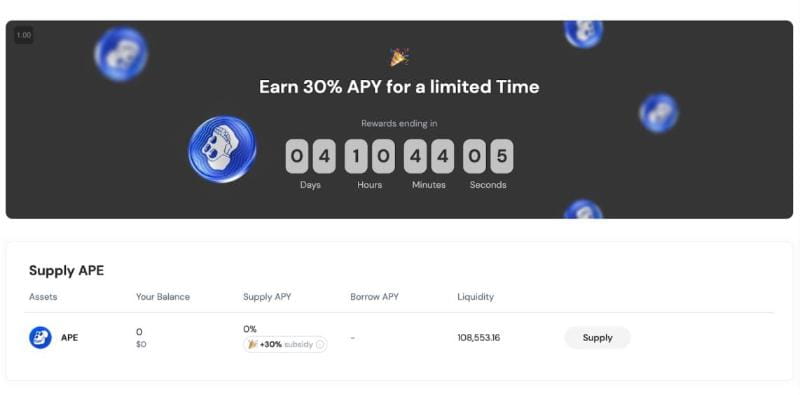
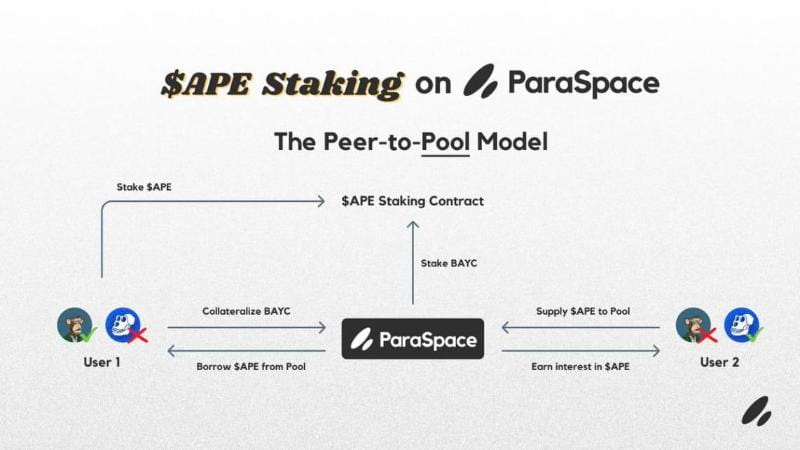
ParaSpace Ape Staking, like BendDAO to be analyzed below, uses NFT mortgage lending as the basic logic of the platform. Combined with the Ape Staking mechanism, NFT holders can obtain additional liquidity funds through mortgage lending while participating in Ape Staking liquidity mining to obtain continuous APE token mining rewards. However, ParaSpace has adopted an innovative Peer-to-Pool model, which greatly improves capital utilization efficiency.
First, after Ape NFT holders pledge NFTs on the ParaSpace platform, they can borrow the required APE tokens from the APE lending pool to pair with their NFTs, without having to find specific APE token holders to let them pledge their tokens to their NFTs, which greatly reduces market friction. At the same time, APE token holders only need to deposit their APE tokens into the ParaSpace lending pool to obtain APE Staking incentives in the form of lending interest rates.
(ParaSpace Twitter)
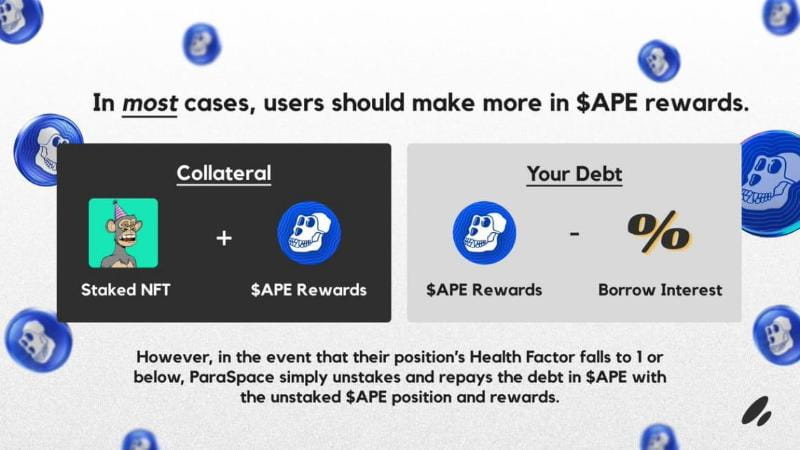
APE Staking paired mining in the form of NFT lending has the risk of Ape NFT being liquidated in terms of mechanism, but ParaSpace has also cleverly solved this problem. First of all, the price of APE tokens and the floor price of Ape NFTs themselves have a relatively strong correlation, so the liquidation risk itself is lower than the NFT mortgage lending ETH model. At the same time, in extreme cases, when the liquidation process is to be started, ParaSpace will automatically redeem the pledged Ape NFT, but will deduct the necessary part from its Staking rewards to ensure the solvency of APE token lending, and at the same time, Ape NFT itself will not actually enter the liquidation auction process.
 (ParaSpace Twitter)
In addition, ParaSpace has also avoided the risk of losing the paired APE tokens if the Ape NFT is sold during the pledge period mentioned in the previous section. If any Ape NFT mined through ParaSpace is traded during the pledge period, ParaSpace will automatically release the pledge and return all Ape tokens before the transfer of the transaction occurs. This fundamentally eliminates the occurrence of this bug in the official mechanism and ensures the security of its own APE lending pool.
Regarding the contract security that users are most concerned about, although ParaSpace is a brand-new NFT lending platform and the new contract developed for Ape Staking was launched on the mainnet on December 10, its contract has undergone security audits by 0xQuit, Certik, trailofbits, and secure3io. At the same time, several other leading security audit companies are also conducting the final stage of security reviews, including SlowMist, VeridiseInc, and Quantstamp.
For users who want to participate in Ape Staking directly but are restricted by ApeStake.io due to their geographical location, ParaSpace has developed a front-end interface that interacts directly with the official Staking contract to facilitate restricted users.
BendDAO
BendDAO is no stranger to most NFT blue-chip players. It has been running smoothly for nearly 9 months. During this period, BendDAO also experienced the sharp fluctuations in the prices of blue-chip NFTs, which led to the liquidation of many NFTs. Not long ago, the industry questioned whether it would become the culprit for the death spiral of blue-chip NFT prices and its ability to resolve bad debts. However, with the continuous iteration and upgrading of products, as well as efforts to modify important parameters through community proposals and decisions, BendDAO has proved its leading position in the NFTFi field with data and time. Therefore, in the Ape Staking activity, BendDAO is also a very important third-party participation platform.
BendDAO’s product planning to support Ape Staking began with a community proposal, and through another subsequent proposal vote, it was decided that BendDAO would charge a 4% APE Staking protocol fee, which can be regarded as a benchmark case of DAO governance in the NFTFi field.
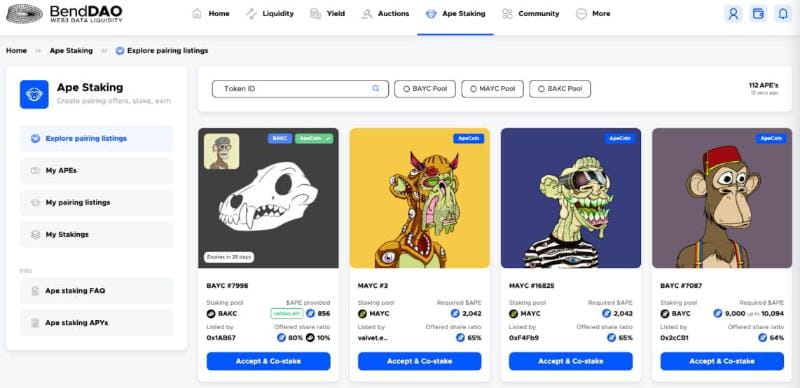
The design concept of Ape Staking adopted by BendDAO is different from the Peer-to-Pool logic of ParaSpace. Instead, it adopts a Peer-to-Peer model with higher user freedom. When each BAYC/MAYC is deposited into BendApe Staking, the NFT holder can freely set several parameters: 1. The percentage of the total APE token reward allocated to each role of the Ape NFT, APE token, and BAKC pairing staker. 2. The number of APE tokens pledged.
For APE token holders, they can choose any Ape NFT pairing for staking, but the most important basis for selection is definitely the reward distribution ratio pre-set by the Ape NFT holder.
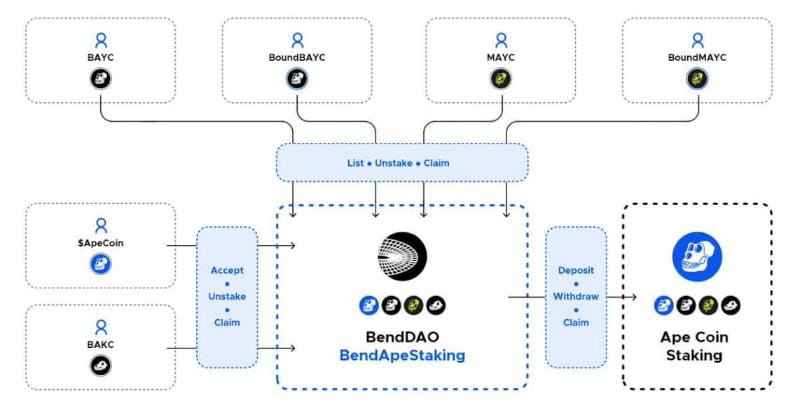
This is BendDAO's Peer-to-Peer pairing mining model, which gives users the greatest freedom, but also brings some problems with high pairing friction, such as the setting of the reward distribution ratio. If the APE token staking profit share is set to be high, then there is a high probability that there will be sufficient APE tokens to participate in the paired staking, but the profit shared by Ape NFT holders may not be as good as the expected rate of return on other platforms; if the APE token staking profit share is low, then there may be a situation where no APE token is willing to pair with this Ape NFT for staking. Therefore, it is very likely that after the Ape Staking activity officially begins, Ape NFT holders will continue to redeem and readjust the reward distribution ratio based on the expected rate of return on other platforms, making it impossible for users of different roles to obtain long-term stable returns.
Binance NFT
Centralized exchanges have also found their own angle of entry in the Ape Staking event. Binance NFT issued an announcement on December 6, announcing that it will launch the Ape NFT staking event on December 12.
The rules of the activity are the simplest and most direct among the Ape Staking projects. Users only need to stake BAYC and MAYC NFTs on the Binance NFT platform to receive daily APE token mining rewards. This is equivalent to providing a centralized staking service for Ape NFT holders, and users can earn income from Ape Staking activities without having to worry about the paired staking rules of APE tokens.
Users can choose to pledge BAYC or MAYC NFT in a current form or for a fixed period of 30, 60, or 90 days. Although the official announcement did not mention the difference in yields for different staking periods, it can be expected that longer fixed-term staking should correspond to higher expected yields.
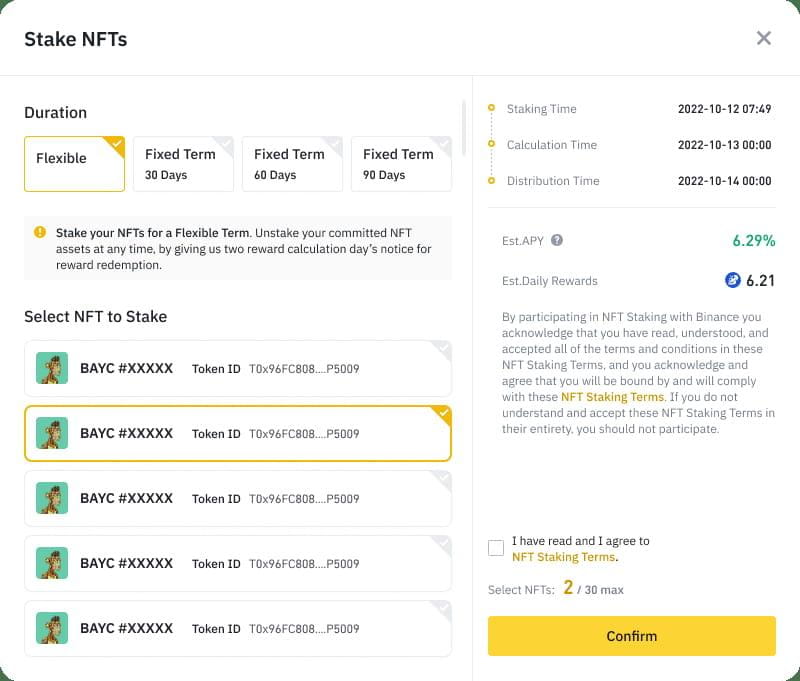
It is worth noting that after the pledge begins, if users want to retrieve the Ape NFT that has been pledged, the official announcement reminds that the redemption process of current pledges will take 48 hours, and the early redemption process of fixed-term pledges will take up to 7 days, and the APE mining income of these 7 days will be lost. This is not a user-friendly pledge redemption mechanism for the highly volatile NFT market. At the same time, compared with the "DeFi" form of ParaSpace and BendDAO, where all processes are carried out through smart contracts and are guaranteed by numerous audit reports, Binance NFT's centralized pledge mechanism also has certain centralized operation risks, but Ape NFT holders can also check whether their BAYC/MAYC has participated in the pledge at any time through on-chain data through official channels.
Binance NFT has not yet announced its specific profit-making methods and profit expectations, including how it will be paired with APE tokens to participate in Ape Staking (the source of these APE tokens should be Binance Earn's APE Staking activities), and how much profit it will get from it. These are still unknown. Therefore, the specific staking yield can only be known after the event is officially launched on December 12, and users can make a direct comparison and make their own decisions. However, it is estimated that the yield at that time should be higher than the official pure NFT staking yield, but lower than the yield of NFT + APE token pairing.
Summarize
In order to facilitate a direct comparison of the above four Ape Staking platforms, I have made the following table for your reference.
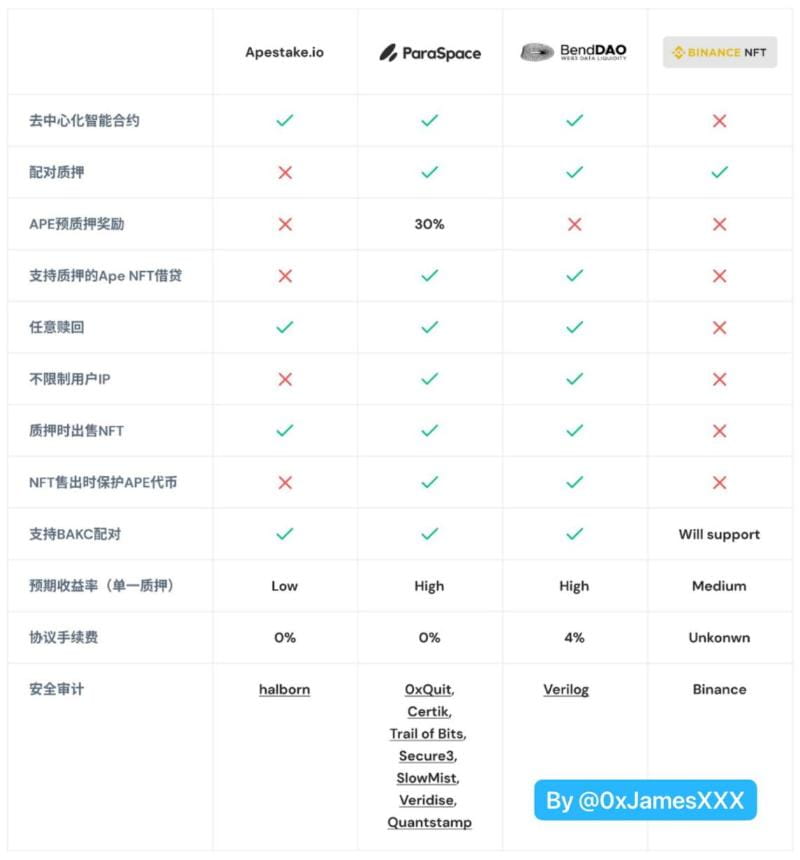
Although the design of Ape Staking activities has been mixed between NFT users and coin holders in the APE ecosystem, as a DeFi researcher, I am very happy to see that NFT native projects are integrating more design ideas of the DeFi track, including the Art Gobblers that was very popular some time ago, which borrowed the (3, 3) model of the DeFi project OlympusDAO.
This is even more true for the NFTFi track: LooksRare and X2Y2, which use trading as mining, have been upgraded to Listing + Bid, i.e. "mining" blind boxes, Blur.io; ParaSpace, BendDAO and JPEG'd, which use over-collateralized lending as the underlying product logic. These projects have provided tremendous support for the underlying liquidity of the NFT track and improved the overall capital utilization efficiency.
I believe that with the continuous exploration of the entire NFT ecosystem for combining token economic models, as well as the continuous efforts of builders in the NFTFi track and mechanism innovation combined with the characteristics of NFT itself, we will soon reap a more attractive PFP series, RWA on-chain investment opportunities undertaken by NFT, customized financial bills, etc. NFT will definitely play a more important role in the future on-chain financial system.