
The NFT royalties battle has intensified beyond Ethereum, with questions over whether to enforce royalties for NFT creators now also spreading to the already troubled Solana blockchain, with the long-simmering dispute between major players in the space, Metaplex and Magic Eden, finally coming to light and spilling over onto social media.
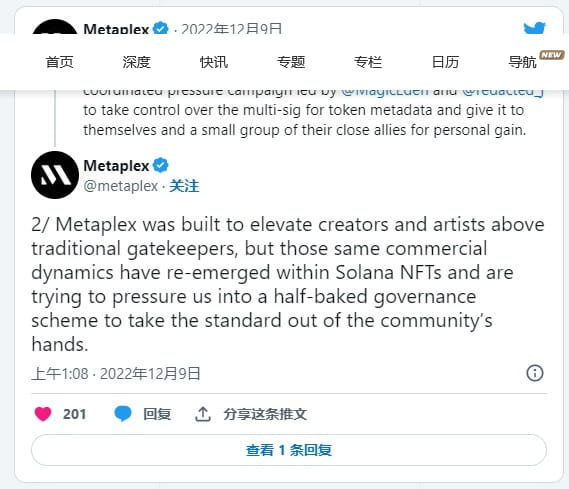
On December 9, Metaplex, the creator of the Solana on-chain NFT standard, posted on Twitter that the top NFT market Magic Eden is leading a "coordinated pressure campaign" and trying to control the on-chain NFT standard it created. If Magic Eden can set token parameters and functions, then NFTs on the Solana chain will have unique features that are different from other similar tokens. As the creator of the Solana on-chain NFT standard, Metaplex wrote almost all of the relevant code, which means they "control" almost every key to the NFT on the Solana chain.

It is worth mentioning that Metaplex also mentioned a person in the tweet: core developer Jordan Prince, who developed the original Metaplex protocol while working at Solana Labs, and then left to found B+J Studios and successfully raised $10 million in September this year to support NFT infrastructure development - Metaplex believes that Jordan Prince is an accomplice of Magic Eden.
Metaplex vs. Magic Eden: The "Tearing War" Begins
Metaplex has always been a supporter of NFT royalty collection on the Solana chain, while Magic Eden hopes to implement a "zero royalty" strategy. In October this year, Magic Eden announced that it would no longer strictly enforce the royalty setting authority for NFT creators in order to attract more users during the bear market and prevent competitors from quickly grabbing market share.
According to Metaplex on social media, they have always played the role of "gatekeepers" for creators and artists on the Solana blockchain, but Magic Eden is more of a business perspective, hoping to take NFT royalty standards away from the community and force users to accept "half-baked" governance plans.
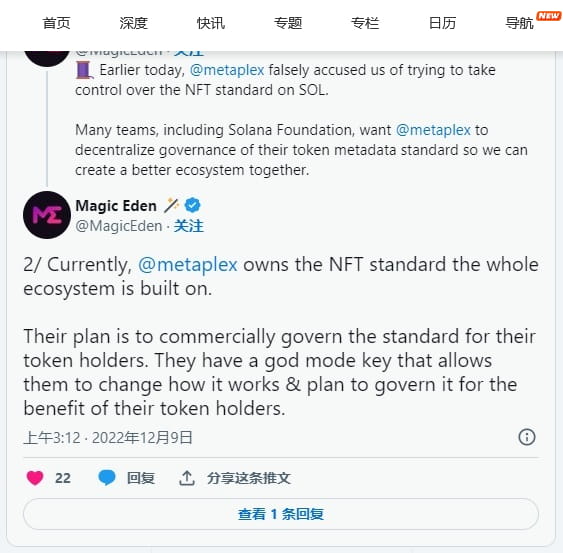
Magic Eden quickly responded, saying that Metaplex "falsely accused" it of trying to control the NFT standard on the Solana chain, and turned the tables, accusing Metaplex of using its MPLX governance token launched in September this year to gain control over the NFT standard on the Solana chain in disguise, which would also bring undue influence to the standard itself. Magic Eden also stated that they and other builders on the Solana chain have expressed their opinions to Metaplex: "Metaplex holds the "God mode" key, they can do almost anything they want, and their goal is actually to protect the interests of their MPLX token holders."
Not to be outdone, Metaplex responded immediately, claiming that it would release a new plan to "decentralize" control over the NFT standard on the Solana chain, but at the same time also strongly retorted that Magic Eden "will not arbitrarily appease a group acting maliciously."
Metaplex vs. Magic Eden: The conflict between the two sides has a long history
This is not the first time that Magic Eden and Metaplex have disagreed on the direction of the Solana NFT ecosystem, but now the conflict between the two sides is spreading into the public eye in an unprecedented way.
As early as August, a source close to Metaplex revealed that Metaplex found that Magic Eden’s method of hosting users to list NFTs had potential security risks, but Magic Eden refused Metaplex’s help and was unwilling to disclose its source code. It is reported that Magic Eden’s source code for building the NFT market actually came from the early Metaplex code, but a lot of modifications were made and it was closed and not disclosed.
However, what exacerbated the conflict between Metaplex and Magic Eden was undoubtedly the much-watched issue of NFT royalties in the secondary market. NFT creator royalties are a small fee, usually between 5% and 10% of the sales price, which is automatically paid by the seller to the original creator of the project through the relevant market. On this issue, Magic Eden and Metaplex have different views. They announced in October this year that they would enable optional royalties on their platform, allowing NFT buyers to choose full royalties, half royalties, or no royalties.
Magic Eden had no choice but to make this move. Over the past year, Magic Eden has been the most important NFT market on Solana, with a market share of more than 90%. However, after competitors such as Hadeswap and Solanart launched the "zero royalty" strategy, Magic Eden's market share fell rapidly, shrinking to 77% in mid-November. Yawww and Hadeswap are also gradually eating into its "cake".
Perhaps because Magic Eden's "zero royalties" was not supported by Metaplex, they decided to start anew. In early November, Magic Eden co-founder and CEO Jack Lu announced the launch of a new Solana on-chain NFT standard, which will enforce royalties at the technical level. The implementation of this standard is expected to produce a new asset class that can provide support for those who want to earn royalties or new business models. Last week, Magic Eden announced the launch of an agreement "Open Creator Protocol (OCP)" starting on December 2, which will impose royalties on all new collectibles that choose to use the tool, and creators can also choose whether to protect royalties.
Just when Magic Eden was full of confidence, Metaplex came out and "suddenly" announced plans to develop a new mandatory royalty NFT asset class standard MIP-1, which will be launched in January 2023. This move made Jack Lu very angry because according to him, Magic Eden's new royalty tool was shared with Metaplex before it was released, and Metaplex deliberately chose to release it after the launch of OCP, which might have some countermeasures.
Conclusion
The bankruptcy of FTX dealt a heavy blow to the Solana ecosystem. The network's DeFi TVL, denominated in US dollars, dropped from US$1 billion on November 6 to US$278.3 million, a drop of 72.1%; the network's stablecoin market value also shrank from US$3.9 billion to US$2.1 billion, a drop of 46.1%.
Now, the on-chain NFT market has also become unstable, which may make the Solana ecosystem worse. Who will eventually control the on-chain NFT standard between Metaplex and Magic Eden? Let's wait and see.