
1. What is cross-chain interoperability?
The current development trend of blockchain is multi-chain parallelism, but the blockchain itself does not have the ability to communicate with external systems or APIs, and data and value cannot be transmitted seamlessly across the network, resulting in the isolation of the ecosystem and the inability to exchange information with each other.
From the developer's perspective, each deployment constitutes an isolated independent entity, resulting in the backend contracts being unconnected to each other and unaware of each other's existence. For example, a decentralized exchange (DEX) DApp may need to be deployed on Ethereum, BNB Chain, and Polygon networks respectively, so that each version of the DApp is independent of each other.
Source: Chainlink
For users, this multiple deployment approach also increases the difficulty of adoption:
1) Users cannot seamlessly transfer tokens from one blockchain to another.
2) The transfer process is time-consuming and the experience is suboptimal, as assets are usually destroyed on the source blockchain and then re-minted on the target blockchain using a third-party bridge.
3) The security risk of holding assets on multiple blockchains is also high, and it is easy to be attacked by hackers, resulting in loss of funds.
Due to the diversity of blockchain ecosystems, it is critical that these different on-chain environments can interoperate and communicate with each other. A key part of the infrastructure for exchanging data and assets between different blockchains is the cross-chain interoperability protocol. Cross-chain interoperability enables developers to build a unified cross-chain application, that is, the same dApp can be deployed on multiple different blockchains without having to deploy multiple independent versions on different chains, unlocking higher capital efficiency and better liquidity conditions.
2. Cross-chain solutions
Cross-chain solutions typically involve validating the state of a source blockchain and relaying subsequent transactions to a target blockchain, with a key piece of infrastructure being a cross-chain bridge, which enables assets to be transferred from a source blockchain to a target blockchain. A cross-chain bridge typically involves locking or destroying assets on the source chain via a smart contract, and unlocking or minting them via another smart contract on the target chain. In practice, the use case for a cross-chain bridge is very narrow, and its role is to transfer assets between different blockchains. Therefore, a cross-chain bridge is typically an application-specific service between two blockchains.
Currently, developers have built a variety of cross-chain solutions, such as:
Chainlink is developing the Cross-Chain Interoperability Protocol (CCIP), an open-source standard that enables cross-chain communication, including sending messages and transferring tokens. The goal of CCIP is to enable universal connectivity between hundreds of blockchain networks using standardized interfaces, hopefully reducing the complexity of building cross-chain applications and services.
The Wormhole protocol is a universal interoperability protocol that enables the transfer of tokens and messages across different blockchain networks. Network guardians monitor information on the source chain, verify it, and facilitate its transfer to the target chain. Developers using Wormhole can build cross-chain decentralized applications called XDApps.
The Inter-chain Message Transfer Protocol (IBC) is a standard protocol for blockchain interactions in the Cosmos network, designed to achieve interoperability between different blockchains. IBC defines a minimum set of functions specified in the Inter-chain Standard (ICS), which define how blockchains communicate with each other and exchange data.
LayerZero is a full-chain interoperability protocol used for lightweight information transmission between blockchains, providing secure, reliable and trustless information transmission.
This article mainly introduces the full-chain interoperability protocol LayerZero, which only focuses on information transmission between chains and can send messages to any smart contract on any supported chain. That is, it is responsible for smart contract communication between blockchains. It is not responsible for cross-chain assets. Cross-chain assets are completed by Stargate developed by LayerZero Labs.
3. LayerZero technical features and advantages
1. Technical features
The most prominent feature of LayerZero is its ultra-lightweight nodes. It uses ultra-light node technology to transmit messages between endpoints of different chains through relays and oracles, reducing costs while ensuring security.
1) Ultra-light nodes
First of all, every node in the blockchain network is actually every computer or server terminal that stores data. Light nodes are just an operating mode of nodes. Unlike full nodes, light nodes only store a small part of blockchain data, such as block headers and other information, and do not store specific transaction information in the block. Compared with light nodes, ultra-light nodes have the same verification method, but because the cost of writing to the blockchain is very high and the continuous transmission of block headers is expensive, ultra-light nodes do not retain all block headers, but stream these block headers on demand through oracles, thereby more efficiently synchronizing off-chain entities to achieve the desired state, changing the original continuous streaming transmission method.
The advantage of this is that it does not rely on the block header data stream of the light node from the beginning, but the disadvantage is the lack of historical sequential data stream. Once the oracle and the relayer do evil at the same time, the verification can be passed, which will cause malicious information to be executed. Therefore, LayerZero has made a trade-off between greatly reducing the verification cost and a certain degree of security loss. Whether this trade-off is worth it may depend on how it weighs it based on its own scenario.
2) Core Components
In the LayerZero official white paper, we can see that the core components responsible for information transmission between the two chains are endpoints, oracle machines, and relayers.
Endpoints are facilities that interact directly with users or applications, and are responsible for handling message transmission, verification, and reception. Their purpose is to ensure effective delivery when users send messages using the protocol. In the LayerZero protocol, each chain needs to deploy endpoints, which can also be called by other apps on the same chain and are responsible for sending information to external links.
Oracles are third-party services that provide a mechanism independent of other LayerZero components that can read a block header from one chain and send it to another chain, so that the validity of the source chain transaction can be verified on the target chain. LayerZero currently uses Chainlink as its oracle.
A relayer is an off-chain service that is similar in functionality to an oracle, but instead of fetching block headers, it fetches proofs of a given transaction. To ensure efficient delivery, the only requirement is that for any given message sent using the LayerZero protocol, the oracle and relayer must be independent of each other. Any entity can assume the roles of oracle and relayer, and LayerZero can even implement its own relay service.
An important trust assumption in LayerZero is that oracles and relayers operate independently of each other. The block header submitted by the oracle will be cross-verified with the transaction proof submitted by the repeater. The two do not form any consensus and only transmit messages. Simply put, the oracle acts as a notary in the LayerZero cross-chain, letting the target chain know the result of the verification, while the repeater is responsible for providing the proof process required to verify the transaction and the specific content of the cross-chain information. In order to ensure the effective transmission of information, once there is any dispute in the information transmission between repeaters or oracles, the smart contract will be suspended and the information will not be submitted to the target chain.
Refer to "Detailed explanation of interoperability protocol LayerZero technology and features"
If a transaction is transferred from chain A to chain B, the overall process is as follows:
The transaction starts with the user launching the application, and then the oracle and relayer, with the help of the LayerZero endpoint, break the transaction into multiple parts (proofs and block headers). Once the oracle and relayer send their respective information on the target chain (signing the transaction on the chain), and the LayerZero Endpoint (contract) verifies the correctness of the information, the message will be transformed and executed on the target chain.
2. Advantages
1) Security
As an underlying protocol, LayerZero's security is independent of external protocols, thus ensuring the stability of the entire protocol consensus. In addition, thanks to the unique oracle and repeater design, the two are independent of each other, and transactions are completed only when both are considered to be true, ensuring the security of information transmission.
2) Scalability
LayerZero acts as a universal messaging layer, which means that any contract can be transferred from chain A to chain B to achieve cross-chain interoperability with the first layer network. Through innovative endpoint design, LayerZero can be easily expanded to support any chain, bringing a wider range of application scenarios to the blockchain ecosystem.
3) High efficiency
First, LayerZero’s ultra-light node technology can achieve higher transmission efficiency and reduce verification costs while ensuring security; second, LayerZero’s repeaters or oracles do not form any consensus, they simply transmit messages, and all verifications are completed on their own target chains, so the speed and throughput limitations depend entirely on the properties of the two transaction chains.
4. Financing
LayerZero has completed three rounds of financing, with a total disclosed amount of US$293 million. Investors include well-known crypto investment institutions such as Multicoin, Binance Labs, a16z, and Sequoia Capital. The latest round of financing was on April 4, 2023, raising US$120 million at a valuation of US$3 billion.
FTX participated as the lead investor in the Series A financing on March 30, 2022. Affected by its collapse, on November 11, 2022, LayerZero officially announced that it had repurchased 100% of the equity, currency rights and other agreements from FTX.
Source: Crunchbase
5. Ecology
So far, LayerZero has supported more than 20 chains including Ethereum, BNB Chain, Aavalanche, Polygon, Base, etc. The number of independent users has reached 3 million, and the cumulative number of transactions has reached 56 million, but 35% of users have only 1 interaction record, and only about 730,000 users have more than 2 interaction records.
Source: Dune Analytics
User interaction activities mainly occur on BNB Chain, Arbitrum and Polygon. Especially since the launch of Arbitrum, the community has been eager to get airdrops, and the expectation of airdrops has also led to a significant increase in user activity on LayerZero.
Source: Dune Analytics
Taking Arbitrum interaction data as an example, the number of transactions reached about 12 million. April 2023 was the peak period of user activity. With the sluggish market conditions, user activity also declined slightly.
Source: Dune Analytics
LayerZero's minimalist architecture gives the protocol unlimited possibilities, and its low developer access complexity means that LayerZero currently has more than 50 dApps integrated or using its technology.
Source: Twitter
Star Projects
1. Stargate Finance
The first dApp based on the LayerZero protocol developed by LayerZero Labs has built the first fully composable native asset bridge. Its vision is to make cross-chain liquidity transfer a seamless, single process. The highlight of the product is the use of a unique "Delta algorithm" to solve the "impossible triangle" problem of cross-chain bridges without having to make trade-offs.
The Stargate team believes that there is an “impossible triangle” in the cross-chain asset bridge:
1) Instant verification and confirmation: assets can be successfully transferred to the target chain when the transaction is confirmed, and timeliness can be guaranteed;
2) Unified liquidity: a single liquidity pool is shared across multiple chains;
3) Asset nativeness: Users can directly obtain native assets through cross-chain bridges, rather than synthesizing or encapsulating assets.
Of course, when ensuring instant verification and confirmation and asset nativeness, if a more complex dynamic liquidity allocation algorithm is not involved, only a liquidity pool can be built between every two chains, which will reduce capital efficiency.
According to defillama data, in terms of transaction volume in the past month, Stargate ranks first among all cross-chain bridge protocols, with up to 96,000 transactions in 24 hours.
Source: defillama
Agreement revenue
Stargate is the first dApp launched on LayerZero. Its protocol fees and revenue have been growing steadily since March 2023, when on-chain transaction activity increased significantly due to airdrop expectations. Currently, the protocol's monthly revenue exceeds $1 million.
Source: Token Terminal
Economic Model
The total amount of STG tokens is 1 billion, and the circulation volume is 200 million. The functions of the tokens are:
1) Cross-chain asset transfer fees. Non-STG token transfers will incur a 0.06% fee, of which 0.045% will be allocated to liquidity providers and 0.015% will be allocated to the protocol’s treasury;
2) Governance: by staking and locking STG tokens for 3 to 156 weeks, you can obtain the governance token veSTG. The longer the STG is locked, the greater the voting weight;
3) Protocol rewards, stablecoin liquidity pool and liquidity mining rewards.
The token issuance time is March 17, 2022, and the initial distribution details are as follows:
Source: tokenunlocks
The tokens allocated to early DEX liquidity, Bonding Curve, initial release plan and the community are unlocked directly at the time of the initial issuance of tokens, totaling 478 million.
Of the portion allocated to the launch of the protocol, 5% (50 million) will be released directly, and the remaining 10% will have a 1-year lock-up period, followed by linear release within 6 months. Currently, 145 million have been released.
The portion allocated to investors and teams has a 1-year lock-up period and a 2-year linear release period.
According to the above token distribution, STG nominal emission has reached 729 million. According to the distribution of STG holding addresses, it can be clearly seen that 297 million of the 304 million allocated to the community are not in circulation, and 320 million of the part allocated to investors and teams are not in circulation. These two parts are in circulation for a total of about 67 million pieces, accounting for about 6.7%.
From the distribution of holding addresses, the top 20 holdings account for 94%, of which the top two addresses are both officially owned and have not yet been circulated, accounting for 62%. Excluding these two parts, the remaining addresses hold 32%, of which Alameda holds 9.42%. The holdings of individual large addresses account for only 0.6%, and the large holders have relatively few chips accumulated.
Alameda co-CEO Sam Trabucco once posted on social media that Alameda Research participated in the public offering of the cross-chain bridge project Stargate on March 18 and purchased all shares of STG (100 million, which is 10% of the protocol launch mentioned above). However, Sam Trabucco said that Alameda will not sell STG within 3 years, will make long-term investments in the project and team, will not interfere in the governance of the project, and will give up its voting rights in aSTG so that voting rights can be more equally distributed among early community members. 9.42% has been released so far.
2. Radiant Capital
Radiant is a cross-chain DeFi lending protocol that implements full-chain leveraged lending and composability by using LayerZero as a cross-chain infrastructure, allowing users to obtain leverage in the DeFi protocols it supports and simplifying users' cross-chain asset lending operations between different chains.
Radiant is essentially similar to the operating mechanism of current lending protocols such as Aave and Compound. The difference is that it is a full-chain lending protocol, that is, users can deposit collateral on chain A and then borrow on chain B. However, when users need to use cross-chain lending services, they need to deposit a certain amount of assets on the supported chain first to become a dynamic liquidity provider (dLP) before they can lend the assets required by the target chain.
Radiant has been deployed on Arbitrum and BSC chains, with a TVL of US$220 million. It ranks relatively high among a number of lending protocols and currently occupies a certain market share, making it the lending leader on Arbitrum.
Agreement revenue
In Radiant, protocol revenue = borrowing fees - supply-side fees. Since February of this year, the protocol has received stable fees of around $2 million, and the protocol's monthly revenue has reached around $1 million.
Source: Token Terminal
Economic Model
The total amount of RDNT tokens is 1 billion, and the circulation volume is 300 million. The main function of the token is governance and liquidity incentives.
According to Token Unlock data, the reserves allocated to 2 pools of liquidity providers, Treasury and Radiant DAO have all been unlocked. The reserves still being unlocked are for the team, core contributors and depositors and borrowers. The reserves allocated to depositors and borrowers release 4.85 RDNT per second. If calculated at this rate, nearly 210,000 RDNT will be released per month.
From the perspective of token holdings distribution, the top 20 token addresses account for 92.3%, of which the first one is the official contract address, with 23.4% still undistributed. Tokens distributed in DEX account for 27.6%, and the top 20 large addresses account for only 3.8%.
route map
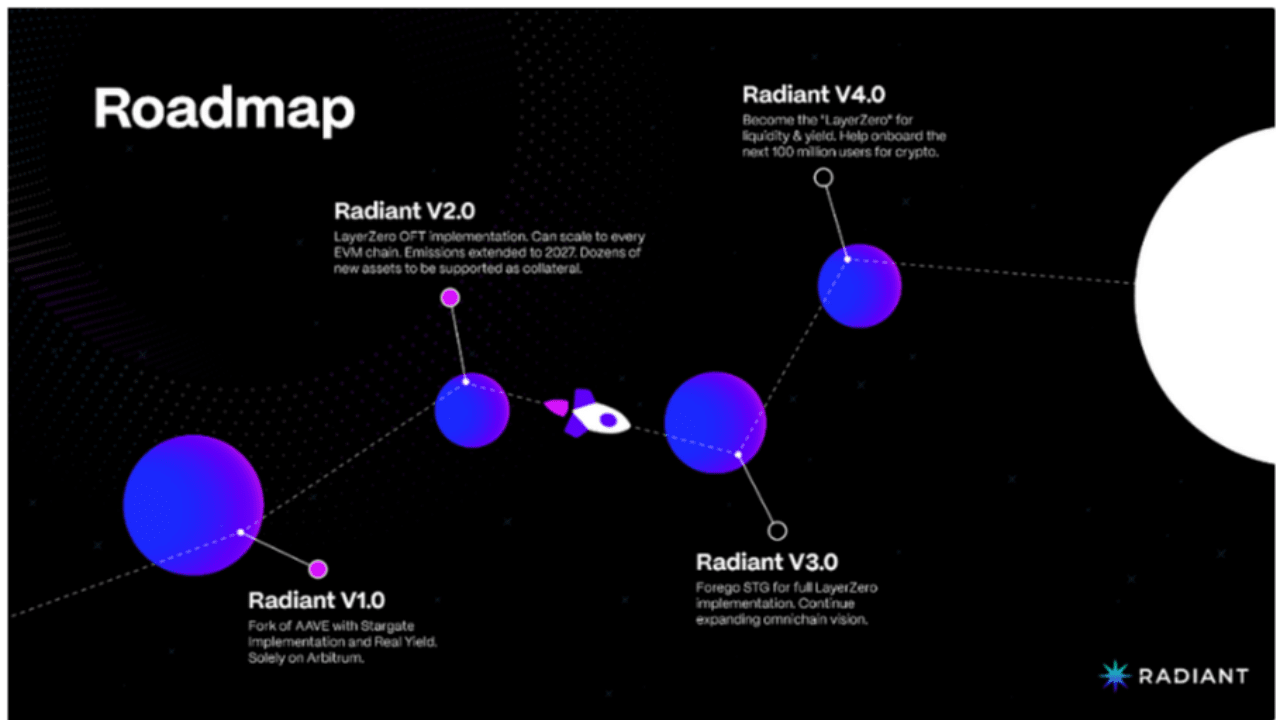
The Radiant official team has disclosed a simple roadmap in its documents. Its version is currently in the 2.0 stage. The primary task is to deploy the Radiant cross-chain and increase the scale of collateral in the application. In the V3 version, it is planned to get rid of the dependence on the third-party cross-chain bridge Stargate and fully integrate LayerZero. The V4 version plans to fully realize full-chain liquidity lending.
Summarize
Multi-chain is the development trend of blockchain, and cross-chain interoperability protocol is a key component of inter-blockchain communication, and its development prospects are quite broad. LayerZero is still in its early stages of development, and there are still few native projects to participate in. It has the support of many well-known investment institutions, rich industry resources, and the expectation of issuing coins has attracted the attention of the entire crypto market.