

Written by: Changpeng Zhao, CEO of Binance
I've tried to write down some principles that I live by (and will continue to improve in the future). Not all of them are right or wrong, most are just the way I see things.

1. General principles
1.1 Fairness
This is a broad principle that covers many aspects of life, from personal relationships to colleagues to business transactions. I am a firm believer in treating people fairly, not taking advantage of others, and don't let others take advantage of you. If you don't maintain your balance correctly, you won't get very far in life, but that's easier said than done.
Everyone is subjective and slightly biased towards themselves, you need to resist this and try to be as objective as possible.
1.2 Establish long-term, win-win relationships or transactions
People overuse these words and give it a bad name, but I believe success is built on the long term and to maintain healthy long term relationships, long term win-win relationships must be created and maintained. For a deal to make sense, it must benefit both parties, so always ask what the other party is getting in return.
One-sided deals don't last because you're always looking for new (weak) partners to work with, and the ROI is negative, so short-term success is slim.
I am against short term wins, they often have negative long term effects, they distract you from the long term focus, and the hidden opportunity cost is high.
Aim for the long term and achieve bigger wins.
Play infinite games.
"Short-term victory" here refers to a one-time short-term victory, not to be confused with incremental victory. It is necessary to establish a larger long-term goal.
1.3 Avoid “bad” relationships
There will always be unethical or unpleasant people in the world, people who don't share your values or mission, people who waste a lot of your time, let them go, remove them from your life, but in the end One category of time-wasters is often missed.
One type is "difficult people", that is, "difficult friends". They always need your attention, worry about small things, need to talk to you, or need you to repeat how important or good they are, etc. , nothing wrong with that, but I can't handle them, I only deal with people who are easy to get along with and confident.
Then there are the “chatty” people, again there’s nothing wrong with that, but at this stage in my life I don’t have time for small talk and I avoid these people, more on that later.
1.4 Ethics
Never cross a moral line, it will always come back to bite you.
When dealing with users, always do the right thing, not the easiest thing.
1.5 Focus
Success does not come from how many things you do, but from how well you do a very few selected things. Focus allows you to work hard and eliminate distractions from your life.
For me, I don’t have a lot of hobbies, I exercise 30 minutes a day, I don’t have a lot of material possessions to maintain because time is expensive.
The potential risk of doing this is focusing too narrowly on things and missing out on opportunities, but in today’s world of information overload, that’s almost impossible to do.
1.6 Positive
We all face many challenges in life, whether it be relationships with family and friends or problems at work, having a positive attitude usually leads to positive results. I’m not sure why, but that’s just how the world works.
There is a quote that has stuck with me and has helped me a lot over the years.
"What do you do when you hit rock bottom? Just keep walking and you'll come out."
Furthermore, if you know that you are doing something ethical, all negative effects will disappear and you will have a positive attitude, which is one of the main benefits of ethics.
1.7 Rare opportunity (Own It)
The right mindset is a prerequisite for success in life, being responsible and proud of what you do.
Don't just do quests, don't just put bricks on the wall, be the one who builds the cathedral. If you don't think you're "building a cathedral," you should find a different job.
If you want to do something, you should think the opportunity is rare. Think about what else you need to do better that no one else is telling you to do, and take responsibility for the results, whether they are successes or failures. If you adopt this mindset, your work results will magically improve and you will progress quickly.
1.8 Continuous learning
The world is constantly evolving, and you have to keep learning, reading, living in different cities, and having your own worldview.
I don’t generally watch the news and I find it easy to agree with the content of 10 minute articles but they don’t go into enough depth and there is nothing to be said after reading them.
When I read a book, it gets into the details, the reasons behind it, the examples, and 8 hours later some new concepts tend to stick in my mind. I find that books have the best ROI in terms of self-improvement, I buy a lot of books, about 300 a year, but I don’t read them all, I read maybe 80 books a year.
I also try to write a little bit every day. It can be a blog post or an article (like this one). Writing helps me solidify my thoughts and organize them better.
2. Understand the world
No matter what level of success one hopes to achieve, it's important to understand how the world works.
How humans work, read "Sapiens" (Foresight News notes, this is a book about the extraordinary history of humans from the Stone Age to the Silicon Age). We live in a human world, and everyone has a different version of the world in their mind, which means everyone lives in a different world and needs to understand their world.
Don't hold too many black and white views. The world is rarely binary. Many people oversimplify their view of the world, which makes it difficult for them to succeed. Look at the problem from a deeper level. In real life, most things are a state of compromise and balance.
For example, some people naively believe that all rules are good, but rules are made by humans and are not always perfect. Recommended reading books: "The Law", "Economics in One Lesson", etc.
Also understand the limitations of the world, we don't live in a perfect world.
Don't fight a battle you won't win, avoid it, go somewhere else, do something else. There is so much to do in this world, focus on the positive contribution you can make.
3. Decision-making framework
Making good decisions is a skill that can be practiced, and I've developed this mental decision-making framework, whether it's a quick decision or a more thoughtful one.
3.1 First principles
If the decision involves one of the core principles, then it is an easy matter to follow those principles, otherwise carefully review the decision framework.
3.2 Small vs. Large
The first thing to determine is the scale or impact of the decision.
Small decisions, make them quickly or delegate them to someone else and then move on – like where to eat, or a small investment.
For big decisions, collect data, discuss it in a group, and then sleep for 24 hours - big sponsorships, investments, etc.
3.3 Reversible vs permanent
Some decisions are reversible, such as developing new product features. You can stop at any time and work on other things or shut it down when you are done. Although there will be some sunk cost in time and energy, it is limited.
Some decisions are not easily reversed, such as huge advances for sponsorship deals, mergers and acquisitions of large companies planning to integrate with the team, etc.
3.4 Do I have professional knowledge?
If it’s something I know very well, or if I have some background information, such as technology or product, then I can make a decision faster. In areas I don’t know much about, like marketing, I either delegate, involve other experts, or make decisions more carefully.
3.5 Sufficient Information
The final question to ask is whether we have sufficient information. For small decisions, I don't need a lot of information. For major decisions, we should try to obtain the necessary information. But at the end of the day, we often have to make decisions with limited information.
Finally: Making a decision and then executing on it is usually much better than not making a decision at all.
4. Team and organization
4.1 Team over self
In a poorly performing team, good individual performance rarely leads to personally satisfactory results, and vice versa. If a team does well, every member, including those who are struggling, is likely to do well.
The team should generally come first, which is also the best long-term individual outcome for everyone on the team. In the short term, you may have to "sacrifice for the team" on various occasions, but in the long run, you are the winner.
4.2 Frequently shuffle the team
Don't let the organization become stale, provide new leaders with more opportunities for growth, and quickly solve the problem of "people sitting in the wrong seat" (of course, it may also exacerbate the problem).
The team structure determines the system architecture. Read the book Team Topologies. We don't want our software to become obsolete and we need to change the team structure frequently.
4.3 Internal competition is good
There will always be external competition, and some internal competition is good, as long as it is professional.
4.4 Controlled chaos is a structure
This explanation is a bit counterintuitive. Let’s look at the two extremes of chaos and structure. It’s easy to understand that complete chaos is bad.
Many people tend to think that the more organized an organization is, the better. I disagree with this, a clear structure has many benefits, including clear delineation of authority and responsibility, reduction of overlap or wasted effort, etc., and it generally makes the organization more efficient.
But what most people don't think about is that it usually only makes an organization efficient at doing one thing (in fact, the word "organization" means the structure and optimization of one thing. The most extreme version of over-organization is bureaucracy, As we grow, we need to constantly remind ourselves not to get to that point.
When the world changes, a strongly structured organization will have to work harder to adapt. The world is changing rapidly, especially in a young industry like ours. In a strongly structured organization, there is less organic innovation and internal competition (or There is less pressure to continuously improve) and at a certain scale, top-down decision-making becomes less effective.
This is not to say that "chaos" is better, there is a balance here. We live and work in a changing world and a new industry. Our industry has redefined many traditional concepts such as headquarters, companies, teams, and even money, and given that our work is remote and global, many traditional structures are not suitable for us.
At the same time, we do need strong controls in many areas. When we handle user funds, security, compliance, ethics and neutrality must be strictly enforced. We operate in a regulated environment and compliance is of the utmost importance. A controlled chaos environment requires the best people, passionate and responsible people.
How to find this balance is our challenge to constantly improve ourselves, so sometimes chaos is a feature.
4.5 Frequent local team building
Once a month should be the goal, but in reality it's usually once every two months due to scheduling and such.
Eating is the best team building. It is simple and effective to get everyone together for a meal.
Do it locally, across teams. I’m generally against flying for team building, it’s too expensive, the time cost is too high. I don’t want to create the feeling that we’re just flying around for a “vacation”.
For small teams that are truly dispersed, once every 18 months may be okay as an exception, preferably leveraging existing trips or events.
4.6 Providing Feedback
No matter where I am, I provide direct feedback in one-on-one discussions or in large group discussions, something I learned from Netflix’s No Rule Rules.
In fact, I prefer giving feedback to a large group of people so that others can learn and I don't have to repeat myself multiple times. Many people told me they were initially shocked when receiving feedback like this, but eventually got used to it.
I want to build a culture of candid feedback at Binance. I feel like 99% of people don’t give people enough feedback. When working remotely, we don’t get body language feedback during actual meetings. We must compensate for this by providing direct and candid feedback.
Ray Dalio of Bridgewater Associates has a DOT feedback system that I really like and we will find a way to adopt it in the future.
4.7 Not so much verbal praise
If you do something well, you might hear someone else say "Well done," but I might not say that. Conversely, when you do something wrong, if I see it, you'll probably hear it too.
My reasons are:
We hold ourselves to high standards, we expect excellence, and good results should be the norm. If we make one big thing out of every "small" achievement, it feels like we're setting a low bar, which is not what we want to do.
I don’t see all teams winning when working remotely. I can't possibly cover everything, and if I only congratulated some people but not others, it would create a psychological imbalance or create a feeling of favoritism. This problem doesn't happen with criticism. I give direct feedback on things I see. Give constructive feedback and others won’t complain about favoritism.
Satisfaction should come from within, the intrinsic reward within me when I do something well is enough.
This doesn't save time. Once one thing is done well, we should focus on the next thing.
I'm not saying this is a good approach, it's just how I operate. I actually think giving both carrots instead of just sticks might be a better approach, but I haven't figured out how to do this efficiently in a distributed fashion.
Different cultures also have different expectations, the book "Culture Map" explains this well, Americans generally have a more "amazing job" culture, while Asians have more of a "big stick" culture.
A more effective approach would be to adjust their compensation during the next review cycle, so I do give them the carrot, just not verbally.
4.8 Upgrades vs Rumors
Upgrading is part of normal business and there is a right and wrong way to do it.
The rumor is that you complain to me one-on-one about someone else without telling the other person. Rumors are bad, I don't deal with them, I just ignore them, in fact when you do that to me, I mark a negative impression on you (not them).
The upgrade is when you book a three-way meeting with me, the person you want to complain about, when I can hear both sides of the story in one breath.
More importantly, it forces you to have an honest conversation with the person before you talk to me.
I only have to have one meeting to deal with an escalation, as opposed to multiple one-on-one conversations back and forth when I deal with rumors. You know how I feel about time.
Use upgrades, not rumors, it's hard. However, being able to articulate why you are unhappy with someone or something in a professional way is one of the key skills for success. Not too soft, not too hard, finding the right balance is key.
4.9 Bottoming out
I believe in "bottom up" principles and I've read many arguments against ranking, not creating internal competition, etc. They have merit, but I'm not convinced they strike the best balance.
In my experience, high performers love working with high performers, and when a high performer team works well together, the work itself becomes addictive. When you have a low performer, everything is ruined, so the person below needs to be moved out.
I also believe in the "team, not family" principle described in the book "No Rules Rules". It doesn't sound pretty, but organizations are slightly different from families. We care about each other, but we don't bring in poor performers. around, it’s irresponsible to the rest of the team.
5. Recruitment
Always hire the best people, you need to be part of a strong team to win - hire people who are not as good as you, hire people who are just like you, hire people who are above you.
Hiring your own boss is one of the best ways to grow your career and show that you're mature.
5.1 Passion
Passion is one of the most important things I look for, we work remotely, we can't (and shouldn't) micromanage, people without passion will slack off and hit rock bottom, so hire people who build cathedrals.
5.2 Hire hungry people
Hire people who will grow into the role, not people who have "been there, done that." While previous experience can certainly be helpful in many situations and is a prerequisite for certain roles such as compliance, the latter can get boring. It also often gives rise to "fixed mindset" thinking, as people are often over-shaped by their previous experiences.
5.3 Doers vs Orators
Hire guests who can express themselves, not talkers who can't do anything. Inarticulate doers are crafty, and in some limited technical situations they may be okay, but we can't have too many of them on the team.
5.4 Targeted hiring
Each new person must have clear responsibilities and, ideally, aggressive numerical targets, with about a 70% chance of success.
5.5. No title
Don’t hire people who care about titles. That’s not a bad thing, but it’s definitely not a good sign.
5.6 Mission is greater than money
Instead of hiring people who are too obsessed with salary and compensation, we should pay our employees fairly.
5.7 If in doubt, don’t hire
If you have doubts during the hiring process, don't hire. Small doubts during the interview phase will always turn into big problems down the road.
6. Leadership style
6.1 Don’t try to motivate those who are not self-motivated
It’s like dragging a dead horse, it’s impossible, it’s not worth it, there’s no way we can inspire people who don’t share your mission or values, or don’t like you as a leader, and are just lazy, to go somewhere else Work. People are either motivated or they are not, so only work with people who are self-motivated.
We work remotely and it’s easy for lazy people to slack off because no one is paying attention to them. But this is a blessing in disguise. People can slack off for a day, a week or even a month. But after a few months, they run out of results, and by then you know, working remotely actually makes it easier for you to identify them over time, and once you identify those unmotivated people on your team, remove them Resign.
6.2 Never micromanage
Micromanaging takes more time than doing it yourself. If you need to micromanage, you should let that person go.
6.3 Pay attention to qualifications during the interview, and then focus on the results
Only use "years of experience" in the hiring process, and once someone joins the team, use results to measure performance.
6.4 Work hard, uphold our values and lead by example
7. Goals, certainty conditions/key performance indicators
Use output metrics (users, revenue, market share) rather than input metrics (tasks, features, meetings, work hours).
7.1 Don’t take your goals too seriously
Goals or goal setting have many potential disadvantages. Much has been written about this, so I won’t go into details. They include feelings of failure when you fail to achieve them, not working hard after achieving a simple goal, rigid direction, etc.
My biggest problems with goals are: 1. They are never accurate or scientific. It's always some random guessing. In our industry, market conditions change too quickly. 2. They take too much time (and expensive) to discuss.
For these reasons, set a goal, work towards it, and if you've achieved it, set a new one. Don't take it too seriously, don't get too hung up on it.
An example to end this topic - when Binance was founded we set a goal of becoming the top 10 exchange in the world within 3 years, but then we became the#1exchange in the world within 5 months and we didn't So stop.
8. Business Transactions
8.1 Keep transactions simple
Complex deals with many variables often fail, even after signing. Complex transactions are difficult to understand, there is often confusion or misunderstanding, and one party always feels like it's screwed up in some way and wants to change something.
Keep the deal simple: Party A offers this and gets that; Party B offers this and gets that.
8.2 Say no early
Too many people waste too much time on useless “partnership” discussions, and when your mental space is spent on these useless discussions, you won’t be thinking about useful partnerships.
8.3 No exclusivity
Long-term, mutually beneficial relationships do not require exclusivity, and people who demand exclusivity are often insecure about competitiveness or the value they can provide, at least in the long term. In these cases, a short-term (or one-time) compensation package may be more appropriate, but you know my point, don't spend too much time on short-term trading, the world changes too fast, you can't be locked in, you can't predict the future .
Don’t sign an exclusive contract. Don't lock yourself in and don't expect others to be locked in.
8.4 Termination
There is always a termination clause in the contract, there needs to be a way to get out of a non-win-win relationship, there is always an option.
Many people make the mistake of thinking about general scenarios (often optimistically) during the contract stage, think of the worst case scenario, that's what contracts are for.
8.5 Limited liability at all times
Never sign a contract that may ultimately result in large or "unlimited" liability, consider extreme worst-case scenarios at the contract stage, rather than "normal or best-case scenarios".
8.6 No special circumstances
Never give a client a private deal that no one else has. Always treat all customers equally.
9. Passive BD, go for the low-hanging fruit
I generally take a reactive approach to BD (Business Development) in my life, and people tend not to understand this aspect of me, or how it works.
This is not to be confused with passion, I am passionate about me and our work, but passive in how I relate to others, business partnerships, etc.
I don’t chase shiny things, and in the BD department I generally don’t chase big clients or partners because it takes a lot of effort and time to teach them crypto, guide them through internal legal and board processes to get deals done, and the conversion time is too long, and they often demand unfair terms with low return on investment.
Instead, I like to spend time working with the top companies that come to us and they already have the intention of getting into crypto and want to work with us, we just have to figure out how and the terms of the deal, the ROI is much higher even though they may Not Apple or Google, but if we keep having small successes, sooner or later the big partners will come to us, mostly "on our own."
Other examples include: I won’t waste my time trying to convince people who are determined not to like cryptocurrencies, like Warren Buffett. I talk to people who want to learn, even though they may not be that famous.
I don’t visit countries or governments that have a negative attitude toward cryptocurrencies, I visit countries or governments that want to adopt cryptocurrencies and help them, even if they are small countries.
Essentially, dealing with deals we can make.
This is not to be confused with a "short-term" mentality, most of these low-hanging fruits, even if they may not be with the 10 most prominent companies in the world, are still long-term.
There are some caveats to this approach.
We need to be good enough that others want to come to us. Luckily Binance is in this position and we need to maintain it, I had that mentality even before Binance was successful, but it obviously worked better after that.
We need to choose well. There are always a lot of requests, especially given the current situation Binance is in, and choosing the best one is not as easy as it seems, and again, getting to core transactions quickly is often my approach.
Having said all that, we still need to make external contact sometimes in case the other party also has a "passive" mentality. Our external contact is specific and clear. If they don't respond afterwards, then we know they are not interested.
It's the same in life, I don't try to meet so-and-so celebrities, but I do interact with people who come to us.
10. How to work – don’t waste time
Time is a more limited resource than money, don't waste it, money will come when you start to value time.
10.1 Say no early and often
The most effective tool for saving time is saying "no."
Someone wanted to discuss an "important" but vague partnership, and I said no; someone invited me to meet some big shots, but with no clear purpose, and I said no; someone invited me to an art gallery show, and I said no; someone invited me to I watch F1, I say no; football games, no... I do go to these events with friends, but the default answer is no.
This way I can save time for more important things, even if it's just staying in a hotel room by myself, I can think and focus my attention on more important things, like writing this article.
11. Communication
11.1 Be concise and direct
Always be clear about your intentions or goals, what do you want? Say "I want..." before starting to explain the background. The other person will probably agree with you and you don't have to explain.
11.2 Write concisely and to the point
Reading On Writing Well, I hate it when I see people either not writing or writing too long, which means they either don't take the time or can't organize their thoughts.
You need to write it down, but keep it short (not long) and write it well.
For me, I want to see these:
15 minute meeting with 3-5 key points per person;
Half a page or 1 page per person in a 30-60 minute group session;
MBR or QBR (Quarterly Business Review) maximum 5 pages;
No PPT, no fancy slides, just text and simple bar charts;
For a blog, article, or book, write longer;
Learn to write well, I’m still practicing…
11.3 Use the most effective methods/tools possible
There's an old saying I disagree with: "Don't email if you can call the person; don't call if you can meet in person."
I preach the opposite: "If a phone call will suffice, don't meet. If an instant message will suffice, don't call."
There is nothing wrong with either approach. For difficult conversations, it’s better to meet in person. But for most common communications, I prefer efficiency over form. You need to build strong enough relationships with the people you communicate with regularly to understand each other, not guess, and always give the benefit of the doubt. Most of our work is done remotely, so I took this approach.
11.4 Avoid communication chains
Don't talk to someone who always talks about who said what, such information must be wrong, talk directly to the source.
At work, we often have project managers or other leaders as intermediaries, and we need to avoid long communication chains, keep sources in one group/meeting, and not make the meeting too big.
11.5 Use instant messaging for synchronization or work coordination
11.6 Use one message instead of multiple messages
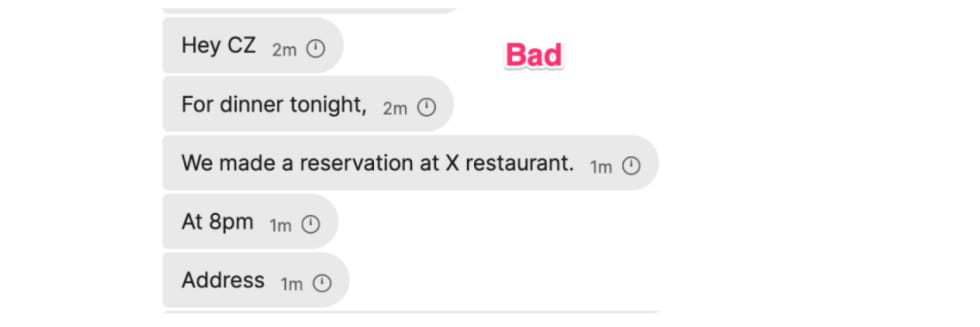 This will receive 5 message notifications and may make me wait longer to read, so do the following:
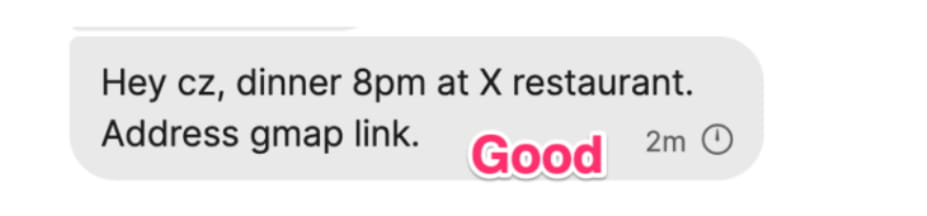 A message notification, completed.
Yes, I try to optimize my time like this, I don't like chatting with people who have a "bad" style, they have a lot of time and I don't.
11.7. Don’t use instant messaging for arguments
Instead of IM chatting during a debate/argument, pick up the phone and debate via video or voice call.
11.8 Too much communication is bad
Too little communication is bad, and too much communication is bad. If you have to constantly over-communicate to make something work, there is a problem and you need to address the root problem.
11.9 Ask questions in context
We work in a remote environment where we don't see many of our colleagues and questions can easily be misunderstood, so always provide the reason and context for your question.
12. Meetings
12.1 Keep it short
Keep it short, preferably 5 minutes. If you can’t have a 5-minute meeting with your close colleagues, then you haven’t gotten into the groove with them to figure out how to do this.
12.2 Start on time
Join the meeting 1 minute early and set the alarm for 3:59 instead of 4:00 so that the meeting starts on time at 4:00.
12.3 Don’t
Instead of the old “This is what I’m going to tell you and what I just told you,” just say the “Told you” part;
Don’t start with “Here’s the agenda…” start directly;
Instead of saying, “Can you hear me? Can you see my screen?” test the equipment first and then jump right into the meeting;
Don’t say “Thank you for joining” and just jump into the meeting;
12.4 Discussion with less than 10 people
Discussions should only involve 5-10 people who are familiar with the topic, having more people will slow things down.
Calls with more than 10 people should be fast, simultaneous calls.
12.5 Remove silent people
If you are participating in a discussion meeting and do not need to say anything, you probably should not join the meeting and you may only receive the minutes.
12.6 Written communication
Write down key points before the meeting. Writing things down can help clarify your thoughts. I'm a visual creature, I remember much less of things that are just explained to me verbally, and written documents are easier to forward than verbal ones are impossible.
Don’t make the written document too long, one page should be enough for a 30-minute meeting.
12.7 No PPT
They are wasting their time, using bullet points and bar charts to show history and trends is enough.
12.8 No "introductory" meetings
I don’t attend meet-and-greets, get-to-know-you sessions, discovery sessions, etc. I'm not a pivot and not good at maintaining many relationships. I prefer meetings with a specific purpose, some might say this is too "realistic", but it works. It may offend some people, but my goal is not to be friends with everyone, but to get things done.
13. Products and Delivery
13.1 Scalable Products Only
Only work on scalable products, MVPs, and then close, pivot, or expand (push it all in). If it doesn’t scale, don’t use it.
13.2 Follow users
Having users is key, everything else is less important, no users equals no value, treat them well.
14. Public Relations
14.1. No major events
Don’t do a big PR on the first day of release, something will always go wrong, give the system and product a week or so to settle in and stabilize before we do a big PR.
14.2 Do not PR with empty MOUs or letters of intent
Only PR results unless PR helps us in a meaningful way, beware of smaller partners who just want to use our brand for credibility.
14.3 No delay PR, announce when ready
What I disagree with is that sometimes PR teams will recommend waiting until a certain date or time to announce something that is ready, reasons may include but are not limited to:
It's Friday night and the PR will have less reverberation, so let's wait until Monday morning;
We just announced some other news and we wanted to stagger the PR a bit;
Let’s save this for the Christmas period, which is a week away, as we’ll have less news then;
This will only cause unnecessary delays that further slow down all future workflows, and the loss in efficiency far outweighs the small optimization of "better reception" of news. Delaying the work we do is extremely expensive, and delaying a PR will just stick in people's minds longer, which is unnecessary.
Announce when you're ready and move on to the next task.
tweet. Many social media experts recommend tweeting at the best time of day, which may work if your job is specifically about social media. I just tweet when I have something in my head.
Otherwise the mental cost of keeping it in your head is worth the benefit of tweeting about it a few hours later. Once I’m done tweeting, I’ll go do something else.
14.4 Responding to reporters
If you don't respond, they'll just write the worst possible story. Respond to it, record it, and have to publish it later.
14.5 Respond quickly to negative news
Otherwise it will just spread and unless you make sure it's a small news outlet, it won't get any coverage.
15. Rest, stay calm and relax
I was asked about sleeping hours, jet lag, etc. so I added this section.
15.1 Sleep
I suggest you find your own sleep pattern that gives you the most energy.
For me, I sleep 5-6 hours at night and then usually 30-45 hours in the afternoon. I'm usually most awake after a nap, and my second most awake in the morning, an hour after I wake up. So during that time, I do the hard thinking or the hard decisions and use the rest of the day to tackle more “mundane” tasks.
Here’s a little secret, napping is also my way of dealing with jet lag. When I'm jetlagged, naps tend to be a little longer and having two chances to sleep helps.
Besides, when I’m tired, I either relax or take a nap.
15.2 Calm
I have a calm personality, if other people have certain emotional fluctuations, mine may be less so. I still have strong emotions, but I won't be overly excited or overly sad. As a startup in a new industry that is growing rapidly, we often encounter stressful situations, and having this calm personality helps us deal with such situations.
Part of this personality is innate and part of it is trained. I believe in simulation theory and it helps a lot in keeping my emotions calm.
It helps to hold ourselves to a high moral standard, and knowing we're doing the right thing doesn't have much to worry about.
15.3 Relaxation and entertainment
I chill out like most other people, I work out a little bit every day and play some sports, I enjoy snowboarding, watching some movies (usually after someone else recommended it), when I visit new cities I go to some tourist spots, I relax with friends - eat, drink, etc.
I don't like luxury goods, cars, jewelry, etc., although my lifestyle may have been considered high-end by most people. I travel a lot, stay in nice hotels, and get invited to fancy parties (which I actually don't enjoy).
I love gadgets, cell phones, cameras, drones and even digital watches that have features I have never used before.