
Reference News Network reported yesterday that according to a report on the Spanish "El Pais" website on September 2, two years ago, El Salvador became the first country to use Bitcoin as its official currency, shocking the world. Journalists from around the world traveled to the Central American country of 6.3 million people known for its beaches to document the new monetary reality. On September 7, 2021, El Salvador’s new Bitcoin law came into effect. It felt like an atypical moment for such a small country to briefly attract great attention from the world.
Today, outside attention has waned, but the experiments continue. It would be easy to sum up the Bitcoin law as a success or a failure, but in El Salvador under President Nayib Bukele, everything is not that simple. The country’s Bitcoinization process is difficult to analyze because it is opaque and has several different goals: financial inclusion, public financial gains, and the president’s reputation.
The experiment began with multiple purchases by the Bukele government. The exact amount of Bitcoin held by El Salvador as part of its international reserves is unclear as the government has not released public records and the closest thing to a purchase announcement was a brief statement posted by the president on his social networks. According to estimates by some websites, El Salvador has lost 37% of the value of its Bitcoin investments, equivalent to $45 million, as digital asset prices have fallen since 2021. It is estimated that El Salvador currently holds approximately $76.5 million worth of Bitcoin.
In order to introduce this currency to the population and consider its use for all types of transactions, the government of El Salvador launched the official Bitcoin wallet "Chivo" and pre-deposited $30 in Bitcoin for each citizen. But since then, hundreds of people have had their wallets hacked and their funds and identities stolen, leaving many people scared.
One of the benefits of cryptocurrencies is how quickly you can send money from abroad. But so far this year, only 1.3% of remittances in the country have been transferred through digital wallets using cryptocurrencies, according to the latest data from the country’s central bank. In comparison, 4% of remittances to Mexico are via cryptocurrencies.
This week, Ark Investment Management, an investment research firm well-known to cryptocurrency enthusiasts, generated attention on social media when it released a report claiming that Bitcoin adoption in Argentina surpassed that of El Salvador. Analyst David Puelli noted: “It’s understandable that El Salvadoran citizens prefer to conduct transactions in U.S. dollars. The U.S. dollar became El Salvador’s legal tender in 2001, insulating it from the inflation that has hit other countries in the region hard. and the impact of currency devaluation. In contrast, Bitcoin’s price has been quite volatile in the face of growing problems while it strives to evolve into a more liquid and globally adopted currency system.”
Monica Tahir, an expert in the field of cryptocurrency payments, said: “I think the goal of using Bitcoin in El Salvador is to promote economic freedom for the people, but without a coherent education process, it will take a long time to achieve this in the country. Mass adoption of cryptocurrencies.”
Andres Engler, a cryptocurrency journalist and former editor of the Bitcoin Desk website, believes that El Salvador has achieved at least one undeniable success in the cryptocurrency field. Engler said: “On the media level, Bukele is on the cover. And on the cryptocurrency industry level, El Salvador is definitely a big name today. When you ask anyone in the industry about El Salvador, they don’t know. will be unfamiliar, and Bukele's name is likely to be mentioned. From this perspective, it all seems to be effective." (Compiler/Helmsman)
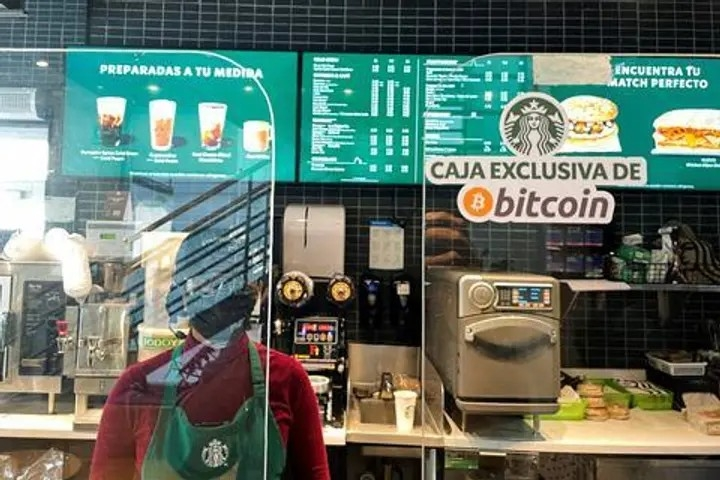
A Starbucks coffee shop in San Salvador, the capital of El Salvador, accepts Bitcoin as a method of payment