


What is an automated market maker (AMM) in crypto?
Automated market makers (AMMs) are decentralized cryptocurrency trading platforms that use smart contracts to perform token swaps and value exchanges. Unlike centralized exchanges, AMM does not rely on order books to determine asset prices but uses mathematical formulas based on supply and demand.
AMM has become a popular feature in the decentralized finance (DeFi) industry due to its many advantages. They are more accessible, less expensive and more efficient than traditional cryptocurrency platforms. The appeal of AMM is growing as more investors seek a trading environment that is stable and unaffected by sanctions.
What is market creation?
In traditional finance, market making is a popular trading strategy. A company or individual takes on the role of providing liquidity for an asset, ensuring there are enough buyers and sellers. They set buying and selling prices based on the market size of the asset.
Market makers profit from the difference between the bid and ask prices, as well as from fees for providing liquidity and executing trading orders.
What is an automated market maker (AMM)?
AMM is a market maker that uses smart contracts to automatically execute buy and sell orders without the need for a third party. AMMs are popular on decentralized exchanges (DEXs) and decentralized applications (dApps) that run on blockchain, allowing anyone to trade cryptocurrencies without the need for an intermediary.
AMM operates with liquidity pools, which are crowdfunded funds for each trading pair. This allows liquidity to be provided to both sides of the market. Good examples of AMMs include Uniswap and PancakeSwap.
As assets are bought and sold, the smart contract automatically adjusts the ratio of assets in the pool to maintain price balance. The price of each asset is calculated according to a preset formula, the most common being x * y = k, where x is the supply of asset A, y is the supply of asset B, and k is a constant reflecting the total payment. group account.
How does AMM work?
AMMs operate similarly to order books on centralized exchanges but without the need for a counterparty. The AMM protocol uses smart contracts to execute transactions on behalf of investors. The liquidity pools consist of two cryptocurrencies, and use algorithms to determine prices for each asset.
Once the transaction begins, funds are deposited into the relevant pool. The algorithm calculates asset prices based on the number of tokens in the pool and automatically adjusts asset ratios to ensure sufficient liquidity for each asset. AMMs charge a small fee for each trade, which is then shared among the liquidity providers in the pool.
What is a liquidity pool?
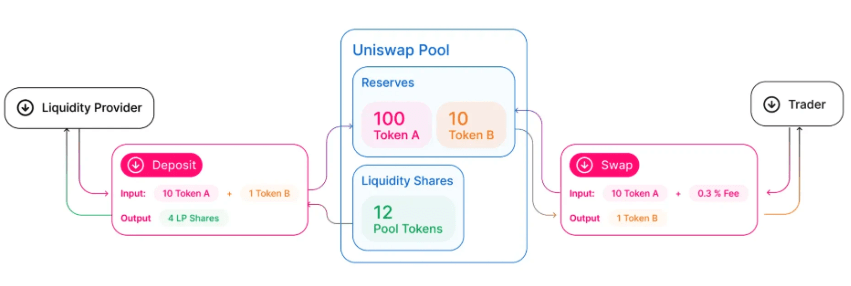
What is a liquidity pool?
A liquidity pool is a smart contract-based financial instrument, designed to provide liquidity for cryptocurrency transactions.
Simply put, a liquidity pool allows investors to entrust their digital assets to a smart contract. The contract then uses that asset to support buyer and seller transactions, in return for which the investor receives a portion of the transaction fees.
Benefits of liquidity pools
One of the main benefits of a liquidity pool is that it does not require buyers and sellers to meet in person to execute a transaction. This is in contrast to centralized exchanges, where transactions must involve direct participation from both parties. With liquidity pools, buyers can execute buy orders at a certain price through pre-funded pools.
How liquidity pools work
Liquidity pools are funded by users, and they earn a portion of each transaction fee. Investors will deposit a liquid pair of equal value (50:50) into the pool. For example, if investors want to contribute to the ETH/DAI liquidity pool, they must contribute equal amounts of both ETH and DAI.
Thanks to this mechanism, liquidity pools have become the preferred tool of DeFi protocols to enable automated transactions. They also help solve the problem of price slippage, stabilizing the price of the asset relative to the market size, ensuring that the price of the asset does not fluctuate too much during the transaction process.
Liquidity reserve mechanism
The liquidity provision mechanism on AMM works based on two principles. First, liquidity recipients must pay a fee to liquidity providers to retrieve the underlying asset. Second, when liquidity is withdrawn from the pool, the bonding curve automatically transfers fees from the recipient to the provider.
The role of smart contracts
Smart contracts are the core element of AMM operations. They execute buy and sell orders instantly in a liquidity pool that cannot be tampered with, ensuring transparency and security of transactions.
Price discovery mechanism
Price discovery mechanisms are an important part of AMM protocols, helping to determine the prices of assets in decentralized services. There are three basic formats of this mechanism.
First, ‘ab intus without a priori knowledge’ determines prices according to local exchanges, as seen in Uniswap V2 or Balancer. Second, ‘ab intus with a priori operates on the ideology that price = 1’, used by stable swap AMMs such as Curve V1. Finally, the mechanism uses external input from oracles to determine prices, typically like the DODO AMM protocol.
Liquidity pools have become an integral part of the DeFi ecosystem, providing liquidity, price stability, and convenience to investors and traders.
Calculate the pricing algorithm in AMM
To minimize slippage across liquidity pools, AMM platforms use pricing algorithms. The most common formula is x * y = k, where:
X is the number of first assets in the liquidity pool.
Y is the number of the second asset in the same group.
K is the total amount of fixed liquidity in the pool.
Although this is a common formula, some platforms such as Curve and Balancer apply more complex formulas to achieve the ultimate goal of maintaining stable prices for assets in the liquidity pool through smart contracts. .
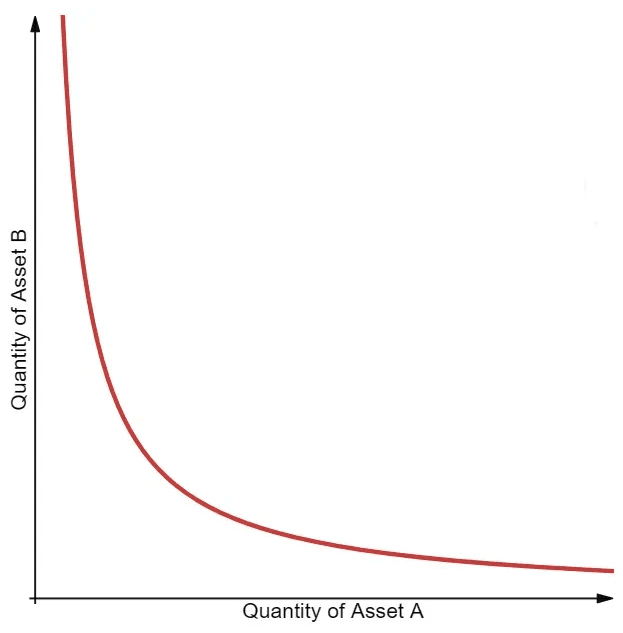
Calculate the Pricing Algorithm in AMM
How AMM works
AMMs operate on the principle of maintaining a fixed total liquidity value within the pool. When the value of one asset decreases, the value of the other asset will increase to maintain equilibrium. For example, if a user buys ETH in the ETH/DOT liquidity pool and ETH volume increases, the pool will become unbalanced. An equivalent buy order for DOT will be placed to rebalance liquidity, keep the price from fluctuating wildly, and minimize slippage.
Outstanding automated market making protocols
With the rapid development of blockchain technology, many financial solutions have focused on decentralizing the financial system. Some of the top automated market makers include Uniswap, Sushiswap, Curve, and Balancer. Other names such as Bancor and DODO also contributed significantly.
Characteristics of AMM
AMM is different from centralized exchanges even though both support asset trading. Some key identifying characteristics of AMM include:
Decentralized: No need to interact with third parties, users only need to interact with smart contracts through the liquidity pool.
Using Smart Contracts: Enables automatic transactions when pre-set conditions are met, ensuring transparency and security.
Non-Custodial Framework: Users are solely responsible for the security of their property. DEX platforms only process transactions without storing user assets.
Security: AMM protocols are more difficult to attack due to their decentralized and distributed nature.
No Price Manipulation: With fixed pricing algorithm, price manipulation becomes difficult, maintaining stable liquidity.
Advantages and disadvantages of AMM
AMM is seen as the next stage in the decentralized finance landscape, bringing many advantages but also some disadvantages.
Advantage:
Anyone can become a liquidity provider and earn passive income.
Allows automatic trading.
Minimize price manipulation.
No need for intermediaries, safer than centralized exchanges.
Defect:
Mainly used in the DeFi market.
Complicated for newbies.
Fees may vary based on network traffic.
Compare AMM model and order book
Order books and AMMs are both popular trading models. Order books typically involve intermediation and order flow management, while AMMs facilitate trading without the need for counterparties. AMM incentivizes investors to become liquidity providers by sharing trading fees, which does not exist in an order book system.
The role of AMM in DeFi
AMMs play an important role in the DeFi market, helping crypto traders access liquidity easily and earn additional income. They also provide a stable pricing environment, enable self-regulation and reduce barriers to entry, leveling the playing field for a new generation of investors.
Frequently asked questions
What is AMM?
AMM, short for Automated Market Maker, are decentralized cryptocurrency trading hubs that enable trading of a variety of assets through smart contracts.
What types of AMMs are there?
Currently there are many different types of AMM. Most notable is the constant functionality market maker (CFMM) – Uniswap is a prime example. Other types include constant product market makers (CPMM), constant sum market makers (CSMM), and constant average market makers (CMMM).
What is the formula of AMM?
The most common formula is x * y = k, where x is the number of tokens of the first asset, y is the number of tokens of the second asset, and k represents the total liquidity in a particular pool. This formula automatically adjusts the balance between asset volumes to maintain a fixed level of liquidity.
What are the benefits of AMM?
AMMs offer many benefits, including reduced price manipulation, increased security, passive income opportunities, low barriers to entry, and allowing users to self-manage their assets.
How does AMM liquidity work?
Liquidity in AMM is provided through community cryptocurrencies. Traders can deposit assets into relevant liquidity pools, thereby providing liquidity and reducing slippage. In return, liquidity providers receive a portion of trading fees from the platform.