

Author: Paul Veradittakit, Partner at Pantera Capital; Translation: Golden Finance 0xJS
introduction
We live in a multi-chain world; from L2 to application chains to non-EVM ecosystems, it is clear that there is no one public chain that works for all use cases. However, due to the diversity of code bases, frameworks, and design choices among various ecosystems, achieving interoperability has always been an extremely difficult problem to solve. In the absence of a unified interoperability protocol, many blockchains and applications need to build internal cross-chain interaction implementations that are expensive, error-prone, and highly unscalable.
Chainlink's Cross-Chain Interoperability Protocol (CCIP) is a bold attempt to solve this interoperability problem, which was announced on the EthCC mainnet in July 2023. By leveraging its unique position in the blockchain ecosystem as a market-leading Web3 service platform, Chainlink attempts to build an "industry standard" protocol for interoperability between diverse ecosystems. In this article, we will explore the conceptual design and architecture of CCIP, including the novel risk management network, and the use cases unlocked by this groundbreaking new idea.
Concept Design
Historically, most cross-chain interactions have been conducted through blockchain bridges, which have traditionally been centralized and non-scalable, introducing counterparty risk and leading to some of the largest cryptocurrency hacks by volume. At a high level, CCIP seeks to solve this “centralized bridge problem” by leveraging Chainlink’s decentralized oracle network (DONs), which has gained industry recognition and adoption for price feeds and other off-chain data.
CCIP mainly supports three main functions:
Arbitrary messaging between smart contracts on different blockchains — for example, triggering a “Buy NFT” function on Polygon will mint an NFT on the Ethereum mainnet.
2. Token transfer, such as transferring an ERC-20 token from a smart contract on Avalanche to a user wallet on Arbitrum.
3. Programmable token transfers, which are a hybrid of the above two - you are sending bytes of data parameters (e.g., transaction price) and tokens across chains.
One of the main issues CCIP is trying to solve is the fragmentation of liquidity between different chains and ecosystems by transferring tokens and arbitrary bytes of data across chains. This is particularly important for DApps such as Uniswap, which is deployed on more than 10 chains. Currently, even if all chains support EVM and the same smart contracts can be deployed on multiple chains with little to no changes, the inefficiency of the cross-chain framework creates "islands of liquidity" on different chains. For example, less common token trading pairs on Uniswap may only have sufficient liquidity on the Ethereum mainnet, and if someone tries to trade these trading pairs on Arbitrum Uniswap, which has almost no liquidity, they will be forced to migrate to the Ethereum mainnet first and pay higher transaction fees.
Therefore, CCIP may lead to a new generation of cross-chain DApps that can take advantage of the liquidity of certain networks (such as the Ethereum mainnet) and the throughput of scaling solutions like Arbitrum. This not only improves the capital efficiency of these DeFi platforms, but more importantly, provides a cheaper, easier, and smoother experience for developers and users, allowing them to abstract the complexity of cross-chain interactions.
Components and Architecture
Overview
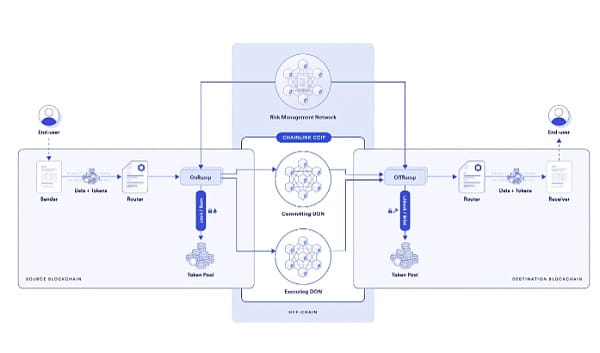
While CCIP may sound relatively simple in concept, designing and securing the system is not, as it requires extensive on-chain and off-chain verification mechanisms. An easy way to imagine the overall CCIP architecture is like an international airport hub where you can catch a “connecting flight” to your destination. In this section, we’ll use this analogy to walk through the three most important parts of Chainlink’s CCIP security architecture: Committing DON (departure hall), Risk Management Network (airport security and air traffic control), and Executing DON (flight and arrival customs).
Committing DON
The first part of the network is the Committing DON. This DON continuously monitors the input data in the "on-ramp" contract (containing transaction information) on the source chain, just like a departure hall serves outbound flights to different destinations. For each "outbound flight", the Committing DON needs to ensure that the transactions on the original source chain (such as the Ethereum mainnet) have reached a final state before packaging them together and preparing to send them to the target blockchain. This DON basically signs the Merkle root hash of the bundle and then writes this data to the "Commit Store" contract, or "check-in process" on the target blockchain (such as Arbitrum).
Executing DON
Executing DON is a separate decentralized oracle network that acts as a "flight and arrival customs". Once the Committing DON stores the commitment of the bundled transaction onto the target chain and has been "blessed" by the Risk Management Network (see below), the Executing DON will create a cryptographic proof (Merkle proof) for each transaction to be executed on the target blockchain. Before executing each transaction, the "off-ramp" contract will verify this Merkle proof against the "blessed" Merkle root in the "check-in process".
Risk Management Network
The core advantage of separating the “Committing” and “Executing” DONs is that we can introduce additional security in the middle, the Risk Management Network, which can stop the transaction midway if something unusual is detected. It’s almost like after check-in until departure, the security team at the airport can stop you before you board the plane.
Chainlink CCIP's Risk Management Network includes a set of independent nodes that monitor the Merkle root hash of the Committing DON written to the "Commit Store" contract. The Risk Management Network is even developed by a different team and using a different programming language (Rust), and external dependencies are avoided to the greatest extent (for example, no OCR-based P2P network is used) to reduce the possibility of shared vulnerabilities between the Risk Management Network and the main CCIP system.
For each record written into the check-in process, the Risk Management Network will independently reconstruct the Merkle root hash from the transaction information in the "on-ramp" contract. If the match is successful, the Risk Management node will "bless" the submitted Merkle root hash. Once the submitted Merkle root hash receives enough "blessings" from different risk management nodes, it is ready for use by the Executing DON. On the contrary, if there is a mismatch between the submitted Merkle root hash and the information constructed by the Risk Management Network, the Risk Management node will not "bless" this message and it will not be executed. In addition, the Risk Management node can trigger an alarm and "curse" the transaction. If the Risk Management Network's operating node receives a certain number of "curses", it will suspend all CCIP transactions, thereby implementing a "safety lock" for further investigation.
Therefore, it is through this three-layer design that Chainlink CCIP attempts to guarantee the security of its cross-chain transactions and decentralize roles and responsibilities among different oracle groups. The Risk Management Network is unique to CCIP, and no other cross-chain solution provides the same decentralization and security guarantees, thanks to its novel architecture.
Use cases and adoption
As mentioned earlier, Chainlink's status as a benchmark for oracle services puts it in an ideal position to lead the field of cross-chain interoperability. So far, Chainlink CCIP is in the "mainnet early access" stage, initially supporting 5 ecosystems: Ethereum, Optimism, Avalanche, Arbitrum, and Polygon. In the near future, more chains will be supported.
Early adopters of Chainlink CCIP include leading DeFi protocols Aave and Synthetix. For example, Aave is using CCIP to enable cross-chain governance so that users can vote on other chains while using Ethereum as a hub to aggregate and manage governance activities. On the other hand, Synthetix uses CCIP to enable cross-chain transfers of sUSD liquidity through a unique destruction and minting model, where the source chain destroys sUSD and the target chain mints an equal amount of sUSD.
Although many of Chainlink CCIP's early use cases are in the DeFi field, such as cross-chain lending, reducing gas fees (by trading on cheap networks instead of Ethereum mainnet), and optimizing cross-chain returns, CCIP's long-term vision is far more than just ordinary DeFi, and also includes connecting traditional financial institutions and DeFi projects by connecting bank chain value and public chain value. For example, Swift, the main network used by financial institutions to guide international fund transfers and financial transactions, announced a partnership with Chainlink and more than a dozen financial institutions and market infrastructure providers, including DTCC, Euroclear, BNY Mellon, etc., to test how enterprises can use their existing Swift infrastructure and CCIP to guide the transfer of tokenized assets on a range of public and private blockchain networks.
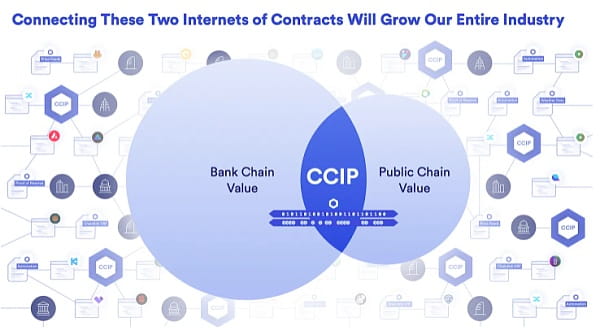 Furthermore, CCIP’s potential use cases extend beyond banks. Until now, while many businesses, including Walmart, have used permissioned enterprise-grade chains, their integration and interoperability with the broader cryptocurrency ecosystem has been lacking due to a lack of available bridge technology and general skepticism about the industry. This could spur a new wave of businesses and institutions to take advantage of Web3 applications and use cases.
in conclusion
Chainlink's Cross-Chain Interoperability Protocol (CCIP) represents a major breakthrough in connecting decentralized liquidity and functionality between different blockchains and ecosystems. By leveraging Chainlink's industry-leading decentralized oracle network for secure messaging and token transfers, CCIP provides a solid foundation for building a new generation of cross-chain DApps.
The introduction of CCIP solidifies Chainlink's position as a fully-featured Web3 service platform, providing developers with all the tools they need to build advanced smart contract applications, from gaining secure access to external data (e.g., data streams) and performing off-chain computations (e.g., automation) to now secure cross-chain messaging and token transfers. The addition of CCIP to the Chainlink network makes it the only platform where developers can access all data, computation, and cross-chain connectivity/value transfers, which is one of the important characteristics of a winning developer platform.
Currently, major DeFi protocols such as Aave and Synthetix are using CCIP to optimize liquidity and improve user experience. But CCIP's potential goes far beyond DeFi - connecting enterprises, financial institutions, and permissioned blockchains with public chains, Chainlink can greatly expand the use cases and practical applications of blockchain technology.