The People's Court of China published an article on Friday (September 1) titled "Identification of the Property Attributes of Virtual Currency and Issues Disposal of Property Involved in Cases". The current legal policy does not characterize Bitcoin as an illegal item, saying that virtual currency has economic attributes and can be classified as Property, therefore the virtual currencies held by relevant Chinese entities are still legal property and are protected by law. The article suggests that all money and property involved in virtual currency cases cannot be confiscated or returned.
The author agrees with the opinion that the behavior of obtaining other people's virtual currency through illegal means such as fraud, theft, robbery and computer information system crimes should be regarded as a competing relationship under the law rather than an imaginary competing relationship. For theft of virtual currency, etc., if the amount does not reach the criminal standard, we cannot settle for second best and be convicted and punished according to computer information system crimes.
In addition, the article recommends that the money and property involved in the case should be handled from a basic standpoint of legality. The author believes that for criminal acts involving virtual currencies, the money and property involved in the case cannot be confiscated or returned. Instead, they should be dealt with separately on the basis of the unified order of criminal and civil laws. Treat them to achieve balanced protection of personal property rights and social and public interests.
The article mentioned that the trend of virtual currencies becoming "accomplices" in illegal crimes has become increasingly prominent. The global criminal transaction volume involving virtual currencies has increased from US$8.4 billion in 2020 to US$20.6 billion in 2022, reaching a record high. At present, in China's judicial practice, differences are increasingly emerging on issues such as the characterization of virtual currency-related crimes and the handling of money and property involved. It is necessary to further clarify the criminal law attributes of virtual currency and the disposal of property involved in the case.
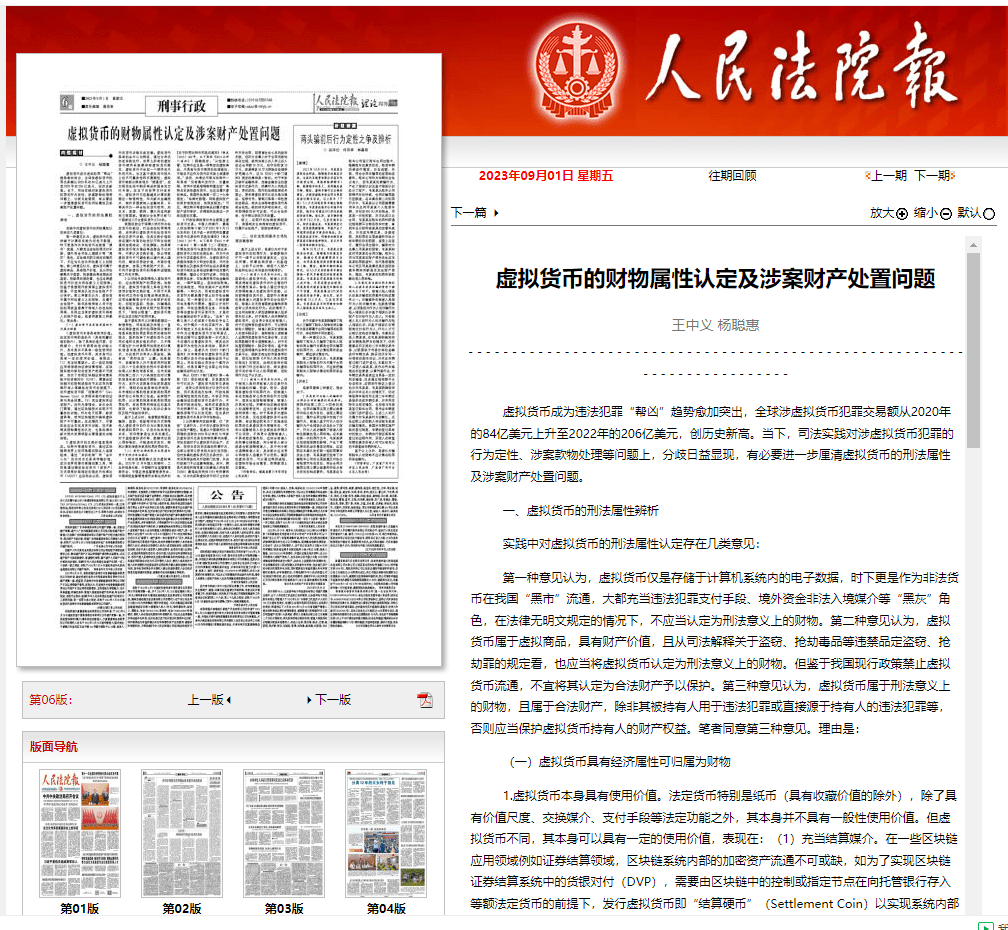
The first opinion is that virtual currency is just electronic data stored in a computer system. It is now circulated in China's "black market" as illegal currency, and most of it is used as a means of payment for illegal crimes and a medium for illegal entry of overseas funds. Role, in the absence of express provisions of the law, should not be recognized as property in the sense of criminal law.
The second opinion is that virtual currency is a virtual commodity with property value, and judging from the judicial interpretation of theft and robbery and other contraband items, virtual currency should also be recognized as property in the sense of criminal law. However, in view of China's current policy prohibiting the circulation of virtual currencies, it is not declared that it will be recognized as legal property and protected.
The third opinion is that virtual currency is property in the sense of criminal law and is legal property. Unless it is used by the holder to commit an illegal crime or directly stems from the holder's illegal crime, virtual currency holders should be protected. property interests.
The author agrees with the third opinion and emphasizes that virtual currency has economic attributes and can be classified as property.
"Virtual currency itself has use value. Legal currency, especially banknotes (except those with collection value), in addition to having legal functions such as value scale, exchange medium, payment method, etc., itself does not have general use value. But virtual currency Different, it itself can have certain use value,” the author emphasized.
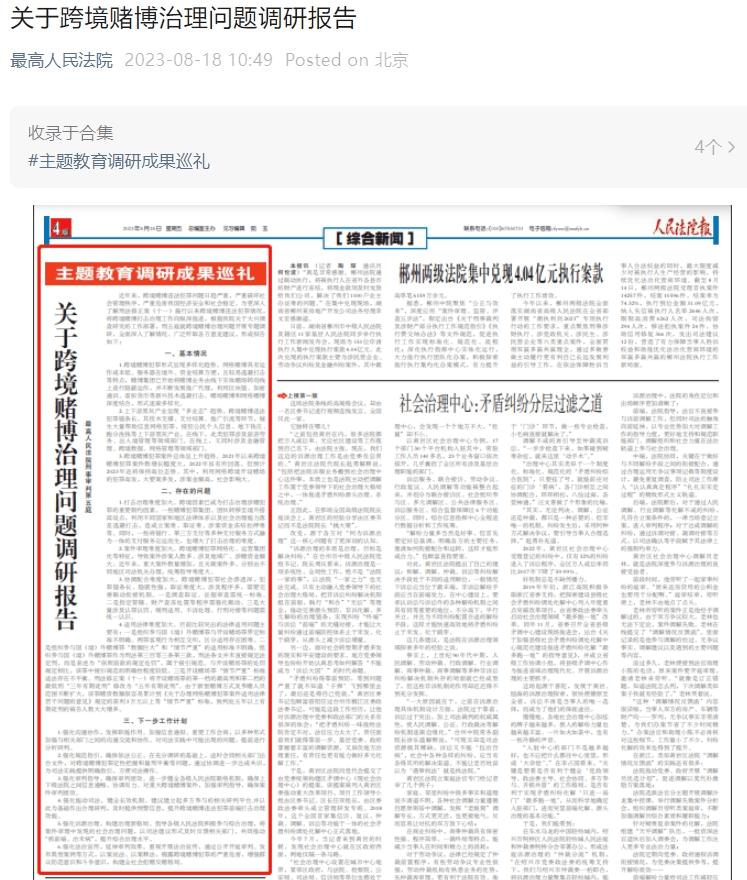
The official account of the Supreme People's Court of China released a "Research Report on Cross-Border Gambling Governance Issues" earlier in August. The report pointed out that gaming groups are using emerging technologies such as blockchain, encrypted communications, and cryptocurrency to shift their business from offline to offline. Operate covertly to avoid attacks. This type of crime also involves black and gray industries such as information network crime.
The report also mentioned that the number of cross-border gaming crime cases has increased significantly since 2021, and is expected to remain at a high level in 2023. New gaming methods have led to an increase in the amount of money involved, and a significant increase in the number of defendants sentenced to more than five years in prison.