

Author: Red Sheehan, Web3 developer & researcher; Translation: Golden Finance xiaozou
Key points:
Cosmos Hub is an independent application chain focused on interoperability and security. Cosmos Hub was launched in 2019.
Cosmos Hub was the first to launch technologies such as Cosmos SDK, CometBFT (Tendermint), ABCI and IBC, which were later used by many Interchain networks.
The Interchain is made up of sovereign networks connected by a universal interoperability protocol, IBC. The Interchain is also known as the Cosmos ecosystem.
Cosmos Hub is sharing its validator set and providing security through Replicated Security for Neutron and Stride. Replicated Security is the first form of shared security implemented on Cosmos Hub.
Various parts of the ATOM 2.0 proposal, such as liquidity staking, are being implemented and explored to improve the capital efficiency of ATOM, the native token of the Cosmos Hub.
1. Background
The first blockchains were application-specific networks that served a single purpose, such as Bitcoin, which facilitated financial transfers, Namecoin, which provided identity solutions, etc. Later, general-purpose chains like Ethereum provided composability, where multiple protocols could exist on the same platform. Finally, application-specific networks (appchains) returned as the dominant architecture, embracing composability in the form of an interoperable multi-chain ecosystem.
Unlike other multi-chain ecosystems such as Ethereum or Polkadot, the Cosmos ecosystem (i.e. Interchain) does not rely on a single root chain to facilitate data and asset transfers. Interchain is a set of interoperable, application-specific sovereign networks called appchains, while the Cosmos Hub itself is an independent appchain focused on interoperability and security. Cosmos Hub is the genesis Interchain and the largest appchain by market capitalization. The Interchain model brings professionalism, composability, and sovereignty to appchains.
These characteristics combine to produce an ecosystem that is extremely decentralized at a social level. Interchain networks have different communities and different governance models. In contrast, other multi-chain ecosystem models result in application chain/modular chain communities that are subsets of their respective base layer communities and are ideologically tied to their base networks (e.g., Stacks with Bitcoin, Optimism with Ethereum, Kusama with Polkadot).
The Cosmos Hub was launched in 2019 using technology developed by the Interchain Foundation and Ignite (aka Tendermint). Various groups continue to support the development of the Cosmos Hub and the Cosmos technology stack, including the Interchain Foundation, Binary Builders, Atom Accelerator DAO, Informal Systems, Strangelove, and others. The Interchain has over 50 independent networks, all with their own unique supporting entities.
2. Technology
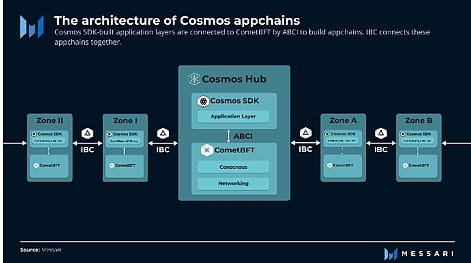
The Cosmos Hub is a proof-of-stake (PoS) sovereign blockchain with an account-based accounting model and no native smart contract functionality. The Cosmos Hub is built using various technologies and standards in the Cosmos technology stack, such as the Cosmos SDK, CometBFT, and the IBC protocol to implement all core blockchain functions (such as consensus). Other specific application networks (application chains) in the Cosmos ecosystem are mainly developed using these same technologies.
(1)Cosmos SDK
Cosmos SDK is an open source software development kit (SDK) for developing multi-asset PoS sovereign public blockchains such as Cosmos Hub. Cosmos SDK is also used to create permissioned Proof of Authority (PoA) blockchains. Blockchains built using Cosmos SDK are often referred to as Lisks (application-specific blockchains).
The SDK is designed around a modular execution stack, allowing applications to mix and match elements as needed. The modular design provides developers with customizability and flexibility while still enabling rapid development by using pre-built open source elements.
Developers using the Cosmos SDK can focus entirely on the application layer without having to worry about other features such as consensus, networking, or interoperability. These "other features" come from CometBFT, IBC, and other features in the application chain stack.
(2)CometBFT
The Cosmos SDK is used to develop a custom application layer (or state machine), while CometBFT is used to securely replicate that state machine across all nodes in the network. CometBFT is an application-agnostic engine that handles the network and consensus layers through two main components:
The consensus algorithm is Tendermint.
Socket protocol, also known as the Application Blockchain Interface (ABCI).
Tendermint is a Byzantine Fault Tolerant (BFT) algorithm. Tendermint Core is the default algorithm, but there are other versions available. CometBFT achieves instant finality through Tendermint, while most other networks use probabilistic finality. Tendermint is a Bound Proof of Stake (BPoS) system in which validators are selected to generate and sign blocks based on their stake. Validators and delegators must wait 21 epochs (1 epoch is about 1 day) after their un-stake request is submitted before they receive their tokens.
ABCI is the interface between the application layer and Tendermint. This socket protocol can be wrapped in any language, allowing CometBFT to be compatible with any application layer.
(3)IBC
The Inter-Blockchain Communication (IBC) protocol was first introduced in 2021. It is not any single instance of a bridge, but a standard for bridges. The Cosmos Hub communicates with other application chains via IBC.
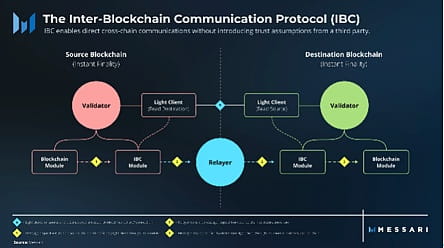
The IBC bridging standard enables heterogeneous blockchains to establish cross-chain connections without adding third-party trust assumptions. Participating chains agree to trust each other's security models and use shared message transmission standards to communicate and verify state changes. This allows IBC messages to inherit the minimum security of the underlying chain. IBC continues to iterate, adding features such as Interchain Accounts (ICA) and Interchain Queries (ICQ) through the Interchain Standards (ICS) proposal.
IBC also relies on the instant finality of Tendermint and CometBFT, which makes it generally incompatible with probabilistic finality networks such as Ethereum. Teams such as Electron Labs and zkBridge are working to make IBC compatible with Ethereum at a reasonable cost. Other teams and projects are also working on integrating IBC into other ecosystems. Composable Finance is an example, whose ultimate goal is to achieve integration with the Polkadot ecosystem.
3. Shared security
(1)Replicated Security
Shared security is about allowing validators from one network to participate in the consensus of another network using the stake on that chain. This setup will allow networks with smaller market caps to “rent” security from larger networks. Cosmos Hub has the largest market cap of all Interchain networks and is a prime candidate for renting security.
Due to the lack of programmability, Cosmos Hub security cannot be shared arbitrarily in a model like EigenLayer restaking, but it can be passed through governance and enabled on an individual basis. Replicated Security (formerly Interchain Security) refers to sharing the full Cosmos Hub validator set with another chain and obtaining permission through governance voting.
(2) Neutron and Stride
The passing of Proposal 792 made Neutron the first chain to leverage the Cosmos Hub validator set for security through Replicated security. Stride followed shortly after as the second such chain. As of August 2023, Neutron and Stride are the only chains using Replicated Security. Neutron became a CosmWasm extension for the Cosmos Hub, while Stride enabled liquidity staking for various Interchain networks and assets.
(3) Alternative models
There are other versions of shared security strategies in Interchain. Mesh Security provides two-way security for networks with an existing validator set, focusing on stakers rather than validators. Cosmos Hub and Osmosis are both exploring Mesh Security. Babylon aims to use Bitcoin to achieve data availability for PoS chains and reduce security risks such as long-range attacks in the process.
To implement Mesh Security, some form of CosmWasm may be deployed first to implement the required logic. The Cosmos Hub itself does not support arbitrary smart contracts as its core focus is on interoperability. The CosmWasm VM is a virtual machine supported by various entities in the Interchain. CosmWasm supports Rust and Go because it is based on Web Assembly (WASM). Although the proposal for permissionless and permissioned versions of CosmWasm on the Cosmos Hub failed in August 2023, the community continues to explore ideas for implementing CosmWasm.
Opt-in Security allows each validator to individually choose to run a consumer chain without the entire validator set having to support another chain. In theory, this approach lowers the barrier for a chain to gain security, allowing consumer chains to be launched in a permissionless manner. This model is similar to merged mining.
4. ATOM Token
The native token of Cosmos Hub, ATOM, is compatible with ICS-20. Therefore, it allows users to transfer ATOM between chains connected via the IBC protocol. The main functions of this asset are as follows:
The transaction fees required for transactions on the Cosmos Hub are settled in ATOM.
Token holders can stake ATOM to operate validators, thereby securing the network and earning rewards.
Token holders can delegate ATOM to existing validators to help secure the network and receive a portion of validator rewards.
All staked and delegated ATOM can be used to vote in the network governance process.
As an ICS-20 token, ATOM can be used for peer-to-peer transactions on any connected Cosmos chain.
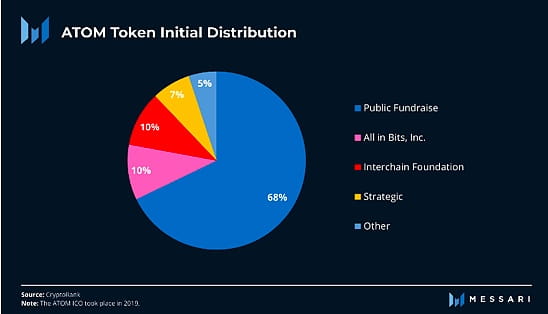
As of August 2022, ATOM has a token supply of approximately 350 million and a market cap of approximately $4 billion, representing the economic security of the Cosmos Hub. Of the 189 million ATOMs initially distributed in 2019, 68% were sold through the ICO. Core contributors to the open-source technology used by the Cosmos Hub also received a portion of the initial distribution.
(1) Token issuance
Validators earn tokens in three ways. All validators’ income is shared with delegators based on a set commission rate.
All transaction fees are distributed proportionally to validators based on their percentage of total staked ATOM.
Block rewards are distributed to validators at a rate of 7%-20% based on the percentage of total staked ATOM. Block rewards lead to inflationary pressure.
When a block producer includes more than 2/3 of the pre-commits, the bonus is earned in a linear manner. If a proposer includes 2/3 of the pre-commits (the minimum value for a block to be valid), an additional 1% bonus is earned. If a proposer includes 100% of the pre-commits, the bonus percentage can reach 5%. These bonuses will create inflationary pressure.
ATOM token deflationary pressure comes in two forms:
Burning - The Cosmos Hub has an on-chain governance mechanism where ATOM holders can vote on governance and issue proposals. These proposals cover issues such as changing consensus parameters and community pool fund allocation. For a proposal to be successfully submitted, it must receive a deposit of at least 250 ATOM from any token holder. If the proposal is rejected, the deposit will be burned.
Slashing - If a transaction is double-signed, or if the validator is offline for a long time, then the validator node reward ATOM may be slashable. Slashed rewards are then destroyed. In addition, the project team has stated in its white paper that during the governance process, voters can use the user's initial ATOM deposit to create any proposal that is considered spam. If more than half of the voters agree to accept the deposit, then these tokens will go directly into the reserve pool (minus the destroyed tokens).
(2) Validator
Users who stake ATOM tokens and meet the system requirements can operate validators to secure the network and receive rewards. Rewards are only received by the top 180 validators, who are ranked based on the total amount of self-staked and delegated ATOM tokens. Rewards are paid in the form of additional ATOM tokens, which come from block reward issuance (about 7% of the total token supply each year) and transaction fees.
There are 180 active Cosmos Hub validators. There are 147 inactive validators outside the top 180 validators. Additionally, there are currently 203 validators jailed for misconduct, such as missing too many blocks, double signing, etc.
(3) Governance
Since the beginning, there have been 121 on-chain governance proposals for the Cosmos Hub, of which 79 have been approved. The Cosmos Hub combines off-chain and on-chain governance processes. Network improvement proposals and parameter updates are designed and discussed off-chain, usually on the Cosmos Governance Forum, but also on various social media platforms.
Once in the on-chain governance system, ATOM stakers vote on whether to approve (and ultimately execute) the proposed changes. Only staked or delegated ATOM tokens can be used to vote on proposals. Validators and delegators vote on proposals, with 1 ATOM corresponding to 1 vote.
Delegators can have their validators vote on their behalf, or they can manually disagree with a validator's selection. All validators are eligible to vote; however, for those votes to count, the validator must be ranked among the top 180 validators at the end of the voting period.
(4)ATOM 2.0
The rejected ATOM 2.0 proposal reimagines the ATOM token economics. The goal of this overhaul is to significantly reduce the issuance of ATOM over a few years before completely eliminating inflation. In addition, it aims to improve capital efficiency and position ATOM as an Interchain reserve asset through liquidity staking. Ultimately, these actions will bring added value to the ATOM token.
While the initial proposal was rejected (likely due to it being too broad and moving too fast), the various components continue to be explored as separate proposals. Notably, two proposals (increasing the treasury size and a liquid staking feature to improve ATOM capital efficiency) were both passed in subsequent proposals after debuting in ATOM 2.0.
Other ATOM 2.0 features still under discussion by the community include a permissionless shared security model and a social coordination (i.e. governance) hub for interchain technologies (e.g., IBC, CosmWasm, etc.). Since then, proposals that have failed to pass the community involve:
Destroy ATOM based on transaction fee quota;
Incentivize holders to stake their tokens; and
Improve the Cosmos Hub’s fee mechanism to minimize junk transactions.
5、Interchain
The Interchain consists of sovereign networks connected by a universal interoperability protocol, IBC.
(1) Application chain
Many Interchain networks are appchains: blockchains designed to implement specific use cases. This design provides greater flexibility for application developers, as the architecture can be specialized to optimize a single function. In contrast, general-purpose platforms (such as Ethereum) can serve a wider range of arbitrary use cases, but their architecture cannot be optimized for any single function.
General purpose platforms can collaboratively build network effects through a variety of protocols with different functions and unique communities. As more protocols and users join a network, the network will attract more builders, forming a positive feedback loop that theoretically increases value. While no single application chain has a wide enough user base to compete with the network effects of a single general purpose network, a group of application chains can. Interchain is essentially a highly composable blockchain system that provides specialized application layers to optimize functionality and the network effects of interconnected application chains. To maintain this architectural advantage, application chains must maintain their composability while mitigating the disadvantage of the small audience range of each application chain.
In addition to providing decentralization of purpose and throughput, the Interchain model and application chains also provide social decentralization because the networks are independent of each other. Unlike other multi-chain ecosystems (e.g., Ethereum with rollups, Polkadot with parachains), Interchain does not rely on a single root chain to facilitate data and asset transfers. Each network has full social sovereignty, like a self-governing mini-DAO.
(2) Multi-chain model
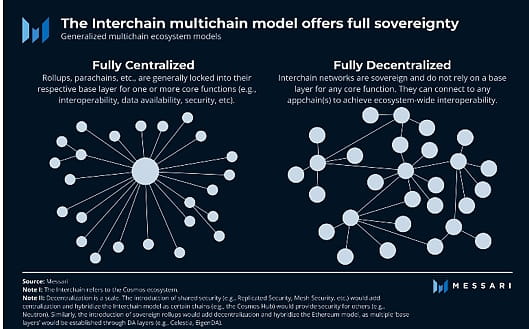
The IBC bridge sits right between the two networks. Directly connecting each application chain requires 2 IBC connections for full interoperability. Interchain uses a hub-and-spoke model (not a perfect metaphor, as there may be multiple "hubs") to minimize the number of hops between chains. In practice, this hub-and-spoke model with multiple hubs has become a classic decentralized model.
Most Interchain networks (aka "Zones") are either application-specific, providing one primary function, or provide a more general platform for application development, like Ethereum. Some networks are dedicated to interoperability, sometimes called "Hubs", the Cosmos Hub being a prime example. Typically, networks are incentivized to focus on interoperability in order to earn fees for routing and validating information passed between different chains. With Tendermint and IBC, any given Interchain network can be plugged into another network and, by extension, access other IBC-connected networks.
The decentralized spirit of Interchain is reflected in the fact that the "Hub" interoperability role is not unique to the Cosmos Hub - because the networks are not locked to the Cosmos Hub, they can maintain their sovereignty. This decision also helps with expansion, because "Hubs" can integrate with specific network groups for reasons such as geographic or ideological alignment.
(3) Interchain Network
All Interchain networks are connected via IBC, but not all networks built with the Cosmos SDK have IBC enabled. On the other hand, there are networks that support IBC that are not built with the Cosmos SDK, such as Kusama. Interchain has significant diversity in the following areas:
Decentralized Finance (DeFi)
Osmosis, an AMM DEX.
Osmosis, an order book and derivatives platform.
Terra Luna, issuer of algorithmic stablecoin.
infrastructure
Celestia, a modular data availability layer.
Nyx, a communications infrastructure network that supports network-level privacy via the Nym mixnet.
Akash, a decentralized computing network.
Privacy and Secure Computing
Namada, an asset-agnostic interchain privacy protocol.
Penumbra, a network that supports shielded cross-chain exchanges and transfers.
Secrete Network, a network that enables private computing through fully homomorphic encryption.
Bridging interoperability
THORChain, a cross-chain DEX that supports native decentralized exchange.
Axelar, a bridge and overlay network for communication between networks.
Wormhole, a cross-chain bridge connecting Interchain to Ethereum, Solana, and other networks.
Integration across ecosystems:
Babylon, a security solution utilizing Bitcoin.
Evmos, an EVM-compatible network connected to Ethereum.
Composable Finance, connecting Interchain and Polkadot’s CosmWasm network via IBC.
(4) Developer Ecosystem
The development of the Cosmos Hub has more than 400 contributors from the Interchain Foundation, Informal Systems, Iqlusion, and Ignite (formerly All in Bits Inc.), among others. According to Electric Capital, Interchain has more than 500 full-time developers and more than 1,600 part-time developers. These indicators rank third among all networks, behind Ethereum and Polkadot.
In the wider Interchain, the CosmWasm VM offers a huge advantage in attracting developers compared to VMs using domain-specific languages (DSLs). Due to its compatibility with the Cosmos SDK and the versatility of programming languages, CosmWasm is used by many application chains and enhances interoperable smart contract capabilities. As mentioned earlier, CosmWasm on the Cosmos Hub has been explored by the community. In addition, CometBFT's ABCI is flexible enough to support any application layer, so there are many execution environments with various VMs in the ecosystem.
6. Competition landscape
Interchain is not the only multi-chain ecosystem. Ethereum’s rollup-centric and Polkadot’s paracchains are examples of multi-chain visions of the future. However, compared to other ecosystems that prioritize shared security, Interchain sets itself apart by prioritizing sovereignty.
Ethereum's rollup-centric roadmap has seen dozens of L2 rollups deployed, and even plans for a composable rollup ecosystem and fractal scaling. Similar to the Cosmos model, Ethereum's rollup model provides decentralization of purpose and throughput. However, it does not provide social decentralization. Data availability, security, and governance make the rollup model a centralized ecosystem model.
While the centralized ecosystem model is conducive to collaboration (e.g., OP Stack is contributed by teams from Optimism, Arbitrum, Base, and Boba Network), it does not encourage much ideological diversity. There are already many teams that have abandoned the EVM and started building custom VMs (e.g., Starknet, Fuel, and Aztec). Even so, they are still affected by the decisions made at the base layer and therefore must be ideologically aligned with Ethereum in order to build reasonably in the ecosystem.
There are many different ideological groups in Interchain. THORChain focuses on native asset swaps; Namada and Penumbra focus on on-chain privacy protection; Secret Network focuses on achieving fully homomorphic encryption; Babylon focuses on obtaining Bitcoin security; Ethermint focuses on reducing the cost of EVM activities. However, all of these chains are in Interchain because it is convenient to develop and build using the Cosmos stack.
The rollup model is starting to change with the introduction of independent data availability layers such as Celestia, EigenDA, and Polygon Avail, which enable sovereign rollups that can publish data elsewhere. Currently, the vast majority of L2s are using the EVM while only using Ethereum for data availability, tying them to Ethereum at a social and technical level.
Independent networks have recently begun to migrate to a multi-chain ecosystem, and the Celo community is very interested in migrating from L1 to Ethereum L2. In June 2022, the application chain DEX dYdX in the Ethereum ecosystem began to migrate to the Interchain network.
Ethereum, Polkadot, Avalanche, and other multichain ecosystems are likely to integrate with IBC at some point and join the Interchain. Bridging between Tendermint’s instant finality and other forms of probabilistic or hybrid consensus is particularly difficult, but teams are working to solve this problem now.
7. Conclusion
The Cosmos Hub has been the core symbol of the Interchain since 2019. It has been a pioneer in the shared technology that connects the Interchain sovereign networks. However, it is moving beyond the role of a technology leader to become a potential security center for certain Interchain networks.
In 2023, Cosmos Hub once again takes the lead in Interchain by introducing Replicated Security. With Neutron and Stride (the first blockchains to adopt Replicated Security), Cosmos Hub's validator set now extends security to multiple networks. At the same time, other Interchain networks remain autonomous in both technical and social coordination. With a strong validator set and the huge market value of the ATOM token, Cosmos Hub is well positioned to provide Replicated Security and other shared security mechanisms to other networks.