

Written by: TechFlow Maintenance Worker
Yesterday, the most explosive market information came from Huawei. When I had free time, I took a look at the WeChat groups. The WeChat communities of cryptocurrency, stocks, and real estate all talked about Huawei Mate60. Without any warm-up, notification, or publicity, Huawei suddenly launched the new generation flagship mobile phone Mate 60 Pro in the Huawei official mall in advance in the name of "Pioneer Plan".
What everyone is most concerned about is the core - where does the chip come from?
Since being included in the Entity List by the US government on May 16, 2019, Huawei has encountered a comprehensive technological blockade. On September 14, 2020, TSMC completely stopped supplying Huawei chips. Since then, Huawei has had no chips available for 1,081 days.
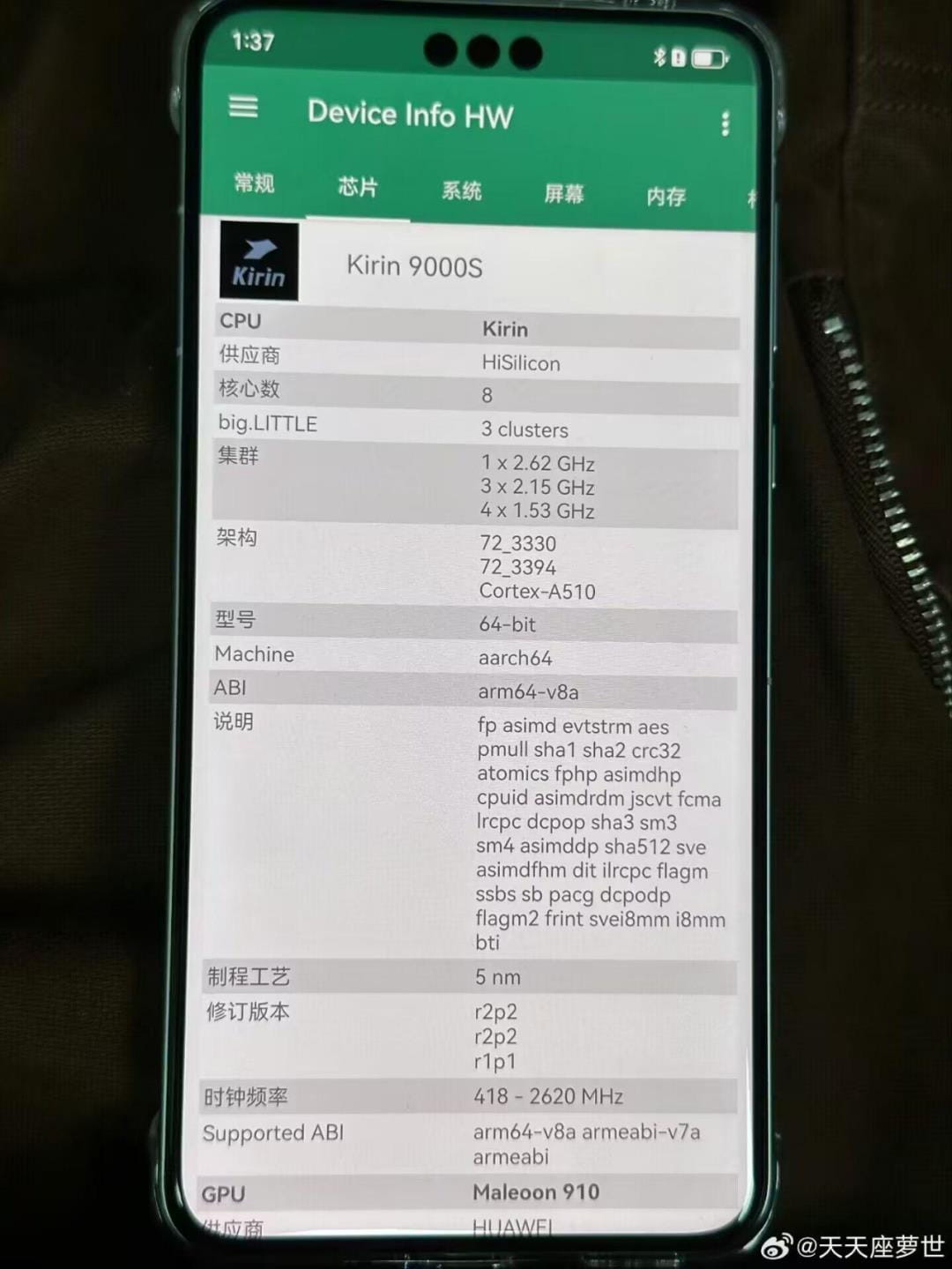
Now, Huawei Mate 60 Pro is confirmed to use the Kirin 9000s chip developed by Huawei HiSilicon, with a total of 8 cores, including 4 large cores and 4 small cores, with a maximum main frequency of 2150MHz, and the GPU is Maleoon 910.
Who is the manufacturer of this chip? Huaqiangbei took action immediately. A mobile phone repair anchor live disassembled the phone and found that the number on the CPU of Huawei Mate 60 Pro is 2035-CN. CN represents the origin of mainland China. Previously, the chips manufactured by TSMC were marked with TW.
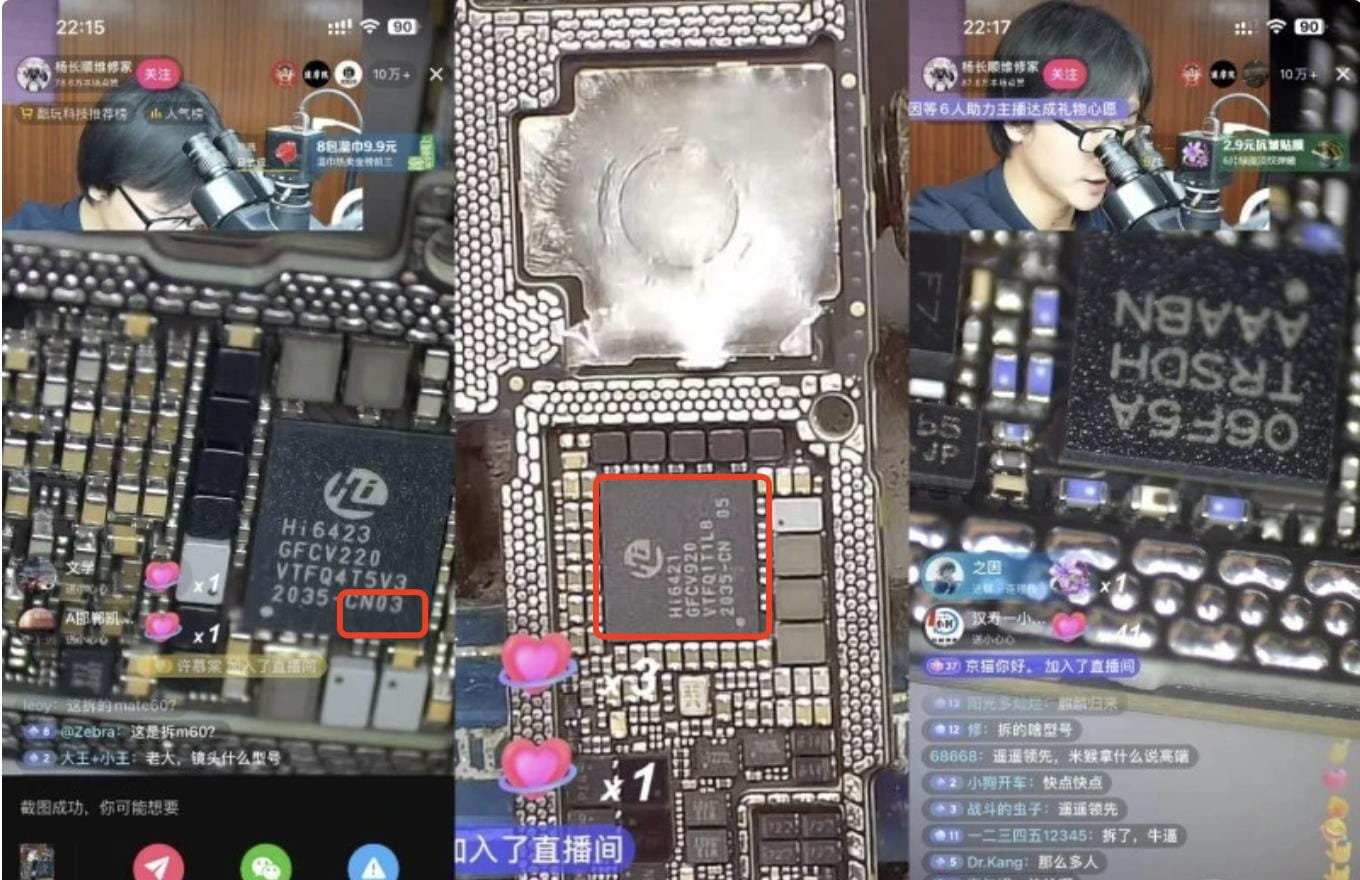
The answer is revealed. The Kirin 9000s chip of Mate 60 Pro is manufactured by SMIC.
According to the screenshots taken by netizens, Kirin uses a 5nm process, but technical experts generally believe that the 9000S is not a 5nm process, but SMIC's N+2.
SMIC is the only company in China that can mass produce 14nm FinFET technology. Both N+1 and N+2 processes are improved based on the 14nm FinFET process and are implemented based on DUV lithography machines, bypassing the US ban. (Currently, the most advanced process requires EUV lithography machines)
SMIC has not publicly stated that N+1 and N+2 are 7nm processes, but the chip industry generally believes that the N+1 process is equivalent to the 7nm LPE (low power consumption) process, and the N+2 process is equivalent to the 7nm LPP (high performance) process.
The shipment of Mate 60 Pro also seems to have revealed the information that SMIC's N+2 process has matured into mass production. However, many people in the industry are not surprised. As early as two years ago, SMIC had already started to outsource N+1 7nm chips, and their customers were Bitcoin mining machine companies.
In July 2022, TechInsights, a well-known foreign "reverse engineering" analysis company, released a report in which they dismantled the dedicated chip used for mining by MinerVa Semiconductor, a Bitcoin mining machine company. After analysis, they confirmed that this chip was manufactured by SMIC with a process of 7nm.
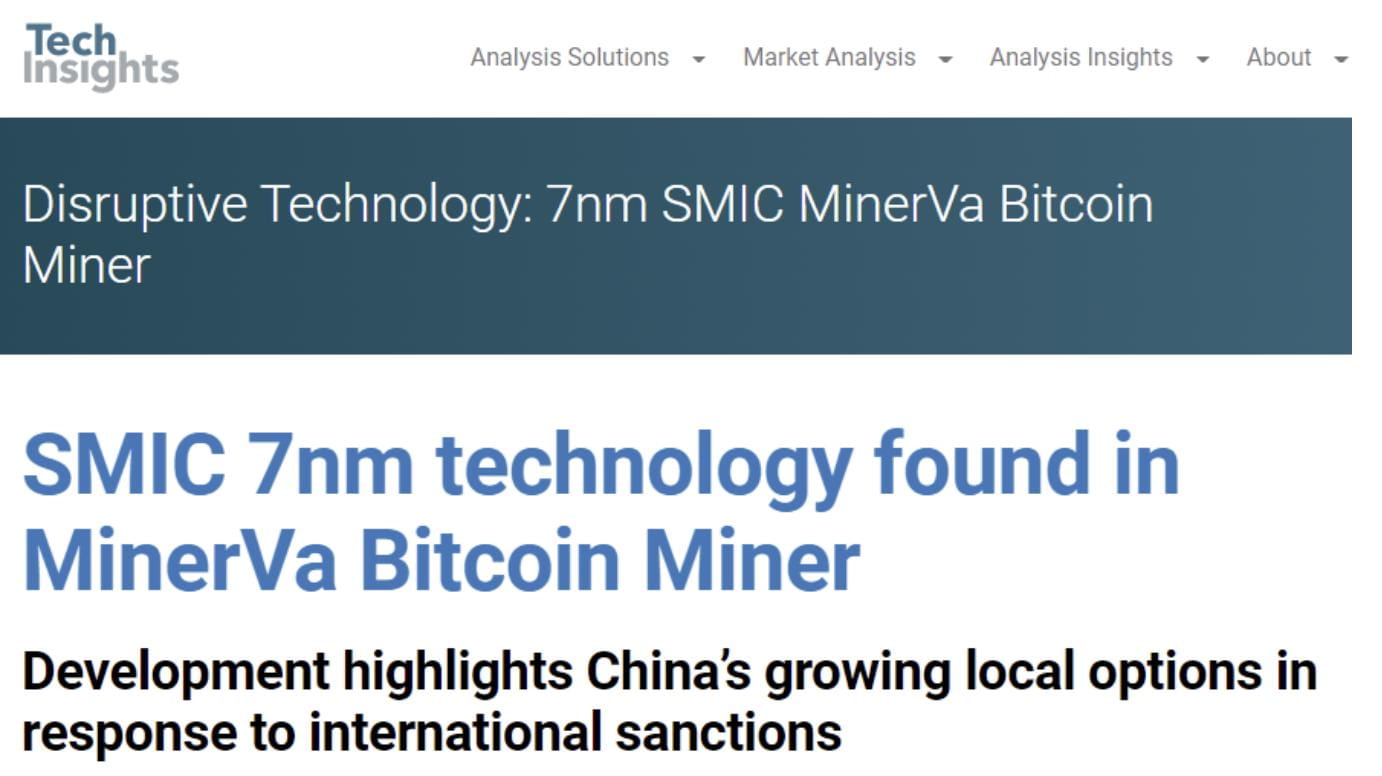
According to the MinerVa Semiconductor website, this IC began shipping as early as July 2021, from which it can be inferred that SMIC will have the ability to mass-produce 7nm process in early 2021.
Industry insiders told TechFlow that Innosilicon, China's leading one-stop IP and chip customization company, and a mining machine chip designer, is one of the first customers of SMIC's N+1 process. It successfully completed trial production at the end of 2020. The mining IC, MinerVa Semiconductor, is likely to be manufactured by Innosilicon.
In the early stages of a new process, the yield is usually very low. Chip foundries need to continuously improve the yield in order to gain a large number of customers, but this requires trial and error in orders, which can easily lead to a vicious circle.
Apple has provided considerable support and cooperation to TSMC in its 5nm research and development. In return, 50% of TSMC's 5nm production capacity is used by Apple.
SMIC does not have the appeal of TSMC, but fortunately, it has encountered the "ultra-low-profile version of Apple" - Canaan Technology, Innosilicon Technology and other mining machine chip design companies.
The mining machine chips not only provide SMIC with orders (money), but also provide SMIC with the opportunity to train and improve its yield rate.
According to the minutes of the 2021 telephone meeting of mining machine company Canaan Inc., Canaan Inc. began cooperating with SMIC in 2019. The two parties cooperated on 14nm mining machine chips, and SMIC once gave 95% of its N+1 production capacity to Canaan Inc.

Canaan Technology Conference Call Minutes 20210301
Mining machine companies naturally have a demand for advanced process technology, but that does not mean that wafer foundries are willing to give advanced process production capacity to mining machine companies.
For example, TSMC has no trouble finding buyers, as major mobile phone companies are lining up to give them money. However, they may not necessarily look down upon mining machine companies. The mining giant Bitmain once paid all fees in full at one time to obtain TSMC's production capacity.
Samsung has received a large number of orders from Nvidia and Qualcomm, and announced at the end of 2020 that it would not accept blockchain-related orders.
Mining machine companies need foundries with advanced processes, and SMIC needs customers for its new processes, and the two hit it off.
As for the yield rate, it may be a big problem for other chip companies, but it is not such a big problem for mining machine companies.
According to industry insiders, the structure of ICs dedicated to mining is relatively simple and the RAM capacity is small. Therefore, the yield rate of the newly developed process will exceed that of many ICs.
Usually, mining chips have dozens or even hundreds of cores in one chip. These cores operate in parallel and do not affect each other. Therefore, a normal chip may be scrapped because of a broken unit, while a mining chip may only affect one core, and the other cores continue to calculate normally.
Among different chips, some have more core failures and some have fewer core failures, which leads to different computing capabilities of the chips. This is usually solved by screening chips. Chips with stronger computing capabilities are assembled into high-end mining machines, and chips with weaker computing capabilities are assembled into low-end mining machines.
A mining machine will integrate hundreds of chips. Even if one or two chips are completely broken, it will not have much impact. This also leads to a higher tolerance for yield in mining machine chips.
In short, when SMIC most needed customers to test the latest N+1\N+2 process, mining machine chips stepped forward and laid a solid foundation for the launch of Huawei Mate 60 Pro.
As a leader said during his inspection of a mining machine company, ASIC chips are also chips.