
It is generally believed that cryptocurrencies need to go through three crypto cycles to truly achieve this goal: the first cycle is to gain knowledge and learn important lessons about how cryptocurrencies work, the second cycle is to make some gains and feel comfortable, and the third cycle is to achieve financial freedom.
For me, this is the second bear market, and soon there will be a third bull market. I am ready.

I feel like I’ve been through this phase of the cryptocurrency market before. Because I have, specifically the 2019-2020 market cycle.
But I’m not just talking about the downward trend in prices. I’m referring to the entire market sentiment: regulatory crackdowns by governments, general public indifference to cryptocurrencies or accusations of scams, and PvP models that profit from alternating between different tokens.
If you joined the cryptocurrency market before the last bear market or even before, you probably feel the same way. This familiarity is a huge advantage because your past experience in the crypto space sets the stage for the next bull run that is coming.
Every bull and bear market is slightly different, but the overall picture is largely similar.
This article will explore, based on my experience, how the past can teach us to recognize the beginning of the next bull market.
A familiar market
The first bull run and crash
Deja vu is a feeling that a person has experienced a current situation before. While this feeling usually lasts only a few seconds, the current crypto deja vu phase has lasted for several years.
I joined the cryptocurrency market in late 2017 after reading a BBC article about Bitcoin hitting new all-time highs. I felt FOMO for the first time.
I bought some Bitcoin and the price quickly doubled. I felt really excited and thought I was smart for jumping in early on a new financial paradigm. This excitement quickly turned into confidence that I could make a lot more money if I invested in newer and cheaper coins.
I googled exchanges because the first exchange I used (Bitstamp) didn't have too many shitcoins and somehow found Gate.io CEX. I liked their old UI because I could clearly see the symbols and most importantly the logos of all the coins.
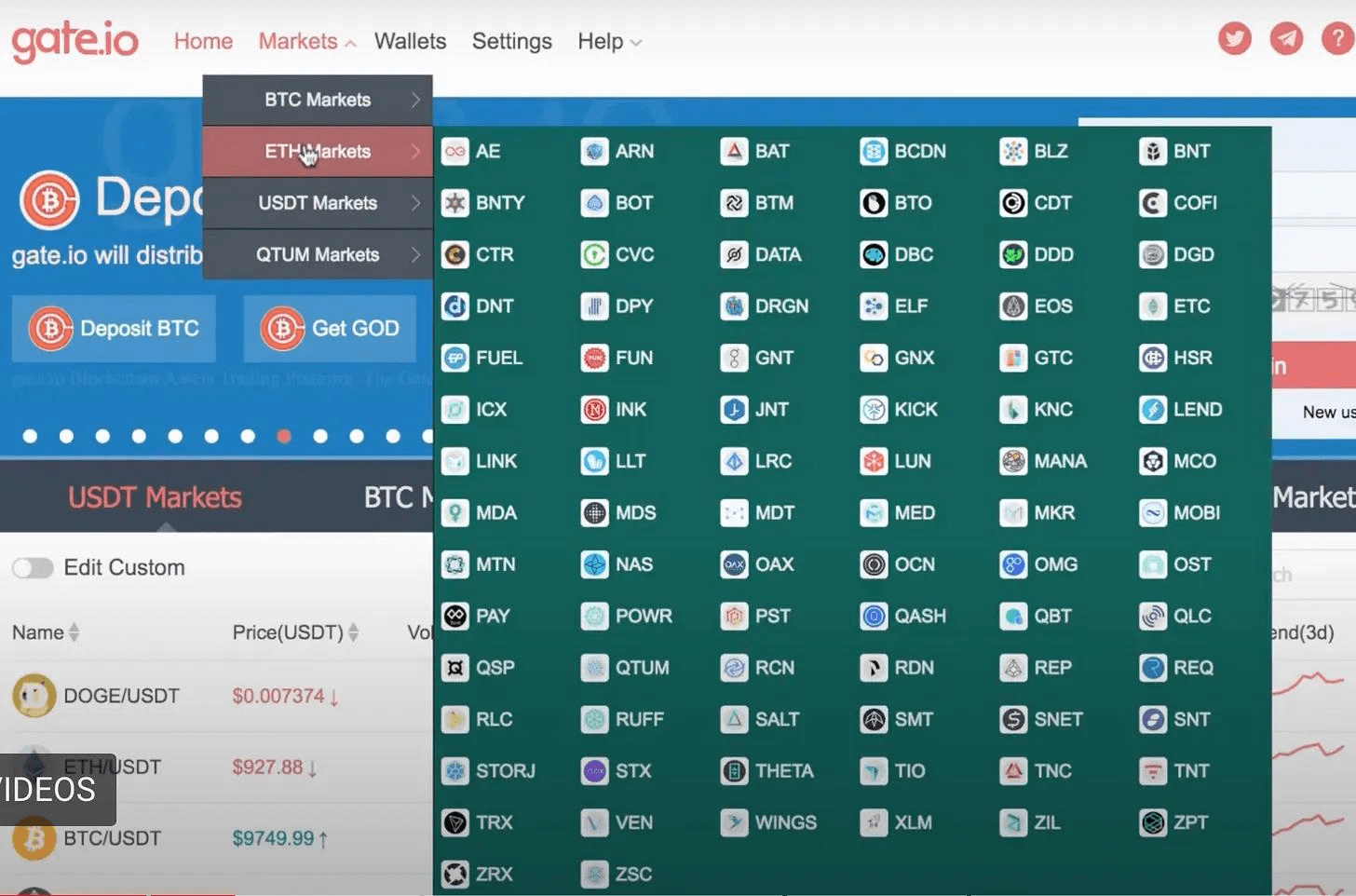
I did some “research” by reading their websites and whitepapers, and all of these projects looked revolutionary. Decentralized supply chain management, decentralized storage, decentralized banking! The FOMO was building.
I kept putting my scholarship money into these tokens, but at a certain stage there were too many of them and they all looked similar, so I decided to invest based on the color of the coin logo without doing much due diligence.
Long story short, I lost most of my money.
None of them had built anything substantial. Just a website and a white paper.
This is a common story among newcomers to the cryptocurrency space. Greed, naive belief in new ideas, and lack of experience and knowledge about how the cryptocurrency market works, lead to disaster. Many people lose a lot and eventually give up on the cryptocurrency space. However, those who stay and learn from their mistakes have a better chance of success.
I was also disappointed but curious about what went wrong.
This curiosity became my main motivation to continue writing about cryptocurrency.
The Second Bull Run and Crash
Curiosity and greed are powerful motivators to wake up in the morning.
After the Bitcoin crash of 2017-2018, I was still interested in cryptocurrencies and followed all the news. In late 2018, my passion for cryptocurrencies landed me my first job at a Korean exchange, where I worked for about 4 years. It was a great experience, I learned how market makers work, analyzed hundreds of tokens, talked to their teams, and attended a dozen of meetings.
But the market is boring and quiet. The relative quietness of the market is just one similarity to the current market phase. Other similarities include:
The regulatory crackdown on ICOs, especially in Asia, is similar to the current regulatory crackdown in Western countries.
Cryptocurrency has been called a scam, a death, and a Ponzi scheme at least 385 times to date.
Waiting for institutional adoption: Bitcoin is starting to be purchased by institutions, with the current spot Bitcoin ETF.
Cryptocurrency gains are transferred from one coin to another without increasing the total size of the cryptocurrency market.
Waiting for the mass adoption of cryptocurrencies.
There are many other similarities, but the common claim that it’s boring to be in crypto right now pales in comparison to the last bear market.
Back in 2018-2019, there really wasn’t a whole lot to do. There was no DeFi, no NFTs, and all my trading was on exchanges. The most interesting were the IEOs (Initial Exchange Offerings) and probably the EOS token sale, which raised a record $4.2 billion but delivered almost nothing.
There is little excitement in the market.
However, seemingly all of a sudden, things started to change. In early 2020, I discovered a new hot token called AMPL (Ampleforth) that completely changed my understanding of token economics. It was the first token with an elastic supply.
AMPL's smart contract automatically increases or decreases the total supply based on a target price that fluctuates between $1.06 and $0.96, a process called a "Rebase." If the price is above $1.06, even at 2 a.m., the protocol will automatically mint more AMPL to bring the price down to the target level. If the price is below $0.96, the protocol will destroy the excess tokens. Long story short, this means that instead of owning a certain amount of AMPL, you own a percentage of the supply. Investors will see their AMPL tokens increase or decrease, which is different from how any other currency works.
It was new, exciting, and it paid off for me. I didn’t really understand the significance of it (speculating on what others were doing during rebalances was the main reason), but I loved seeing the number of AMPL tokens in my wallet grow. At the time, it was the new hot thing.
Soon, more new hot things started to emerge, the most exciting of which was liquidity mining for BAL and COMP tokens, which reward protocol users with free tokens in proportion to the amount you deposit into their smart contracts.
It's a shocking moment. And, when it happens, you should pay attention!
Because every once in a while, an amazing token model comes along that changes the trajectory of an entire industry. The ingenuity of new token economic models drives industry progress and can spawn new bull runs — here are my thoughts on five of the most innovative tokens of the DeFi Summer.
Why would they give away tokens for free? It didn’t make a lot of sense at first, since previously you either had to buy new tokens in an ICO/IEO or complete countless tasks to get a $5 airdrop.
The craziest thing is Yearn Finance’s YFI token launch. Just by depositing my stablecoins into Curve, I got free YFI tokens at an annualized rate of return of 1000%+.
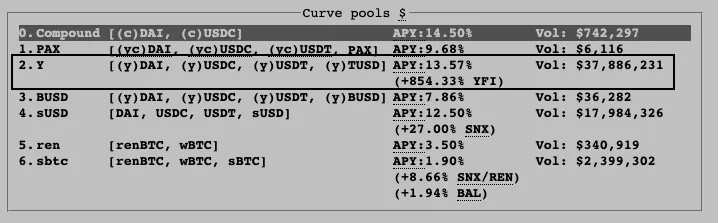
Things get even weirder and crazier because of SushiSwap’s liquidity mining. The mechanism is to deposit ETH/USDT to earn SUSHI, or buy SUSHI and deposit it in the ETH/SUSHI LP pool to earn more SUSHI.
This 2-pool token mechanism is actually a real Ponzi scheme because the price of SUSHI will only rise if more people join.
Dozens of 2-pools are launched and collapsed every day. The game theory to win is simple: be the first in, mine as many tokens as possible, sell when new money inflows are less than token issuance and exits.
Eventually, the sheer number of new popular mining pools distracted attention, and less ETH/USDT was entering these new pools that were popping up every day. As token prices fell, resulting in lower annualized yields, the subsequent total locked value (TVL) flowed to higher yielding places, and these pools collapsed.
But the crash is an important lesson and a recurring pattern in crypto that ultimately provides the best opportunities in crypto. As long as you know when to exit.
How Bull Markets Start and End
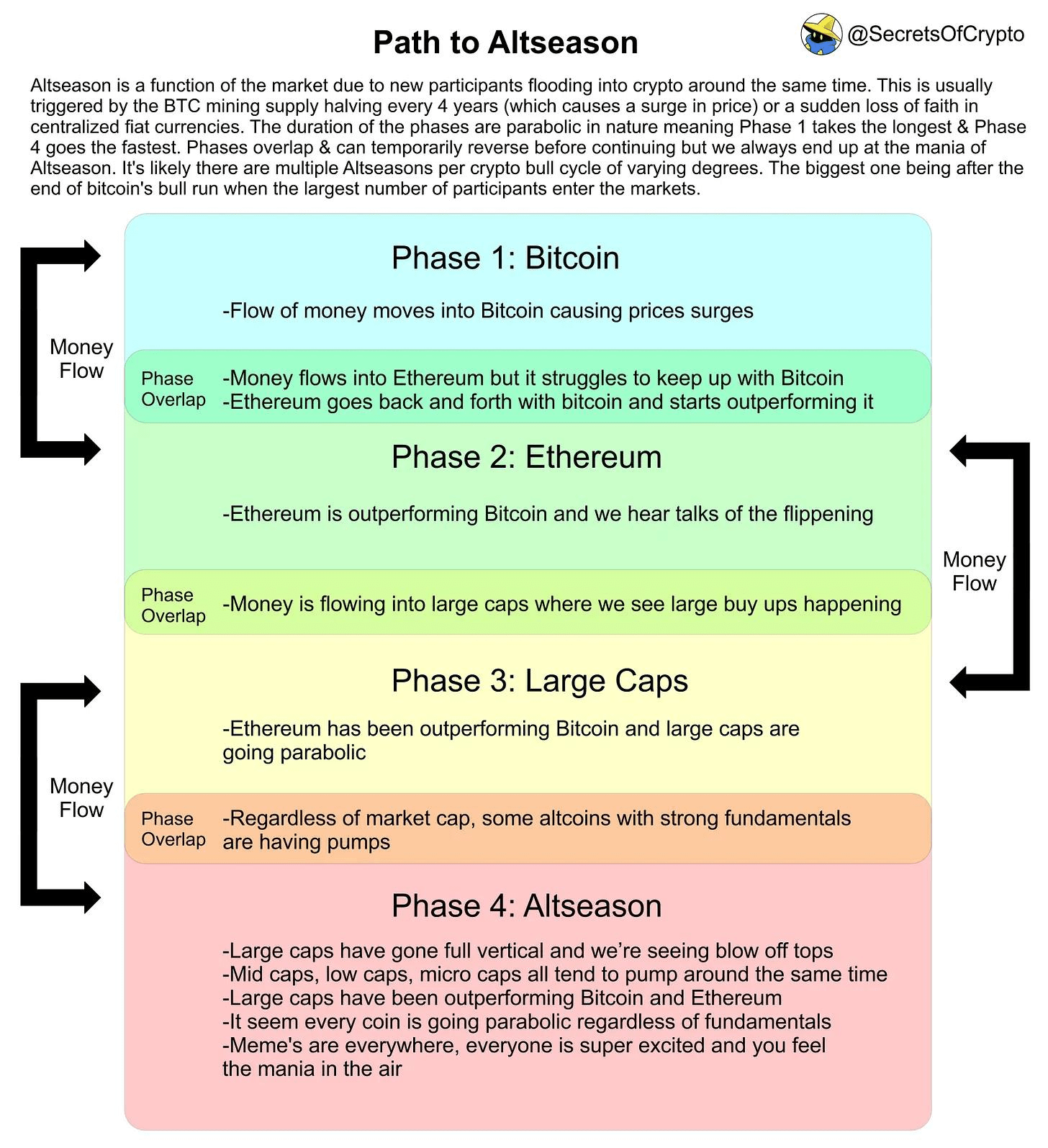
Here’s a summary of SecretsOfCrypto’s “Road to Alt Season,” which does a great job of summarizing how money enters the cryptocurrency ecosystem through Bitcoin and trickles down to Alt Season.
But I believe there is one more key element to the bull market story: innovative money printing.
I'm not talking about central bank money printing, which is certainly good for cryptocurrency prices. I'm talking about the money printing press inherent in cryptocurrencies.
In the crypto space, we claim to hate money printing by centralized governments because it dilutes the purchasing power of fiat currencies, increases inequality, and ultimately leads to currency collapse.
However, the cryptocurrency industry is the best at printing money.
Imagine this: After Bitcoin was first launched, it took several years for a serious competitor to emerge. Litecoin, the first altcoin, launched in 2011. Then Ethereum launched in 2015. The years that followed featured Bitcoin forks like Bitcoin Cash, Bitcoin SV, and Bitcoin Gold. This was the original Layer 1 season.
These Bitcoin forks were also the original money printing machines in crypto, as Bitcoin holders would receive new tokens, and if you sold them on the day of launch, you would make a profit.
However, launching new coins is expensive because these proof-of-work mechanisms require electricity to maintain network security.
Thanks to ERC20 tokens powered by Ethereum smart contracts, issuing new tokens has become easier and cheaper. Now anyone can issue a token at a low cost. Thousands of new tokens can be launched with just a website, a white paper, and a lot of promises.
However, the most important impact of Ethereum and ERC20 is not technical, but social. Before ERC20, tokens were primarily viewed as payment currencies or stores of value. But with ERC20, tokenization has become ubiquitous. As cryptocurrency prices have risen, so have the use cases for cryptocurrencies.
Then, suddenly, the price collapsed.
The crash happened because the funds flowing into the cryptocurrency system could not sustain the exponential growth of new tokens being launched every day. We ended up printing too many tokens. Furthermore, as the number of tokens in circulation increased, attention became fragmented, leading to confusion about where to invest.
Then, a similar pattern repeated itself again during the DeFi Summer.
During this period, the protocol distributed tokens for free to liquidity providers or users through airdrops. The stated purpose of these tokens was more humble and moral this time: to decentralize the protocol in line with cryptocurrency ethics.
Looking back to 2017, when the ICO bubble burst, it seemed like everything needed a utility token. Now, in the DeFi space, protocols need a token for governance. We are still largely in this phase, but frustration with DeFi governance is growing rapidly.
However, the real motivation behind these tokens was, and still is, to kick-start liquidity. Without liquidity, protocols like Aave, Uniswap, or Curve have no value.
Just like in 2017, the DeFi market crashed when daily issuance of tokens exceeded the funds entering the system. It’s a different story, but the root cause of the crash is the same.
Interestingly, NFTs also experienced a crash for the same reason. Crypto Punks and BAYC triggered FOMO among those who missed out, leading to the creation of new NFTs. However, when the attention and new NFT issuance could not sustain price levels, the market eventually collapsed.
Currently, only a handful of NFT collections have managed to survive, which leads me to believe that the NFT market may be nearing a bottom.
New Bull Market: New Story, Same Mechanics
Let’s briefly recap SecretsOfCrypto’s “Road to Alt Season”. The idea here is that a bull run starts with new fiat currencies entering Bitcoin, and then money flows to lower market cap coins.
But I believe that innovative leveraging and repurposing of existing crypto capital will pave the way for bull run money-making opportunities before new money enters the system.
DeFi Summer is an example: DeFi tokens were oscillating up and down before ETH and BTC prices started to surge. Crypto native users deposited ETH and stablecoins to mine brand new tokens that told an attractive story of a new financial system. Some sold these tokens, but many believed in the DeFi story and held on to them.
The pre-bull bubble of DeFi and the wealth it brought was enough to convince newcomers to enter the crypto system and buy ETH/BTC. Of course, the low interest rate environment has a much greater impact than our relatively small money printing.
What interests me most is that before DeFi Summer, the infrastructure of DeFi was already built, but few people paid attention to DeFi before liquidity mining became a thing.
I believe we are currently in a season similar to the pre-DeFi bull run, where the foundation is being laid for innovative money printing and compelling narratives. With that in mind, I want to highlight the top opportunities that have the potential to create a bigger bubble than the short-term narratives we have witnessed in this bear market.
Re-pledge
EigenLayer is at the forefront of this narrative.
In simple terms, Ethereum's security can be "rented" by allowing Ethereum stakers to "restake" their ETH. This allows multiple networks to be secured simultaneously. However, this also comes with increased risk, and to compensate, restakers can receive higher returns. You guessed it, you get a new virtual currency that promises to change the world we live in.
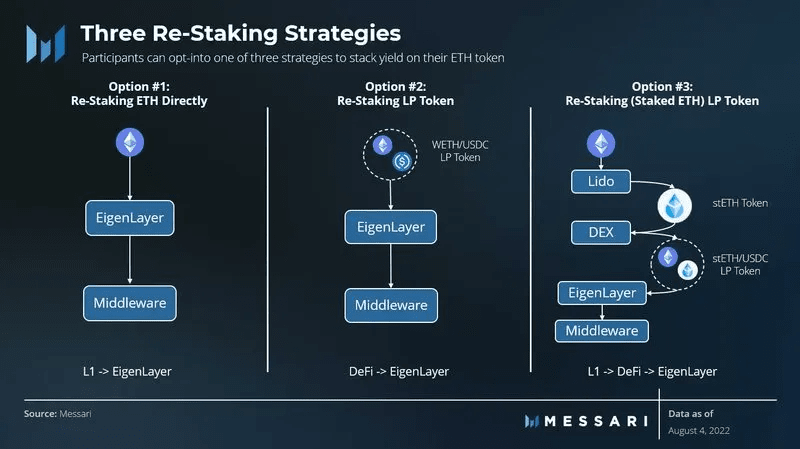
There will be many liquidity mining style scam token economic strategies invented, each more creative to discourage you from selling. Our focus will be on finding tokens that can create a flywheel effect so that as the token inflates, dApp adoption grows as well.
And this has already begun, with Stader’s rsETH being a liquid re-staking token.
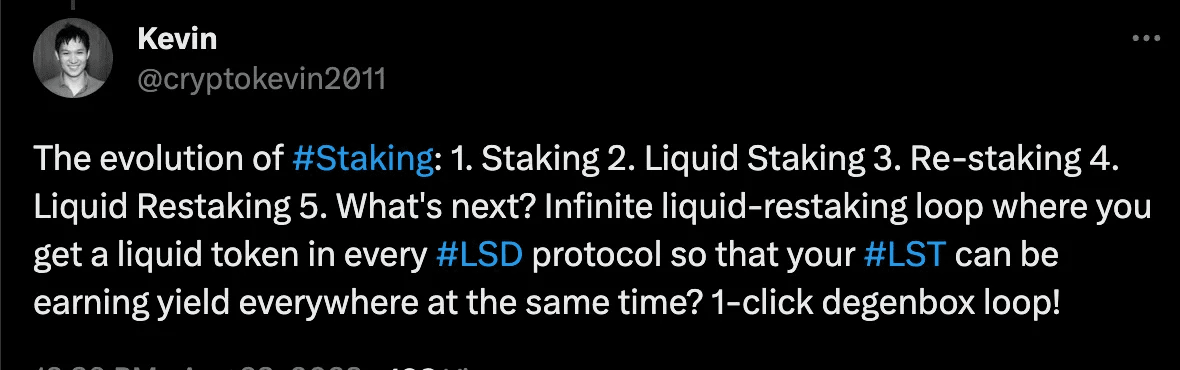
But restaking is a much bigger narrative that goes beyond Ethereum. Cosmos introduced Replicated Security, where ATOM stakers lend their security to other blockchains, the first to implement this was Neutron. I expect more blockchains to adopt the idea of restaking, just as they adopted liquidity mining rewards during the DeFi summer.
Our mission is to understand how rehypothesis works before the bubble starts, because time is money by then.
Bitcoin DeFi
This is a brand new narrative that has yet to gain enough attention even among DeFi fans of the Ethereum Virtual Machine (EVM).
I am optimistic about the potential of Ordinal and Inscriptions in terms of development, but currently they do not have the scam token economics to sustain inflation of newly issued tokens.
As a reminder, Bitcoin Ordinal is the basic unit of Bitcoin, satoshis or sats, which have been minted and integrated with unique information. Therefore, satoshis can become unique and have the same identity as the basic non-fungible tokens.
However, I believe that will change. Ordinal and Inscriptions have demonstrated strong demand for NFTs, fungible tokens, and DeFi in the Bitcoin ecosystem. Stacks is well positioned to meet this demand with its improved functionality and deep integration with Bitcoin.
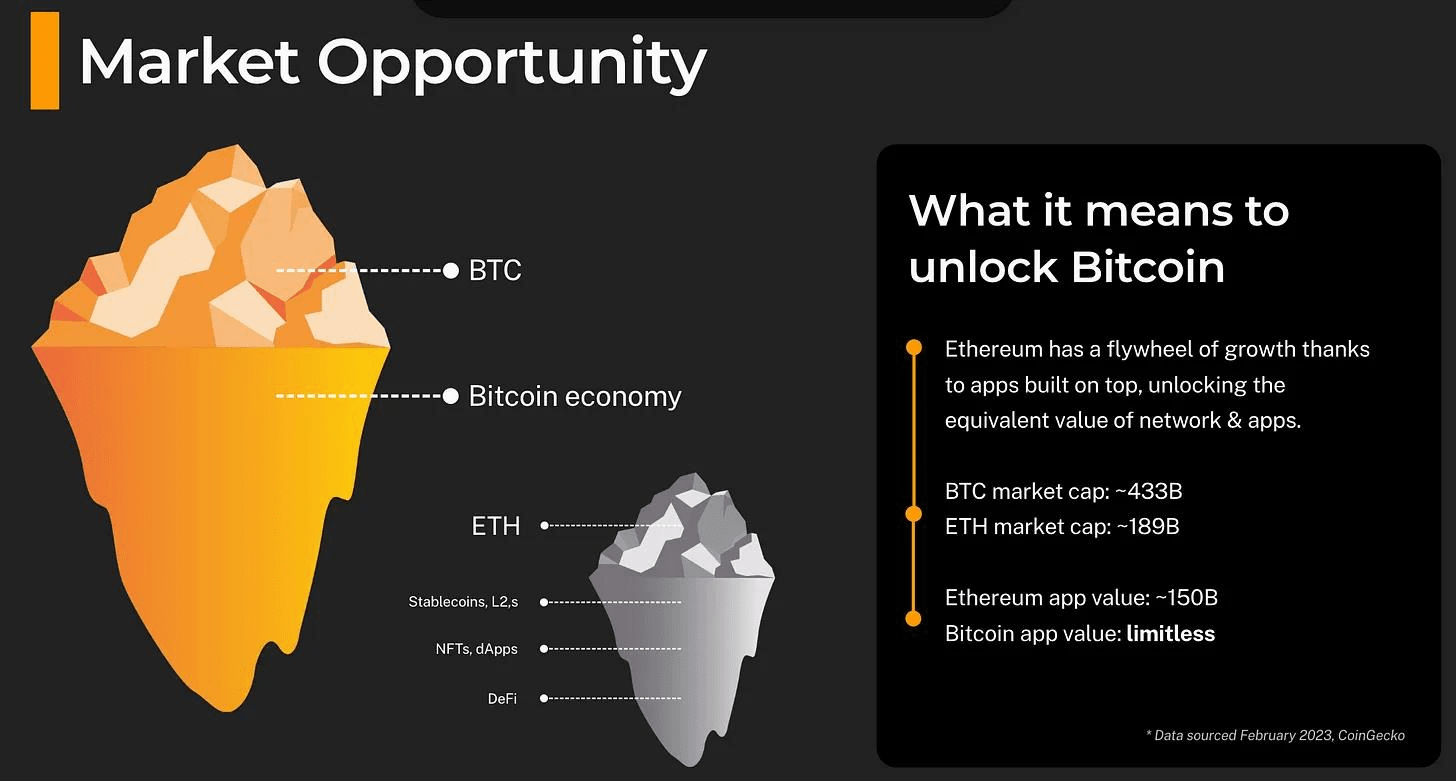
Stacks is a smart contract layer based on Bitcoin, DeFi applications are executed on Stacks and settled on Bitcoin. Stacks is preparing for the large-scale launch of sBTC.
sBTC is a decentralized Bitcoin anchoring system that facilitates the transfer of Bitcoin between Bitcoin and Stacks. Bitcoin sent to Stacks becomes sBTC at a 1:1 ratio. Converting it back to Bitcoin requires trust assumptions, making it trust-minimized but not trustless. Unlike wBTC or RBTC, sBTC avoids centralized custodians and uses an open network of users, improving Bitcoin liquidity for NFTs on DeFi and Stacks.
I am optimistic about Stacks because Bitcoin will enter its ecosystem quickly and there are not many places to put Bitcoin right now. This is a good thing because capital and attention will be focused on the first few applications that launch.
One of them is Alex. ALEX continues to expand its lead in the Stacks DeFi space, emphasizing cryptocurrency trading and lending settled with Bitcoin. At its core is an AMM protocol that powers its issuance platform and order book. It has also built a BSC/Ethereum USDT bridge on Stacks Chain.
Importantly, Alex also launched an on-chain BRC20 token indexer (wrapper) so that you can trade BRC20 tokens on Stacks and add any scam token economics you want.
When will the bull market come?
The two aforementioned claims stand out for their ability to issue new tokens while managing inflation, driven by compelling stories (Bitcoin security sharing and DeFi) and innovative token economics.
That being said, the infusion of new money is critical to sustainability and the longevity of a bubble. Currently, narratives emerge and fade due to a lack of new money entering the system. However, I believe these specific narratives have the potential to attract outside capital into the cryptocurrency market as a whole, specifically buyers buying ETH for rehypothesis, and buyers buying Bitcoin for the Bitcoin DeFi narrative.
But remember, both narratives will also have their moments of unraveling. Too many tokens will be minted to keep up with the growth rate of demand and attention. Don’t blindly believe the story they will sell you, so have an exit strategy in place before it’s too late.
It’s all about timing, and the most important factor remains the macro picture, which is also improving. Over the past few years, we have been buffeted by three major narratives: the Fed’s liquidity cycle, wars, and new government policies. However, recently we have seen a shift, with regulatory crackdowns slowing, China entering deflation, and inflation and rising interest rates peaking.
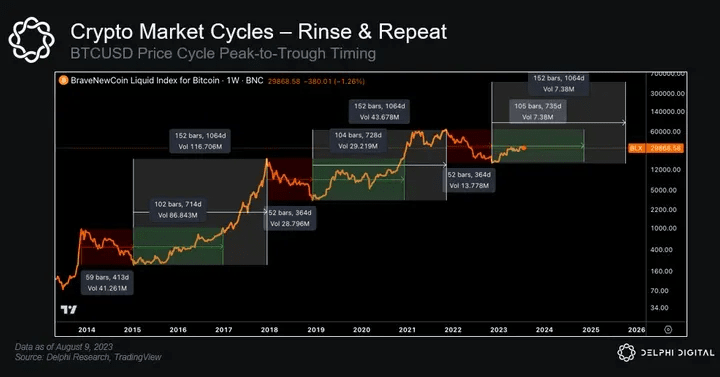
If we believe in crypto cycles, we expect an ATH of $69K by Q4 2024 and a crazy bull run before reaching a new ATH in Q4 2025.