In the Asian market on Tuesday (August 29), Bitcoin continued to fluctuate in the range of $26,100, failing to get rid of the sluggish trading volume. China’s economic uncertainty is hurting the crypto market, with Evergrande’s resumption collapse triggering investor panic given USDT issuer Tether’s reserve assets were found to be backing Chinese bills. It is reported in the market that after Binance's withdrawal, its business is still oriented to the Chinese market and OTC transactions are conducted through WeChat. Now the economic slowdown has led to the depletion of funds, which is enough to hinder Bitcoin's return to the bull market. However, China has low-key "stepped in" to rescue Bitcoin. Hong Kong's HashKey Exchange exchange enabled retail investors to deposit US dollars and legal tender into Bitcoin at the beginning of the week. It has attracted 15 million investors from around the world by the end of next year.
Hong Kong enables retail U.S. dollar deposit transactions
According to the official announcement, HashKey Exchange has opened Bitcoin and Ethereum deposit, withdrawal and trading services to retail investors, and has officially opened BTC/USD and ETH/USD trading pairs to retail investors. The exchange also stated that it does not exercise voting rights related to virtual assets on behalf of its users, and users who wish to exercise any voting rights related to their virtual assets must withdraw the corresponding assets from the platform.
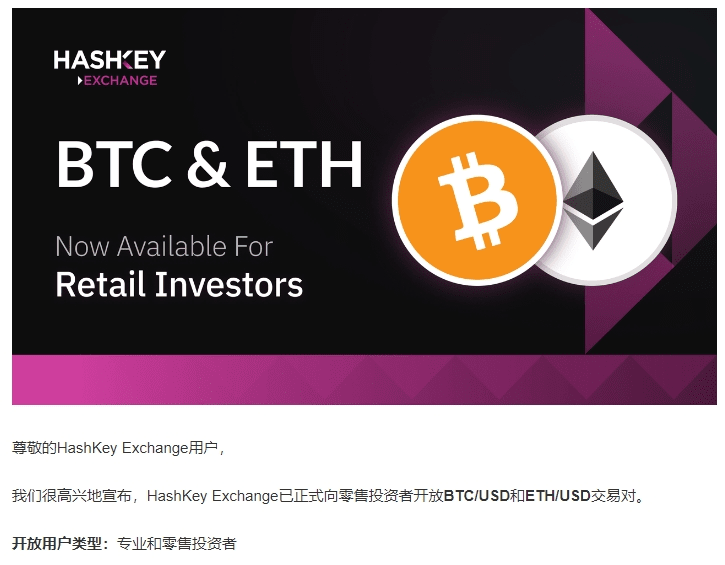
In addition, starting from August 28, HashKey Exchange spot transactions will not charge any fees, and all users can enjoy 0 rate. The deadline for this event has not yet been determined.
It is worth noting that the MATIC/USD and AVAX/USD trading pairs appear in the Hashkey Exchange system, but they are shown to be online and only for professionals and institutions to trade, and are currently not open to ordinary retail investors. Retail investors can trade BTC, ETH, USDT and USDC. Previously, the U.S. Securities and Exchange Commission had classified a large number of public chain tokens such as MATIC, AVAX, and SOL as securities, but Hong Kong seems to be breaking this restriction.
Weng Xiaoqi, chief operating officer of Hashkey Group, said in an interview that the exchange does not support users from mainland China and is only open to 16 countries and regions supported and approved by the Hong Kong Securities Regulatory Commission. Mainland Chinese residents with Hong Kong work visas cannot use it, but mainland Chinese users with Hong Kong ID cards are allowed to use it.
In addition, HashKey Exchange announced a strategic cooperation with the decentralized wallet imToken. imToken will serve as the official cooperative wallet of the exchange, and the exchange will provide compliant legal currency deposits, withdrawals and trading services for imToken users.
Evergrande, WeChat and Binance exchanges reported “loud noises”
Protos revealed in an analysis article that most cryptocurrency companies returned to China in a low-key manner soon after leaving China, emphasizing that “cryptocurrencies have always been a lucrative way to help Chinese residents avoid capital controls.” Like other exchanges, Binance has frequently said that its cryptocurrency operations will cease to be available to Chinese residents. In fact, despite Binance’s numerous announcements of permanently withdrawing from China, about 1/5 of its business still comes from China.
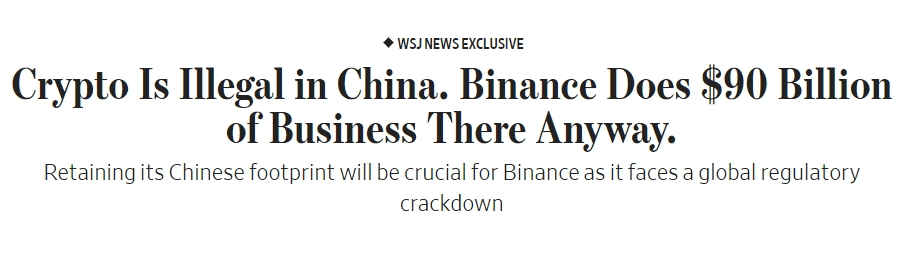
In May 2023, Binance conducted transactions worth up to $90 billion in China. An anonymous source within Binance confirmed that the exchange does not mind helping certain VIP traders circumvent China’s geo-restrictions. Even if cryptocurrency exchanges leave China, their unofficial liquidity channels typically continue to operate. Almost all exchanges maintain active peer-to-peer (P2P) markets for digital assets for those who have difficulty accessing their official exchanges or who wish to trade in large volumes. The exchange executes over-the-counter (OTC) transactions through chat tools, including the WeChat app.
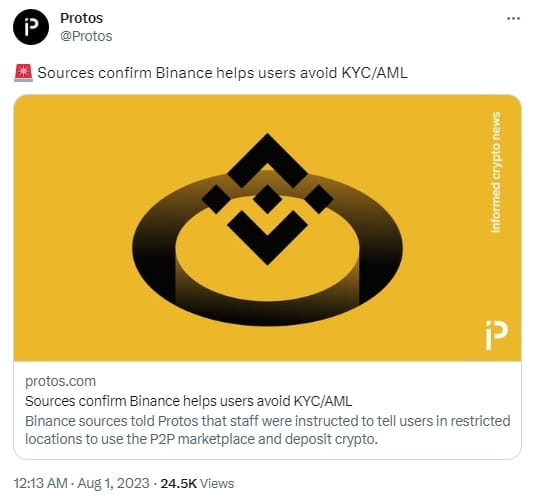
The report mentioned: “For various reasons, China is more important to the cryptocurrency market than its government is willing to admit. Its crackdown has never stopped cryptocurrency companies from operating, nor has it prevented Chinese residents from trading digital assets. Even senior Chinese officials have played an important role in funding Ethereum through a network of agents."
“China’s preeminent position in the cryptocurrency industry is enough to hinder a bull run whenever China’s economy stalls. The uncertainty about China’s long-term recovery from the epidemic is certainly related to the multi-year bear market for all cryptocurrencies. Many Chinese residents have exhausted their emergency supplies in the past 3 years Money, busy with work, residents have almost no savings available for cryptocurrency investment. Since cryptocurrency exchanges still rely on China’s trading volume, this may harm the global cryptocurrency market,” the report continued to comment.
Finally, the collapse of China's real estate market certainly won't boost confidence. China’s leadership has decried the “reckless” lending and pre-sale housing practices that fueled the real estate bubble and directed that a vital source of funding for real estate companies be stopped, which had the predictable result of causing the bubble to begin to burst.
Cracks have appeared in China Evergrande, and Country Garden cannot escape the fate of defaulting. Youth unemployment has become another issue, with a staggering 20% of young people unemployed as of June 2023.
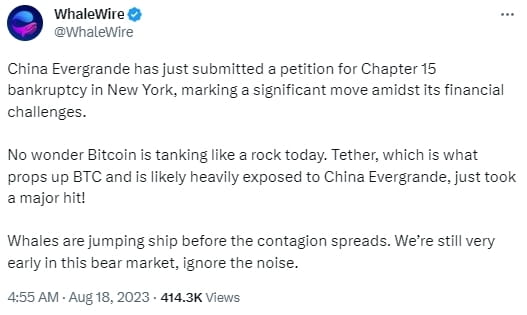
Evergrande’s “thunder” is also deeply connected to Tether. As the issuer of USDT, the world's largest U.S. dollar stablecoin, investors are highly focused on the complexity of Tether's asset pegs and the potential risks to China's financial system, making it the focus of investors' attention. Tether’s reserves back up reserves that have traditionally included fiat currencies such as the U.S. dollar. However, over time, its composition changed to include other assets such as commercial paper. Since Evergrande filed for bankruptcy, the price of Bitcoin has plummeted by more than 10%.
In other words, currently supporting the reserves of USDT anchored to the US dollar fiat currency at 1:1, assets with a higher degree of risk are beginning to appear. Commercial paper is no different than U.S. dollars or U.S. Treasuries because businesses generally have more uncertainty than governments.
In mid-2021, reports highlighted that nearly 50% of Tether's support came from commercial paper, short-term unsecured promissory notes issued by companies. Although Tether quickly assured the market that it has no direct exposure to Evergrande’s debt, specific details of the commercial paper in Tether’s reserves have not been disclosed. The concern is that commercial paper issued by Chinese companies could still become part of Tether’s reserves, indirectly linking Tether to China’s broader economic situation.
Protos concluded: “Put simply, when China sneezes, cryptocurrencies catch a cold. The country remains crucial to this nascent industry. Despite repeated claims over the years that cryptocurrencies have moved away from China, the reality clearly has not .”
Bitcoin technical analysis
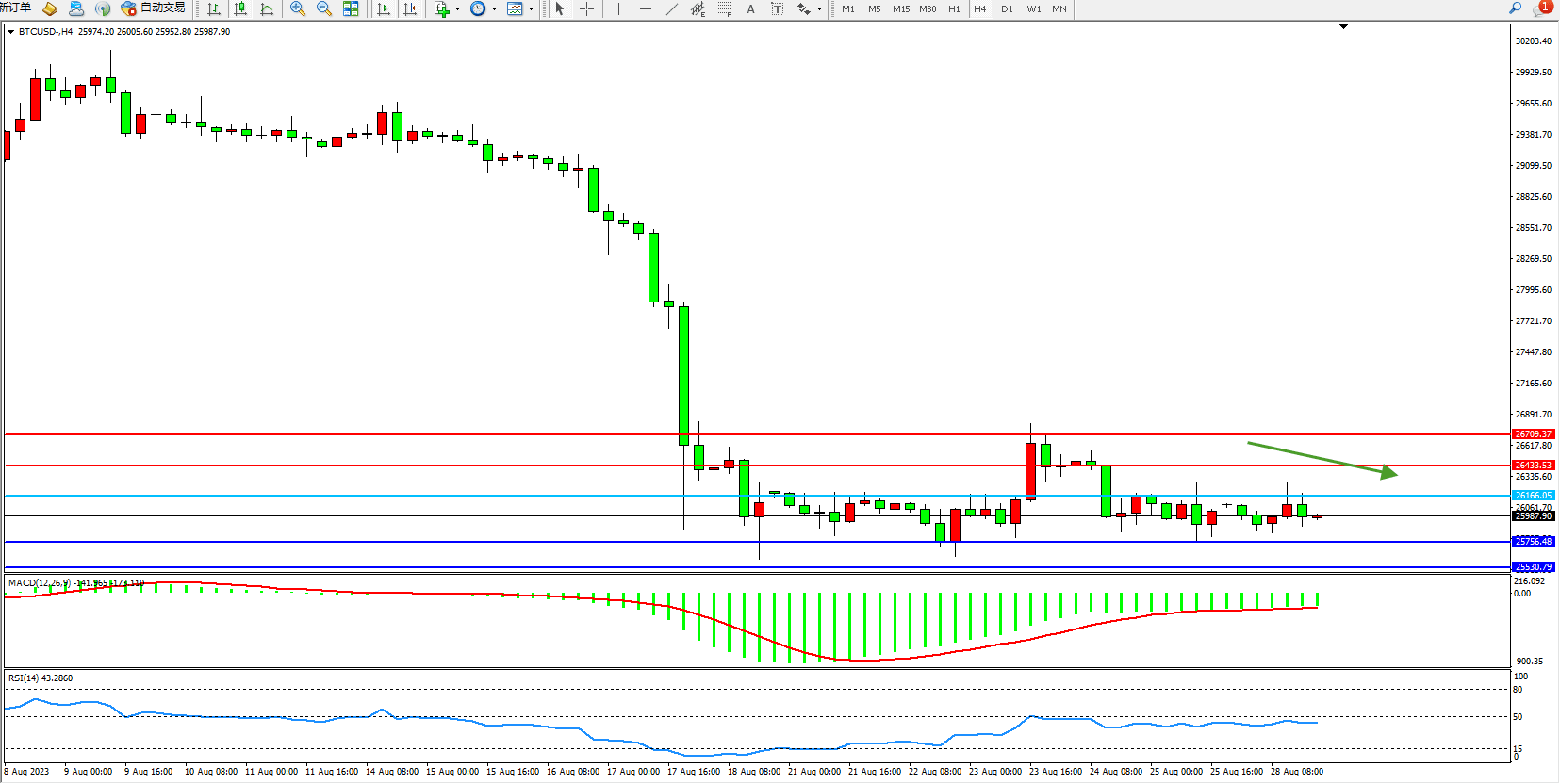
CMTrade said that on the 4-hour chart, Bitcoin is consolidating in a narrow range at low levels, the market's short sentiment is consolidating weakly, and there are signs of continued weak consolidation in the short term. The MACD indicator is consolidating weakly below the 0 axis, and the RSI indicator is hovering weakly below the 50 equilibrium point.
Resistance level: 26433 26709
Support level: 25756 25530
Trading strategy: short 26166 below, target 25756 25530