

Author: Omkar Godbole, CoinDesk; Translated by: Song Xue, Golden Finance
The relative abundance of out-of-the-money call and put options related to Bitcoin suggests that traders are pricing in “tail risk” in the Bitcoin market.
Tail risk indicates a high probability that an investment will deviate more than three standard deviations from the mean.
They call it tail risk in cryptocurrency markets: the risk that an asset’s current price deviates by three standard deviations in the context of a rare event.
Traders are worried about such an event for Bitcoin (BTC), even as the cryptocurrency has been hovering around $26,000 since falling more than 10% in the week ended Aug. 20. Bitcoin’s seven-day historical, or realized annualized, volatility has fallen to 26% from nearly 60% early last week, according to Amberdata.
Griffin Ardern, volatility trader at crypto asset manager Blofin, said: "The Bitcoin butterfly index has risen to a yearly high. This shows that investors and market makers are pricing in tail risks."
The Butterfly Index measures the relative abundance of out-of-the-money (OTM) call and put options by comparing cryptocurrency exchange Deribit’s Bitcoin Volatility Index (DVOL) with at-the-money (ATM) volatility.
A rising index indicates relatively strong demand for OTM options or call options with strike prices above the current price of BTC, while put options with strike prices below the current market price of BTC. In other words, it indicates traders’ fear of tail risk or sensitivity to uncertainty.
A call option is a derivative contract that gives the buyer the right to buy the underlying asset at a preset price at a later time. A put option gives the right to sell. Call buyers are implicitly bullish on the market, while put buyers are bearish on the market. Demand for out-of-the-money call and put options increases when traders expect above-average price movements.
“Looking at the BTC Butterfly Index, we can see that the wings are approaching the 90th percentile (red horizontal line). So while the outright volatility [indicator] appears confident that spot prices are consolidating, traders are still paying the price for the tail ,” said Greg Magadini, director of derivatives at Amberdata, in a weekly newsletter.
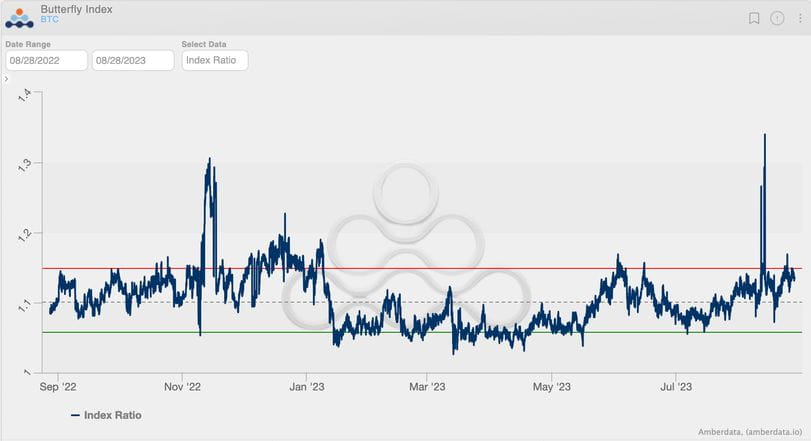
The butterfly index remains high, indicating lingering concerns about large fluctuations in Bitcoin prices. (Amberdata)
The index is expressed as the ratio or spread between cryptocurrency exchange Deribit’s Bitcoin Volatility Index (DVOL) and At-the-Money Volatility (ATM). Deribit’s DVOL takes into account the pricing of all options, while the ATM tool is based on the pricing of at-the-money options.
The pricing of tail risks is consistent with lingering macroeconomic uncertainty.
On Friday, Federal Reserve Chairman Jerome Powell reiterated that the central bank remains committed to achieving and maintaining its 2% inflation target, while signaling that monetary policy will remain tight for longer than expected.
The Fed’s continued tightening bias has lifted bond yields to their highest level since 2007. Rising bond yields tend to weigh on risky assets, including cryptocurrencies.
Magadini noted: “One of Jerome Powell’s key insights was that ‘getting inflation back to 2% will probably require below-trend growth,’ which means he’s not worried about the economy and the job market taking some hits.”
Ardern said tail risks are likely to remain elevated ahead of Friday’s U.S. nonfarm payrolls report. The data is likely to show the U.S. economy added 200,000 jobs last month after adding 209,000 jobs in June, leading to a steady unemployment rate at 3.6%, The Wall Street Journal reported.