



introduction
In-depth exploration of the new lending module launched by Thorchain on August 22, we found the shadow of Terra LUNA. The similarity with LUNA is mainly reflected in the fact that the collateral deposited by the user is exchanged for RUNE. In fact, the exchange rate of RUNE-collateral rises and falls. Determines the inflation and deflation of RUNE, that is, RUNE absorbs the volatility of the RUNE-collateral exchange rate through inflation and deflation, just like LUNA absorbs the volatility of UST, but in the form of both (RUNE participates in lending, opening and closing loan positions Destroyed and minted when UST is anchored, LUNA participates in stablecoin anchoring, and is destroyed and minted by arbitrageurs when UST is unanchored)) and the risk volume behind it (LUNA has no upper limit for minting, RUNE has an inflation and deflation upper limit and is mortgaged by synthetic assets) Things are only 50% RUNE) different. Moreover, the lending agreement has implemented strict risk control and risk isolation measures, so the overall risk is relatively small and will not produce systemic risks similar to Terra LUNA. Even if a negative spiral occurs, it will not have an impact on other functions of Thorchain.
one. Understanding the Thorchain Lending Mechanism
The characteristic of Thorchain lending is that there is no interest, no liquidation risk, and no time limit (initial period, the minimum loan period is 30 days). For users, the essence is to hold short USD and multiple BTC/ETH mortgage assets; for the protocol, the essence is Short BTC/ETH, long USD. The debt is denominated in TOR (Thornchain’s USD equivalent), so the user is similar to an OTM call of a gold standard option to purchase BTC, with the holder of the protocol/RUNE being the counterparty.
Opening new loans will have a deflationary effect on $RUNE assets, while closing loans will have an inflationary effect on $RUNE assets. The BTC collateral will first be converted into RUNE, then destroyed, and finally the assets required for RUNE exchange will be minted. In this process, the difference between the collateral value and the debt, excluding handling fees, is the net destruction value corresponding to RUNE.
If the collateral rises when repaying, then when the price of RUNE remains unchanged, more RUNE needs to be minted to exchange for the required assets, which will lead to inflation; if the price of RUNE rises, then there is no need to mint as much RUNE which is ideal Situation, if the price of RUNE falls, inflation will be more serious. If the collateral falls during repayment, the RUNE price remains unchanged and the user may choose not to repay (no minting occurs).
If the value of RUNE relative to $BTC remains the same when the loan is opened and closed, then $RUNE will have no net inflationary effect (the amount burned is the same as the amount minted minus the exchange fees). However, if the value of the collateral relative to RUNE increases between loan opening and closing, then there will be net inflation in the $RUNE supply.
To address inflation concerns, borrowing controls are in place - there is also a circuit breaker design if minting causes the total supply to exceed 5 million RUNE. In this case, the reserve would step in to redeem the loan (rather than minting it further) and the entire lending design would cease and be withdrawn from use, but other aspects of THORChain would continue to function normally.
Therefore, the entire lending process has a greater impact on RUNE's inflation and deflation. However, when the cap of the overall lending is low, there is an upper limit for inflation and deflation. When the RUNE-collateral exchange rate rises infinitely, the maximum deflation is the maximum. The open position is currently 15mln*0.33 (0.33 is the lending lever, might change), which is 4.95mln (may increase in the future). In the case of an infinite decline in the RUNE-collateral exchange rate, inflation is also controlled within 5mln by the circuit breaker.
Specifically, if a user overcollateralizes 200% of their collateral to lend 50% of the required assets, the other 50% is minted based on the RUNE-collateral exchange rate when redeemed. This step is essentially similar to LUNA, except that under the Thorchain Lending mechanism, since the rune back part is only 50% and the product capacity is small, the overall risk is relatively small and will not generate systemic risks similar to Terra LUNA. Partial risk isolation, even if a negative spiral occurs, will not have an impact on Thorchain's other functions.
1. How to understand that the design of lending is similar to a long option with deep out-of-value and resettable exercise price for users.
When Alice gives 1 BTC, she also gets 50% cash (at a CR of 200%) and the opportunity to buy 1 BTC with this cash.
If BTC rises during repayment (assuming one month later), Alice repays the debt (that is, equivalent to 50% of the value of BTC one month ago) and purchases this BTC at the BTC price one month ago. If it falls a lot, it exceeds 50 %, if Alice chooses not to repay, the agreement will not produce inflation caused by mint rune (for Alice, she failed to do long).
2. How to understand that there is no borrowing interest?
It can be seen as the user paying multiple swap fees instead of interest rate, which is essentially a CDP product. If borrowing interest is charged, the product will be even less attractive to users.
The entire loan process is as follows:
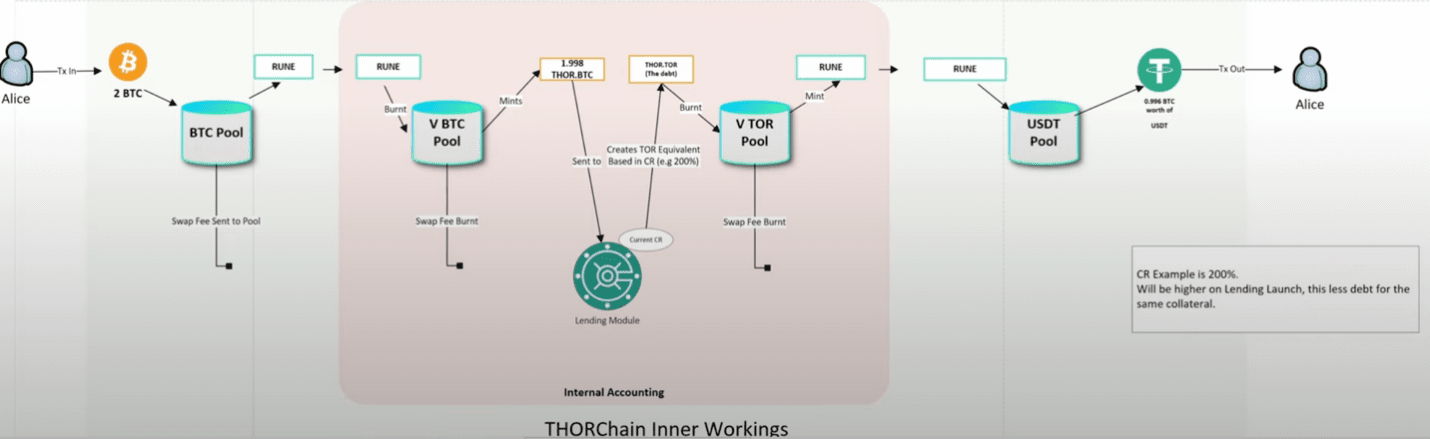
Users deposit collateral of native assets (BTC, ETH, BNB, ATOM, AVAX, LTC, BCH, DOGE). In the initial stage, the collateral is limited to BTC and ETH. How much collateral each debt position can accept (the upper limit of the debt position) is determined by the hard cap (15mln), Lending lever, and pool depth coefficient. Overcollateralization creates debt, and the proportion of debt available is determined by CR.
Borrowing: Alice deposits 1 BTC. This BTC will first be exchanged for RUNE in the BTC-RUNE swap pool. These RUNEs enter a V BTC pool and are destroyed and converted into a derivative asset Thor.BTC. The collateral of the synthetic asset is a constant. Product liquidity is always 50% of assets, and the remaining 50% is RUNE. Then the derivative asset Thor.BTC is sent to an Internal module, where there is a dynamic CR (collateralization rate) to determine how much loan you can get, and Thor.Tor (similar to USD) tokens are generated as an accounting method for loan generation. . The steps that occur here are entirely for internal accounting use, and then the USDT loan is generated and given to Alice.
Repay the loan: When Alice repays, all USDT or other Thorchain-backed assets are sent to the protocol and converted to RUNE. RUNE will mint Tor. The protocol checks whether the user has returned all the loans denominated in Tor. If it is returned in full, the mortgage The asset will be released and converted into derived collateral (Thor.BTC), and then the derived asset will be cast back into RUNE and then swapped back to L1 BTC. In this process RUNE is cast.
It should be noted that these swap and convert processes will generate handling fees (a loan will generate at least 4 swap fees), so the total repayment needs to be more than the actual amount to pay these swap fees. Although there is no interest, this kind of The charging of multiple handling fees can actually be regarded as a substitute for interest. Although the wear and tear is huge, the handling fees generated in the form of RUNE are destroyed. This part is real deflation.
3. How to understand no liquidation and no repayment time limit?
Since the debt denominated in TOR stable currency is fixed, in fact, although the borrower can choose any asset for repayment, it will actually be converted into RUNE through the market, and liquidity providers and savers will not directly lend their assets to Borrower. The pool is just a medium of exchange between collateral and debt. The entire process is a gambling behavior, which is why there is no liquidation. The protocol needs to use RUNE to repay enough TOR (full repayment) to help users get back their collateral. If the price of the collateral drops a lot and the user chooses not to repay (at the same time, this part of RUNE will not be re-cast, resulting in a net destruction). In fact, the protocol does not want users to repay. If the price of collateral rises and the price of RUNE falls, user repayment will cause inflation.
4. How to understand the deflation and inflation of RUNE as a medium of exchange
First of all, the total upper limit of all lending pools is determined by the RUNE Burnt part in the gray part of the figure below multiplied by the Lending lever, and the RUNE Burnt of 15mln is the result of the previous protocol burning non-upgraded BEP2/ERC20 RUNE. Therefore, we can see that the protocol currently has 15mln room for inflation from the maximum supply of 500mln RUNE.
The above also introduces the role of RUNE in the entire borrowing process (you can review the part about the mechanism above). Opening new loans will have a deflationary effect on RUNE assets, while closing loans will have an inflationary effect on RUNE assets.
If the collateral rises when repaying, then when the price of RUNE remains unchanged, more RUNE needs to be minted to exchange for the required assets, which will lead to inflation; if the price of RUNE rises, then there is no need to mint so much RUNE which is ideal Situation, if the price of RUNE falls, inflation will be more serious. If the collateral falls during repayment, the RUNE price remains unchanged and the user may choose not to repay (no minting occurs).
If the value of RUNE relative to BTC remains the same when the loan is opened and closed, then RUNE will have no net inflationary effect (the amount burned is the same as the amount minted minus exchange fees). However, if the value of the collateral assets relative to RUNE increases between loan opening and closing, then there will be net inflation in the RUNE supply.
To address inflation concerns, borrowing controls are in place - there is also a circuit breaker design if minting causes the total supply to exceed 5 million RUNE. In this case, the reserve would step in to redeem the loan (rather than minting it further) and the entire lending design would cease and be withdrawn from use, but other aspects of THORChain would continue to function normally.
If calculated based on the parameters in the figure, the total amount of all debt pools currently only amounts to 4.95mln RUNE. That is, all debt positions can accept a total of 4.95mln RUNE equivalent collateral.
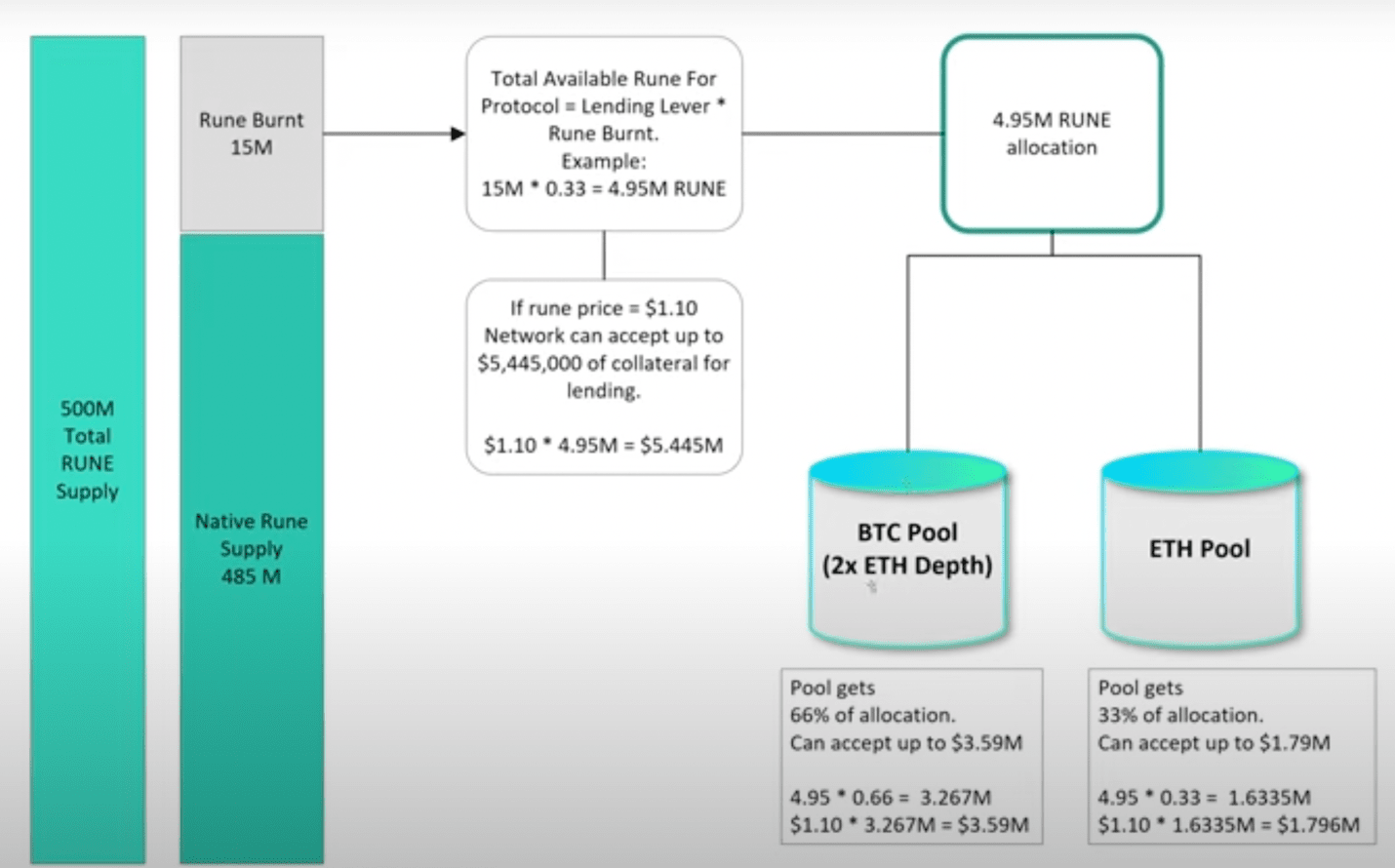
The RUNE Burnt of the entire Reserve is the Buffer of all debt positions and the last resort where inflation occurred. The total amount of 4.95mln of the RUNE Burnt* Lending lever in the Reserve (currently) will be distributed according to the depth of each debt position pool. The deeper the depth, the The more Reserve buffers there are, for example, the depth of the BTC Lending pool is twice the depth of the ETH Lending pool, then the value of the Rune Burnt*Lending lever*depth coefficient in the Reserve is the maximum mortgage limit that can be assumed in this lending pool. Therefore, When the price of RUNE rises, the more collateral can be accepted in this pool. It can also be seen that the prices of Lending lever and RUNE jointly determine the upper limit of collateral that the lending pool can accommodate.
The THORChain protocol and all RUNE holders are counterparties to every loan. RUNE's burning/minting mechanism means that RUNE is condoned/diluted (among all RUNE holders) when debt is opened and closed. When the RUNE-collateral exchange rate falls, inflation occurs, and vice versa deflation.
5. Is the CDP protocol a good on-chain storage model?
For Lending launched by Thorchain, it is such a disguised way of attracting deposits and using RUNE as an essential medium in the loan and repayment process, adding scenarios of destruction and minting.
So does this storage mode have any advantages? Let’s first look at the storage modes of some other tracks.
CEX is the most obvious beneficiary of the deposit-taking model, because at the same time, as a custodian, this part of the funds can generate more income in many cases (this part of the income is required to be much less than before after the reserve is disclosed), how to protect user custody funds Security This is something that the regulatory framework needs to be clear about, and regulators usually want exchanges to have full reserves.
The situation on the chain is completely different.
DEX needs to provide high incentives to LPs after absorbing deposits. Therefore, the purpose of absorbing deposits is to deepen liquidity. It cannot directly use the "deposits" provided by LPs to generate benefits, but forms a liquidity moat through huge reserves.
Pure Lending is similar to Aave or Compound, in that you need to pay an interest rate cost for attracting savings. The entire model is no different from traditional lending. For example, you need to proactively manage borrowing positions and have repayment time limits.
In contrast, the CDP model is a healthier model for deposit accumulation. Due to the high volatility of mortgage assets, most over-collateralized CDPs currently on the market are users who over-collateralize certain assets and obtain a certain amount of stablecoins/other assets. In this process, the CDP protocol actually obtained more "deposits". And there is no need to pay interest on this part of the deposit.
Thorchain also belongs to this CDP model, so where is the collateral custody? In fact, the collateral is exchanged for RUNE through the liquidity pool. Therefore, no one "stores" the collateral. As long as the THORChain pool is healthy and functioning properly, any collateral deposited will be exchanged for RUNE and arbitrageurs will then rebalance the pool as normal. It can be seen here that the collateral is deposited in the currency pair pool of Thorchain's RUNE against other currencies. Precisely because collateral such as BTC has entered the circulation market rather than being hosted in the protocol, although the debt generated is 100% collateral, the difference between the value of the collateral and the debt is determined by the value of RUNE, thus giving the entire The mechanics cast a shadow similar to Terra LUNA.
Capital Sink may be one of the goals that Thorchain lending wants to achieve. It uses users’ mortgage assets to settle into asset liquidity in the swap pool. As long as the user does not close the loan and the price of RUNE does not drop significantly, the protocol remains Assets, RUNE generates deflation, forming a good positive cycle. Of course, the opposite creates a negative spiral.
6. Risks
Collateral such as BTC has entered the circulation market rather than being hosted in the protocol. Therefore, although the debt generated is 100% collateral, the difference between the value of the collateral and the debt is determined by the value of RUNE, thus shrouding the entire mechanism. A shadow similar to Terra LUNA. Since the RUNE burned when the loan is opened and the RUNE burned when the loan is closed are not necessarily exactly equal, deflation and inflation will occur. It can also be understood that when the price of RUNE rises during repayment, deflation will occur, and vice versa, inflation will occur. If the RUNE price falls below the lending lever price when the position was opened, the circuit breaker will be triggered. During the entire lending process, the price of RUNE plays a decisive role in deflation and inflation. When the price of RUNE drops, a large number of users choose to close their loans and the risk of inflation is still high. However, the protocol has implemented strict risk control and risk isolation measures, so the overall risk is relatively small and will not generate systemic risks similar to Terra LUNA. Even if a negative spiral occurs, it will not have an impact on other functions of Thorchain.
The three factors of Lending lever, CR and whether to open different collateral debt positions have become the three pillars of Thorchain lending risk control.
In addition, Thorchain has a history of being stolen and its code is highly complex. Thorchain Lending may also have vulnerabilities that need to be suspended or repaired.
two. in conclusion
The launch of Thorchain Lending products generates network linkage benefits, additional transaction volume, and higher pool capital efficiency, driving the system to generate real income and increasing the total amount of Total bonded, allowing Thorchain to gain potential upside by reducing the total amount of circulation (in RUNE- when the collateral exchange rate rises).
Capital sink (accumulation may be a goal that Thorchain lending wants to achieve) uses the user's mortgage assets to settle into asset liquidity in the swap pool. As long as the user does not close the loan and the price of RUNE does not drop significantly, the protocol retains the assets and RUNE If deflation occurs, a good positive cycle can be formed.
But in fact, reverse market trends leading to inflation and negative spirals are entirely possible. To control risk, Thorchain lending has limited use and smaller capacity. Generally speaking, deflation and inflation will not have a fundamental impact on the price of RUNE based on the current cap size (up to 5 million RUNE).
In addition, Thorchain's capital efficiency is not high for users. The CR is between 200% and 500%, and may eventually float between 300% and 400%. It is not the best product purely from the perspective of increasing leverage. And although there are no borrowing fees, the wear and tear of multiple internal transaction fees is not user-friendly.
Only evaluating the lending product does not represent the development of the entire Thorchain defi product matrix. There will be a series of analyzes on other Thorchain products in the future.