
Whether in the cryptocurrency market or the traditional financial market, the terms "black swan" and "gray rhino" are often seen in articles or news reports. What do these terms mean to investors? What is the difference between the two?

What is the significance of the Black Swan?
The term "black swan" was coined by author Nassim Nicholas Taleb in his book of the same name, referring to an extremely rare and unpredictable event. These events usually have a huge impact and are explained as "natural" by people after the fact. In his book, Taleb emphasized that traditional statistics and risk models cannot effectively capture these extreme events because they are based on past data, and black swan events have never occurred in the past and therefore cannot be predicted.
In our culture, predicting a black swan is impossible, but confirming one is inevitable.
In the book, Taleb emphasizes that we cannot assume that the future will be safe just because past experience was safe. He also reminds people that when faced with the unknown and uncertainty, they often make logical mistakes and tend to construct their own fantasies and explanations so that they can "think" they can understand and control the situation. "In the real world, most changes are nonlinear and not smooth."
If you hear a "famous" economist use the words "equilibrium" or "normal distribution", don't argue with him; ignore him, or try to put a mouse down his shirt.
 Taleb, "Grey Rhino"
Why is it called "Black Swan"?
The term "black swan" was used in ancient times to describe something that was impossible to happen, because Europeans believed for a long time that all swans were white and therefore believed that black swans did not exist. However, a black swan was discovered in Australia, which overturned people's expectations and existing theories, and also became an example of an unpredictable event.
In addition, the word "black swan" itself carries a strong visual image, which easily reminds people of rare, sudden, and unpredictable events. This is very consistent with the concept that Taleb wants to convey in the book and is easy for people to remember.
 Source:Bournemouth News
The "Black Swan" events that have occurred in the cryptocurrency circle
The price of cryptocurrency market fluctuates violently, and the attitudes of governments towards cryptocurrency vary. The regulatory strength also varies. It is often affected by factors such as technology, regulations, and market sentiment. For example, the government’s new regulatory policy on cryptocurrency, or sudden large-scale hacker attacks, etc., make more events difficult to predict.
On March 12, 2020, when the Wuhan pneumonia outbreak occurred, the crypto market experienced two sharp declines, just 13 hours apart. The first decline was in the morning, about 25%; the second decline was at midnight US time, and Bitcoin fell directly below $4,000 in a few minutes, becoming the largest and deepest single-day drop in seven years. At that time, analysts could only summarize the reason afterward: systemic collapse.
More than a year later, China's three major financial industry associations jointly issued a joint statement on May 18, 2021, emphasizing that any business involving cryptocurrencies has been banned, and warned investors that the cryptocurrency market is a speculative market. After hearing the news, the cryptocurrency market plunged directly, losing $13,591 that day, setting a record for the largest actual loss in history, as high as $2.56 billion, with a single-day liquidation of more than $9 billion, and Bitcoin fell by more than 50% in 7 days.
Author Taleb has a love-hate relationship with the cryptocurrency world
As for how Taleb, the author of The Black Swan, views cryptocurrencies, he said in 2018 that Bitcoin could become "an insurance policy" to remind governments that they no longer have complete monopoly control over "currency."
However, in 2021, Taleb's attitude towards Bitcoin suddenly took a 180-degree turn. He, who was originally a Bitcoin fanatic, began to criticize Bitcoin for "not having" the ability to hedge against inflation risks, and severely called Bitcoin an open Ponzi scheme and a fool's game.
What is the significance of the gray rhino?
The term "grey rhino" was coined by author and risk analyst Michele Wucker in her book Grey Rhino. Grey rhinos refer to risk events that are obvious and likely to occur, but are often ignored or postponed.
These events usually have a high probability of occurrence and may have a serious impact on individuals, organizations or society, but they are often ignored because people tend to focus on other things or because dealing with these risks requires difficult decisions. The concept of gray rhinos emphasizes that identifying these risks early and taking appropriate actions can help reduce future losses.
The longer you delay, the more chances the gray rhino will have to build up its momentum and pounce with greater destructive power than before.
The difference between the "gray rhino" and the black swan lies in "predictability" and "frequency". The gray rhino emphasizes the ignored and obvious risks, while the black swan emphasizes extremely rare and unpredictable uncertain events.
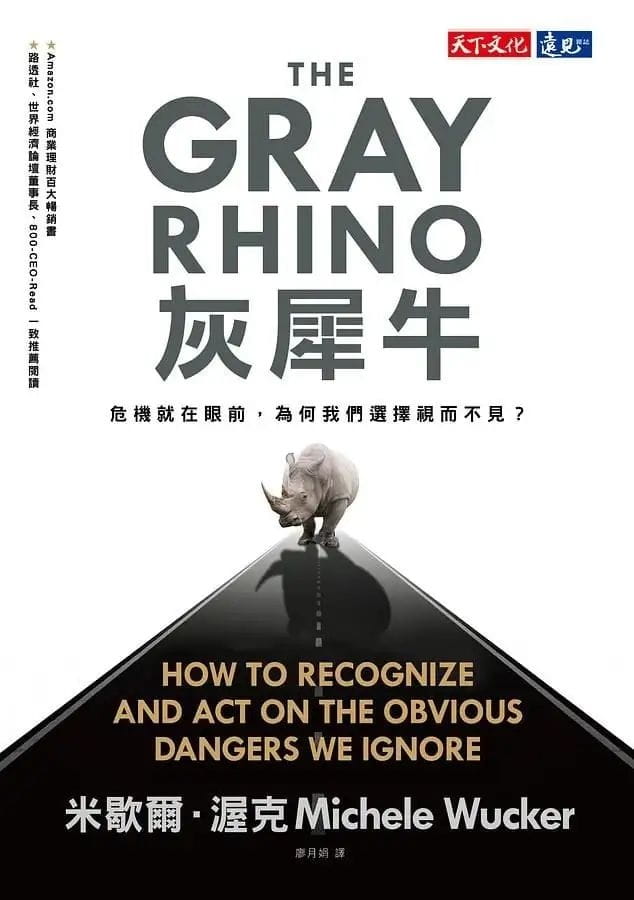 Michelle Walker, "Gray Rhino"
Why is it called "Gray Rhino"?
Michele Wucker chose the "gray rhino" because it symbolizes a powerful, obvious and threatening presence, and also echoes the characteristics of these risks. Unlike the "black swan", the "gray rhino" emphasizes those risks that we can clearly see but are ignored for various reasons (such as inertia, difficult decisions, distraction, etc.).
 Source: AFP
Author: Gray rhino is a good description of cryptocurrency
The author of Gray Rhino said in an interview in 2022 that this concept is very suitable for explaining the craze in the cryptocurrency market. She said that how each person defines whether cryptocurrency is a "gray rhino" depends on their role and perspective.
From the perspective of those involved in building the industry, handing over monetary policy to traditional financial institutions may bring greater risks than the prospects of decentralized finance. However, for central banks in various countries, the popularity of cryptocurrencies may mean losing control of the financial system. Investors or individuals may be optimistic about the continued growth of the cryptocurrency market and think that not investing may be a risk; but for those who expect cryptocurrency to be a bubble, investing money is the real risk.
The "grey rhino" incidents that have occurred in the cryptocurrency circle
The algorithmic stablecoin UST launched by Terra (LUNA) experienced a significant decoupling in the early morning of May 10, 2022, starting a death spiral. A large number of market users panicked and burned UST and re-minted it back into LUNA tokens, which were then dumped into the market. The token LUNA almost returned to zero. In addition to causing a large number of users and whales to lose all their money, many top cryptocurrency venture capital companies also suffered heavy losses.
Many analysts believe that LUNA’s collapse has been traced for a long time. It has been controversial since the beginning of 2022. Through the Luna-UST dual-currency mechanism, it successfully promoted its own algorithmic stablecoin UST in the crypto market, which quickly increased Luna’s price and market value. At the same time, the Anchor Protocol used to promote UST has been criticized, and this mechanism is generally considered to be an unsustainable "Ponzi scheme."
MakerDAO co-founder and CEO Rune Christensen publicly criticized LUNA and warned the cryptocurrency market as early as January of the same year:
Please note that UST and MIM are indeed Ponzi schemes, and I respect that. You can certainly make a lot of money from them, but they are not built for supply elasticity and will go back to zero once the market drains money out.
Now stop deceiving users that you are stable in the long term, and allow users who pursue long-term stability to exit and provide them with liquidity.
In addition, Ethereum officially switched from PoW to PoS on September 15 last year. After completing the merger of the execution layer and the consensus layer, the dream of using graphics cards for mining and PoW came to an end. Miners who did not have time to exit were left with mining cards that had fallen sharply in price. Now less than 2% of graphics card miners are still struggling to mine other small coins. However, Ethereum's switch from proof of work (PoW) to (PoS) is actually foreseeable. Although these miners know this, they think it is still a long way off, or they may still have a chance to struggle one last time. This is a kind of gray rhino of "investing in mining."